Loading...
Welcome to China Surfactant Detergent & Cosmetics, Today is

Table of Content

    22 May 2026, Volume 56 Issue 5 Previous Issue    Next Issue
    Lecture of science and technology
    Viscoelastic surfactants (V) Similarity and difference between wormlike micelles and polymers
    Yujun Feng
    2026, 56 (5):  557-563.  doi: 10.3969/j.issn.2097-2806.2026.05.001
    Abstract ( 107 )   HTML ( 15 )   PDF (2312KB) ( 89 )  

    Wormlike micelles (WLMs) are self-assembled, one-dimensional aggregates that form transient entangled networks in aqueous solutions, exhibiting macroscopic rheology akin to that of traditional water-soluble polymers. This behavioral resemblance has fostered the “living polymer” analogy, yet the underlying assembly mechanisms differ fundamentally—a source of persistent ambiguity in both theory and application. To clarify these similarities and distinctions, a comparative study was reviewed on C22-tailed ultra-long zwitterionic EDAB wormlike micelles and ultra-high molecular weight (12×106 g/mol) polyacrylamide (PAM) using macroscopic rheology, small-angle neutron scattering, cryo-transmission electron microscopy, and reptation theory. Both systems behave as semi-flexible chains that form entangling networks above a critical overlap concentration, display shear thinning at high rates, and follow Arrhenius temperature dependence (25-85 ℃), with optimal zero-shear viscosity reaching 40 000 mPa·s. Despite these parallels, their internal assembly modes diverge fundamentally. Traditional polymers rely on permanent covalent bonds—fixed chain length, molecular weight, and single reptation relaxation. In contrast, WLMs arise from reversible non-covalent hydrophobic and electrostatic interactions, yielding a thermodynamically balanced dynamic system with continuous breakage-reorganization and molecular exchange. Consequently, EDAB micelles exhibit 2.5-fold higher thickening efficiency and a lower critical overlap concentration (0.04 wt%) than PAM. They also show markedly higher temperature sensitivity (flow activation energy: 145 kJ/mol for EDAB vs. 24 kJ/mol for PAM). While polymers display a multi-mode relaxation spectrum, WLMs obey Maxwell single-relaxation behavior at elevated temperatures and feature a dual relaxation mechanism coupling breakage with reptation. Morphologically, WLMs possess a larger core radius (~2.9 nm) and persistence length (≥20 nm), with temperature-induced reversible transitions (shortening, branching, cyclization) ; polymer structures remain stable. Thus, the similarity between wormlike micelles and polymer solutions is only superficial under low concentrations and mild conditions; their essential dynamic and thermodynamic differences govern performance under complex environments. This analysis delineates the valid scope of the “living polymer” analogy and offers a theoretical basis for targeted design and application of both rheology modifiers.

    Figures and Tables | References | Related Articles | Metrics
    Basic research
    Effects of pressure on CO2 foam properties and core flow characteristics
    Chengfei Guo, Haining Zhang, Meng Lei
    2026, 56 (5):  564-570.  doi: 10.3969/j.issn.2097-2806.2026.05.002
    Abstract ( 77 )   HTML ( 6 )   PDF (1928KB) ( 72 )  

    Since the influences of pressure on the performance and seepage characteristics of CO2 foam are unclear, in this work, the effects of pressure on the foaming capability, stability, bubble diameter, plugging capacity, and oil displacement efficiency of CO2 foam were systematically investigated through experimental methods. The results showed that, the higher the pressure, the higher the foaming capacity of the CO2 foam system, however in contrast, there was a competitive mechanism in the effect of pressure on foam stability. The nano-SiO2-reinforced foam system effectively addressed the problem of instability in traditional foams. Negative correlation was observed between pressure and bubble diameter, with high-pressure conditions producing smaller and more uniform bubbles. Elevated pressure could promote the formation of CO2 foam with good uniformity and stable migration in cores. Moreover, the increased pressure could enhance the effective viscosity and plugging efficiency of CO2 foam, expanding its applicability to reservoirs with diverse ranges of permeability. High-pressure conditions could improve the oil displacement efficiency of CO2 foam flooding, alleviating the disadvantages situation caused by reservoir heterogeneity and achieving substantial oil recovery enhancement. This research might deepen the understanding of the role of pressure in CO2 foam-enhanced oil recovery and provide theoretical basis for effective gas channeling control strategies.

    Figures and Tables | References | Related Articles | Metrics
    Study on the preparation of a quaternary ammonium surfactant and its effects on fabric antibacterial and finishing properties
    Jiao Fang, Bo Xing
    2026, 56 (5):  571-579.  doi: 10.3969/j.issn.2097-2806.2026.05.003
    Abstract ( 90 )   HTML ( 12 )   PDF (2632KB) ( 90 )  

    A cationic surfactant, i.e., a quaternary ammonium salt namely C16-GPBCH, was synthesized through a one-step nucleophilic substitution reaction, with the yield of 89%. The molecular structure of the product was characterized by 1H NMR and Fourier transform infrared spectroscopy, confirming its high purity and consistency with the expected structure. Then, C16-GPBCH was applied to the functional finishing of cotton knitted fabrics by impregnation method. The influences of those process parameters such as the mass concentration of the finishing solution, water bath temperature, and the pH upon the antistatic and antibacterial properties of fabrics were investigated. The results showed that, when the mass concentration of the finishing solution was 30 g/L, the water bath temperature was 70 ℃, and the pH was 8, the finished fabric exhibited the best comprehensive performance: The static half-life was significantly shortened to 12.8 s, and the peak voltage was reduced to 912 V. Compared with the untreated fabric, the half-life and peak voltage were decreased by 79.5% and 40.1%, respectively. In addition, the antibacterial rates against Escherichia coliE. coli) and Staphylococcus aureusS. aureus) reached 99.95% and 99.99%, respectively, indicative of obvious inhibition zones, which demonstrated excellent dual antibacterial mechanisms of contact killing and diffusion killing. This work might provide important experimental basis and theoretical support for constructing an efficient and multifunctional finishing process for cotton fabrics.

    Figures and Tables | References | Related Articles | Metrics
    Preparation of carbon nitride heterojunction catalyst and its performance for photocatalytic CO2 reduction
    Wei Gao, Jianfen Qiao, Yajuan Guo
    2026, 56 (5):  580-588.  doi: 10.3969/j.issn.2097-2806.2026.05.004
    Abstract ( 57 )   HTML ( 6 )   PDF (1618KB) ( 71 )  

    Carbon nitride is an ideal catalyst for photocatalytic reduction of CO2, but the recombination of photoelectron-holes has greatly limited the application of carbon nitride. Based on the strategy of heterojunction construction, graphite-phase carbon nitride/nitrogen-rich carbon nitride (C3N4/C3N5) catalysts were synthesized by high-temperature thermal polymerization-thermal reflux method using melamine and 3-amino-1, 2, 4-triazole as raw materials. The catalysts were characterized by a series of methods. The photocatalytic performance of C3N4/C3N5 catalyst for CO2 reduction was evaluated by introducing high-purity CO2 into the aqueous phase under 300 W xenon lamp irradiation. The results showed that only CH4 was produced during the photocatalytic reduction of CO2 by C3N4/C3N5 catalyst under light irradiation for 5 h, and the yield reached 2.102 8 μmol/ (g·h), which was 9.8 times and 5.2 times that of single-component C3N4 and C3N5 catalysts, respectively. The photocatalytic performance was significantly improved. It was not only due to the increases of specific surface area and pore size after the disordered stacking of C3N4 and C3N5, but also due to the construction of Z-scheme heterojunction after the coupling of C3N4 and C3N5, which effectively promoted the separation of photoelectron-holes and promoted the transfer of charges. Active species such as photoelectrons and holes played a key role in the process of photocatalytic CO2 reduction.

    Figures and Tables | References | Related Articles | Metrics
    Research of preparation and dielectric properties of polyimide composites modified by coupling agents
    Shujia Mao, Shuyan Xu
    2026, 56 (5):  589-594.  doi: 10.3969/j.issn.2097-2806.2026.05.005
    Abstract ( 63 )   HTML ( 3 )   PDF (1621KB) ( 76 )  

    γ-Methacryloyloxypropyltrimethoxysilane (KH570) was selected as the silane coupling agent to prepare graphite/polyimide composites with different proportions of coupling agent KH570. The morphology, mechanical properties and thermal stability parameters of the composite system were tested and analyzed. The results showed that all the polyimide composites doped with graphite with different dosages of coupling agent KH570 exhibited the structure of polyimide. The shear strength of the composite adhesive first increased and then decreased with the increase of the dosage of coupling agent, among which the composite system with 5% coupling agent had the highest shear strength of 27.93 MPa. The higher the amount of coupling agent doping, the higher the dielectric constant and the lower the dielectric loss for the graphite/polyimide composite. In the investigated range, the dielectric constant of graphite/polyimide composite reached a maximum of 12.1 at the coupling agent content of 7%, while the minimum dielectric loss of 0.018 appeared at 5% coupling agent doping in the graphite/polyimide composite. The coupling agent improved the interface uniformity of the composite system, as well as the dielectric properties and the thermal stability thereof. The glass transition temperatures of all composite adhesives were around 261 ℃.

    Figures and Tables | References | Related Articles | Metrics
    Study on the efficacy and mechanism of Platycladus orientalis extracted by supercritical CO2 in prevention and treatment of androgenetic alopecia
    Yanju Feng, Hongyan Dong, Yuan Meng, Yuqi Zhang, Minjia Yuan, Congyan Li
    2026, 56 (5):  595-602.  doi: 10.3969/j.issn.2097-2806.2026.05.006
    Abstract ( 175 )   HTML ( 12 )   PDF (2275KB) ( 142 )  

    The aim of this study is to investigate the anti-hair loss mechanism of supercritical CO2 extraction of Platycladus orientalis (L.) Franco (SC-CO2-PO). Supercritical CO2 extraction technology was used to prepare the extract of Platycladus orientalis (L.) Franco. Full component analysis and quantification of the characteristic active ingredients were performed by gas chromatography-mass spectrometry (GC-MS). An AI-based target prediction model was established to screen key anti-shedding targets. The cytotoxic effect of SC-CO2-PO on human sebaceous gland cells (SZ95) was determined by MTT assay. Nile red fluorescence staining was used to evaluate its inhibitory effect on lipid synthesis. Enzyme activity assays were used to measure the inhibition rate of type II 5α-reductase (SRD5A2). Semi-quantitative RT-PCR was used to detect the relative expression levels of androgen receptor (AR) mRNA. An in vitro hair follicle culture model was used to observe its regulatory effect on the hair follicle growth cycle. The results show that SC-CO2-PO contains 25 active ingredients, with the contents of the characteristic active ingredients cedarol and β-caryophyllene being 1.32% and 0.10%, respectively. The safe concentration of SC-CO2-PO in SZ95 cells is 0.019 5 mg/mL. SC-CO2-PO can inhibit neutral lipid synthesis, suppress SRD5A2 activity, reduce the relative expression levels of AR mRNA, increase hair follicle length and vascular endothelial growth factor (VEGF) content. These results indicate that SC-CO2-PO exerts anti-hair loss effects via dual pathways: it reduces sebum secretion by inhibiting SRD5A2 activity and down-regulating AR mRNA expression, thereby modulating the androgen signaling pathway. SC-CO2-PO increases the expression level of VEGF, promoting the reconstruction of blood vessels around hair follicles during the hair follicle cycle, enhancing the activity of hair follicles, stimulating hair growth, and prolonging the growth period of hair follicles.

    Figures and Tables | References | Related Articles | Metrics
    Research on development, efficacy and mechanism of xylooligosaccharides as a skin protective functional ingredient based on the Nrf2/TLR4 signaling pathway
    Ruimin Zhang, Lei Zhang, Yafei He, Limin Fan
    2026, 56 (5):  603-613.  doi: 10.3969/j.issn.2097-2806.2026.05.007
    Abstract ( 84 )   HTML ( 4 )   PDF (1918KB) ( 61 )  

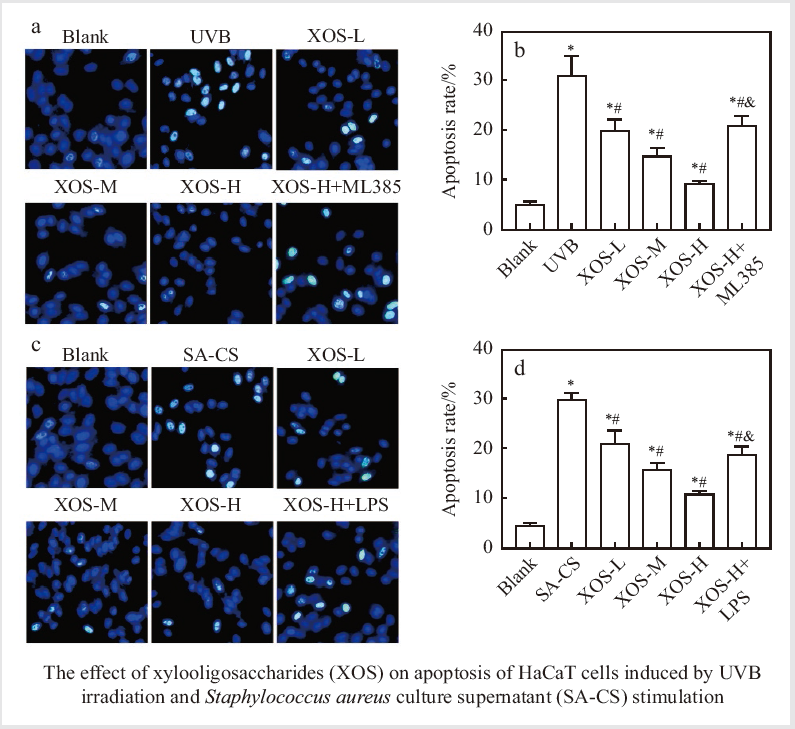
    To investigate the regulatory effect and molecular mechanism of xylooligosaccharides (XOS) on skin barrier immune function, we systematically evaluated two HaCaT cell models: ultraviolet B (UVB) -induced injury and Staphylococcus aureus culture supernatant (SA-CS) -induced inflammation. In the UVB injury model, HaCaT cells were irradiated with 30 mJ/cm2 UVB and then treated with low, medium and high doses of XOS (50, 100, 200 μg/mL) and an Nrf2 inhibitor (ML385) for 24 h. In the SA-CS inflammation model, cells were treated with 20% SA-CS for 24 h, with low, medium and high doses of XOS and a TLR4 agonist (LPS) added simultaneously. Each group consisted of six replicate wells. Cell viability, apoptosis rate (TUNEL assay), mRNA levels of apoptosis-related genes (Bax, Bcl-2), transepithelial electrical resistance (TEER) value, mRNA levels of barrier-related proteins (FLG, Claudin-1/4), oxidative stress indicators (ROS, MDA, SOD), proteins of the Nrf2/Keap1 pathway, inflammatory factors (IL-1β, IL-8, TNF-α, etc.) and protein levels of the TLR4/NF-κB pathway were measured. The results show that UVB irradiation significantly decreases cell viability and TEER value, downregulates mRNA expression of barrier-related proteins, promotes cell apoptosis, induces oxidative stress and inhibits Nrf2 nuclear translocation in HaCaT cells. XOS reverses these injuries in a dose-dependent manner, an effect that can be blocked by ML385. SA-CS treatment significantly reduces cell viability and TEER value, downregulates mRNA expression of barrier-related proteins, promotes cell apoptosis, and increases the levels of inflammatory factors and protein expression of TLR4 and p-NF-κB p65. XOS also ameliorates these injuries in a dose-dependent manner, while LPS reverses this effect. In summary, XOS antagonizes UVB-induced oxidative damage in skin cells by activating the Nrf2 pathway, and alleviates SA-CS-mediated inflammatory damage by inhibiting the TLR4/NF-κB pathway, thereby protecting skin barrier function. This study provides experimental evidence and theoretical support for the development of cosmetic raw materials with skin barrier protection, antioxidant and anti-inflammatory effects.

    Figures and Tables | References | Related Articles | Metrics
    Anti-aging effects and mechanism of enzymatic hydrolysate of Camellia chekiangoleosa Hu seed oil against D-galactose-induced senescence in human skin fibroblasts
    Qi Lu, Wendie Xiang, Guangtao Li, Shipeng Yin, Hongqi Gao, Guo Yu
    2026, 56 (5):  614-622.  doi: 10.3969/j.issn.2097-2806.2026.05.008
    Abstract ( 94 )   HTML ( 7 )   PDF (2922KB) ( 90 )  

    This study investigated the protective effects and underlying mechanisms of the enzymatic hydrolysate from Camellia chekiangoleosa Hu seed oil (EHCO) on D-galactose (D-gal)- induced senescence in human normal foreskin fibroblasts (HFF). A cellular senescence model was established by treating HFFs with 60 mg/mL D-gal. Cells were co-treated with D-gal and EHCO (0.1% or 0.5%) for 24 hours, and cell viability and senescence levels were subsequently assessed. The content of ATP and the activity of SOD were measured using ELISA kits. Mitochondrial function and proliferative capacity were evaluated via fluorescent staining for ROS, JC-1, and EDU. The mRNA expression levels of senescence-associated and inflammation-related genes were quantified by RT-qPCR. Furthermore, the protein expression of apoptosis-related and autophagy-related markers, along with the phosphorylation status of P53 and ERK, were analyzed by Western blotting. In EHCO-treated HFF, the mRNA levels of P16, P21, P53, IL-1β, and IL-6, as well as the phosphorylation levels of P53 and ERK, significantly reduce in a dose-dependent manner (P<0.05). Concurrently, the pro-apoptotic BAX/BCL-2 protein ratio decreases, while the expression of the autophagy marker protein LC3B elevates. This study demonstrates that EHCO, obtained through lipase-catalyzed hydrolysis of Camellia chekiangoleosa Hu, promotes cell proliferation and protects against D-gal-induced senescence in HFF. Mechanistically, EHCO exerts anti-skin-aging effects by improving fibroblast function via the suppression of the ERK-P53 signaling axis and the activation of cellular autophagy.

    Figures and Tables | References | Related Articles | Metrics
    Development and application
    Study on essential oil from Platycladus orientalis L. branches for promoting hair growth in androgenetic alopecia mice
    Lei Zhang, Zihan He, Jun Yang, Xiaowei Zhou, Zhenhua Wang, Gang Li, Chengjun Ma
    2026, 56 (5):  623-634.  doi: 10.3969/j.issn.2097-2806.2026.05.009
    Abstract ( 116 )   HTML ( 6 )   PDF (5661KB) ( 102 )  

    Supercritical CO2 extraction was employed to isolate the essential oil from Platycladus orientalis L. branches (EOPB). The extraction process was optimized using a Box-Behnken design (BBD) with the extraction yield as the response variable. The chemical constituents of the extracted essential oil were characterized via gas chromatography-mass spectrometry. An androgenetic alopecia (AGA) model was established in C57BL/6 mice by depilating the dorsal hair and administering daily intraperitoneal injections of testosterone to evaluate the hair growth-promoting effects of EOPB. The underlying mechanisms were investigated using network pharmacology. Furthermore, the cutaneous levels of IL-1β, IL-6, TNF-α, SOD, CAT, and MDA were measured using ELISA kits. The results indicate that the optimal extraction parameters for EOPB are a pressure of 10.62 MPa, a temperature of 43.69 ℃, and an extraction time of 83.86 minutes, achieving a maximum extraction yield of 20.107%. The primary constituents of EOPB are identified as thujopsene (32.27%) and cedrol (20.88%). The 10% (φ/%) EOPB group achieves complete hair regrowth by day 21, exhibiting an efficacy comparable to that of the minoxidil positive control. Histological analysis confirms that EOPB enhances hair follicle density and accelerates the anagen phase transition. Network pharmacology analysis reveals the involvement of EOPB in inflammatory and oxidative stress pathways. EOPB effectively suppresses inflammatory factors (IL-1β, IL-6, TNF-α), restores antioxidant enzyme (SOD and CAT) activities, and reduces lipid peroxidation (MDA levels). This study provides a reference for the application of EOPB in hair care products, offering alternative therapeutic choices for patients with androgenetic alopecia.

    Figures and Tables | References | Related Articles | Metrics
    Whitening effect of glabridin and its mechanism
    Jun Liang, Xiaoming Shi
    2026, 56 (5):  635-643.  doi: 10.3969/j.issn.2097-2806.2026.05.010
    Abstract ( 139 )   HTML ( 6 )   PDF (3727KB) ( 114 )  

    This study aimed to investigate the whitening effect of glabridin (GLA) and its mechanism. A mouse model of ultraviolet B (UVB) -induced skin photoaging (SP) mice was used. The mice were randomly assigned to 6 treatment groups (n=12), which were control group (C group), UVB group, low, medium and high dose glabridin group (L, M, H-GLA), and high dose glabridin + nuclear factor E2-related factor 2 (Nrf2) inhibitor ML385 group (H-GLA+ML385). Group C was conventionally fed without UVB irradiation, while the other groups were subjected to UVB irradiation. Each group received percutaneous administration 1 h before UV exposure once daily for 8 weeks. The skin was analyzed by hematoxylin and eosin (HE) staining and Masson’s trichrome staining. Melanin content was determined by the NaOH dissolution method. Tyrosinase activity was detected by ELISA. The activities of superoxide dismutase (SOD), catalase (CAT), and glutathione peroxidase (GSH-Px) and the content of malondialdehyde (MDA) were determined using commercial kits. Reactive oxygen species (ROS) were detected by dihydroethidium (DHE) staining. The levels of interleukin-6, tumor necrosis factor-α (TNF-α) and IL-1β in skin tissue were detected by ELISA. mRNA levels of type I collagen α1 chain (COL1A1), matrix metalloproteinase-1 (MMP-1), tyrosinase-associated protein (TRP) -1, TRP-2, heme oxygenase-1 (HO-1) and NAD (P) H: quinone oxidoreductase-1 (NQO-1) were detected by RT-qPCT. Western blot was used to analyze protein expression of α-MSH, Nrf2 (nuclear) and Keap1 in the skin. The results show that compared with the UVB group, the three doses of glabridin (L, M and H-GLA groups) alleviate UVB-induced skin damage and collagen degeneration in the skin photoaging mice, decrease the level of MMP-1 mRNA and increase the level of COL1A1 mRNA. decrease skin melanin content, tyrosinase activity, the levels of TRP-1 and TRP-2 mRNA, the relative expression level of α-MSH protein, increase the skin SOD, CAT and GSH-Px activities, decrease MDA content and ROS relative fluorescence intensity, and decrease skin IL-6, TNF-α and IL-1β contents, increase the expression level of Nrf2 (nuclear) protein, and HO-1 and NQO-1 mRNA, and decrease the relative expression level of Keap1 protein (P<0.05). However, the Nrf2 inhibitor ML385 attenuates the above effects of glabridin (P<0.05). These results indicate that glabridin alleviates UVB-induced skin damage and collagen degeneration, inhibits melanin production, and reduces oxidative stress and inflammation in mice with skin photoaging by activating Nrf2.

    Figures and Tables | References | Related Articles | Metrics
    A study on the anti-aging mechanism of Piteguo fermentation filtrate
    Menglin Nie, Guanfeng Wang, Hongling Kan, Qingyuan Xi, Yuchen Zhang, Jiahui Chen
    2026, 56 (5):  644-653.  doi: 10.3969/j.issn.2097-2806.2026.05.011
    Abstract ( 81 )   HTML ( 5 )   PDF (2298KB) ( 63 )  

    Using a standardized fermentation process with the yeast Hanseniaspora uvarum, Piteguo fermentation filtrate was produced, and its multi-pathway anti-aging efficacy was comprehensively assessed. After fermentation, the contents of organic acids, phenylpropyl compounds and flavonoids in the Piteguo filtrate were significantly increased, indicating its potential to exert anti-aging effects through synergistic antioxidant and anti-inflammatory pathways. In vitro experimental results reveal that Piteguo fermentation filtrate exerts synergistic anti-aging effects through several key mechanisms: it scavenges free radicals, reduces intracellular oxidative stress levels, and attenuates reactive oxygen species (ROS) generation. In an inflammageing model, it inhibits senescence-associated β-galactosidase (SA-β-gal) activity and the secretion of pro-inflammatory cytokines, while also improving the expression profile of key senescence marker proteins. It reduces the cellular accumulation of advanced glycation end products (AGEs), indicating notable anti-glycation potential. It significantly upregulates the expression of type I collagen (COL I), thereby directly intervening in a fundamental structural component of skin aging. Safety evaluations, including the Hen's Egg Test-Chorioallantoic Membrane (HET-CAM) assay and controlled human trials, show no skin irritation or adverse symptoms. A randomized controlled human efficacy study demonstrates that sustained use of Piteguo fermentation filtrate leads to measurable improvements in skin firmness and a reduction in wrinkle severity. In summary, Piteguo fermentation filtrate combats skin aging through a combined strategy involving antioxidant defense, suppression of inflammaging, inhibition of glycation, and stimulation of collagen synthesis. These findings provide a robust scientific foundation for the high-value utilization of this regional fruit and support its innovative application in anti-aging cosmetic formulations.

    Figures and Tables | References | Related Articles | Metrics
    Reviews
    Research progress and development directions of enhanced oil recovery technologies for Bohai high water-cut oilfields
    Yufei Zheng, Xiang Qi, Xiang Li, Jinlong Liu, Qingbo Qin, Yongkang Jia, Xuan Feng
    2026, 56 (5):  654-665.  doi: 10.3969/j.issn.2097-2806.2026.05.012
    Abstract ( 67 )   HTML ( 2 )   PDF (4857KB) ( 82 )  

    As some offshore oil fields enter the medium to high water-cut stage, oil stabilization and water control have become one of the important means to enhance oil recovery. In this review, the development history, research progress, and field applications of chemical EOR technologies in Bohai oilfield were outlined. Addressing the reservoir geological characteristics of Bohai oilfield and the key challenges during waterflooding, those applicable chemical EOR technologies were summarized and primarily categorized into three systems: Profile control systems, profile control and flooding systems, and oil displacement systems. The operational mechanisms, research status, and practical achievements of each technology category were systematically introduced, and the existing technical limitations were also analyzed. Furthermore, the main challenges and future development directions for chemical EOR technologies in Bohai oilfield were prospected. Notably, the development of unconventional reservoirs featured by high temperature, high pressure, and low permeability was the major technical obstacle. Future research should prioritize the development of green and environmentally friendly, intelligent, low-cost, and multifunctional chemical materials. In terms of operational processes, the industry should advance toward large-scale implementation, online operations, and automated technologies.

    Figures and Tables | References | Related Articles | Metrics
    Advances of surfactants in the development of formulations of pesticide carbendazim
    Liming Xue, Jiale Xu, Jingxian Zhou, Yu’e Jin
    2026, 56 (5):  666-673.  doi: 10.3969/j.issn.2097-2806.2026.05.013
    Abstract ( 65 )   HTML ( 1 )   PDF (1665KB) ( 66 )  

    Carbendazim is a broad-spectrum and highly effective benzimidazole fungicide. However, its conventional formulation, wettable powder (WP), suffers from issues such as low utilization ratio, high environmental pollution, and a tendency to induce drug resistance. Surfactants are one of the key components in pesticide formulations, which have also been used in carbendazim formulations to address these traditional challenges. Surfactants can enhance efficacy and utilization, reduce environmental residues, and lower exposure risks for applicators. In this review, the research progress of surfactants in carbendazim formulations was summarized, including suspension concentrates (SC), water-dispersible granules (WG), and nano-formulations. It was elaborated that the surfactants in carbendazim formulations had improved physical stability through steric hindrance and electrostatic stabilization, and they could also enhance utilization by increasing solubility, foliar adhesion, and absorption. Then, potential negative effects and green design strategies to reduce environmental fate and operator exposure risks were discussed. It was pointed out that the future development of efficient, green and bio-degradable surfactants combined with nanotechnology would be a crucial direction for achieving green and sustainable development of carbendazim pesticides.

    Figures and Tables | References | Related Articles | Metrics
    Cosmetovigilance: regulatory trends and corporate practices across countries
    Manru Ning, Yihuai Liang, Feifei Wang
    2026, 56 (5):  674-680.  doi: 10.3969/j.issn.2097-2806.2026.05.014
    Abstract ( 77 )   HTML ( 4 )   PDF (2939KB) ( 77 )  

    Post-marketing surveillance (PMS) is a critical component of risk management throughout the entire product lifecycle of cosmetics. As a core element of PMS, cosmetovigilance has emerged as a central approach and a key pillar of regulatory systems both domestically and internationally. This review summarizes the regulatory frameworks and operational mechanisms for cosmetovigilance in the European Union, the United States, Japan, and China. Furthermore, two international renowned cosmetic companies were selected as case studies to demonstrate how they developed their internal PMS systems and benefits derived from them. The aim is to provide insights and references for domestic cosmetic companies to actively respond to regulatory requirements, fulfill their legal obligations, and enhance their internal cosmetovigilance systems.

    Figures and Tables | References | Related Articles | Metrics
    Analytical methods and testing
    Determination of PPO content in LAB by high-temperature gas chromatography
    Aizhong Huang, Yingxue Li, Dong Liu, Lijun Chen, Xiaoyu Dong, Hong Cao
    2026, 56 (5):  681-686.  doi: 10.3969/j.issn.2097-2806.2026.05.015
    Abstract ( 65 )   HTML ( 2 )   PDF (1360KB) ( 65 )  

    An analytical method for determining the content of primary scintillator 2, 5-diphenyloxazole (PPO) in liquid scintillators composed primarily of linear alkylbenzene (LAB) was established using a high-temperature gas chromatograph with a cold column inlet and an external standard quantification method. The results demonstrate excellent linearity for PPO in the concentration range of 0-0.856 g/L, with correlation coefficients R2 > 0.99. The limit of detection of the method is 2.33 μg/L, the limit of quantification is 7.00 μg/L, and the recovery rate ranges from 97.0% to 100.1%. This method is straightforward, high sensitivity and accurate, provides stable results, and yields reliable data. It is suitable for the quantitative analysis of PPO in LAB-based liquid scintillators, offering a robust analytical method for quality control of LAB-formulated liquid scintillation systems.

    Figures and Tables | References | Related Articles | Metrics
    Determination of the contents of six ginsenosides in ginseng cosmetic preparations by high performance liquid chromatography
    Song Qin, Songbin Li
    2026, 56 (5):  687-694.  doi: 10.3969/j.issn.2097-2806.2026.05.016
    Abstract ( 93 )   HTML ( 3 )   PDF (1269KB) ( 93 )  

    In this study, a synchronous quantitative analytical method for six ginsenosides (Rb1, Rb2, Rc, Rd, Re, Rg1) in ginseng cosmetics using high performance liquid chromatography (HPLC) was established. The method uses 80% ethanol solution as the extraction solvent. Matrix interference is eliminated by degreasing with petroleum ether combined with extraction with water-saturated n-butyl alcohol, and the thermosensitive components are protected by temperature-controlled concentration. Samples were ultrasonically extracted at 40 ℃ for 40 min (power 300 W, frequency 40 kHz), with vortexing for 10 s every 10 min. A Kinetex C18 chromatographic column with a core-shell structure (100 mm×2.1 mm, 2.6 μm) was used, and gradient elution was performed with acetonitrile-0.1% phosphoric acid aqueous solution as the mobile phase (the proportion of acetonitrile increases from 18% to 55% within 0-35 min), which achieved baseline separation of the six ginsenosides within 35 min at a wavelength of 203 nm. Method validation shows that the relative standard deviation (RSD) of intra-day precision is 1.72%-4.65%, and the RSD of inter-day precision is 2.24%-4.59%, both less than 5%. Linear regression analysis shows that the correlation coefficients (r) of the six ginsenosides are all greater than 0.999, the limit of detection (LOD) ranges from 0.11 to 0.23 μg/mL, and the limit of quantification (LOQ) ranges from 0.33 to 0.70 μg/mL. The average recoveries of the six ginsenosides at different spiked mass concentrations range from 95.73% to 104.65%, with RSDs all less than 5%. Using this optimized HPLC method, this study quantitatively analyzes the six ginsenosides in 10 commercially available ginseng cosmetics (including essences, creams, and lotions). The results show that Rb1 is the dominant ginsenoside, and the total ginsenoside content in creams (average 471.0-552.7 μg/g) is higher than that in essences (average 178.7-418.4 μg/g) and lotions (average 212.1-347.6 μg/g). This method, which combines triple purification with rapid separation, significantly improves detection efficiency and overcomes interference from the cosmetic emulsion system, providing technical support for quality control of the functional components of ginseng.

    Figures and Tables | References | Related Articles | Metrics