Loading...
Welcome to China Surfactant Detergent & Cosmetics, Today is

Table of Content

    22 April 2026, Volume 56 Issue 4 Previous Issue    Next Issue
    Invited paper
    Applications and challenges of synchrotron small-angle scattering in nanostructure characterization of cosmetics
    Jie Yu, Aihua Zou, Na Li
    2026, 56 (4):  407-424.  doi: 10.3969/j.issn.2097-2806.2026.04.001
    Abstract ( 119 )   HTML ( 20 )   PDF (13738KB) ( 91 )  

    Cosmetic products encompass a broad range of categories, including sunscreens, personal care products, and color cosmetics. These products are typically multiphase soft matter systems composed of multiple components with complicated interactions. Their interior commonly contains entities with spatial scale from 1 to 100 nm, including lamellar liquid crystals, vesicles, micelles, microemulsions, nanoparticles, and weakly interacting networks formed by these entities. Such nanostructures play a decisive role in stability, sensory properties, delivery behavior, and overall efficacy of cosmetic products. Small-angle X-ray scattering (SAXS) enables in-situ and ensemble-averaged structural characterization of nanoscale structures under non-destructive conditions in real formulations and actual application states. Therefore, SAXS has now become an essential structural characterization tool throughout cosmetic formulation design, process optimization and scale-up, quality control, consistency evaluation, and structure-function relationship research. In this review, both recent academic and industrial progresses of SAXS for characterizing cosmetic nanostructures were summarized. Representative applications and case studies of SAXS in typical cosmetic systems were systematically discussed. Furthermore, current opportunities and challenges in the aspects of data interpretation in complex multi-component systems, including modeling strategies and result interpretability, were critically analyzed. The potential of BioSAXS beamline BL19U2 at the Shanghai Synchrotron Radiation Facility (SSRF) to empower cosmetic research was also discussed. Finally, considering the emerging trends in artificial intelligence-driven data analysis and multimodal structural characterization, the prospects for SAXS applications in the rational design of cosmetic formulations and the mechanism studies of efficacy were discussed.

    Figures and Tables | References | Related Articles | Metrics
    Lecture of science and technology
    Viscoelastic surfactants (IV) Dynamic rheology
    Yujun Feng
    2026, 56 (4):  425-432.  doi: 10.3969/j.issn.2097-2806.2026.04.002
    Abstract ( 82 )   HTML ( 4 )   PDF (4594KB) ( 78 )  

    Wormlike micelles (WLMs) feature dynamic rheological behaviors that connect their microstructural dynamics to macroscale performance, underpinning diverse industrial applications. In this review, WLM dynamic rheology was introduced, and the rules in linear and nonlinear dynamic rheological behaviors were elucidated. Unlike steady-state rheology, dynamic rheology is characterized by viscoelastic responses, relaxation kinetics, and structural changes in alternating flow fields, targeting quantitative relationships between rheological parameters, microstructures, and flow conditions. Linear dynamic rheology has been measured by the test of small amplitude oscillatory shear (SAOS), whose viscoelastic responses mostly conform to Maxwell model. The key parameters and mesoscopic structural data are extracted by broadband techniques. Nonlinear behaviors (the Wisenberg number Wi > 1) include shear banding, strain hardening, and elastic instabilities, which are characterized by large amplitude oscillatory shear (LAOS) with TDM and SPPM. The understanding of dynamic rheology is valuable to guide the applications of WLMs in oil and gas industry (tunable fracturing fluids), personal care (biodegradable thickeners), biomedicine (stimuli-responsive drug delivery), and smart materials. Core challenges involve model-dependent mesoscopic parameter extraction and lack of universal nonlinear models. Future research should prioritize multi-scale coupling, in-situ characterization, theoretical innovation, and industry-adapted designs to advance WLM commercialization.

    Figures and Tables | References | Related Articles | Metrics
    Basic research
    Preparation and performance of high-hydrogen silicone oil emulsions stabilized with straight-chain fatty alcohol polyoxyethylene ethers
    Xiao Wang, Xiaoya Liang, Zhiwang Han, Jiaqian Yang, Lifei Zhi, Zhiyun Li, Guoyong Wang
    2026, 56 (4):  433-440.  doi: 10.3969/j.issn.2097-2806.2026.04.003
    Abstract ( 107 )   HTML ( 7 )   PDF (4500KB) ( 79 )  

    High-hydrogen silicone oil-in-water emulsions were prepared by mechanical emulsification using polymethylhydrosiloxane trimethylsiloxy terminated (H=1.6%) as the dispersed phase and fatty alcohol polyoxyethylene ethers AEO-3 and AEO-9 as the mixed emulsifiers. The effects of the mass ratio and dosage of the mixed emulsifiers on the stability of emulsions were investigated. The stabilization mechanism of the emulsion was studied by analyzing the surface/interfacial activities of the mixed emulsifiers and the particle size distribution and microstructure of the emulsion. The results showed that the optimized conditions for preparation of the emulsion were as follows: The content of polymethylhydrosiloxane trimethylsiloxy terminated was 35%, the mass ratio of AEO-3∶AEO-9 was 7∶3, the total dosage of the mixed emulsifiers was 2% of the mass of the emulsion, and the stirring rate for emulsification was 3 000 r/min. The appearance of the emulsion thus prepared was a milky white liquid, indicative of good centrifugal stability and dilution stability, and the particle size of the emulsion was approximately 1.30 μm and merely increased to 1.76 μm after 90 days. The results for modification of the surface of a microscope slide with the high-hydrogen silicone oil emulsion showed that, the contact angle of water on the surface of the slide treated with the emulsion could reach 123.3 °, and the contact angle was still 114.5 ° after 50 times of rinsing, which indicated that the emulsion endowed the slide with good water repellency. This work could provide theoretical basis and technical support for application of high-hydrogen silicone oil emulsions.

    Figures and Tables | References | Related Articles | Metrics
    Study on the modification mechanism and performance of nonionic surfactants in the dispersion process of SiO2 aerogels
    Yunan Wan, Zhen Ren, Yichun Zhang
    2026, 56 (4):  441-448.  doi: 10.3969/j.issn.2097-2806.2026.04.004
    Abstract ( 93 )   HTML ( 7 )   PDF (94340KB) ( 113 )  

    Four dispersion systems were prepared by surface modification of SiO2 aerogel (AG) with four different nonionic surfactants, including fatty acid methyl ester ethoxylate (FMEE), fatty alcohol polyoxyethylene ether (AEO9), alkyl polyglycoside (APG08-10), and nonylphenol polyoxyethylene ether (NP-10). The dispersity was evaluated by sedimentation volume ratio, Zeta potential, average particle size, FT-IR and TEM. The adsorption modes for different surfactants on the surface of AG and their effects on dispersing performance were analyzed. The results showed that the best dispersion of AG system was achieved at mass fractions of FMEE, AEO9, APG08-10 and NP-10 of 0.04%, 0.10%, 0.04% and 0.06%, respectively. The order of dispersity of surfactant-modified AG was NP-10 > AEO9 > FMEE > APG08-10. NP-10 attracted AG particles through hydrophobic interaction and van der Waals force, with its benzene ring adsorbing vertically onto the AG particle surface via π-π stacking. The strong steric hindrance of the long polyoxyethylene (EO) chain in the liquid phase prevented adsorptive agglomeration among AG particles and thus ensured the stability of the dispersion.

    Figures and Tables | References | Related Articles | Metrics
    Construction of a cationic liposomal system for enhanced transdermal delivery of hyaluronic acid
    Yu Wang, Shuang Ren, Suzhen Yang, Tingting Han, Yingying Ji, Zijia Zhang, Wanping Zhang
    2026, 56 (4):  449-462.  doi: 10.3969/j.issn.2097-2806.2026.04.005
    Abstract ( 89 )   HTML ( 6 )   PDF (5210KB) ( 75 )  

    In this study, we developed a cationic liposome (OTAC-L) delivery system based on octadecyltrimethylammonium chloride (OTAC) to enhance the low percutaneous permeability of hyaluronic acid. OTAC-HA-L was successfully prepared, showing a particle size of (90.42±1.92)nm and a polydispersity index of 0.23±0.02. This was achieved through measurements of particle size, Zeta potential, and entrapment efficiency, as well as analysis film properties using a fluorescence probe and optimizing the OTAC amount in chicken embryo experiments. Transmission electron microscopy (TEM) confirmed that the liposomes had a regular spherical shape. Low-field NMR and isothermal calorimetry were employed to investigate the molecular movement of water and the thermodynamic parameters of the HA binding process, respectively, confirming the effective binding between HA and cationic liposomes. Fourier transform infrared spectroscopy (FT-IR) identified the characteristic absorption peak of HA, confirming successful loading of HA and interaction with the liposomes. In vitro permeation tests showed that OTAC-HA-L’s permeation performance was significantly improved, with a cumulative permeation rate of 15% at 12 hours, which was 1.91 and 2.56 times higher than that of standard liposomes and aqueous HA, respectively. Additionally, the system demonstrated good stability under normal-, high-, and low-temperature conditions, making it a promising approach for deep HA delivery in skin care.

    Figures and Tables | References | Related Articles | Metrics
    Extraction of polyphenols from spent coffee grounds and their antioxidant activity
    Jialin Liu, Meng Li, Xiao Ning, Jin Cao
    2026, 56 (4):  463-470.  doi: 10.3969/j.issn.2097-2806.2026.04.006
    Abstract ( 111 )   HTML ( 9 )   PDF (4772KB) ( 104 )  

    Ultrasound-assisted extraction (UAE) coupled with response surface methodology (RSM) was applied to optimize the recovery of polyphenols from spent coffee grounds (SCGs), a typical by-product of the coffee industry. Extraction temperature, time, and liquid-to-solid ratio were investigated as major variables. The optimal conditions are determined to be 49 ℃, 25 min, and a liquid-to-solid ratio of 29∶1 (mL/g). Under these conditions, the total polyphenol yield reaches 16.71 mg GAE/g DW, which closely matches the predicted value of 16.75 mg GAE/g DW, thereby verifying the accuracy of the model. Antioxidant activity was evaluated by DPPH and PTIO radical scavenging assays. At a volume fraction of 4%, the UAE extract shows a DPPH scavenging rate of 99.38%, which is higher than that of the water extract. In the PTIO assay, the UAE extract shows a scavenging rate of 27.86% at a volume fraction of 80%, whereas the water extract reaches 36.19% at 100%. Moreover, ultra-high-performance liquid chromatography-mass spectrometry (UHPLC-MS) identifies chlorogenic acid, ellagic acid, and protocatechuic acid as the major phenolic compounds, confirming the chemical basis of the antioxidant effect. These findings demonstrate that UAE not only enhances the extraction efficiency of polyphenols from SCGs but also yields extracts with strong antioxidant activity. The study provides technical support and scientific evidence for the valorization of coffee by-products as natural antioxidants, highlighting their potential application in skincare formulations and daily chemical products.

    Figures and Tables | References | Related Articles | Metrics
    Design, screening and efficacy evaluation of melanin-production inhibitory peptides
    Yu Dong, Shaofeng Rong, Shimin Guan, Qianqian Li
    2026, 56 (4):  471-478.  doi: 10.3969/j.issn.2097-2806.2026.04.007
    Abstract ( 83 )   HTML ( 3 )   PDF (5647KB) ( 82 )  

    Currently, there is little research on tetrapeptides with melanin inhibitory activity. This article aims to study melanin inhibition by constructing a virtual peptide library and establishing a design and screening method to select and evaluate tetrapeptides with melanin inhibitory activity. Based on a virtual peptide library, technologies such as molecular docking, activity prediction, and force analysis were used to screen the target active tetrapeptides, and then solid-phase peptide synthesis was employed for directed synthesis of the target tetrapeptides. The efficacy of the target active tetrapeptides was further evaluated from biochemical detection, cell models, and molecular transcription perspectives. Four tetrapeptides are selected: Peptide-1 (CHWH), Peptide-2 (RVGW), Peptide-3 (LHSY), and Peptide-4 (LFSY). Compared to the other three tetrapeptides, Peptide-1 exhibits better Cu2+ chelation, ABTS positive ion scavenging, and tyrosinase inhibitory activity. The IC50 values for tyrosinase activity and melanin production inhibition in B16 cell models are 0.28 and 0.20 g/L, respectively, and it dose not significantly affect cell proliferation below a mass concentration of 10 g/L. Transcriptional studies also further show that Peptide-1 can decrease the intracellular levels of MITF (microphthalmia-associated transcription factor) and TYR (tyrosinase) gene expression in a concentration ration-dependent manner.

    Figures and Tables | References | Related Articles | Metrics
    Development and application
    Exploration of the preparation process and anti-inflammatory effects of sheep umbilical cord extract
    Yanling Qu, Afeng Li, Lingjuan Dong, Zhe Wang, Fengqing Shang, Leiguo Ming
    2026, 56 (4):  479-486.  doi: 10.3969/j.issn.2097-2806.2026.04.008
    Abstract ( 70 )   HTML ( 4 )   PDF (2699KB) ( 108 )  

    In this study, sheep umbilical cord extract (S-UCE) was obtained through a multi-step purification process involving enzymatic hydrolysis, homogenization, ultrasonication and filtration. The protein mass concentration of S-UCE, as determined by the bicinchoninic acid (BCA) assay, was (1.64±0.37) mg/mL. The effect of S-UCE on cell viability of human dermal fibroblasts (HDFs), human immortalized keratinocytes (HaCaT), and RAW 264.7 macrophages were evaluated using the MTT colorimetric assay. Results demonstrate that S-UCE at protein mass concentrations ranging from 0 to 400 μg/mL exhibit no cytotoxicity and promote cell proliferation by 50%-100% in the aforementioned cell lines. An inflammatory model was established using lipopolysaccharide (LPS) -stimulated RAW264.7 cells. Morphological changes were observed using microscope, while nitric oxide (NO) release in the culture supernatant was quantified using the Griess reagent method. Enzyme-linked immunosorbent assay (ELISA) was employed to measure the expression levels of pro-inflammatory cytokines, including tumor necrosis factor-alpha (TNF-α), interleukin (IL) -6, and IL-1β. Furthermore, western blotting and immunofluorescence assays were performed to detect the protein expression of polarization markers CD86 (M1 phenotype) and CD206 (M2 phenotype) in RAW264.7 cells. The results indicate that S-UCE at protein mass concentrations of 50-200 μg/mL significantly attenuate LPS-induced morphological alterations in RAW264.7 cells, reduce NO production, and suppress the expression of IL-6, IL-1β, and TNF-α. Notably, S-UCE at 100 μg/mL exhibits the most potent anti-inflammatory effects, downregulating the relative protein expression of CD86 while upregulating CD206 expression. These findings demonstrate that the prepared S-UCE possesses favorable biosafety and anti-inflammatory properties, providing an experimental foundation for the development of novel animal-derived functional ingredients in cosmetic applications.

    Figures and Tables | References | Related Articles | Metrics
    Exploration of hair follicle irritation and hair growth efficacy of a Traditional Chinese Medicine hair growth solution
    Feng Zou, Rong Zhang, Yingshan Lu, Wenfeng Wu, Jiafen Liang, Hongyi Li
    2026, 56 (4):  487-496.  doi: 10.3969/j.issn.2097-2806.2026.04.009
    Abstract ( 89 )   HTML ( 11 )   PDF (4369KB) ( 77 )  

    This study observed the effects of the same Traditional Chinese Medicine combination on hair papilla cells, keratinocytes, and isolated hair follicles under 7 different extraction methods, and explored which extraction method promotes the effect of promoting hair growth while causing less toxic damage to cells. The MTT assay was used to detect the toxicity and proliferative effects of the seven extraction solutions on dermal papilla cells and keratinocytes. Three extraction solutions with better cell viability enhancement effects at the 72-hour time point in the proliferation experiment were selected for hair follicle culture in vitro, and the growth of hair follicles and changes in hair follicle growth cycle were observed. Finally, the fingerprint spectrum of the Traditional Chinese Medicine formula was constructed using liquid chromatography-mass spectrometry, and the main chemical components were identified. The results show that the extraction method for 7 medicinal herbs with alcohol precipitation, and 3 medicinal herbs with alcohol extraction combined with 15 μL of volatile oil (G extraction solution) has a significant promoting effect on the growth of hair follicles in vitro. It also has a regulatory effect on the growth cycle of hair follicles by prolonging the growth period and slowing the degeneration period, thereby achieving hair growth.

    Figures and Tables | References | Related Articles | Metrics
    Evaluation of the efficacy of recombinant mussel adhesive protein in improving androgenetic alopecia and study on its mechanism in vitro
    Qiu Zhang, Ya Zhang, Rong Wang, Zengmiao Hou, Wentao Huang, Lu Yang
    2026, 56 (4):  497-504.  doi: 10.3969/j.issn.2097-2806.2026.04.010
    Abstract ( 97 )   HTML ( 2 )   PDF (1366KB) ( 97 )  

    The study aims to investigate the effects and mechanisms of recombinant mussel adhesive protein on improving androgenetic alopecia (AGA) through in vitro experiments. The recombinant mussel adhesive protein was structurally characterized through molecular weight and protein content analysis. The effects of different mass concentrations of recombinant mussel mucin on type II 5α-reductase inhibition, human dermal papilla cell (HDPCs) viability were examined, and in the DHT-induced AGA cell model, the changes in inflammation factors, growth regulatory factors (VEGF and HGF) secretion, reactive oxygen species (ROS) levels, and cellular senescence marker β-galactosidase (SA-β-gal) activity were assessed, verifying its anti-androgenetic alopecia efficacy from multiple dimensions. The results show that the measured molecular weight of recombinant mussel adhesive protein (22 681.366 Da) is highly consistent with the theoretical value, and the purity of three batches of raw materials all exceeds 90%, which ensures the reliability of subsequent functional studies. Functional studies on recombinant mussel adhesive protein reveal that it exhibits an inhibitory effect on type II 5α-reductase (IC50 = 1 500 μg/mL) with a dose-dependent relationship. Furthermore, regarding its effect on HDPCs cell, recombinant mussel adhesive protein can promote the proliferation of HDPCs in a concentration-dependent manner without toxicity at high concentrations. Further studies indicate that recombinant mussel adhesive protein exerts a hair growth-promoting effect by inhibiting DHT-induced ROS production, reducing the release of pro-inflammatory factors such as IL-6 and TNF-α, while significantly decreasing the expression of SA-β-gal to delay the premature senescence of HDPCs and maintain their proliferation potential. Notably, the efficacy of recombinant mussel adhesive protein at low concentrations is comparable to that of minoxidil.

    Figures and Tables | References | Related Articles | Metrics
    Reviews
    Research progress on the formation mechanism and protection technologies of under-deposit corrosion in oil and gas field development
    Xiaoyong Bai, Kai Li, Le Yang, Dingjiang Liu, Chunsheng Wu, Yongli Yan
    2026, 56 (4):  505-517.  doi: 10.3969/j.issn.2097-2806.2026.04.011
    Abstract ( 69 )   HTML ( 0 )   PDF (20138KB) ( 48 )  

    Under-deposit corrosion (UDC) is a critical challenge in the integrity management of oil and gas production facilities because it is hidden, rapid-evolving and highly destructive. Its formation mechanism involves the interplay of multiple factors, including electrochemical, microbial, and physical barrier effects. In this review, the evolution process, mechanisms, and main influencing factors of under-deposit corrosion were systematically summarized. The synergistic effects of deposit types, electrochemical behavior, microbial activity, and environmental parameters on the corrosion process were analyzed. On this basis, the current status of application and the mechanisms were summarized for commonly used protection technologies such as scale inhibitors and corrosion inhibitors, as well as their applicability and limitations in practical working conditions. Finally, the future research directions for preventing under-deposit corrosion were proposed, aiming to provide theoretical basis and technical support for corrosion control in oil and gas fields.

    Figures and Tables | References | Related Articles | Metrics
    Research progress on the efficient catalytic cracking of LCO to produce high-value BTX aromatics
    Jiahuan Yu, Yanxin Song, Guang Chen
    2026, 56 (4):  518-528.  doi: 10.3969/j.issn.2097-2806.2026.04.012
    Abstract ( 64 )   HTML ( 0 )   PDF (1816KB) ( 48 )  

    The shifting landscape of China’s fuel market, characterized by a declining diesel-to-gasoline ratio and the rigorous enforcement of China VI diesel standards, has intensified the challenge of optimizing light cycle oil (LCO) utilization. The trend of diesel overcapacity coincides with a growing supply-demand imbalance in key petrochemical building blocks, namely benzene, toluene, and xylene (BTX). In this context, hydrocracking (HYC) is increasingly recognized as a pivotal upgrading technology to address both issues simultaneously: alleviating the diesel surplus while selectively producing high-value BTX aromatics. This review provides a systematic analysis of contemporary technologies for the catalytic transformation of LCO into BTX. We delve into the fundamental reaction mechanisms, including hydrogenation, ring-opening, and dealkylation, which govern the selectivity towards light aromatics. A particular focus is placed on recent advancements in bifunctional catalyst design, in which the delicate balance between metal function and zeolite acidity is critical for directing the reaction pathway. Furthermore, we critically analyze the often-overlooked aspect of mass transfer and diffusion limitations within catalyst particles and zeolite micropores. A profound understanding of molecular diffusion is paramount for the rational design of next-generation catalysts, ultimately enabling the highly efficient and selective conversion of low-value LCO into premium BTX products via hydrocracking.

    Figures and Tables | References | Related Articles | Metrics
    Physiological functions and applications of dermatan sulfate in skin tissue
    Zheng Wang, Jiajun Qian, Yumei Fan, Peixue Ling
    2026, 56 (4):  529-538.  doi: 10.3969/j.issn.2097-2806.2026.04.013
    Abstract ( 80 )   HTML ( 5 )   PDF (4202KB) ( 62 )  

    Dermatan sulfate (DS) is a glycosaminoglycan composed of alternating N-acetylgalactosamine (GalNAc) and uronic acid residues. Characterized by significant structural heterogeneity and high negative charge density, DS interacts specifically with diverse proteins, widely participating in critical physiological and pathological processes including tissue development, injury repair, and inflammation regulation. In the skin, DS plays a pivotal role in maintaining mechanical strength, promoting wound healing, and combating aging by regulating collagen fibril assembly, modulating cell signaling, and mediating cell adhesion. In recent years, with deepening research into its biological functions, the application potential of DS in skin health management and disease intervention has become increasingly prominent. This review systematically summarizes the latest research progress of DS in the frontier fields such as skin tissue engineering, wound healing, anti-fibrosis, and anti-aging. Furthermore, it dissects the core mechanisms by which DS conformational flexibility (mediated by iduronic acid) and specific sulfation patterns regulate cutaneous biological functions, aiming to provide a theoretical basis and novel insights for the translation of basic research and the development of innovative products.

    Figures and Tables | References | Related Articles | Metrics
    Research progress and prospects of Camellia oleifera in the field of daily chemicals
    Mengyang Li, Jinbo Li, Weijuan Huang
    2026, 56 (4):  539-544.  doi: 10.3969/j.issn.2097-2806.2026.04.014
    Abstract ( 88 )   HTML ( 2 )   PDF (4760KB) ( 87 )  

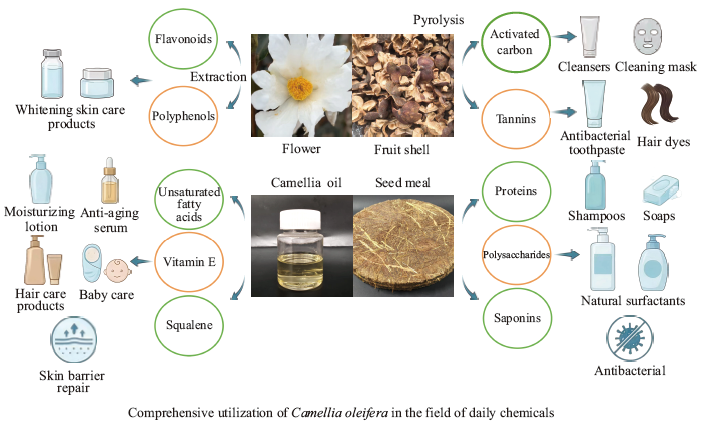
    Camellia oleifera Abel., a vital economic tree species in China, is extensively cultivated across southern provinces and comprises more than 100 documented cultivars. Its primary product, camellia oil, is rich in unsaturated fatty acids and contains bioactive components such as vitamin E and squalene, which exhibit excellent antioxidant and long-lasting moisturizing effects, as demonstrated in preliminary studies. Beyond the oil, other parts of the plant, flowers, fruit shells, and seeds, also offer significant application potential due to their distinct structural and chemical characteristics. Flower extracts, rich in flavonoids, provide anti-inflammatory and soothing effects for sensitive skin. Pyrolyzed or enzymatically treated fruit shells form porous structures with high adsorption capacity, making them suitable as natural cleaning agents. Additionally, camellia seed proteins, which account for about 10% of the seed content, serve as nutritional additives in skincare formulations to support skin barrier function. Collectively, these attributes support the integration of C. oleifera in moisturizing skincare, natural cleansers, anti-aging serums, and hair care products. However, the comprehensive development and utilization of this resource remain in the early stages. Current research predominantly focuses on individual components, with limited exploration of synergistic applications. Systematic investigations are urgently needed to address key challenges, including efficient extraction of active ingredients, robust efficacy validation through in vitro and in vivo testing, and formulation optimization for product stability. Advancing these areas will facilitate industrial transformation, extend the value chain, reduce resource waste, and generate substantial economic and ecological benefits. This review systematically summarizes the phytochemical composition, functional properties, and industrial applications of C. oleifera in daily chemical products.

    Figures and Tables | References | Related Articles | Metrics
    Analytical methods and testing
    Detection of nine β-blockers in cosmetics via graphene-based solid-phase extraction coupled with two-dimensional high-performance liquid chromatography-tandem mass spectrometry
    Yiqing Liu, Hongyan Chen, Ming Wei, Yilin Xu
    2026, 56 (4):  545-550.  doi: 10.3969/j.issn.2097-2806.2026.04.015
    Abstract ( 62 )   HTML ( 1 )   PDF (2547KB) ( 77 )  

    This study established a method for the determination of nine β-blockers, including atenolol, in cosmetics using magnetic graphene solid-phase extraction coupled with two-dimensional high performance liquid chromatography tandem mass spectrometry. The samples were extracted with acetonitrile solution, and the targets were adsorbed with magnetic graphene as the solid phase extraction adsorbent. The samples were analyzed by two-dimensional liquid chromatography-tandem mass spectrometry (2D-LC-MS/MS), and quantified by the standard curve external standard method. The findings indicate that a dosage of 8 mg of magnetic graphene, in conjunction with an adsorption period of 20 minutes and the utilization of a 5 mL acetonitrile solution as the eluent, can effectively achieve the enrichment and purification of nine β-blockers. The targets exhibit satisfactory linearity across three distinct matrices: aqueous, emulsion, and cream, within the mass concentration ranges of 50-800 ng/mL and 100-1 600 ng/mL, with the correlation coefficients (r) all greater than 0.999 1. The mean recoveries is found to range from 90.32% to 100.11%, 90.26% to 102.22%, and 90.42% to 102.02%, respectively. The method is characterized by high specificity, high sensitivity, and good reproducibility, and is suitable for the determination of nine β-blockers in complex cosmetic systems.

    Figures and Tables | References | Related Articles | Metrics
    Determination of 17 kinds of organic acids in cosmetic products by UPLC-MS/MS
    Zhihang Wu, Minting Luo, Chuwen Huang
    2026, 56 (4):  551-556.  doi: 10.3969/j.issn.2097-2806.2026.04.016
    Abstract ( 63 )   HTML ( 1 )   PDF (1673KB) ( 76 )  

    A method based on ultra-performance liquid chromatography-tandem mass spectrometry (UPLC-MS/MS) was established for the determination of 17 organic acids in cosmetics. Cosmetic samples were extracted with 50% (V/V) methanol-water solution. The sample solution was separated on a Welch Ultimate AQ-C18 (2.1 mm× 100 mm, 1.8 μm) using 0.01% formic acid in water and methanol as the mobile phases under gradient elution. Mass spectrometry detection was performed in multiple reaction monitoring (MRM) mode. Qualitative analysis was based on retention time and relative abundance ratio of characteristic ion pairs, while quantitative analysis was carried out using the peak areas of quantitative ion pairs. Quantification was performed by the matrix-matched external standard method using calibration curves. For various matrix types, including creams, lotions, liquids, and gels, the 17 organic acids exhibit good linearity within their respective concentration ranges (R2 > 0.99). The limits of detection (LODs) range from 0.101 3-5.215 μg/g, and the limits of quantification (LOQs) range from 0.303 9-15.64 μg/g. At three spiked concentration levels (low, medium, and high), the recoveries of the target analytes in different matrix samples range from 92.7% to 106%, with relative standard deviations (RSDs, n=6) of 1.5%-8.5%. This method features simple sample preparation, high analytical efficiency, high sensitivity, accurate quantification, and strong reproducibility, and is suitable for the determination of the 17 organic acids in various cosmetic products.

    Figures and Tables | References | Related Articles | Metrics