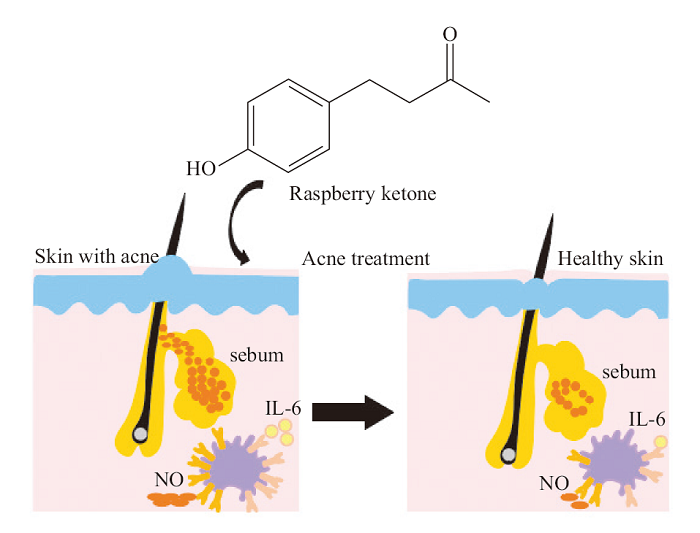
建立了油脂合成与炎症模型,在体外细胞层面上来评估覆盆子酮(Raspberry Ketone,RK)在控油与舒缓肌肤方面的效果,进一步开展了关于RK在控油、舒缓及祛痘方面的人体功效试验。结果显示:低剂量组4 μg/mL和高剂量组40 μg/mL的RK均可显著减少中性和极性油脂的合成。4 μg/mL的RK未能抑制IL-6和NO的分泌,而40 μg/mL的RK可显著抑制IL-6和NO的表达,抑制率分别为39.5%和20.7%,且与100 μg/mL地塞米松磷酸钠相比,RK在该质量浓度下对NO分泌的抑制效果无显著性差异。符合筛选标准的志愿者在连续使用含0.5% RK的膏霜样品14天后,皮肤均无不良反应,且油脂和卟啉含量分别减少了23.0%和22.5%;乳酸刺痛评分值、血红素EI值、红区a*值和红区面积分别减少了48.8%,6.1%,11.3%和41.8%;粉刺、丘疹和脓疱的皮损消退率分别为33.8%,41.8%和57.1%;痤疮的高度和体积分别减少了46.2%和63.2%。本研究表明覆盆子酮具有控油、舒缓和祛痘功效。
Raspberry ketone (RK), a common ingredient in cosmetics, possesses antioxidant, preservative, and skin-whitening properties. However, the action mechanism of RK in the treatment of acne remains unclear. Therefore, the study evaluated the sebum-controlling and soothing efficacy of RK by establishing celluar models of lipid synthesis and inflammation in vitro. Additionally, a human efficacy testing on the acne-alleviating effects of RK was conducted. The results indicate that both low-dose (4 μg/mL) and high-dose (40 μg/mL) RK significantly decrease the synthesis of neutral and polar lipids. While the low concentration of RK at 4 μg/mL does not inhibit the secretion of interleukin-6 (IL-6) and nitric oxide (NO), the high concentration of 40 μg/mL significantly inhibits their expression with the inhibition rates of 39.5% and 20.7%, respectively. Additionally, compared with 100 μg/mL dexamethasone sodium phosphate (positive control group), RK at this concentration shows no significant difference in its inhibitory effect on NO secretion. In a trial involving volunteers who meet the inclusion criteria, after consecutively using cream samples containing 0.5% RK for 14 days, all participants report no adverse skin reactions. Notably, their sebum and porphyrin contents decrease by 23.0% and 22.5%, respectively. Furthermore, the lactic acid sting score, erythema index (EI) value, a* value in the red area, and red area size decrease by 48.8%, 6.1%, 11.3%, and 41.8%, respectively. The lesion regression rates for comedones, papules, and pustules are also reconfirmed at 33.8%, 41.8%, and 57.1%, respectively. Additionally, the height and volume of acne lesions decrease by 46.2% and 63.2%, respectively. The study demonstrates that RK exhibits sebum-controlling, soothing, and acne-reducing properties.