欢迎访问《日用化学工业(中英文)》,今天是

日用化学工业(中英文) ›› 2026, Vol. 56 ›› Issue (9): 1144-1157.doi: 10.3969/j.issn.2097-2806.2026.09.003
闫梦瑶1,2,梁慧斌1,2,赵永杰1,孙晋源1,2,张科1,2,周婧洁1,2,*( ),耿涛1,2,*()
收稿日期:2025-10-31
修回日期:2026-08-11
出版日期:2026-09-22
发布日期:2026-09-30
基金资助:
Mengyao Yan1,2,Huibin Liang1,2,Yongjie Zhao1,Jinyuan Sun1,2,Ke Zhang1,2,Jingjie Zhou1,2,*(),Tao Geng1,2,*()
Received:2025-10-31
Revised:2026-08-11
Online:2026-09-22
Published:2026-09-30
Contact:
*E-mail: 摘要:
对天然甘油三酯添加环氧乙烷(EO)进行改性,合成数种非离子表面活性剂,通过对比选用巴巴苏油、乳木果油两种油脂分别添加60%,65%,70% EO,探索不同EO含量对乙氧化物作为化妆品保湿剂应用性能的影响。并与市售水溶性巴巴苏油、市售水溶性乳木果油(聚甘油醚类)进行对比。使用人体皮肤含水量值(MMV值)测试、人体经表皮失水值(TEWL值)测试对产品进行功效对比,与恒温条件下不同湿度的体外称重法结果进行联合分析,以保湿率为评价指标判断样品的保湿效果。实验结果表明,巴巴苏油和乳木果油进行乙氧基化改性后具有良好的保湿效果,与市售原料样品对比,自制乙氧基化非离子表面活性剂具有更稳定且长效的保湿效果,并对可能的原因进行了分析。同时发现样品具有良好的卸妆功效,为保湿化妆品原料提供了新的选择。
中图分类号:
闫梦瑶, 梁慧斌, 赵永杰, 孙晋源, 张科, 周婧洁, 耿涛. 乙氧基化改性油脂对改善皮肤保湿效果的研究分析[J]. 日用化学工业(中英文), 2026, 56(9): 1144-1157.
Mengyao Yan, Huibin Liang, Yongjie Zhao, Jinyuan Sun, Ke Zhang, Jingjie Zhou, Tao Geng. Research and analysis of ethoxylated modified oils for improving skin moisturizing effect[J]. China Surfactant Detergent & Cosmetics, 2026, 56(9): 1144-1157.
"
"
| Result evaluation method | Stimulus rating method | ||
|---|---|---|---|
| Stimulation score | Stimulation classification | Stimulation score | Stimulation classification |
| ES ≤ 12 | No/mild irritation | IS < 1 | No irritation |
| 12 < ES < 16 | Moderate irritation | 1 ≤ IS < 5 | Mild irritation |
| ES ≥ 16 | Strong irritation/corrosivity | 5 ≤ IS < 10 | Moderate irritation |
| IS ≥10 | Strong irritation/corrosion | ||
"
| Sample | Ethylene oxide content/% | Saponification value | Average molar mass/ (g/mol) | EO additive number |
|---|---|---|---|---|
| Babassu oil 1560 | 62.38 | 67.77 | 1 241.70 | 8 |
| Babassu oil 1565 | 66.06 | 64.28 | 1 389.76 | 11 |
| Babassu oil 1570 | 70.81 | 50.84 | 1 655.21 | 17 |
| Shea butter oil 1565 | 66.43 | 68.83 | 1 254.66 | 7 |
| Shea butter oil 1570 | 70.28 | 49.12 | 1 713.15 | 17 |
| Commercially available water-soluble babassu oil | 72.93 | 60.33 | 929.03 | — |
| Commercially available water-soluble shea butter oil | 70.08 | 38.51 | 1 457.11 | — |
| Babassu oil | — | 186.60 | 901.93 | — |
| Shea butter oil | — | 174.21 | 966.08 | — |
"
"
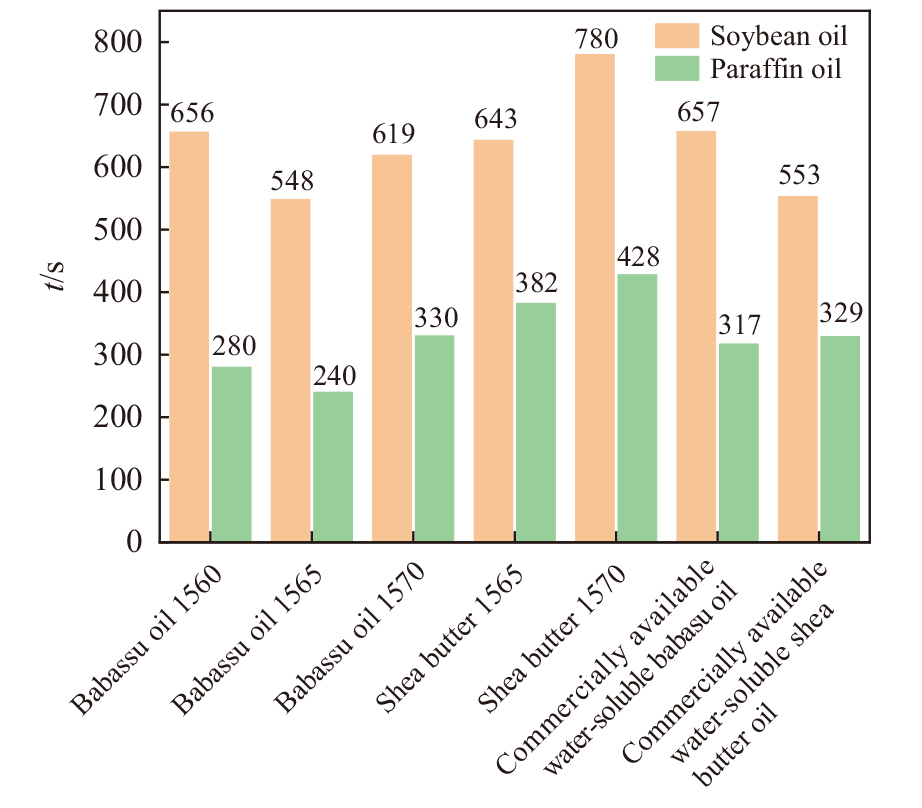
"
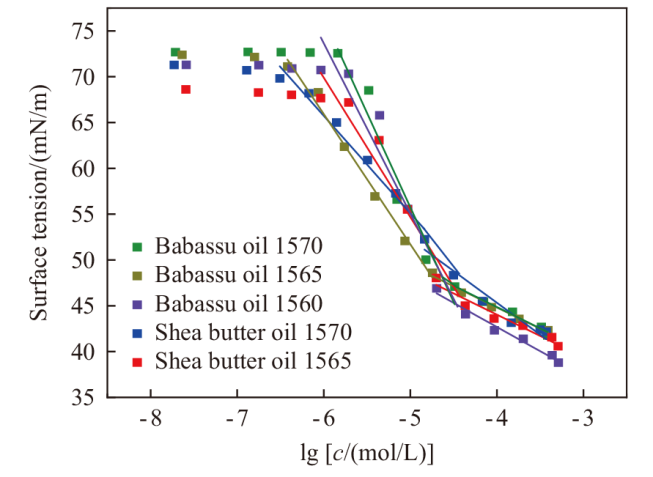
"
"
| Sample | cmc/ (mol/L) | γcmc / (mN/m) | Γmax / (μmol/m2) | Amin /nm2 | pc20 | ΔGθmic / (kJ/mol) | ΔGθads / (kJ/mol) |
|---|---|---|---|---|---|---|---|
| Babassu oil 1560 | 3.68×10⁻⁴ | 43.42 | 4.16 | 0.39 | 4.93 | -29.56 | -29.63 |
| Babassu oil 1565 | 3.18×10⁻⁵ | 46.20 | 2.57 | 0.65 | 5.11 | -35.63 | -35.74 |
| Babassu oil 1570 | 2.80×10⁻⁵ | 46.48 | 4.11 | 0.40 | 4.91 | -35.94 | -36.00 |
| Shea butter oil 1565 | 3.71×10⁻⁵ | 44.48 | 2.66 | 0.62 | 4.86 | -35.24 | -35.36 |
| Shea butter oil 1570 | 5.79×10⁻⁵ | 44.31 | 2.11 | 0.79 | 4.83 | -34.14 | -34.28 |
| Commercially available water-soluble babassu oil | 3.14×10⁻⁵ | 35.62 | 3.104 | 0.53 | 5.46 | -35.36 | -35.47 |
| Commercially available water-soluble shea butter oil | 1.03×10⁻⁵ | 38.49 | 4.905 | 0.34 | 5.47 | -36.83 | -36.96 |
"
| Sample | 1H | 4H | 7H | 24H | ||||
|---|---|---|---|---|---|---|---|---|
| Moisturizing rate/% | RSD/ % | Moisturizing rate/% | RSD/ % | Moisturizing rate/% | RSD/ % | Moisturizing rate/% | RSD/ % | |
| Babassu oil 1565 | 107.06 | 1.3 | 108.72 | 1.7 | 109.33 | 3.0 | 109.07 | 3.0 |
| Commercially available water-soluble babassu oil | 113.70 | 1.7 | 118.49 | 1.3 | 119.46 | 2.5 | 121.51 | 2.3 |
| Shea butter oil 1565 | 103.00 | 0.7 | 103.94 | 1.7 | 105.24 | 1.4 | 105.86 | 1.3 |
| Commercially available water-soluble shea butter oil | 110.21 | 0.8 | 115.59 | 3.2 | 117.38 | 3.1 | 115.52 | 2.9 |
| Babassu 1560 | 107.43 | 0.6 | 113.14 | 5.3 | 112.19 | 0.8 | 108.95 | 3.1 |
| Babassu 1570 | 113.06 | 3.4 | 127.39 | 1.4 | 148.08 | 0.7 | 128.54 | 1.1 |
| Shea butter 1570 | 115.67 | 1.7 | 117.38 | 1.3 | 118.33 | 2.5 | 111.51 | 2.2 |
"
| Sample | 1H | 4H | 7H | 24H | ||||
|---|---|---|---|---|---|---|---|---|
| Moisturizing rate/% | RSD/ % | Moisturizing rate/% | RSD/ % | Moisturizing rate/% | RSD/ % | Moisturizing rate/% | RSD/ % | |
| Babassu oil 1565 | 100.45 | 0.1 | 100.43 | 0.1 | 100.43 | 0.1 | 100.42 | 0.1 |
| Commercially available water-soluble babassu oil | 100.39 | 0.1 | 100.38 | 0.1 | 100.37 | 0.1 | 100.36 | 0.1 |
| Shea butter oil 1565 | 101.38 | 0.3 | 101.36 | 0.3 | 101.35 | 0.3 | 101.35 | 0.3 |
| Commercially available water-soluble shea butter oil | 99.61 | 0.4 | 99.59 | 0.4 | 99.57 | 0.4 | 99.55 | 0.4 |
| Babassu 1560 | 99.42 | 0.4 | 99.26 | 0.7 | 99.44 | 0.6 | 99.46 | 0.5 |
| Babassu 1570 | 100.10 | 0.6 | 100.43 | 1.8 | 100.29 | 0.7 | 99.58 | 0.4 |
| Shea butter 1570 | 100.48 | 1.5 | 100.23 | 0.9 | 100.16 | 1.8 | 98.47 | 1.7 |
"
| Sample | 1H | 4H | 7H | 24H | ||||
|---|---|---|---|---|---|---|---|---|
| Moisturizing rate/% | RSD/ % | Moisturizing rate/% | RSD/ % | Moisturizing rate/% | RSD/ % | Moisturizing rate/% | RSD/ % | |
| Babassu oil 1565 | 99.78 | 0.1 | 99.75 | 0.1 | 99.75 | 0.1 | 99.68 | 0.1 |
| Commercially available water-soluble babassu oil | 100.06 | 0.5 | 100.06 | 0.5 | 100.02 | 0.5 | 99.85 | 0.5 |
| Shea butter oil 1565 | 100.76 | 0.1 | 100.74 | 0.1 | 100.70 | 0.2 | 100.68 | 0.1 |
| Commercially available water-soluble shea butter oil | 99.48 | 0.5 | 99.48 | 0.5 | 99.53 | 0.5 | 99.53 | 0.5 |
| Babassu 1560 | 100.37 | 0.2 | 96.69 | 0.5 | 99.25 | 0.3 | 99.25 | 0.4 |
| Babassu 1570 | 104.10 | 0.3 | 105.63 | 0.4 | 101.54 | 0.2 | 100.51 | 0.3 |
| Shea butter 1570 | 106.60 | 0.1 | 108.63 | 0.1 | 108.46 | 0.2 | 104.55 | 0.1 |
"
"
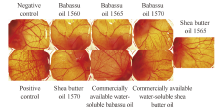
"

"
| Sample | ES | IS | Result evaluation |
|---|---|---|---|
| Babassu oil 1565 | ≤12 | 3.08 | Mild irritation |
| Commercially available water- soluble babassu oil | ≤12 | 6.99 | Moderate irritation |
| Shea butter oil 1565 | ≤12 | 2.99 | Mild irritation |
| Commercially available water- soluble shea butter oil | ≤12 | 6.11 | Moderate irritation |
| Babassu 1560 | ≤12 | 3.09 | Mild irritation |
| Babassu 1570 | ≤12 | 3.05 | Mild irritation |
| Shea butter 1570 | ≤12 | 2.93 | Mild irritation |
| [1] |
Algiert-Zielińska B, Mucha P, Rotsztejn H. Lactic and lactobionic acids as typically moisturizing compounds[J]. International Journal of Dermatology, 2019, 58 (3) : 374-379.
doi: 10.1111/ijd.14202 pmid: 30270529 |
| [2] | Meng Hong, Li Jiarui, Dong Yinmao, et al. Poly traditional Chinese medicine formulation prepared with skin moisturizing properties[J]. Dermatologic Therapy, 2020, 33 (6). DOI: 10.1111/dth.14105. |
| [3] |
Mehta P, Picken H, White C, et al. Engineering optimisation of commercial facemask formulations capable of improving skin moisturisation[J]. International Journal of Cosmetic Science, 2019, 41 (5) : 462-471.
doi: 10.1111/ics.12560 pmid: 31318061 |
| [4] |
Lourith N, Kanlayavattanakul M. Ceylon spinach: A promising crop for skin hydrating products[J]. Industrial Crops and Products, 2017, 105: 24-28.
doi: 10.1016/j.indcrop.2017.05.002 |
| [5] | Altunisik N, Tetik B K, Mete B. Evaluation of awareness regarding skin moisturisation and moisturiser usage frequency in individuals over 65 years of age[J]. Australasian Journal on Ageing, 2020, 39(4) : 247-252. |
| [6] |
Jeffrey R, Neha C, Peter L, et al. The skin barrier and moisturization: Function, disruption, and mechanisms of repair[J]. Skin Pharmacology and Physiology, 2023, 36 (4) : 174-185.
doi: 10.1159/000534136 pmid: 37717558 |
| [7] |
Geunchang C, Do-Hee L, Ikpyeong P, et al. Evaluation of moisturizing cream using terahertz time-domain spectroscopy[J]. Current Applied Physics, 2022, 39: 84-89.
doi: 10.1016/j.cap.2022.04.002 |
| [8] |
Paula M, Kelly H, Gianina P, et al. Assessment of the moisturizing properties of a magnetic mask containing iron oxide particles[J]. Journal of Cosmetic Dermatology, 2019, 18 (3) : 835-842.
doi: 10.1111/jocd.12717 pmid: 30043423 |
| [9] |
Nina M, Jyotsna D, Krunal D, et al. Revitalizing the skin: Exploring the role of barrier repair moisturizers[J]. Journal of Cosmetic Dermatology, 2024, 23 (5) : 1533-1540.
doi: 10.1111/jocd.16171 pmid: 38214440 |
| [10] |
Sachin G, Ramam M, Sharma V K, et al. Evaluation of a paraffin‐based moisturizer compared to a ceramide-based moisturizer in children with atopic dermatitis: A double-blind, randomized controlled trial[J]. Pediatric Dermatology, 2023, 40 (4) : 627-632.
doi: 10.1111/pde.15355 pmid: 37269189 |
| [11] | Mayrovitz H N, Deehan E, Ruppe M, et al. Skin tone parameters as possible factors in humectant moisturizing effectiveness[J]. Cureus, 2025. DOI:10.7759/cureus.86665. |
| [12] | Eva M, Rui R L, Tiago S H. In vivo skin hydrating efficacy of fish collagen from greenlandhalibut as a high-value active ingredient for cosmetic applications[J]. Marine Drugs, 2023, 21 (2) : 57. |
| [13] |
Jemec G B E, Christian W H. The plastic sing effect of moisturizers on human skin in vivo: a measure of moisturizing potency?[J]. Skin Research and Technology, 1998, 4 (2) : 88-93.
doi: 10.1111/j.1600-0846.1998.tb00092.x pmid: 27332105 |
| [14] | Zhang Tong, Guo Qiwei, Xin Yu, et al. Comprehensive review in moisture retention mechanism of polysaccharides from algae, plants, bacteria and fungus[J]. Arabian Journal of Chemistry, 2022, 15(10) : 104163. |
| [15] | Zhao Jian, Zhang Xiongxiong, Piao Hongwei, et al. Collagen peptide/poly(ethylene oxide) nanofiber facial mask with enhanced moisturizing and antioxidant performance[J]. ACS Applied PolumerMaterrials, 2025. DOI:10.1021/acsapm.5c02084. |
| [16] |
Wichuda S, Wongnapa N, Pensri C, et al. Evaluation of moisturizing and irritation potential of sachainchi oil[J]. Journal of Cosmetic Dermatology, 2020, 19 (4) : 915-924.
doi: 10.1111/jocd.13099 pmid: 31441999 |
| [17] |
Barreto S M A G, Maia M S, Benicá A M, et al. Evaluation of in vitro and in vivo safety of the by-product of Agave sisalana as a new cosmetic raw material: Development and clinical evaluation of a nanoemulsion to improve skin moisturizing[J]. Industrial Crops and Products, 2017, 108: 470-479.
doi: 10.1016/j.indcrop.2017.06.064 |
| [18] | Tao Yongduo. Properties and applications of natural oil ethoxylates[D]. Taiyuan: China Research Institute of Daily Chemical Industry, 2015. |
| [19] | Technical committee for standardization of surface active agents in chemical industry. Surface active agents-determination of emulsifying power-colorimetric method: GB/T 6369-2008[S]. China: Standards Press of China, 2008. |
| [20] | Chen H J, Lee P Y, Chen C Y, et al. Moisture retention of glycerin solutions with various concentrations: A comparative study[J]. Scientific Reports, 2022, 12 (1) : 10232. |
| [21] | Yang Fan, Guo Miao, Zhu Jinjin, et al. Clinical evaluation of a multi-component facial mask for moisturizing, repairing, and anti-aging effects[J]. Journal of Cosmetic Dermatology, 2025, 24 (8) : e70355. |
| [22] | Klotz T, Moran H, Vu P, et al. Commonly recommended moisturising products: Effect on transepidermal water loss and hydration in a scar model[J]. Burns, 2025, 51 (8) : 107629. |
| [23] |
Chen Yuyan, Chi Jing, Shen Tianshu, et al. A multi-granularity facial extreme makeup transfer and removal model with local-global collaboration[J]. Applied Intelligence, 2024, 54 (20) : 9741-9759.
doi: 10.1007/s10489-024-05692-8 |
| [24] | Tsukiyama J, Miyamoto Y, Kodama A, et al. Cosmetic cleansing oil absorption by soft contact lenses in dry and wet conditions[J]. Eye & Contact Lens: Science & Clinical Practice, 2017, 43 (5) : 318-323. |
| [25] |
Setsiripakdee A, Lourith N, Kanlayavattanakul M. In vitro and in vivo removal efficacies of a formulated pumpkin seed oil makeup remover[J]. Journal of Surfactants and Detergents, 2019, 22 (6) : 1461-1467.
doi: 10.1002/jsde.12315 |
| [26] |
Pakkang N, Uraki Y, Koda K, et al. Preparation of water-in-oil microemulsion from the mixtures of castor oil and sunflower oil as makeup remover[J]. Journal of Surfactants and Detergents, 2018, 21(6) : 809-816.
doi: 10.1002/jsde.2018.21.issue-6 |
| [27] |
Hosokawa K, Taima H, Kikuchi M, et al. Rubbing the skin when removing makeup cosmetics is a major factor that worsens skin conditions in atopic dermatitis patients[J]. Journal of Cosmetic Dermatology, 2021, 20 (6) : 1915-1922.
doi: 10.1111/jocd.13777 pmid: 33040474 |
| [28] | Pawlikowska P, Tayoun T, Oulhen M, et al. Exploitation of the chick embryo chorioallantoic membrane (CAM) as a platform for anti-metastatic drug testing[J]. Scientific Reports, 2020, 10 (1) : 16876. |
| [29] | Budpud K, Okeyoshi K, Kobayashi S, et al. Super-moisturizing materials from morphological deformation of suprapolysaccharides[J]. Macromolecular Rapid Communications, 2022, 43 (11) : 2200163. |
| [30] | Yu J Y, Jang A Y, Park J H. Comparative analysis of skin condition after using cleansing oil and cleansing water for removing facial makeup[J]. Medico-Legal Update, 2019, 19 (2) : 526. |
| [31] |
Lee H, Lee K, Kim M, et al. Synergistic moisturizing effect of a cellulose nanofibril/hyaluronic acid/poly-γ-glutamic acid blend system[J]. Cellulose, 2025, 32 (8) : 4781-4796.
doi: 10.1007/s10570-025-06535-6 |
| [32] |
Ning R, Feng C, Zhang F, et al. Synthesis and characterization of superhigh moisturizing carboxymethyl tamarind xyloglucan and its potential application in cosmetics[J]. Biomacromolecules, 2025, 26(3) : 1647-1658.
doi: 10.1021/acs.biomac.4c01453 pmid: 39909484 |
| [33] |
Voegeli R, Rawlings A V. Moisturizing at a molecular level-The basis of corneocare[J]. International Journal of Cosmetic Science, 2023, 45 (2) : 133-154.
doi: 10.1111/ics.v45.2 |
| [34] |
Nguyen K H, Pham L D, Nguyen T TT, et al. Moisturizing effectiveness of immediate compared with delayed moisturization[J]. Journal of Cosmetic Dermatology, 2022, 21 (10) : 5134-5140.
doi: 10.1111/jocd.v21.10 |
| [35] | Seok-Young K, Ji-Young U, Bo-Young C, et al. Moisturizer in patients with inflammatory skin diseases[J]. Medicina, 2022, 58 (7) : 888. |
| [36] | Draelos Z D, Nelson D B. In vitro and in vivo evaluation of an emollient‐rich moisturizer developed to address three critical elements of natural moisturization[J]. Journal of Cosmetic Dermatology, 2025, 24 (4) : e70085. |
| [37] |
McDaniel D H, Dover J S, Wortzman M, et al. In vitro and in vivo evaluation of a moisture treatment cream containing three critical elements of natural skin moisturization[J]. Journal of Cosmetic Dermatology, 2020, 19 (5) : 1121-1128.
doi: 10.1111/jocd.13359 pmid: 32141711 |
| [38] | Anusha R, Akhila N, Nikhitha J, et al. Formulation and evaluation of herbal hair serum-a review[J]. International Journal of Basic & Clinical Pharmacology, 2023, 12 (5) : 759-765. |
| [39] | Ren Hankun, Zha Peina, Liu Yueheng, et al. Study on moisturizing effect of dendrobium officinale, sparassis crispa, and their compound extracts[J]. Journal of Cosmetic Dermatology, 2025, 24 (4) : e70189. |
| [40] | Barnes T M, Mijaljica D, Townley J P, et al. Vehicles for drug delivery and cosmetic moisturizers: Review and comparison[J]. Pharmaceutics, 2021, 13 (12) : 2012. |
| [1] | 陈丽芬, 陈默, 张君芳, 赵亚, 张婷. 防脱发、乌发和抗头皮屑活性物功效评价方法的研究进展[J]. 日用化学工业(中英文), 2026, 56(9): 1233-1241. |
| [2] | 何志明, 黄加文, 詹易, 吴德松, 查雨锋. 三七不同提取物舒缓功效对比研究[J]. 日用化学工业(中英文), 2026, 56(8): 1053-1061. |
| [3] | 刘璐璐, 陈强, 冯玉军. 黏弹性表面活性剂(VIII)——超长链非离子表面活性剂[J]. 日用化学工业(中英文), 2026, 56(8): 977-983. |
| [4] | 万郁楠, 任真, 张一纯. 非离子表面活性剂在SiO2气凝胶分散过程中的改性机理与性能研究[J]. 日用化学工业(中英文), 2026, 56(4): 441-448. |
| [5] | 曾丛瑞,刘琦,常思思,赵华. 环境温湿度对化妆品感官评价与保湿功效的影响研究[J]. 日用化学工业(中英文), 2026, 56(3): 339-346. |
| [6] | 陈凤玲, 王亚茹, 叶蓉姿, 梁嘉恩, 谢嘉颖, 谭建华. 经表皮失水率测量影响因素剖析及标准化操作研究[J]. 日用化学工业(中英文), 2025, 55(6): 715-722. |
| [7] | 王莹莹, 马振超, 李哲, 孔艺博, 赵欣怡, 邢耀文, 桂夏辉. 基于两性/非离子表面活性剂的纳米乳液捕收剂强化低阶煤浮选机理[J]. 日用化学工业(中英文), 2025, 55(12): 1534-1543. |
| [8] | 董雷, 邹欢金, 刘雪锋. pH开关聚醚型非离子表面活性剂及其去除土壤中菲的潜在应用[J]. 日用化学工业(中英文), 2025, 55(11): 1388-1394. |
| [9] | 张太军,陈海琪,尹捷醇,康丽,李柔柔,邓茹钰. 覆盆子酮的祛痘功效及其作用机制研究[J]. 日用化学工业(中英文), 2025, 55(10): 1313-1322. |
| [10] | 尤孝鹏, 彭宁, 陈智仙. 酵母菌/锌发酵产物在头皮护理中的功效研究[J]. 日用化学工业(中英文), 2024, 54(9): 1099-1105. |
| [11] | 宋雨芯, 许琳琳, 佟瑶, 董坤, 何聪芬. 基于热糖化法体外生化抗糖化评价体系的优化与应用[J]. 日用化学工业(中英文), 2024, 54(5): 558-565. |
| [12] | 许梦然, 赵华. 化妆品晒后修护功效评价方法研究进展[J]. 日用化学工业(中英文), 2024, 54(3): 329-336. |
| [13] | 李慧怡, 周悦, 吴谦, 杜丽镝, 谢嘉颖, 谭建华. 化妆品防晒黑功效评价方法研究[J]. 日用化学工业(中英文), 2024, 54(2): 168-174. |
| [14] | 张嘉琪, 万可宁, Ranjit Kaur Bhogal, 浦铭铭, 顾佳音, 盘瑶. 基于毛囊生长周期机制评估防脱化妆品功效的研究进展[J]. 日用化学工业(中英文), 2024, 54(12): 1504-1514. |
| [15] | 梁馨支, 孙婷, 叶馨遥, 王宇凯, 白亮, 李洪光. 聚醚有机硅表面活性剂与经典阴离子表面活性剂复配体系[J]. 日用化学工业(中英文), 2024, 54(10): 1155-1165. |
|
