Welcome to China Surfactant Detergent & Cosmetics, Today is


China Surfactant Detergent & Cosmetics ›› 2026, Vol. 56 ›› Issue (5): 687-694.doi: 10.3969/j.issn.2097-2806.2026.05.016
• Analytical methods and testing • Previous Articles
Song Qin1,*( ),Songbin Li2
Received:2026-01-08
Revised:2026-05-08
Online:2026-05-22
Published:2026-06-22
Contact:
*E-mail: qinmugong@foxmail.com.
CLC Number:
Song Qin, Songbin Li. Determination of the contents of six ginsenosides in ginseng cosmetic preparations by high performance liquid chromatography[J].China Surfactant Detergent & Cosmetics, 2026, 56(5): 687-694.
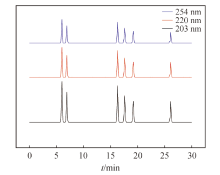
Fig.1
HPLC chromatograms at three wavelengths: 203, 220, and 254 nm"
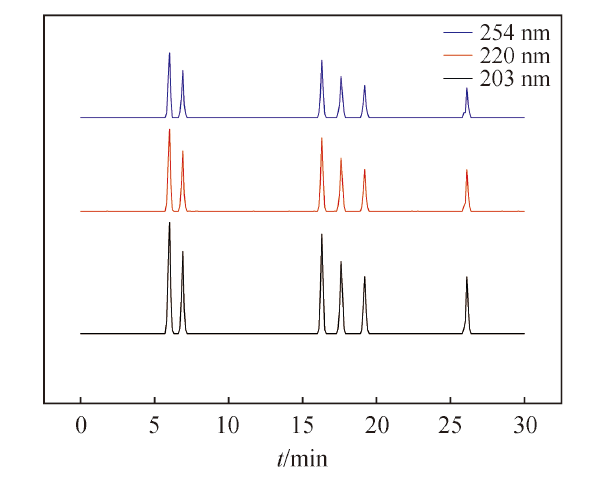
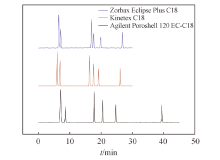
Fig.2
HPLC chromatograms of different chromatographic columns"
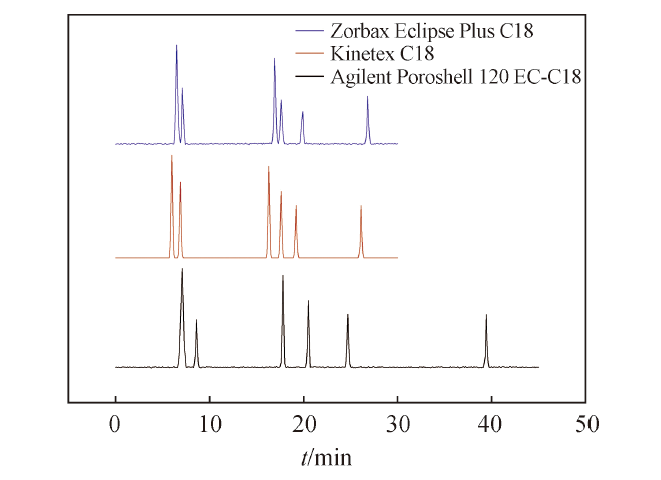
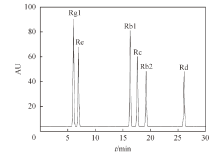
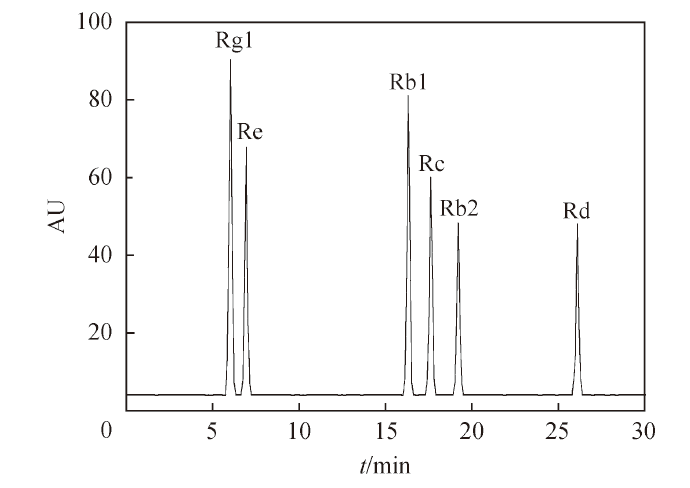
Fig.3
HPLC chromatograms of six ginsenosides"
Tab.1
Intra-day precision of six ginsenosides"
| ρ(μg/mL) | 重复 | ρ实测/(μg/mL) | |||||
|---|---|---|---|---|---|---|---|
| Rb1 | Rb2 | Rc | Rd | Re | Rg1 | ||
| 5 | 1 | 5.06 | 4.87 | 5.12 | 4.91 | 4.74 | 4.89 |
| 2 | 4.72 | 5.14 | 5.39 | 4.99 | 5.03 | 4.83 | |
| 3 | 4.89 | 4.99 | 4.96 | 5.24 | 5.05 | 4.67 | |
| 4 | 4.73 | 4.63 | 4.72 | 4.99 | 5.00 | 4.89 | |
| 5 | 5.18 | 4.89 | 4.91 | 5.03 | 4.83 | 5.00 | |
| 6 | 4.94 | 5.12 | 4.90 | 4.99 | 5.25 | 5.01 | |
| RSD/% | 3.69 | 3.82 | 4.60 | 2.24 | 3.60 | 2.56 | |
| 50 | 1 | 50.17 | 52.56 | 49.01 | 47.90 | 51.24 | 47.72 |
| 2 | 51.15 | 50.23 | 47.95 | 51.16 | 50.68 | 52.37 | |
| 3 | 50.93 | 49.91 | 51.26 | 50.63 | 50.06 | 48.89 | |
| 4 | 49.27 | 47.51 | 48.08 | 52.77 | 50.25 | 50.50 | |
| 5 | 50.61 | 50.48 | 47.65 | 50.36 | 48.65 | 49.75 | |
| 6 | 51.81 | 51.19 | 50.22 | 51.14 | 50.99 | 50.53 | |
| RSD/% | 1.72 | 3.31 | 2.94 | 3.14 | 1.84 | 3.18 | |
| 100 | 1 | 94.82 | 100.40 | 102.39 | 101.66 | 95.73 | 93.34 |
| 2 | 99.95 | 102.39 | 102.41 | 102.05 | 104.80 | 103.99 | |
| 3 | 97.83 | 96.92 | 100.15 | 98.78 | 104.58 | 99.29 | |
| 4 | 95.51 | 99.62 | 94.40 | 102.74 | 99.43 | 95.95 | |
| 5 | 96.17 | 100.28 | 100.85 | 100.66 | 99.41 | 102.83 | |
| 6 | 104.09 | 94.63 | 99.89 | 110.24 | 104.71 | 104.80 | |
| RSD/% | 3.55 | 2.82 | 2.95 | 3.84 | 3.76 | 4.65 | |
Tab.2
Inter-day precision of six ginsenosides"
| ρ(μg/mL) | 重复 | ρ实测/(μg/mL) | |||||
|---|---|---|---|---|---|---|---|
| Rb1 | Rb2 | Rc | Rd | Re | Rg1 | ||
| 5 | D1-1 | 4.92 | 5.15 | 4.88 | 4.97 | 4.92 | 4.87 |
| D1-2 | 5.09 | 5.02 | 4.91 | 5.02 | 5.08 | 5.35 | |
| D2-1 | 5.14 | 4.78 | 4.95 | 5.26 | 4.83 | 5.12 | |
| D2-2 | 5.12 | 4.98 | 4.91 | 4.76 | 4.90 | 5.13 | |
| D3-1 | 5.15 | 5.18 | 5.22 | 4.99 | 5.08 | 5.01 | |
| D3-2 | 4.90 | 5.00 | 5.27 | 5.11 | 5.20 | 5.15 | |
| RSD/% | 2.24 | 2.85 | 3.46 | 3.29 | 2.80 | 3.12 | |
| 50 | D1-1 | 52.09 | 49.71 | 49.79 | 50.78 | 48.74 | 52.05 |
| D1-2 | 49.05 | 47.43 | 51.74 | 47.02 | 47.88 | 51.44 | |
| D2-1 | 53.34 | 51.62 | 48.12 | 48.30 | 49.95 | 48.67 | |
| D2-2 | 48.85 | 50.14 | 49.13 | 46.79 | 49.54 | 49.59 | |
| D3-1 | 51.25 | 50.42 | 48.66 | 49.38 | 47.08 | 49.48 | |
| D3-2 | 50.10 | 49.26 | 47.82 | 50.46 | 51.81 | 52.15 | |
| RSD/% | 3.49 | 2.80 | 2.90 | 3.49 | 3.40 | 2.96 | |
| 100 | D1-1 | 100.21 | 103.18 | 101.26 | 103.74 | 97.29 | 96.86 |
| D1-2 | 99.03 | 95.31 | 102.09 | 103.86 | 92.33 | 101.65 | |
| D2-1 | 97.96 | 93.91 | 100.38 | 104.85 | 97.63 | 100.39 | |
| D2-2 | 99.11 | 103.92 | 99.49 | 97.06 | 101.78 | 97.05 | |
| D3-1 | 104.54 | 104.59 | 105.09 | 102.65 | 93.35 | 97.75 | |
| D3-2 | 98.70 | 99.60 | 93.57 | 105.43 | 99.84 | 94.53 | |
| RSD/% | 2.38 | 4.59 | 3.81 | 2.95 | 3.76 | 2.63 | |
Tab.3
Linear regression analysis of six ginsenosides"
| 人参皂苷 | 线性范围/(μg/mL) | 回归方程 | r | LOD/(μg/mL) | LOQ/(μg/mL) |
|---|---|---|---|---|---|
| Rb1 | 1~500 | y=42 105x+1 285 | 0.999 6 | 0.16 | 0.48 |
| Rb2 | 1~500 | y=38 895x+1 042 | 0.999 5 | 0.19 | 0.58 |
| Rc | 1~500 | y=36 720x+905 | 0.999 4 | 0.23 | 0.70 |
| Rd | 1~500 | y=34 850x+1 218 | 0.999 7 | 0.18 | 0.55 |
| Re | 1~500 | y=40 215x+1 338 | 0.999 8 | 0.13 | 0.39 |
| Rg1 | 1~500 | y=48 655x+1 552 | 0.999 8 | 0.11 | 0.33 |
Tab.4
Analysis of spiked recovery of six ginsenosides"
| 人参皂苷 | ρ加标/ (μg/mL) | ρ实测/ (μg/mL) | 平均回收率/% | RSD/% |
|---|---|---|---|---|
| Rb1 | 10 | 9.63,9.50,10.00,9.91,10.16,9.92 | 98.53 | 2.48 |
| 50 | 46.81,50.30,49.19,47.62,48.02,53.32 | 98.42 | 4.79 | |
| 100 | 100.64,104.65,101.72,105.95,103.03,100.96 | 102.83 | 2.07 | |
| Rb2 | 10 | 10.33,10.00,9.97,10.01,10.01,9.67 | 99.98 | 2.09 |
| 50 | 47.23,47.76,48.75,48.45,48.75,51.69 | 97.54 | 3.18 | |
| 100 | 107.29,105.85,101.91,104.60,104.20,104.02 | 104.65 | 1.74 | |
| Rc | 10 | 9.98,9.81,9.78,9.72,10.05,9.98 | 98.87 | 1.35 |
| 50 | 45.70,48.37,48.60,51.98,47.68,49.90 | 97.41 | 4.34 | |
| 100 | 101.96,100.19,94.01,99.08,96.23,102.02 | 98.92 | 3.26 | |
| Rd | 10 | 10.00,10.16,9.55,9.70,10.00,9.52 | 98.22 | 2.72 |
| 50 | 49.89,46.51,52.67,52.25,51.71,51.62 | 101.55 | 4.52 | |
| 100 | 103.08,103.16,99.96,96.07,102.47,97.11 | 100.31 | 3.11 | |
| Re | 10 | 10.03,9.73,10.09,9.58, 9.70,10.17 | 98.83 | 2.46 |
| 50 | 50.81,49.90,50.88,47.25,50.09,49.47 | 99.47 | 2.68 | |
| 100 | 101.04,95.65,100.58,94.52,100.31,100.85 | 98.83 | 2.96 | |
| Rg1 | 10 | 10.14,10.24,10.49,10.57,10.78,10.09 | 103.85 | 2.62 |
| 50 | 48.82,46.70,46.08,47.75,50.82,47.03 | 95.73 | 3.61 | |
| 100 | 99.34,98.95,100.61,104.92,96.39,103.61 | 100.64 | 3.13 |
Tab.5
Detection of six ginsenosides in 10 ginseng cosmetics"
| 样品编号 | 产品类型 | Rb1含量/ (μg/g) | Rb2含量/ (μg/g) | Rc含量/ (μg/g) | Rd含量/ (μg/g) | Re含量/ (μg/g) | Rg1含量/ (μg/g) | 总皂苷含量/ (μg/g) |
|---|---|---|---|---|---|---|---|---|
| S1 | 精华液 | 152.3±4.2 | 48.6±1.8 | 32.1±0.9 | 25.7±0.7 | 86.5±2.1 | 73.2±1.5 | 418.4±11.2 |
| S2 | 乳液 | 98.7±3.1 | 29.4±1.2 | 21.5±0.6 | 18.3±0.5 | 64.8±1.7 | 52.1±1.2 | 284.8±8.3 |
| S3 | 膏霜 | 210.5±5.8 | 67.3±2.1 | 45.2±1.2 | 37.6±1.0 | 102.4±2.5 | 89.7±2.0 | 552.7±14.7 |
| S4 | 乳液 | 75.6±2.4 | 22.1±0.9 | 15.8±0.4 | 12.9±0.3 | 46.3±1.1 | 39.4±0.9 | 212.1±6.0 |
| S5 | 膏霜 | 185.2±4.9 | 58.9±1.7 | 39.7±1.0 | 33.1±0.8 | 94.7±2.3 | 82.5±1.8 | 494.1±12.5 |
| S6 | 乳液 | 124.8±3.5 | 40.2±1.3 | 27.3±0.7 | 22.4±0.6 | 72.6±1.8 | 61.3±1.4 | 347.6±9.3 |
| S7 | 精华液 | 63.4±1.9 | 18.7±0.7 | 13.2±0.3 | 10.8±0.3 | 38.5±1.0 | 33.1±0.8 | 178.7±5.0 |
| S8 | 精华液 | 142.6±3.8 | 45.8±1.4 | 30.9±0.8 | 25.3±0.7 | 81.2±2.0 | 68.9±1.6 | 394.7±10.3 |
| S9 | 膏霜 | 176.3±4.6 | 56.4±1.6 | 38.1±1.0 | 31.7±0.8 | 90.1±2.2 | 78.4±1.7 | 471.0±11.9 |
| S10 | 乳液 | 95.1±2.8 | 30.2±1.0 | 20.4±0.5 | 16.9±0.4 | 58.3±1.4 | 49.7±1.1 | 270.6±7.2 |
| [1] | 郭佳龙, 刘畅, 王瑶, 等. 稀有人参皂苷的应用基础与开发利用研究进展[J]. 中国中药杂志, 2024, 49 (2) : 304-314. |
| [2] | Lee I S, Kang K S, Kim S Y. Panax ginseng pharmacopuncture: Current status of the research and future challenges[J]. Biomolecules, 2019, 10 (1) : 33. |
| [3] |
Mancuso C, Santangelo R. Panax ginseng and Panax quinquefolius: From pharmacology to toxicology[J]. Food Chem Toxicol, 2017, 107(Pt A) : 362-372.
doi: S0278-6915(17)30391-5 pmid: 28698154 |
| [4] | 董喆, 王玉梅, 孙姗姗, 等. 高效液相色谱-串联四极杆质谱法测定人参组培不定根中11种皂苷成分[J]. 化学分析计量, 2024, 33(10) : 55-62. |
| [5] | 陈静静, 白雪媛, 边帅, 等. 基于酿酒酵母体系的人参皂苷抗衰老活性筛选及评价[J]. 食品工业科技, 2022, 43 (1) : 1-9. |
| [6] | 刘梦娜, 李征永, 邵亚兰, 等. 人参皂苷抗皮肤光老化作用的新进展[J]. 南昌大学学报(医学版), 2018, 58 (1) : 91-95. |
| [7] | 郭冲, 郜玉钢, 臧埔, 等. HPLC法同时测定人参及其制剂中16种人参皂苷[J]. 中草药, 2014, 45 (14) : 2009-2013. |
| [8] | 宋志花, 李盛红, 杨刚强, 等. 人参皂苷类化合物样品前处理及分析检测[J]. 化学进展, 2020 (z1) : 239-248. |
| [9] | 曾伟杰, 梁淑明, 高凯雯. HPLC法快速测定人参提取物中7种人参皂苷含量[M]. 2012第五届中国北京国际食品安全高峰论坛论文集. 北京. 2012: 6-9. |
| [10] | 张春辉, 邱学伟, 单秀明, 等. HPLC-ELSD法同时测定跌打片中8种成分[J]. 中成药, 2016, 38 (4) : 801-806. |
| [11] | 刘丹, 濮社班, 朱玲英, 等. RP-HPLC法同时测定不同产地红参中6种人参皂苷的含量[J]. 药学进展, 2011, 35 (6) : 278-281. |
| [12] | 刘志, 阮长春, 刘天志, 等. HPLC法同时测定林下参、鲜人参、生晒参和红参中14种人参皂苷[J]. 中草药, 2012 (12) : 2431-2434. |
| [1] | Manru Ning, Yihuai Liang, Feifei Wang. Cosmetovigilance: regulatory trends and corporate practices across countries [J]. China Surfactant Detergent & Cosmetics, 2026, 56(5): 674-680. |
| [2] | Jie Yu, Aihua Zou, Na Li. Applications and challenges of synchrotron small-angle scattering in nanostructure characterization of cosmetics [J]. China Surfactant Detergent & Cosmetics, 2026, 56(4): 407-424. |
| [3] | Congrui Zeng,Qi Liu,Sisi Chang,Hua Zhao. Research on the impact of environmental temperature and humidity on sensory evaluation and moisturizing efficacy of cosmetics [J]. China Surfactant Detergent & Cosmetics, 2026, 56(3): 339-346. |
| [4] | Wanping Yu,Li Li,Haiyan Wang,Jianbo Sun. Current status of analytical detection of Per- and polyfluoroalkyl substances in cosmetics and research progress on the application of molecular network [J]. China Surfactant Detergent & Cosmetics, 2026, 56(3): 368-375. |
| [5] | Yanfang Zhou,Weihong Huo,Haixin Yang,Xuejing Chen. Simultaneous determination of 5 kinds of sweeteners in oral care toothpaste by HPLC [J]. China Surfactant Detergent & Cosmetics, 2026, 56(3): 400-406. |
| [6] | Ruotong Yang, Fangyuan Wu, Guangqian Xu, Guiwen Guo, Haiyan Wang, Lingyun Jia. Screening and determination of 23 local anesthetics in cosmetics using UPLC-Q-TOF-MS and HPLC-QQQ-MS/MS [J]. China Surfactant Detergent & Cosmetics, 2026, 56(2): 260-270. |
| [7] | Lingli Wang, Tingting Li, Ting Ren, Zhengrui Niu, Zhenxi Yu. Current status and reflection on change management for special cosmetics in China [J]. China Surfactant Detergent & Cosmetics, 2026, 56(1): 114-121. |
| [8] | Bingbing Xie, Linli Liu, Limin Fan. Simultaneous determination of 5 new preservatives in oral care toothpaste by high performance liquid chromatography [J]. China Surfactant Detergent & Cosmetics, 2026, 56(1): 122-128. |
| [9] | Huixiang Liu, Feiyan Diao, Xiaoyun Wu, Junjie Li, Chunlin Liu, Qiyan Li. Determination of 12 whitening ingredients in cosmetics using UPLC-MS/MS [J]. China Surfactant Detergent & Cosmetics, 2026, 56(1): 129-136. |
| [10] | Jiayao Dai, Huai Tao, Zuowei Xiao, Yimiao Zhou. Determination of 8 heavy metals in cosmetics by inductively coupled plasma emission spectrometry [J]. China Surfactant Detergent & Cosmetics, 2025, 55(9): 1215-1220. |
| [11] | Zhaohui Yang, Xiang Qiu, Yuqi Li, Huanhuan Zhao, Erming Wu, Zhiwei Cheng. Advancements in the integration and utilization of plant cell engineering technology in cosmetic ingredient development [J]. China Surfactant Detergent & Cosmetics, 2025, 55(8): 1049-1057. |
| [12] | Lu Wang, Dan Ran, Hui Wang, Shaotong He, Lulu Pi, Nan Deng. Detection of pyoluteorin and pyocyanin in cosmetics using UPLC-MS/MS method [J]. China Surfactant Detergent & Cosmetics, 2025, 55(8): 1066-1071. |
| [13] | Deng Hong, Jiang Zhou, Yuan Yan, Fanzhen Shang, Ting Liu, Liangli Wang, Wen Xie. Simultaneous determination of 5 prohibited phenols in cosmetics by high performance liquid chromatography [J]. China Surfactant Detergent & Cosmetics, 2025, 55(8): 1072-1077. |
| [14] | Cen Chen, Xiaomin Dai, Linqi Yan, Qiaoyuan Cheng. Comparison of high performance liquid chromatography and ion chromatography for the determination of acetic acid and trifluoroacetic acid in cosmetic raw material acetyl hexapeptide-8 [J]. China Surfactant Detergent & Cosmetics, 2025, 55(8): 1078-1084. |
| [15] | Ruina Liu, Biao Jiang, Yafang Lin, Lizhe Yang, Lei Zhai, Kun Li, Su Yao. Suitability study of amplified ATP bioluminescence assay for microbial detection of cosmetics based on two cultivation systems [J]. China Surfactant Detergent & Cosmetics, 2025, 55(7): 909-919. |
|
