欢迎访问《日用化学工业(中英文)》,今天是

日用化学工业(中英文) ›› 2026, Vol. 56 ›› Issue (9): 1242-1250.doi: 10.3969/j.issn.2097-2806.2026.09.013
李宇奇1,杜普洋1,郭雨佳1,赵欢欢1,马道品2,成志伟1,*( )
收稿日期:2025-11-11
修回日期:2026-08-14
出版日期:2026-09-22
发布日期:2026-09-30
Yuqi Li1,Puyang Du1,Yujia Guo1,Huanhuan Zhao1,Daopin Ma2,Zhiwei Cheng1,*()
Received:2025-11-11
Revised:2026-08-14
Online:2026-09-22
Published:2026-09-30
Contact:
*E-mail: 摘要:
植物外泌体样纳米囊泡(PDENs)是一类直径介于30~200 nm的纳米级脂质双层囊泡,其内部富含蛋白质、核酸、代谢物及脂质等活性物质,近年来在医学、药学及皮肤健康等领域的应用广受关注。本文围绕4个核心方面展开综述:PDENs与动物外泌体在组分构成及其生物学形成机制上的异同;PDENs在护肤领域的具体功效及作用机理;国内外关于PDENs原料的监管政策对比;以及PDENs在化妆品产品中的实际应用现状。最后,分析并探讨PDENs在实际应用中面临的关键问题,以期为其后续的产业化应用提供理论支撑与解决方案。
中图分类号:
李宇奇, 杜普洋, 郭雨佳, 赵欢欢, 马道品, 成志伟. 植物外泌体样纳米囊泡护肤功效作用机制和应用现状[J]. 日用化学工业(中英文), 2026, 56(9): 1242-1250.
Yuqi Li, Puyang Du, Yujia Guo, Huanhuan Zhao, Daopin Ma, Zhiwei Cheng. Plant-derived exosome-like nanovesicles in skincare: Mechanisms and applications[J]. China Surfactant Detergent & Cosmetics, 2026, 56(9): 1242-1250.
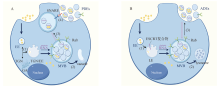
图1
PDENs(A)和ADEs(B)的生物发生途径"
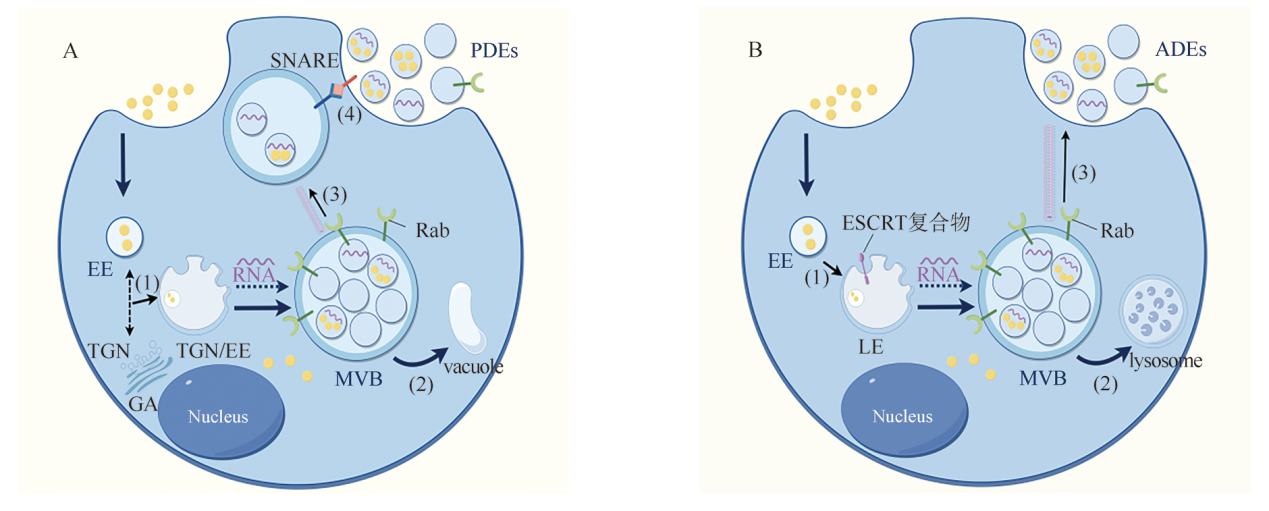
表1
ADEs与PDENs组分比较"
| 组分类别 | PDENs | ADEs | 参考文献 |
|---|---|---|---|
| 脂质 | 仅含植物固醇,无胆固醇;含植物特有的半乳糖脂。磷脂酸(PA)占比高,鞘磷脂含量极低 | 胆固醇为核心固醇,鞘磷脂含量高,PA占比少。磷脂酰胆碱、鞘磷脂为主要磷脂 | [ |
| 蛋白质 | 含植物特有序列蛋白(如水通道蛋白PIP2、突触融合蛋白(PEN1);细胞壁修饰酶、病程相关蛋白(PR-1、几丁质酶) | 四跨膜蛋白(CD9、CD63、CD81)、ESCRT复合物蛋白(TSG101、Alix)、热休克蛋白(HSP70、HSP90) | [ |
| 核酸 | 携带sRNA,可调控植物抗逆、代谢 | 涵盖DNA、mRNA、miRNA、lncRNA、tRNA,多调控细胞增殖、凋亡 | [ |
| 特异性组分 | 植物次生代谢物,类黄酮、姜黄素、叶绿素等 | 依赖细胞来源,如阿尔茨海默病患者外泌体中Aβ42蛋白、免疫细胞中免疫球蛋白等 | [ |
图2
PDENs发挥皮肤护肤作用分子机制图"
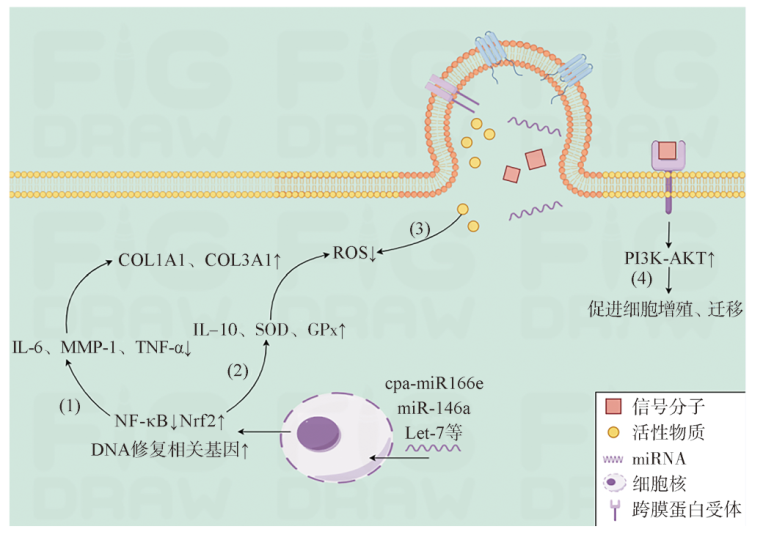
表2
PDENs国外护肤产品应用"
| 国家/地区 | 产品名称 (所含PDENs) | PDENs来源及护肤功效 |
|---|---|---|
| 美国 | 111SKIN Exosome Firming Concentrate (人参根愈伤组织PDENs) | 激活成纤维细胞、促进I型胶原蛋白合成,8周提升皮肤弹性31.4%、减少皱纹23.6% |
| 韩国 | Cosrx (积雪草PDENs) | 修复痘肌微损伤,7天缓解泛红,14天改善痘印色素沉着 |
| 日本 | EXSEED iGS (葡萄籽芽PDENs) | 抵御光老化,8周减少UV导致的色素沉着42%,提升皮肤弹性29% |
表3
PDENs国内护肤产品应用"
| 品牌或产品名 | 宣称所含PDENs | 护肤功效宣传 |
|---|---|---|
| 毕生之研厚脸皮冻干次抛 | 油橄榄叶PDENs | 7天厚屏障,21天自扛老强调“细胞级修护”“真皮层渗透” |
| 无敏氏植物干细胞修护系列 | 虎杖和枳雀PDENs | 敏感肌修护与屏障强化 |
| 黑松露及PDENs护肤组合 | 包含小球藻外泌体 | 抵御光老化,8周减少UV导致的色素沉着42%,提升皮肤弹性29% |
| 艾娑姟雅美肌赋颜微囊莹润水 | 荷叶、积雪草PDENs | 深层补水与长效锁水、舒缓修护敏感肌、改善肤质与抗衰老 |
表4
常用外泌体提取方法比较"
| 方法 | 优点 | 缺点 | 参考文献 |
|---|---|---|---|
| 超速离心法 | 操作简单、外泌体产率较高 | 超高速离心机设备成本高,高速离心易对外泌体造成损伤 | [ |
| 密度梯度离心 | 操作简单、外泌体纯度高 | 常与超速离心联用,耗时长,规模小,回收率低 | [ |
| 超滤离心法 | 仪器成本较低,获得的外泌体纯度较高 | 超滤管等耗材成本高,可能损伤外泌体,不能保持其形态 | [ |
| 免疫亲和法 | 能特异性分离外泌体的选择性亚型 | 抗体磁珠或亲和柱耗材使用成本高,且易使外泌体失活 | [ |
| 聚合物沉淀法 | 聚合物价格较低,操作简单、无需专门设备,目前已有商业化试剂盒 | 杂蛋白会与外泌体共沉淀,导致外泌体纯度降低 | [ |
| 尺寸排阻色谱法 | 能保证较高的外泌体纯度、完整性和生物活性 | 外泌体浓度较低,需浓缩后应用,且色谱系统仪器成本高 | [ |
| 微流控技术 | 分离时间短、成本低、灵敏度高 | 微流控设备及专用芯片昂贵,不适合大规模生产 | [ |
| 双水相分离法 | 操作简单,适用于大量材料,仪器需求低 | 聚合物难以去除 | [ |
| [1] |
Pegtel D M, Gould S J. Exosomes[J]. Annual Review of Biochemistry, 2019, 88: 487-514.
doi: 10.1146/biochem.2019.88.issue-1 |
| [2] | Shin K O, Ha D H, Kim J O, et al. Exosomes from human adipose tissue-derived mesenchymal stem cells promote epidermal barrier repair by inducing de novo synthesis of ceramides in atopic dermatitis[J]. Cells, 2020, 9 (3) : 680. |
| [3] | Wu X, Shen J, Zhong Y, et al. Large-Scale isolation of milk exosomes for skincare[J]. Pharmaceutics, 2024, 16 (7) : 930. |
| [4] |
Zi Y, Li J, Qian X, et al. Human umbilical cord mesenchymal stem cell exosomes promote elastin production and acute skin wound healing via TGFbeta1-Smad pathway[J]. Molecular and Cellular Biochemistry, 2025, 480: 4499-4511.
doi: 10.1007/s11010-025-05264-5 |
| [5] |
Fujita M, Hatta T, Ikka T, et al. The urgent need for clear and concise regulations on exosome-based interventions[J]. Stem Cell Reports, 2024, 19 (11) : 1517-1519.
doi: 10.1016/j.stemcr.2024.09.008 pmid: 39454583 |
| [6] | Tiwari A, Soni N, Dongre S, et al. The role of plant-derived extracellular vesicles in ameliorating chronic diseases[J]. Molecular Biology Reports, 2025, 52 (1) : 360. |
| [7] | Sergazy S, Adekenov S, Khabarov I, et al. Harnessing mammalian and plant-derived exosomes for drug delivery: A comparative review[J]. International Journal of Molecular Sciences, 2025, 26 (10) : 4857. |
| [8] |
Arya S B, Collie S P, Parent C A. The ins-and-outs of exosome biogenesis, secretion, and internalization[J]. Trends Cell Biol., 2024, 34 (2) : 90-108.
doi: 10.1016/j.tcb.2023.06.006 |
| [9] |
Mu N, Li J, Zeng L, et al. Plant-Derived exosome-like nanovesicles: Current progress and prospects[J]. International Journal of Nanomedicine, 2023, 18: 4987-5009.
doi: 10.2147/IJN.S420748 pmid: 37693885 |
| [10] |
Farley J T, Eldahshoury M K, De Marcos L C. Unconventionalsecretion of plant extracellular vesicles and their benefits to human health: A mini review[J]. Frontiers in Cell and Developmental Biology, 2022, 10: 883841.
doi: 10.3389/fcell.2022.883841 |
| [11] |
Nielsen M E, Feechan A, Böhlenius H, et al. Arabidopsis ARF-GTP exchange factor, GNOM, mediates transport required for innate immunity and focal accumulation of syntaxin PEN1[J]. Proceedings of the National Academy of Sciences, 2012, 109 (28) : 11443-11448.
doi: 10.1073/pnas.1117596109 |
| [12] | Hasezaki T, Yoshima T, Mine Y. Anti-CD81 antibodies reduce migration of activated T lymphocytes and attenuate mouse experimental colitis[J]. Scientific Reports, 2020, 10 (1) : 6969. |
| [13] | Bodin S, Elhabashy H, Macdonald E, et al. Flotillins in membrane trafficking and physiopathology[J]. Biology of the Cell, 2025, 117 (1) : e2400134. |
| [14] |
Stafa K, Rella A, Eagle W, et al. miR-146a is a critical target associated with multiple biological pathways of skin aging[J]. Front Physiol, 2024, 15: 1291344.
doi: 10.3389/fphys.2024.1291344 |
| [15] |
Pfeffer S R. Rab GTPases: Master regulators that establish the secretory and endocytic pathways[J]. Molecular Biology of the Cell, 2017, 28 (6) : 712-715.
doi: 10.1091/mbc.E16-10-0737 pmid: 28292916 |
| [16] | Zhang J, Qiu Y, Xu K. Characterization of GFP-AtPEN1 as a marker protein for extracellular vesicles isolated from Nicotiana benthamiana leaves[J]. Plant Signaling & Behavior, 2020, 15 (9) : 1791519. |
| [17] | Subha D, Anukiruthika R, Sreeraj H, et al. Plant exosomes: Nano conveyors of pathogen resistance[J]. Discov. Nano., 2023, 18 (1) : 146. |
| [18] |
Li R, Wang L, Li Y, et al. Knockout of SlNPR1 enhances tomato plants resistance against Botrytis cinerea by modulating ROS homeostasis and JA/ET signaling pathways[J]. Physiol Plant, 2020, 170 (4) : 569-579.
doi: 10.1111/ppl.v170.4 |
| [19] |
Han Z, Schneiter R. Dual functionality of pathogenesis-related proteins: Defensive role in plants versus immunosuppressive role in pathogens[J]. Front Plant Sci., 2024, 15: 1368467.
doi: 10.3389/fpls.2024.1368467 |
| [20] |
Li Z, Jin W, Zhu M, et al. Plant-derived extracellular vesicles: Emerging carriers for ingestible nucleotide delivery[J]. Expert Opinion on Drug Delivery, 2025, 23 (1) : 127-144.
doi: 10.1080/17425247.2025.2591237 |
| [21] | Woith E, Fuhrmann G, Melzig M F. Extracellular vesicles-connecting kingdoms[J]. International Journal of Molecular Sciences, 2019, 20 (22) : 5695. |
| [22] |
Wlashek M, Maity P, Makrantonaki E, et al. Connective tissue and fibroblast senescence in skin aging[J]. Journal of Investigative Dermatology, 2021, 141 (4S) : 985-992.
doi: 10.1016/j.jid.2020.11.010 pmid: 33563466 |
| [23] | Li S, Liu F, Zhang S, et al. Lavender exosome-like nanoparticles attenuate uvb-induced photoaging via mir166-mediated inflammation and collagen regulation[J]. Scientific Reports, 2025, 15 (1) : 21286. |
| [24] | Trentini M, Zanotti F, Tiengo E, et al. An apple a day keeps the doctor away: Potential role of miRNA 146 on macrophages treated with exosomes derived from apples[J]. Biomedicines, 2022, 10 (2) : 415. |
| [25] |
Zhang Y, Zhao B, Wang J, et al. Therapeutic potential of lycium barbarum-derived exosome-like nanovesicles in combating photodamage and enhancing skin barrier repair[J]. Extracell Vesicle, 2025, 5: 100072.
doi: 10.1016/j.vesic.2025.100072 |
| [26] |
Choi W, Cho J H, Park S H, et al. Ginseng root-derived exosome-like nanoparticles protect skin from UV irradiation and oxidative stress by suppressing activator protein-1 signaling and limiting the generation of reactive oxygen species[J]. Journal of Ginseng Research, 2024, 48 (2) : 211-219.
doi: 10.1016/j.jgr.2024.01.001 pmid: 38465216 |
| [27] |
Rajkumar J, Chandan N, Lio P, et al. The skin barrier and moisturization: Function, disruption, and mechanisms of repair[J]. Skin Pharmacol. Physiol., 2023, 36 (4) : 174-85.
doi: 10.1159/000534136 |
| [28] |
Mahdipour E. Beta vulgaris juice contains biologically active exosome-like nanoparticles[J]. Tissue Cell, 2022, 76: 101800.
doi: 10.1016/j.tice.2022.101800 |
| [29] | Kim H, Shin H Y, Park M, et al. Exosome-Like vesicles from lithospermum erythrorhizon callus enhanced wound healing by reducing lps-induced inflammation[J]. Journal of Microbiology and Biotechnology, 2024, 35: e2410022. |
| [30] | Majewska L, Kondraciuk A, Dorosz K, et al. Application of standardized rosa damascena stem cell-derived exosomes in dermatological wound healing and scar management: A retrospective case-series study with long-term outcome assessmen[J]. Pharmaceutics, 2025, 17 (7) : 910. |
| [31] |
Natania F, Iriawati I, Ayuningtyas F D, et al. Potential of plant-derived exosome-like nanoparticles from physalis peruviana fruit for human dermal fibroblast regeneration and remodeling[J]. Pharm. Nanotechnol., 2025, 13 (2) : 358-371.
doi: 10.2174/0122117385281838240105110106 |
| [32] | Yang C Y, Guo Y, Wu W J, et al. UVB-Induced secretion of IL-1β promotes melanogenesis by upregulating TYR/TRP-1 expression in vitro[J]. Biomedical Research Internationalt, 2022: 8230646. |
| [33] |
Ma L P, Liu M M, Liu F, et al. Melatonin inhibits senescence-associated melanin pigmentation through the p53-TYR pathway in human primary melanocytes and the skin of C57BL/6 J mice after UVB irradiation[J]. Journal of Molecular Medicine, 2023, 101 (5) : 581-593.
doi: 10.1007/s00109-023-02301-y |
| [34] | Lee R, Ko H J, Kim K, et al. Anti-melanogenic effects of extracellular vesicles derived from plant leaves and stems in mouse melanoma cells and human healthy skin[J]. Journal of Extracellular Vesicles, 2020, 9 (1) : 1703480. |
| [35] |
Kusnandar M R, Wibowo I, Barlian A. Characterizing nanoparticle isolated by Yam Bean (Pachyrhizus erosus) as a potential agent for nanocosmetics: An in vitro and in vivo approaches[J]. Pharmaceutical Nanotechnology, 2025, 13 (2) : 341-357.
doi: 10.2174/0122117385279809231221050226 |
| [36] |
Jang B, Chung H, Jung H, et al. Extracellular vesicles from korean codium fragile and sargassum fusiforme negatively regulate melanin synthesis[J]. Molecules and Cells, 2021, 44 (10) : 736-745.
doi: 10.14348/molcells.2021.2167 |
| [37] | Abolhasani R, Araghi F, Tabary M, et al. The impact of air pollution on skin and related disorders: A comprehensive review[J]. Dermatologic Therapy, 2021, 34 (2) : e14840. |
| [38] | Liu H, Dong T, Dong C, et al. Plant-derived exosome-like nanovesicles: A novel therapeutic perspective for skin diseases[J]. Journal of Nanobiotechnology, 2025, 23 (1) : 640. |
| [39] | Sangiovanni E, Dell’Agli M. Anti-inflammatory activity of plant polyphenols 2.0[J]. Biomedicines, 2021, 10 (1) : 37. |
| [40] | Kim M, Park J H. Isolation of Aloe saponaria-derived extracellular vesicles and investigation of their potential for chronic wound healing[J]. Pharmaceutics, 2022, 14 (9) : 1905. |
| [41] |
Tan S, Liu Z, Cong M, et al. Dandelion-derived vesicles-laden hydrogel dressings capable of neutralizing Staphylococcus aureus exotoxins for the care of invasive wounds[J]. Journal of Controlled Release, 2024, 368: 355-371.
doi: 10.1016/j.jconrel.2024.02.045 pmid: 38432468 |
| [42] | Zhou S, Xie M, Su J, et al. New insights into balancing wound healing and scarless skin repair[J]. Journal of Tissue Engineering, 2023, 14. https://doi.org/10.1177/20417314231185848 |
| [43] | Valentino A, Conte R, Bousta D, et al. Extracellular vesicles derived from Opuntia ficus-indica fruit (OFI-EVs) speed up the normal wound healing processes by modulating cellular responses[J]. International Journal of Molecular Sciences, 2024, 25 (13) : 7103. |
| [44] | Kim M, Jang H, Park J H. Balloon flower root-derived extracellular vesicles: In vitro assessment of anti-inflammatory, proliferative, and antioxidant effects for chronic wound healing[J]. Antioxidants, 2023, 12 (6) : 1146. |
| [45] |
Zhou S, Huang P, Cao Y, et al. Garlic-derived exosome-like nanovesicles-based wound dressing for Staphylococcus aureus infection visualization and treatment[J]. ACS Applied Bio. Materials, 2024, 7 (3) : 1888-1898.
doi: 10.1021/acsabm.3c01256 |
| [46] | Majewska L, Kondraciuik A, Paciepnik I, et al. Therapeutic efficacy of plant-derived exosomes for advanced scar treatment: Quantitative analysis using standardized assessment scales[J]. Pharmaceuticals, 2025, 18 (8) : 1103. |
| [47] | Villarreal-gómez L J, Origel-Lucio S, Hernández-Hernández D A, et al. Use of exosomes for cosmetics applications[J]. Cosmetics, 2025, 12 (1) : 9. |
| [48] | Melam B, Ayisetti Y. Evolving regulations and minimal information standards: Paving the way for reliable extracellular vesicle therapeutics[J]. International Journal of Advance Research Publication and Reviews, 2025, 2 (11) : 133-138. |
| [49] | Huang D, Chen J, Zhao M, et al. Plant-derived extracellular vesicles: Composition, function and clinical potential[J]. Journal of Translational Medicine, 2025, 23 (1) : 1065. |
| [50] |
Yang D, Zhang W, Zhang H, et al. Progress, opportunity, and perspective on exosome isolation-efforts for efficient exosome-based theranostics[J]. Theranostics, 2020, 10 (8) : 3684-3707.
doi: 10.7150/thno.41580 |
| [51] | Chen X, He L, Chen Y, et al. Evaluating stability and bioactivity of Rehmannia-derived nanovesicles during storage[J]. Scientific Reports, 2024, 14 (1) : 19966. |
| [1] | 杨朝晖, 邱湘, 李宇奇, 赵欢欢, 吴二敏, 成志伟. 植物细胞工程技术在化妆品原料中的开发与应用进展[J]. 日用化学工业(中英文), 2025, 55(8): 1049-1057. |
| [2] | 蓝云萍, 谢志洁, 赵楚杰, 刘晓纯, 王诗琼, 何秋星. 国内外合成生物学化妆品原料的研究进展与监管[J]. 日用化学工业(中英文), 2025, 55(3): 367-380. |
| [3] | 王建, 范毓慧, 李丹凤, 程宁文, 李玲, 于玉凤. 重组人源化胶原蛋白基于体外水平的护肤功效研究[J]. 日用化学工业(中英文), 2024, 54(9): 1030-1038. |
| [4] | 柳婧璇, 金建明, 吴华. 化妆品植物原料(Ⅶ)——抗真菌的植物原料的研究与开发[J]. 日用化学工业(中英文), 2024, 54(3): 259-266. |
| [5] | 胡俊, 刘红芹, 徐宝财, 赵莉. 表面活性剂的性能与应用(XVI)——表面活性剂在食品工业中的应用[J]. 日用化学工业, 2015, 45(4): 191-195. |
|
