Welcome to China Surfactant Detergent & Cosmetics, Today is

China Surfactant Detergent & Cosmetics ›› 2026, Vol. 56 ›› Issue (9): 1158-1168.doi: 10.3969/j.issn.2097-2806.2026.09.004
• Basic research • Previous Articles Next Articles
Bumin Guo1,3,Jinwei Shen1,3,Jian Zhao1,3,Ling Chen1,3,Yantao Xu1,3,Yang Wang2,*( )
Received:2026-01-10
Revised:2026-08-13
Online:2026-09-22
Published:2026-09-30
Contact:
*E-mail: CLC Number:
Bumin Guo, Jinwei Shen, Jian Zhao, Ling Chen, Yantao Xu, Yang Wang. Reservoir damage mechanism of the fracturing fluid based on a long-chain alkyl quaternary ammonium salt at different rock interfaces: Molecular dynamics simulation and experimental verification[J].China Surfactant Detergent & Cosmetics, 2026, 56(9): 1158-1168.
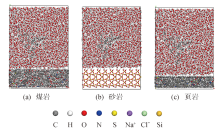
Fig.1
Initial models of long-chain alkyl quaternary ammonium salt on different rock surfaces"

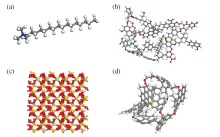
Fig.2
Basic molecules of different rock formations. (a) Long-chain alkyl quaternary ammonium salts, (b) coal rock, (c) sandstone, and (d) shale"
Tab.1
Composition of the viscoelastic systems based on long-chain alkyl quaternary ammonium salt"
| 序号 | w (长链烷基季铵盐) /% | w (NaSal) /% | w (KCl) /% |
|---|---|---|---|
| 1 | 3.6 | 3 | 1.5 |
| 2 | 3 | 3 | - |
| 3 | 2 | 3 | 1.5 |
| 4 | 1.2 | 3 | 1.5 |
| 5 | 0.9 | 2 | - |
| 6 | 0.9 | 2.8 | 1.5 |
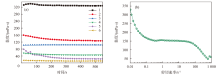
Fig.3
(a) Viscosity curves of long-chain alkyl quaternary ammonium salt/NaSal systems with different mixing ratios; (b) curve of apparent viscosity versus shear rate for the optimized system"
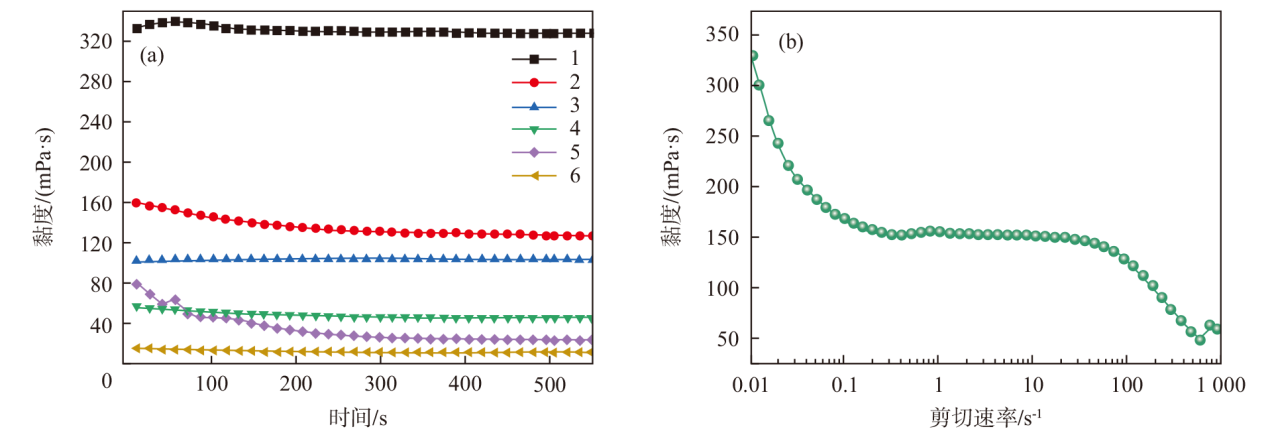
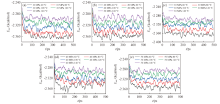
Fig.4
Effects of temperature and pressure on the shale interaction energy adsorbed with long-chain alkyl quaternary ammonium salt"
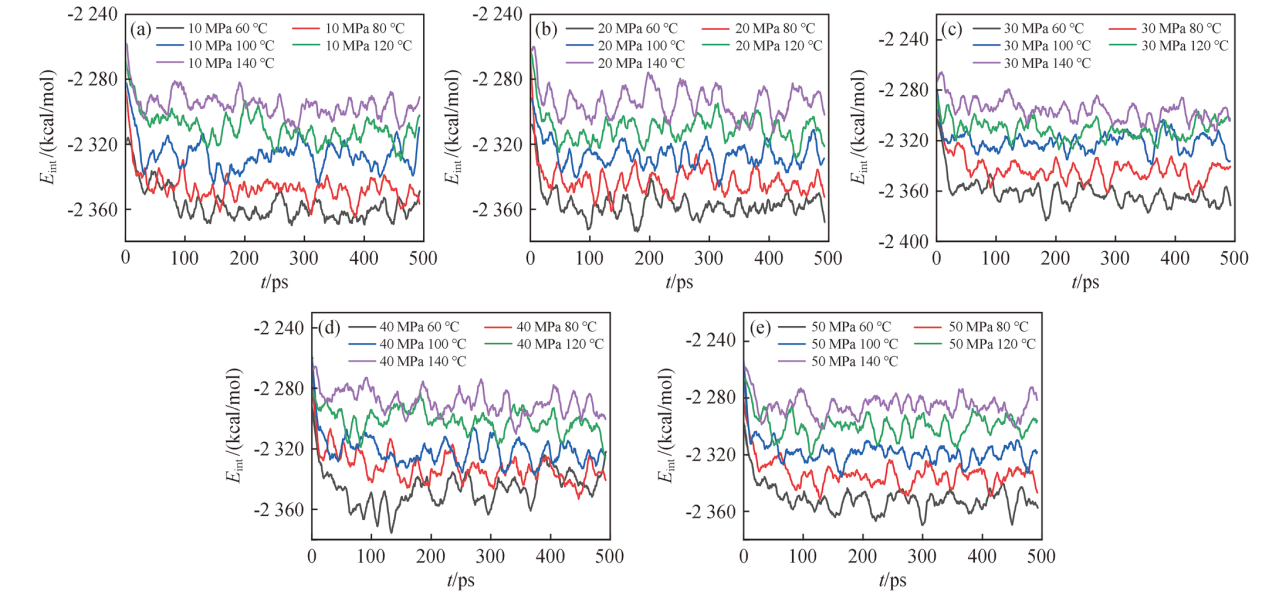
Fig.5
Effects of temperature and pressure on the coal rock interaction energy adsorbed with long-chain alkyl quaternary ammonium salt"
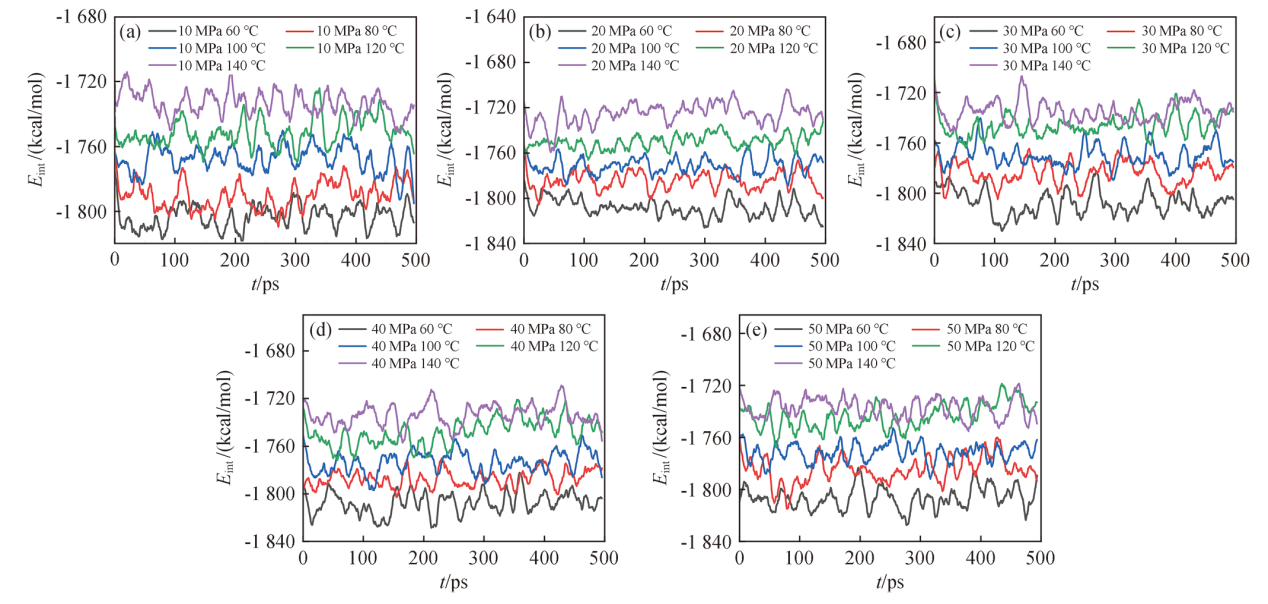
Fig.6
Effects of temperature and pressure on the sandstone interaction energy adsorbed with long-chain alkyl quaternary ammonium salt"
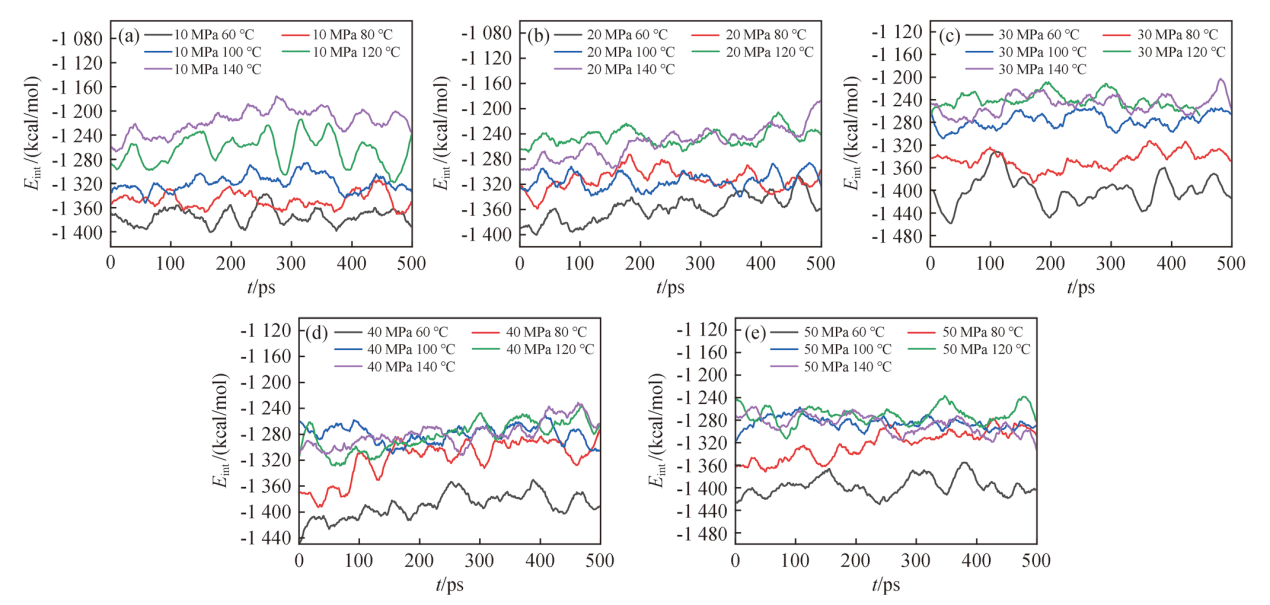

Fig.7
Comparison of the average interaction energy of long-chain alkyl quaternary ammonium salt molecules on the surfaces of different rocks.(a) Shale; (b) coal rock; (c) sandstone"

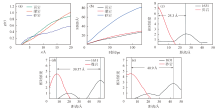
Fig.8
Comparison of (a) RDF, (b) MSD and (c-e) relative concentrations under the conditions of maximum adsorption strength of long-chain alkyl quaternary ammonium salt on different rock surfaces"
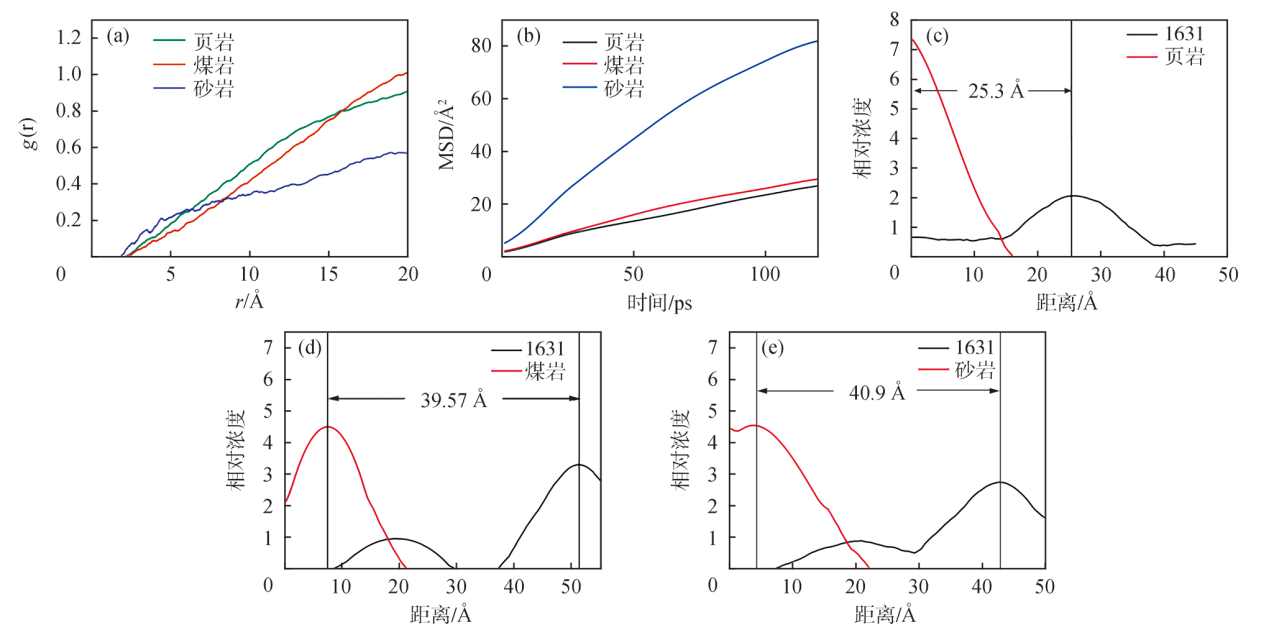
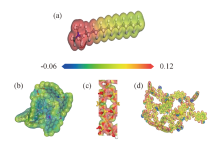
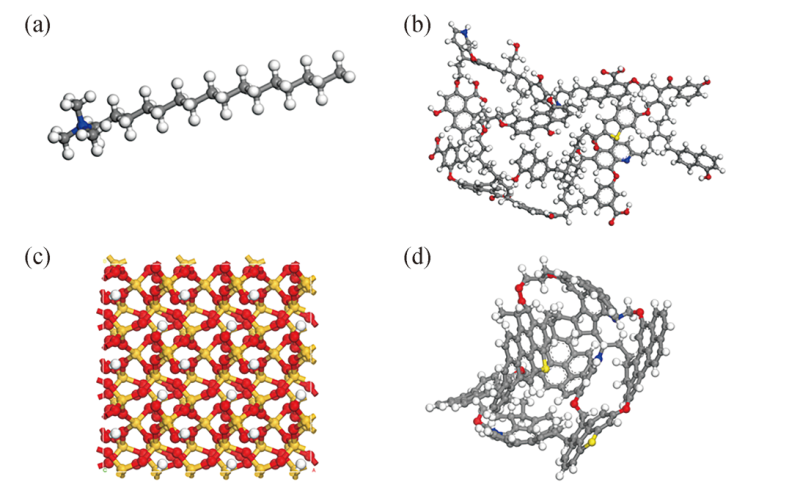
Fig.9
Molecular structure and electrostatic potential diagrams of (a) long-chain alkyl quaternary ammonium salt, (b) shale, (c) sandstone and (d) coal rock"
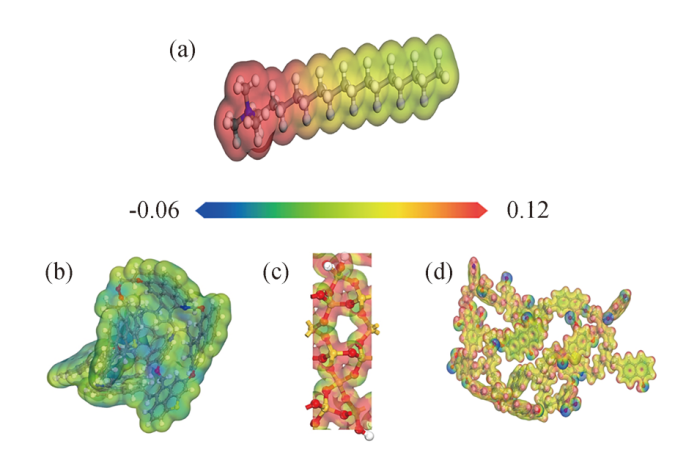
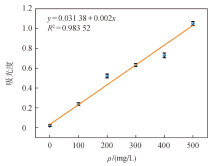
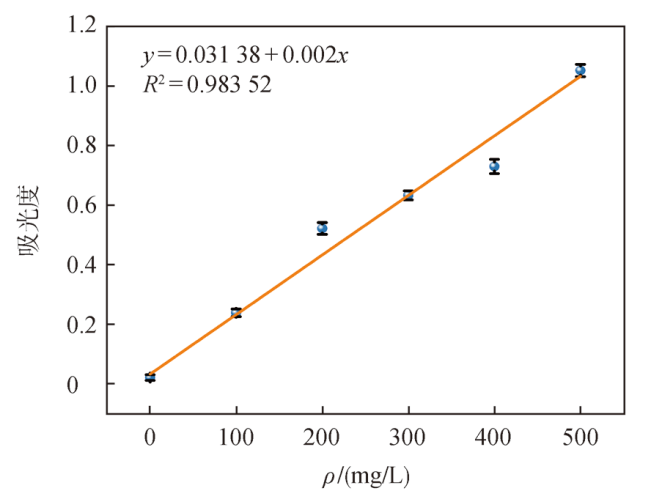
Fig.10
Fitting curve of absorbance vs. mass concentration for the standard solution of the fracturing fluid based on long-chain alkyl quaternary ammonium salt"
Tab.2
Adsorption capacity of the fracturing fluid based on long-chain alkyl quaternary ammonium salt on different cores"
| 岩心类型 | 吸光度 | 平衡吸附浓度ρ1 | 吸附量Q | 平均吸附量Q1 |
|---|---|---|---|---|
| 页岩 | 0.374 72 | 178.4 | 8.04 | 8.11 |
| 0.370 21 | 176.2 | 8.10 | ||
| 0.363 24 | 172.8 | 8.18 | ||
| 煤岩 | 0.573 98 | 275.6 | 5.61 | 5.45 |
| 0.581 77 | 279.4 | 5.50 | ||
| 0.605 96 | 291.2 | 5.22 | ||
| 砂岩 | 0.799 48 | 385.6 | 2.86 | 2.75 |
| 0.804 81 | 388.2 | 2.80 | ||
| 0.822 03 | 396.6 | 2.58 |
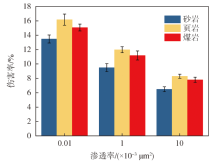
Fig.11
Comparison of formation damage of the fracturing fluid based on long-chain alkyl quaternary ammonium salt in different rocks with different permeability"
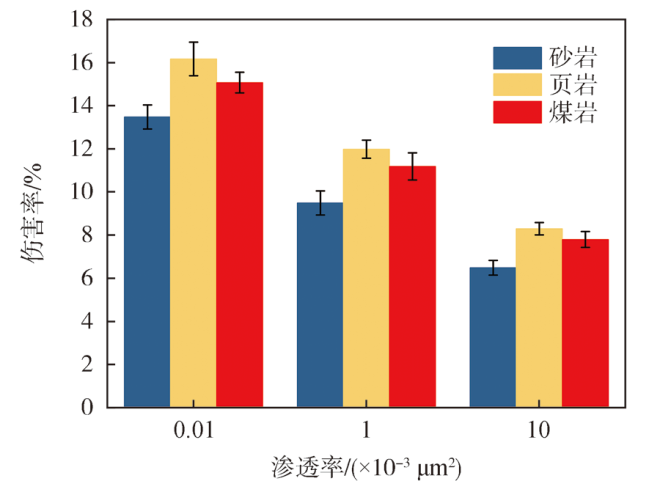
Tab.3
Parameters and determination coefficient of damage rate formula"
| 岩心类型 | γ | n | p | m | R2 |
|---|---|---|---|---|---|
| 砂岩 | 15.2 | 0.1 | 0.1 | 0.05 | 0.992 |
| 页岩 | 17.5 | 0.2 | 0.15 | 0.05 | 0.99 |
| 煤岩 | 16.3 | 0.2 | 0.2 | 0.06 | 0.991 |
| [1] |
Tong X, Zhang G, Wang Z, et al. Distribution and potential of global oil and gas resources[J]. Petroleum Exploration and Development, 2018, 45 (4) : 779-789.
doi: 10.1016/S1876-3804(18)30081-8 |
| [2] |
Sun Y, Wang X, Meng Y, et al. Fracture propagation mechanism and application of supercritical CO2 fracturing in shale: A review[J]. Petroleum Science, 2025, 22 (4) : 1625-1652.
doi: 10.1016/j.petsci.2025.01.009 |
| [3] |
Pan Y, Zheng L, Liu Y, et al. A review of the current status of research on convection-heated in situ extraction of unconventional oil and gas resources (oil shale)[J]. Journal of Analytical and Applied Pyrolysis, 2023, 175: 106200.
doi: 10.1016/j.jaap.2023.106200 |
| [4] |
He Y, Jiang G, Dong T, et al. Research progress and development tendency of polymer drilling fluid technology for unconventional gas drilling[J]. Frontiers in Energy Research, 2023, 10: 1058412.
doi: 10.3389/fenrg.2022.1058412 |
| [5] |
Abdulhadi D, Ali J A, Hama S M. Advanced techniques for improving the production of natural resources from unconventional reservoirs: A state-of-the-art review[J]. Energy & Fuels, 2025, 39 (23) : 10853-10876.
doi: 10.1021/acs.energyfuels.5c01259 |
| [6] |
Alfarge D, Aljarah A M, Alali N. Insights from field applications of miscible gases based EOR for unconventional oil reservoirs: A review[J]. Unconventional Resources, 2025, 5: 100132.
doi: 10.1016/j.uncres.2024.100132 |
| [7] |
Jiao F. Re-recognition of “unconventional” in unconventional oil and gas[J]. Petroleum Exploration and Development, 2019, 46 (5) : 847-855.
doi: 10.1016/S1876-3804(19)60244-2 |
| [8] |
Mcfarland E. Unconventional chemistry for unconventional natural gas[J]. Science, 2012, 338 (6105) : 340-342.
doi: 10.1126/science.1226840 |
| [9] | Peng G, Zhao L, Guo X, et al. Hydraulic fracturing optimization method for fractured reservoir based on phase-field modeling[J]. Physics of Fluids, 2025, 37 (3) : 032128. |
| [10] |
Liu J, Liu P, Du J, et al. Review on high-temperature-resistant viscoelastic surfactant fracturing fluids: State-of-the-art and perspectives[J]. Energy & Fuels, 2023, 37 (14) : 9790-9821.
doi: 10.1021/acs.energyfuels.3c00488 |
| [11] |
Chowdhury S, Shrivastava S, Kakati A, et al. Comprehensive review on the role of surfactants in the chemical enhanced oil recovery process[J]. Industrial & Engineering Chemistry Research, 2022, 61 (1) : 21-64.
doi: 10.1021/acs.iecr.1c03301 |
| [12] |
Liu J, Peng B, Gao Y, et al. Recent advances in nanoparticle-enhanced clean VES fracturing fluids: A comprehensive review of performance improvement, synergy, and challenges[J]. Chemical Engineering Science, 2026, 319: 122240.
doi: 10.1016/j.ces.2025.122240 |
| [13] |
Yang Y, Zhang H, Wang H, et al. Pseudo-interpenetrating network viscoelastic surfactant fracturing fluid formed by surface-modified cellulose nanofibril and wormlike micelles[J]. Journal of Petroleum Science and Engineering, 2022, 208: 109608.
doi: 10.1016/j.petrol.2021.109608 |
| [14] |
He D, Zhu X, Fu Y, et al. Effects of sodium oleate surface properties on the characteristics of two-phase foam in froth flotation[J]. Colloids and Surfaces A: Physicochemical and Engineering Aspects, 2024, 694: 134119.
doi: 10.1016/j.colsurfa.2024.134119 |
| [15] |
Wang Q, Gu X, Li W, et al. Preparation of sodium oleate-derived multifunctional surfactants by hydroxymethylation[J]. Russian Journal of Physical Chemistry B, 2023, 17 (2) : 283-292.
doi: 10.1134/S1990793123020136 |
| [16] |
Tsendra O, Scott A M, Gorb L, et al. Adsorption of nitrogen-containing compounds on the (100) α-quartz surface: ab initio cluster approach[J]. The Journal of Physical Chemistry C, 2014, 118 (6) : 3023-3034.
doi: 10.1021/jp406827h |
| [17] |
Liu J, Yang Y, Sun S, et al. Flow behaviors of shale oil in kerogen slit by molecular dynamics simulation[J]. Chemical Engineering Journal, 2022, 434: 134682.
doi: 10.1016/j.cej.2022.134682 |
| [18] |
Chen X, Gao J, Deng C, et al. Characterization of the wetting properties of ionic liquids on lignite surfaces: Molecular dynamics simulations[J]. Journal of Molecular Liquids, 2023, 389: 122886.
doi: 10.1016/j.molliq.2023.122886 |
| [19] | Zhang C, Cao L, Jiang Y, et al. Molecular dynamics simulations on the adsorbed monolayers of n-dodecyl betaine at the air-water interface[J]. Molecules, 2023, 28 (14) : 5580. |
| [20] |
Okunade O A, Yekeen N, Padmanabhan E, et al. Shale core wettability alteration, foam and emulsion stabilization by surfactant: Impact of surfactant concentration, rock surface roughness and nanoparticles[J]. Journal of Petroleum Science and Engineering, 2021, 207: 109139.
doi: 10.1016/j.petrol.2021.109139 |
| [21] |
Du A, Mao J, Wang D, et al. Wettability alteration at a water-wet quartz surface by a novel trimeric surfactant: Experimental and theoretical study[J]. Journal of Molecular Liquids, 2022, 354: 118771.
doi: 10.1016/j.molliq.2022.118771 |
| [22] |
Shi K, Chen J, Pang X, et al. Effect of wettability of shale on CO2 sequestration with enhanced gas recovery in shale reservoir: Implications from molecular dynamics simulation[J]. Journal of Natural Gas Science and Engineering, 2022, 107: 104798.
doi: 10.1016/j.jngse.2022.104798 |
| [23] |
Zhong J, Wang P, Zhang Y, et al. Adsorption mechanism of oil components on water-wet mineral surface: A molecular dynamics simulation study[J]. Energy, 2013, 59: 295-300.
doi: 10.1016/j.energy.2013.07.016 |
| [24] |
Liu B, Shi J, Wang M, et al. Reduction in interfacial tension of water-oil interface by supercritical CO2 in enhanced oil recovery processes studied with molecular dynamics simulation[J]. The Journal of Supercritical Fluids, 2016, 111: 171-178.
doi: 10.1016/j.supflu.2015.11.001 |
| [25] |
Yuan M, Nie W, Zhou W, et al. Determining the effect of the non-ionic surfactant AEO9 on lignite adsorption and wetting via molecular dynamics (MD) simulation and experiment comparisons[J]. Fuel, 2020, 278: 118339.
doi: 10.1016/j.fuel.2020.118339 |
| [26] |
Zhang Q, Zhou G, Hu Y, et al. Microwetting dynamic behavior and mechanism for coal dust based on low field NMR method-A case study[J]. Fuel, 2021, 297: 120702.
doi: 10.1016/j.fuel.2021.120702 |
| [27] |
Xing M, Xu C, Zhou G, et al. Experimental investigation for effect of multicomponent inorganic-organic acid solution on pore structure of lignite[J]. Powder Technology, 2021, 392: 503-513.
doi: 10.1016/j.powtec.2021.07.014 |
| [28] |
Yang Y, Liu J, Yao J, et al. Adsorption behaviors of shale oil in kerogen slit by molecular simulation[J]. Chemical Engineering Journal, 2020, 387: 124054.
doi: 10.1016/j.cej.2020.124054 |
| [29] |
Goharshadi E K. A review on the radial distribution function: Insights into molecular structure, intermolecular interactions, and thermodynamic properties[J]. Journal of Molecular Liquids, 2025, 433: 127900.
doi: 10.1016/j.molliq.2025.127900 |
| [30] |
Wang L, Zhang Y, Zou R, et al. Applications of molecular dynamics simulation in studying shale oil reservoirs at the nanoscale: Advances, challenges and perspectives[J]. Petroleum Science, 2025, 22 (1) : 234-254.
doi: 10.1016/j.petsci.2024.09.023 |
| [31] |
Yang M, Zhang J, Zhang L, et al. Physicochemical effect on coal pores of hydrocarbon chain length and mixing of viscoelastic surfactants in clean fracturing fluids[J]. ACS Omega, 2024, 9 (17) : 19418-19427.
doi: 10.1021/acsomega.4c00692 pmid: 38708200 |
| [32] |
Zarei A R, Bagheri S H, Abedin S. Selective cloud point extraction for the spectrophotometric determination of cetylpyridinium chloride in pharmaceutical formulations[J]. Iran. J. Pharm. Res., 2013, 12 (4) : 671-677.
pmid: 24523746 |
| [33] |
Almanassra I W, Kochkodan V, Mckay G, et al. Kinetic and thermodynamic investigations of surfactants adsorption from water by carbide-derived carbon[J]. Journal of Environmental Science and Health, Part A, 2021, 56 (11) : 1206-1220.
doi: 10.1080/10934529.2021.1973822 |
| [34] |
Li X, Zhang X, Wang L, et al. Self-assembled viscoelastic surfactant micelles with ph-responsive behavior: a new fracturing-displacement integrated working fluid for unconventional reservoirs[J]. ACS Omega, 2024, 9 (21) : 22691-22702.
doi: 10.1021/acsomega.4c00459 pmid: 38826515 |
| [35] |
Ma K, Cui L, Dong Y, et al. Adsorption of cationic and anionic surfactants on natural and synthetic carbonate materials[J]. Journal of Colloid and Interface Science, 2013, 408: 164-172.
doi: 10.1016/j.jcis.2013.07.006 pmid: 23957928 |
| [1] | Shuai Wang, Zhongguo Ma, Junjie Li, Zhengfan Wang, Liaoliao Gao, Fangling Qin. Preparation and performance evaluation of synergistic organic boron crosslinker for low-concentration guar gum [J]. China Surfactant Detergent & Cosmetics, 2026, 56(9): 1188-1197. |
| [2] | Ruirui Guo, Haifeng Liu. Research on a novel supramolecular clean fracturing fluid suitable for deep coalbed methane wells [J]. China Surfactant Detergent & Cosmetics, 2026, 56(6): 739-746. |
| [3] | Wanhuang Guo, Zhicheng Ye, Chaoling Qi, Kangfu Zhou, Feifei Wang, Yazhuo Shang. A study on the microscopic mechanism for the formation of deep eutectic solvents based on matrine and fatty acids [J]. China Surfactant Detergent & Cosmetics, 2026, 56(2): 149-157. |
| [4] | Haibing Cheng, Yong Zhang, Lei Sun, Weijia Li, Zhi Chen, Congming Tang, Li Chang. Synthesis and crosslinking properties of W-SN crosslinking agent [J]. China Surfactant Detergent & Cosmetics, 2025, 55(3): 279-285. |
| [5] | Jian Zhao, Bumin Guo, Jinwei Shen, Li Wang, Tianpeng Xu, Wenhui Bao. Study on the mechanism and kinetics of crosslinking in high-temperature-resistant seawater-based plant gum fracturing fluid [J]. China Surfactant Detergent & Cosmetics, 2025, 55(12): 1560-1566. |
| [6] | Jin Zhen, Zhang Chunsheng. Preparation and performance evaluation of organic zirconium gelled fracturing fluid with high temperature resistance and slowly-cross-linking [J]. China Surfactant Detergent & Cosmetics, 2023, 53(3): 279-284. |
| [7] | Yongkang Zhang, Mengmeng Liu, Zhiwei Wan, Yaocong Wang, Mimi Tian, Liewei Qiu. Effect of spacer on the performance of Gemini betaine surfactant in clean fracturing fluid [J]. China Surfactant Detergent & Cosmetics, 2023, 53(12): 1398-1404. |
| [8] | Zhong Ju, Sarsenbekuly Bauyrzhan, Yin Xia, Kang Wanli. Performance and application of high-temperature resistant carboxymethyl guar gum fracturing fluid [J]. China Surfactant Detergent & Cosmetics, 2023, 53(10): 1125-1131. |
| [9] | GUO Yu-fei,ZHANG Jian,YU Wen. Molecular dynamics simulation of protease PB92 for washing before and after substrate binding [J]. China Surfactant Detergent & Cosmetics, 2021, 51(4): 299-305. |
| [10] | CUI Xiu,FANG Bo,XU Hai-tao. Rheological properties of a novel clean fracturing fluid: the micellar system of 25-HP-21/NaSal [J]. China Surfactant Detergent & Cosmetics, 2020, 50(10): 653-659. |
| [11] | KANG Wan-li,LI Xin-xin,ZHAO Yi-lu,WANG Peng-xiang,HOU Xiao-yu,YANG Hong-bin. Construction of N-erucamido-N, N-dimethylamine and benzoic acid fracturing fluid system [J]. China Surfactant Detergent & Cosmetics, 2019, 49(9): 555-560. |
| [12] | LI Ju-long,DING Feng-mei,ZHOU Xiang,XING Zhi-qi,ZHAO Tao. Foamability of vanillin-based nonionic surfactants with different ethoxy chain length [J]. China Surfactant Detergent & Cosmetics, 2019, 49(7): 419-425. |
| [13] | CHEN Yu-jia, LIU Jia-xi, ZHU Qian-qian, HU Song-qing, SUN Shuang-qing, WANG Xiu-min. Effects of sodium salicylate on the self-assembly behavior of DTAB/PAM mixed system [J]. China Surfactant Detergent & Cosmetics, 2018, 48(6): 308-313. |
| [14] | LI Xia-qing, ZHANG Chi, ZHANG Gui-cai, GE Ji-jiang, WANG Zong-sheng. Applications of viscoelastic surfactant in oilfield [J]. China Surfactant Detergent & Cosmetics, 2014, 44(9): 521-524. |
|
