Welcome to China Surfactant Detergent & Cosmetics, Today is


China Surfactant Detergent & Cosmetics ›› 2026, Vol. 56 ›› Issue (6): 695-705.doi: 10.3969/j.issn.2097-2806.2026.06.001
• Lecture of science and technology • Next Articles
Zonglin Chu1,Zhanpeng Jiang1,Yujun Feng2,*( )
)
Received:2026-06-15
Online:2026-06-22
Published:2026-07-22
Contact:
*E-mail: yjfeng@scu.edu.cn
CLC Number:
Zonglin Chu, Zhanpeng Jiang, Yujun Feng. Viscoelastic surfactants (VI) Smart wormlike micelles[J].China Surfactant Detergent & Cosmetics, 2026, 56(6): 695-705.
Fig.1
Thermal stimuli-response of the PDAS/NaCl solution: (a) shear viscosity η as a function of shear rate; (b) thermoreversible viscosity at shear rate of 10 s-1, η10 [11]"
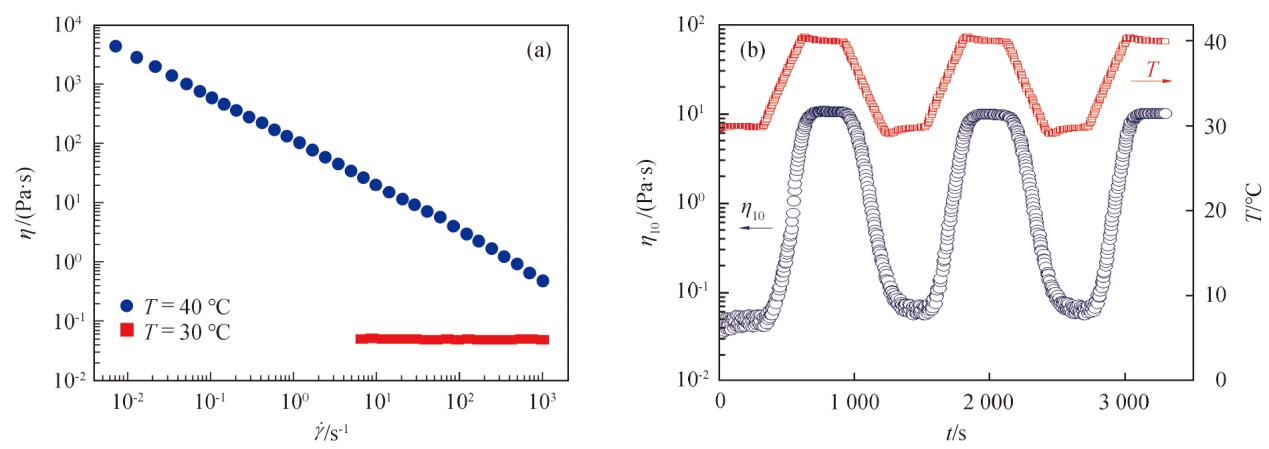
Fig.2
pH-Switchable WLMs systems obtained from the “pseudo-gemini” structure formed by N-erucamidopropyl-N, N-dimethylamine (UC22AMPM) and added maleic acid with a 2∶1 ratio [16]"
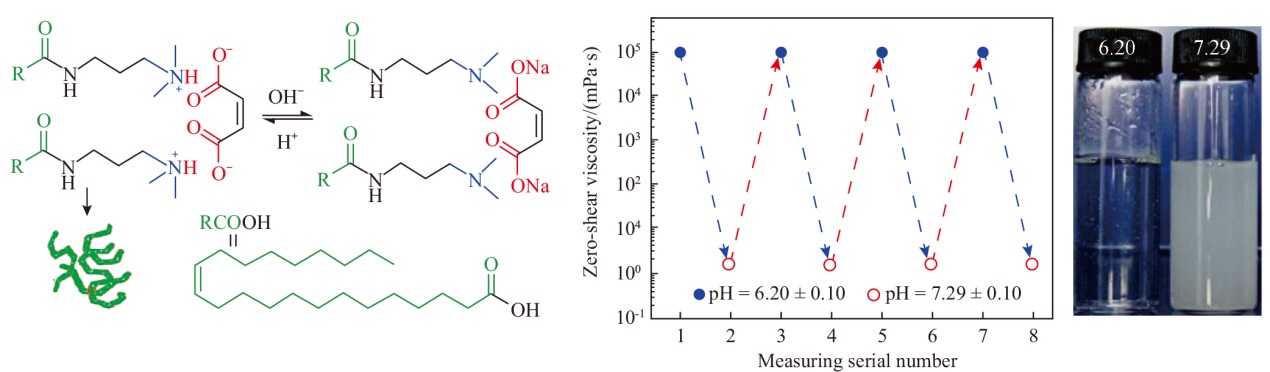
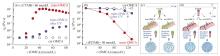
Fig.3
Viscosity change upon UV irradiation (a, b) and the corresponding responsive mechanism (c, d) for photo-thinning WLMs based on “CTAB/OMCA” (a, c) and photothickening WLMs based on “EDAB/OMCA” (b, d)[19,20]"
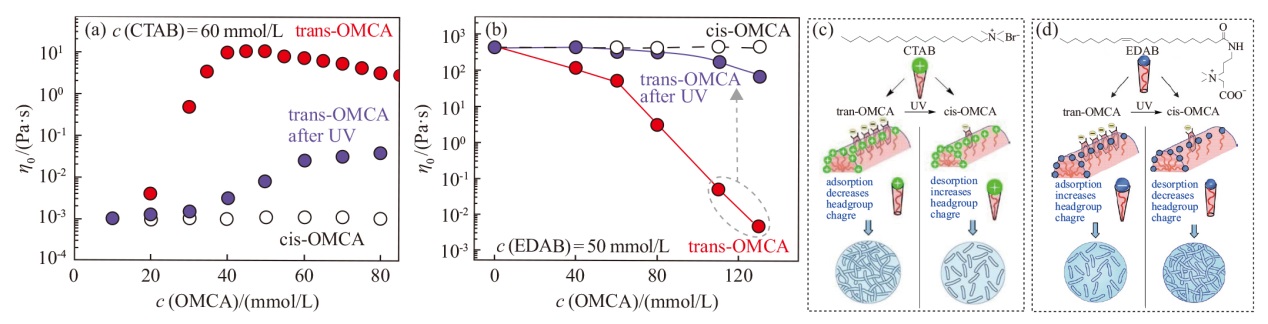
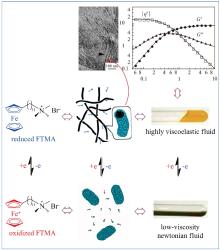
Fig.4
Electro-stimulus response of FTMA wormlike micelles: Rheological response, mechanism, and FF-TEM image [21]"
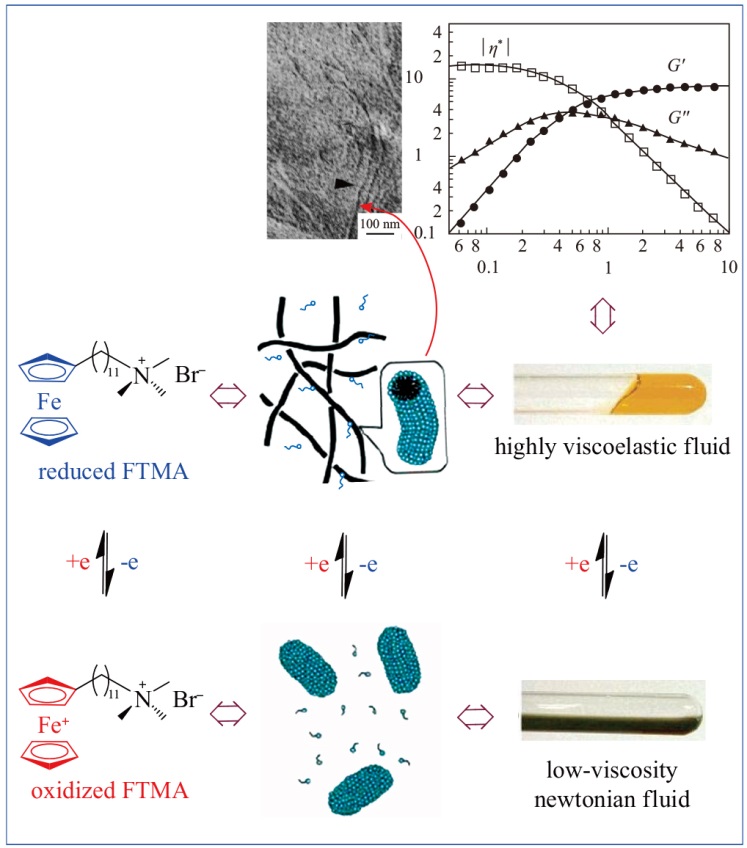
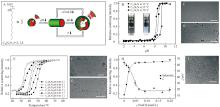
Fig.5
Schematic illustration of the influence of pH, temperature and electrolyte on the morphological transition of the aggregates formed from N-dodecyl-1, ω-diaminoethane [29]"
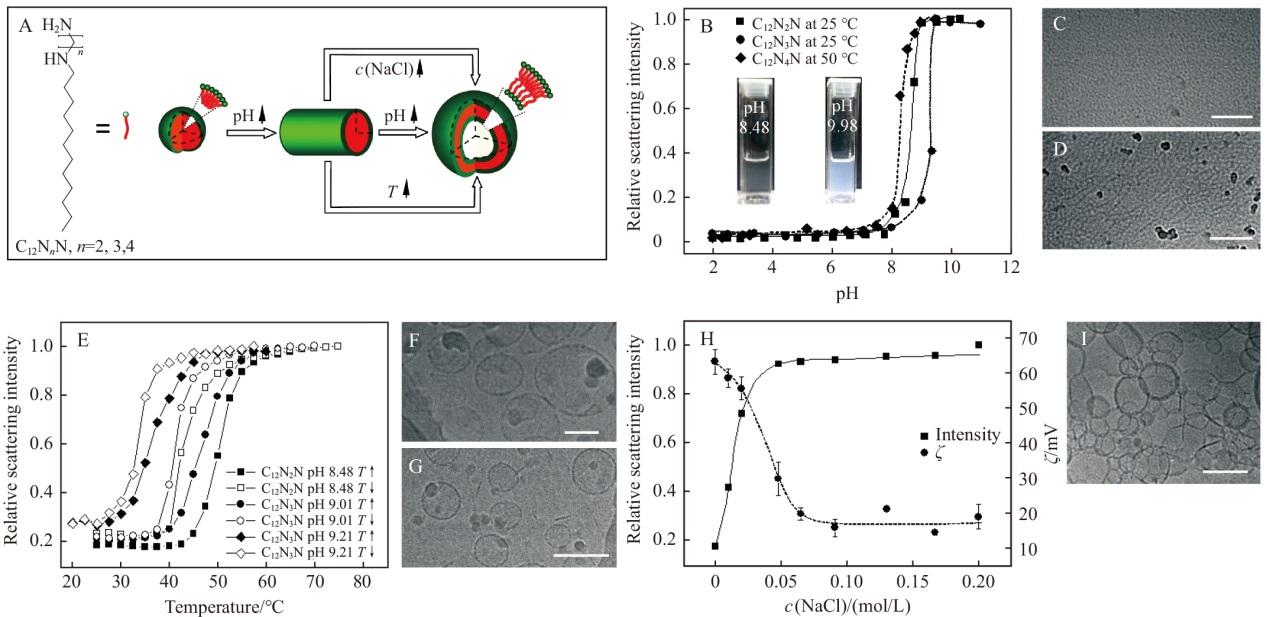
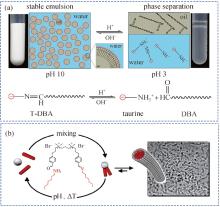
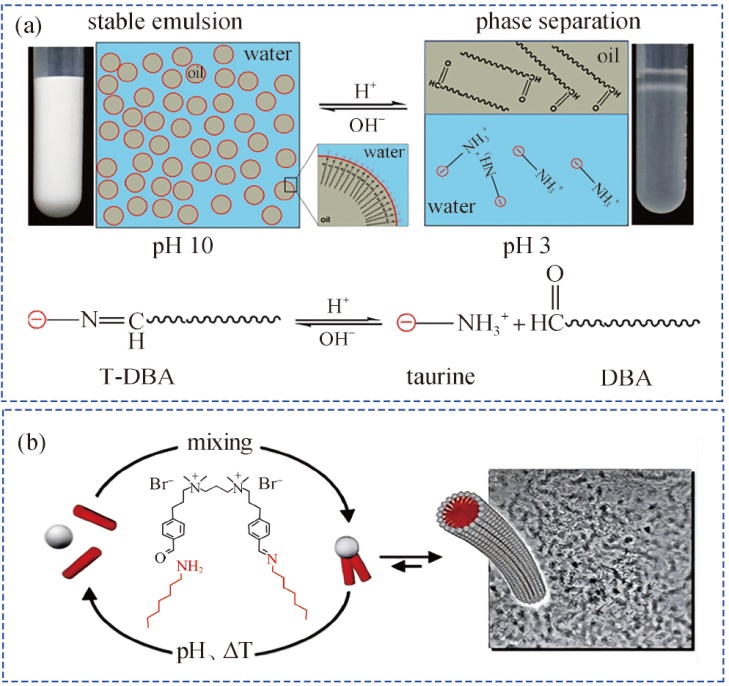
Fig.6
(a) Mechanism of reversible emulsification and demulsification governed by the dynamic association and dissociation of imine linkages. (b) Schematic representation of the self-assembly of dynamic covalent wormlike micelles derived from imine-based gemini surfactants"
| [1] | 冯玉军. 黏弹性表面活性剂 (I)——百年胶束发展史及蠕虫状胶束的发现[J]. 日用化学工业(中英文), 2026, 56 (1) : 8-16. |
| [2] | 冯玉军. 黏弹性表面活性剂(II)——蠕虫状胶束形成机理及体系构成[J]. 日用化学工业 (中英文), 2026, 56 (2) : 137-148. |
| [3] | 冯玉军. 黏弹性表面活性剂(III)——稳态流变与剪切带现象[J]. 日用化学工业 (中英文), 2026, 56 (3) : 278-283. |
| [4] | 冯玉军. 黏弹性表面活性剂(IV)——动态流变[J]. 日用化学工业 (中英文), 2026, 56 (4) : 425-432. |
| [5] | 冯玉军. 黏弹性表面活性剂(V)——蠕虫状胶束与聚合物的相似点及差异性[J]. 日用化学工业(中英文), 2026, 56 (5) : 558-563. |
| [6] |
Chu Z, Dreiss C A, Feng Y. Smart wormlike micelles[J]. Chemical Society Reviews, 2013, 42 (17) : 7174-7203.
doi: 10.1039/c3cs35490c pmid: 23545844 |
| [7] | Feng Y, Chu Z, Dreiss C A. Smart wormlike micelles: Design, characteristics and applications[M]. Springer, Heidelberg, 2015. |
| [8] |
Sharma S C, Shrestha L K, Tsuchiya K, et al. Viscoelastic wormlike micelles of long polyoxyethylene chain phytosterol with lipophilic nonionic surfactant in aqueous solution[J]. Journal of Physical Chemistry B, 2009, 113 (10) : 3043-3050.
doi: 10.1021/jp8102244 |
| [9] |
Hassan P A, Valaulikar B S, Manohar C, et al. Vesicle to micelle transition: Rheological investigations[J]. Langmuir, 1996, 12 (18) : 4350-4357.
doi: 10.1021/la960269p |
| [10] |
Mendes E, Oda R, Manohar C, et al. A small-angle neutron scattering study of a shear-induced vesicle to micelle transition in surfactant mixtures[J]. Journal of Physical Chemistry B, 1998, 102 (2) : 338-343.
doi: 10.1021/jp972392a |
| [11] |
Chu Z, Feng Y. Thermo-switchable surfactant gel[J]. Chemical Communications, 2011, 47 (25) : 7191-7193.
doi: 10.1039/c1cc11428j pmid: 21544301 |
| [12] |
Greenhill-Hooper M J, O’Sullivan T P, Wheeler P A. The aggregation behavior of octadecylphenylalkoxysulfonates 1. temperature-dependence of the solution behavior[J]. Journal of Colloid and Interface Science, 1988, 124 (1) : 77-87.
doi: 10.1016/0021-9797(88)90327-X |
| [13] |
Tobita K, Sakai H, Kondo Y, et al. Thermoresponsive viscoelasticity of sodium 1-oxo-1- [4- (tridecafluorohexyl)phenyl] -2-hexanesulfonate aqueous solutions[J]. Langmuir, 1997, 13 (19) : 5054-5055.
doi: 10.1021/la970347o |
| [14] |
Maeda H, Yamamoto A, Souda M, et al. Effects of protonation on the viscoelastic properties of tetradecyldimethylamine oxide micelles[J]. Journal of Physical Chemistry B, 2001, 105 (23) : 5411-5418.
doi: 10.1021/jp0101155 |
| [15] |
Lin Y, Han X, Huang J, et al. A facile route to design pH-responsive viscoelastic wormlike micelles: Smart use of hydrotropes[J]. Journal of Colloid and Interface Science, 2009, 330 (2) : 449-455.
doi: 10.1016/j.jcis.2008.10.071 pmid: 19059596 |
| [16] | Chu Z, Feng Y. pH-Switchable wormlike micelles[J]. Chemical Communications, 2010, (46) : 9028-9030. |
| [17] |
Feng Y, Chu Z. pH-Tunable wormlike micelles based on an ultra-long-chain “pseudo” gemini surfactant[J]. Soft Matter, 2015, 11(23) : 4614-4620.
doi: 10.1039/C5SM00677E |
| [18] |
Sakai H, Orihara Y, Kodashima H, et al. Photoinduced reversible change of fluid viscosity[J]. Journal of American Chemical Society, 2005, 127 (39) : 13454-13455.
doi: 10.1021/ja053323+ |
| [19] |
Ketner A M, Kumar R, Davies T S, et al. A simple class of photorheological fluids: Surfactant solutions with viscosity tunable by light[J]. Journal of American Chemical Society, 2007, 129 (6) : 1553-1559.
doi: 10.1021/ja065053g |
| [20] |
Kumar R, Raghavan S R. Photogelling fluids based on light-activated growth of zwitterionic wormlike micelles[J]. Soft Matter, 2009, 5 (4) : 797-803.
doi: 10.1039/B809452G |
| [21] |
Tsuchiya K, Orihara Y, Kondo Y, et al. Control of viscoelasticity using redox reaction[J]. Journal of American Chemical Society, 2004, 126(39) : 12282-12283.
doi: 10.1021/ja0467162 |
| [22] | Hoffmann H, Ebert G. Surfactants, micelles and fascinating phenomena[J]. Angewandte Chemie International Edition, 1988, 27(7) : 902-912. |
| [23] |
Hoffmann H, Ulbricht W. The rheological behavior of different viscoelastic surfactant solutions[J]. Tenside, Surfactants and Detergents, 1987, 24 (1) : 23-31.
doi: 10.1515/tsd-1987-240111 |
| [24] |
Molchanov V S, Philippova O E, Khokhlov A R, et al. Self-assembled networks highly responsive to hydrocarbons[J]. Langmuir, 2007, 23(1) : 105-111.
pmid: 17190491 |
| [25] |
Philippova O E, Khokhlov A R. Smart polymers for oil production[J]. Petroleum Chemistry, 2010, 50: 266-270.
doi: 10.1134/S0965544110040031 |
| [26] |
Shibaev A V, Tamm M V, Molchanov V S, et al. How a viscoelastic solution of wormlike micelles transforms into a microemulsion upon absorption of hydrocarbon: new insight[J]. Langmuir, 2014, 30 (13) :3705-3714.
doi: 10.1021/la500484e pmid: 24617576 |
| [27] |
Jiang L X, Wang K, Ke F Y, et al. Endowing catanionic surfactant vesicles with dual responsive abilities via a noncovalent strategy: Introduction of a responser, sodium cholate[J]. Soft Matter, 2009, 5(3) : 599-606.
doi: 10.1039/B813498G |
| [28] |
Zhang Y, Han Y, Chu Z, et al. Thermally-induced structural transitions from fluids to hydrogels with pH-switchable anionic wormlike micelles[J]. Journal of Colloid and Interface Science, 2013, 394: 319-328.
doi: 10.1016/j.jcis.2012.11.032 |
| [29] |
Yang Y, Dong J, Li X. Micelle to vesicle transitions of N-dodecyl- 1, ω-diaminoalkanes: Effects of pH, temperature and salt[J]. Journal of Colloid and Interface Science, 2012, 380 (1) : 83-89.
doi: 10.1016/j.jcis.2012.04.068 pmid: 22647344 |
| [30] | Ren G, Li B, Ren L, et al. pH-responsive nanoemulsions based on a dynamic covalent surfactant[J]. Nanomaterials, 2021, 11 (6) : 1390. |
| [31] |
Minkenberg C B, Homan B, Boekhoven J, et al. Responsive wormlike micelles from dynamic covalent surfactants[J]. Langmuir, 2012, 28 (38) : 13570-13576.
pmid: 22873840 |
| [1] | Ruirui Guo,Haifeng Liu. Research on a novel supramolecular clean fracturing fluid suitable for deep coalbed methane wells [J]. China Surfactant Detergent & Cosmetics, 2026, 56(6): 739-746. |
| [2] | Shu Zhou,Zhiyong Luo,Yiyue Wang,Yuyao Wan,Sa Zeng,Tao Meng. Pickering emulsions stabilized by silica nanoparticles in combination with surfactant for the enhancement of the stability of anthocyanins [J]. China Surfactant Detergent & Cosmetics, 2026, 56(6): 706-716. |
| [3] | Yujun Feng. Viscoelastic surfactants (V) Similarity and difference between wormlike micelles and polymers [J]. China Surfactant Detergent & Cosmetics, 2026, 56(5): 557-563. |
| [4] | Jiao Fang, Bo Xing. Study on the preparation of a quaternary ammonium surfactant and its effects on fabric antibacterial and finishing properties [J]. China Surfactant Detergent & Cosmetics, 2026, 56(5): 571-579. |
| [5] | Liming Xue, Jiale Xu, Jingxian Zhou, Yu’e Jin. Advances of surfactants in the development of formulations of pesticide carbendazim [J]. China Surfactant Detergent & Cosmetics, 2026, 56(5): 666-673. |
| [6] | Yunan Wan, Zhen Ren, Yichun Zhang. Study on the modification mechanism and performance of nonionic surfactants in the dispersion process of SiO2 aerogels [J]. China Surfactant Detergent & Cosmetics, 2026, 56(4): 441-448. |
| [7] | Yujun Feng. Viscoelastic surfactants (III)Steady rheology and shear bandings [J]. China Surfactant Detergent & Cosmetics, 2026, 56(3): 277-283. |
| [8] | Zhengyu Li,Degang Xing,Yancheng Zheng,Hongyun Zhao,Fuchang You. Synergism in the mixture of sodium dodecyl block polyether sulfonate and Gemini betaine surfactant for oil displacement [J]. China Surfactant Detergent & Cosmetics, 2026, 56(3): 284-292. |
| [9] | Li Liu,Yongchun Liu. Experimental study on the performance of CO2 foam channeling plugging system in ultra-low permeability reservoir [J]. China Surfactant Detergent & Cosmetics, 2026, 56(3): 314-322. |
| [10] | Yujun Feng. Viscoelastic surfactants(II)Formation mechanisms and system formulations of wormlike micelles [J]. China Surfactant Detergent & Cosmetics, 2026, 56(2): 137-148. |
| [11] | Ruochen Wu, Zhenbang Xu, Chengjun Pan, Lei Wang. Preparation and performance study of a special low-foaming cleaning surfactant for agricultural film [J]. China Surfactant Detergent & Cosmetics, 2026, 56(2): 226-235. |
| [12] | Ziying Liao, Fan Min, Zonglin Chu. Smart wormlike micelles based on the surfactants with dynamic imine bonds [J]. China Surfactant Detergent & Cosmetics, 2026, 56(1): 1-7. |
| [13] | Haiyong Tang, Yueqing Huo, Enze Li, Shengti Cao, Chunxin Gao, Chuangxin Ji, Xiaochen Liu. Excellent temperature/salt resistant foam by alcohol ether sulfates(AEnS)for gas well deliquification [J]. China Surfactant Detergent & Cosmetics, 2026, 56(1): 28-40. |
| [14] | Li Wang, Yanan Hou, Bumin Guo, Jian Zhao, Wenhui Bao, Jinwei Shen. Preparation of a synergistic system with modified nano-SiO2 for high-temperature oil reservoirs and its oil displacement effect [J]. China Surfactant Detergent & Cosmetics, 2026, 56(1): 48-54. |
| [15] | Yujun Feng. Viscoelastic surfactants (I)Evolution of micelles and discovery of wormlike micelles [J]. China Surfactant Detergent & Cosmetics, 2026, 56(1): 8-16. |
|
