Welcome to China Surfactant Detergent & Cosmetics, Today is


China Surfactant Detergent & Cosmetics ›› 2026, Vol. 56 ›› Issue (2): 208-216.doi: 10.3969/j.issn.2097-2806.2026.02.009
• Basic research • Previous Articles Next Articles
Danyu Wang,Xueshuo Wang,Haipeng Luo,Jingyun Li,Shenghui Cui*( ),Yong Lu*()
Received:2025-03-23
Revised:2026-01-28
Online:2026-02-22
Published:2026-03-09
Contact:
E-mail: CLC Number:
Danyu Wang, Xueshuo Wang, Haipeng Luo, Jingyun Li, Shenghui Cui, Yong Lu. Study on the species diversity of culturable bacteria in human facial skin and the influence of cosmetic preservatives[J].China Surfactant Detergent & Cosmetics, 2026, 56(2): 208-216.
Tab.1
Preparation of AGAR plates containing preservatives"
| 防腐剂 | 琼脂平板中防腐剂浓度范围 |
|---|---|
| 4-羟基苯甲酸 | 8.00~0.065 mg/mL |
| 4-羟基苯甲酸乙酯 | 9.60 ~0.075 mg/mL |
| 苯甲醇 | 2.00%~0.016% |
| 苯氧乙醇 | 2.00%~0.016% |
| 十六烷基三甲基溴化铵(CTAB) | 0.03~0.000 25 mg/mL |
| 脱氢乙酸 | 48.00~0.19 mg/mL |
| 水杨酸钠 | 11.60~0.10 mg/mL |
| 咪唑烷基脲 | 12.00~0.09 mg/mL |
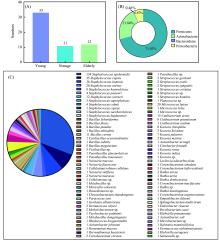
Fig.1
Age of volunteers and distribution of isolated strains(A: Age of volunteers; B: Phyla level distribution of 435 isolates; C: Species level distribution of 435 isolates)"

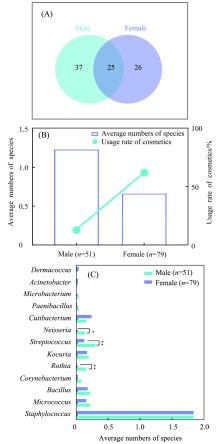
Fig.2
Facial microbial composition of different gender groups: A: Venn diagram of species; B: The average number of bacterial species in male and female samples and the usage of cosmetics; C: The average number of species within the corresponding genus of male and female samples(*: T检验, P<0.05; **: P<0.01)"
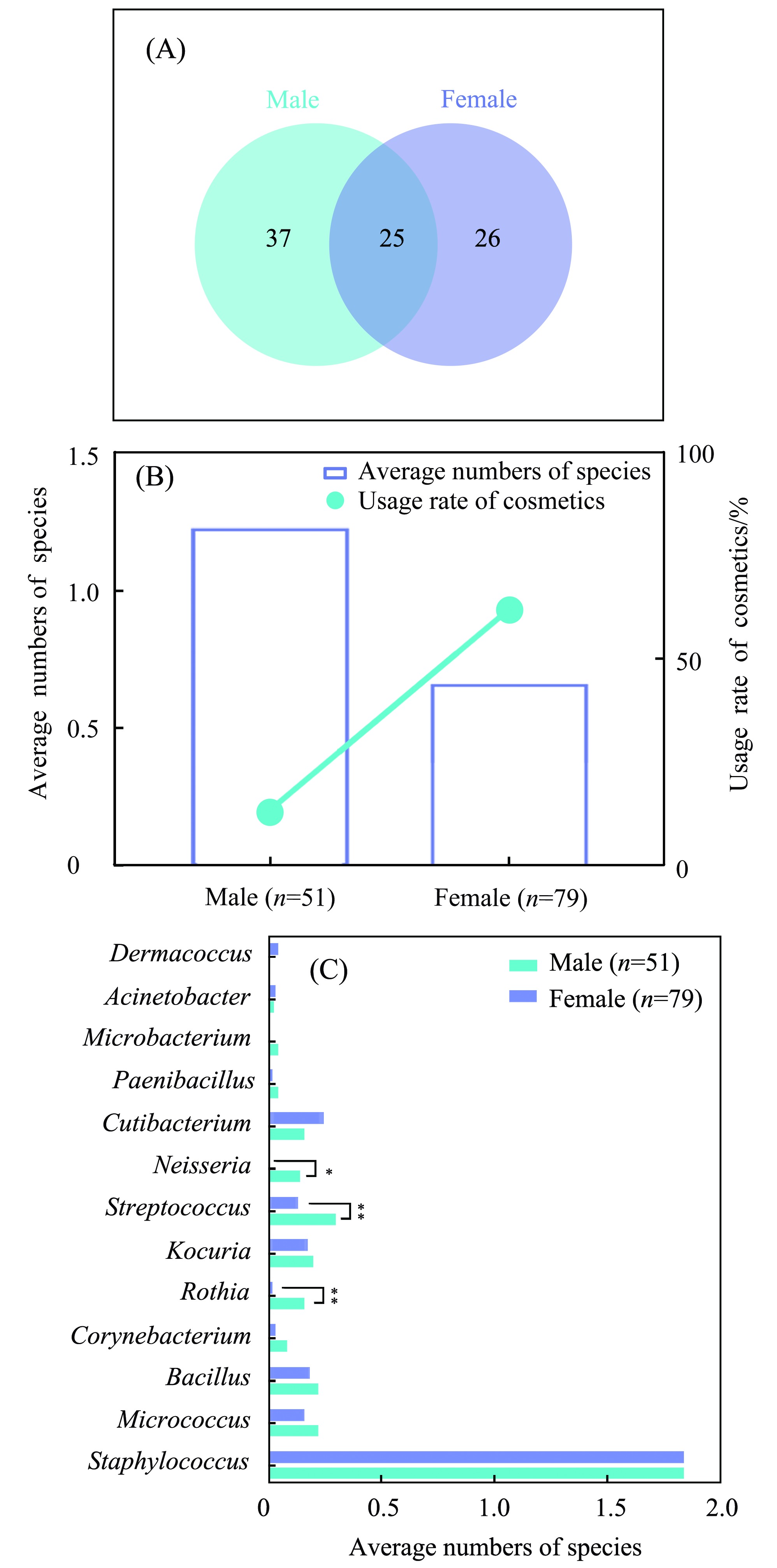
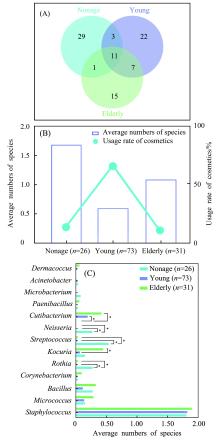
Fig.3
Facial microbial composition of different age groups: A: Venn diagram; B: The average number of bacterial species in nonage/young/elderly samples and the usage of cosmetics; C: The average number of species within the corresponding genus of nonage/young/elderly samples(*: Tamhane’s T2-test, P<0.05)"
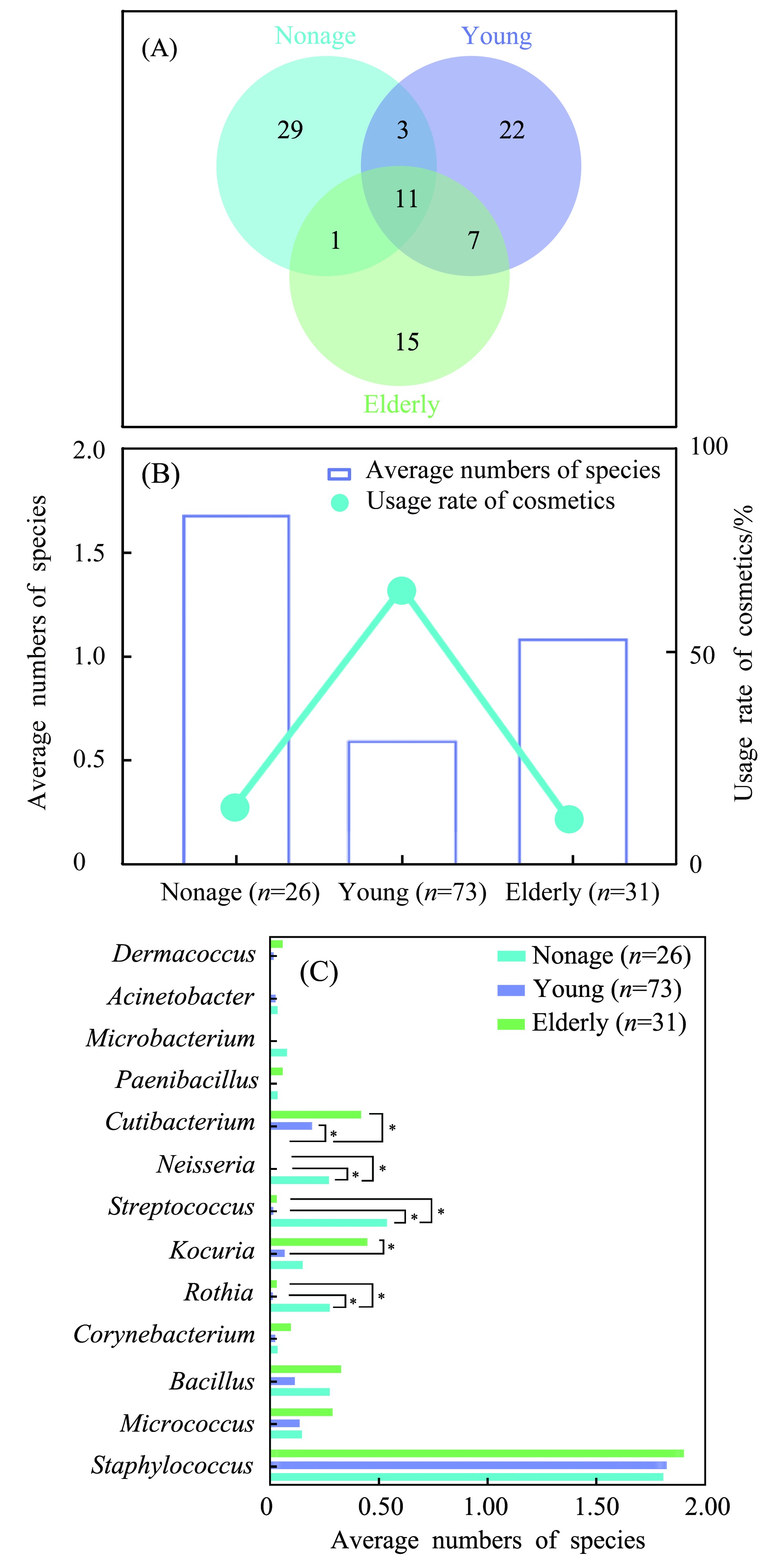
Fig.4
Facial microbial composition of different cosmetics usage groups: A: Venn diagram; B: The average number of bacterial species in cosmetic and non-cosmetic user samples; C: The average number of species within the corresponding genus of cosmetic and non-cosmetic user samples(*: T检验, P<0.05; **: P<0.01)"
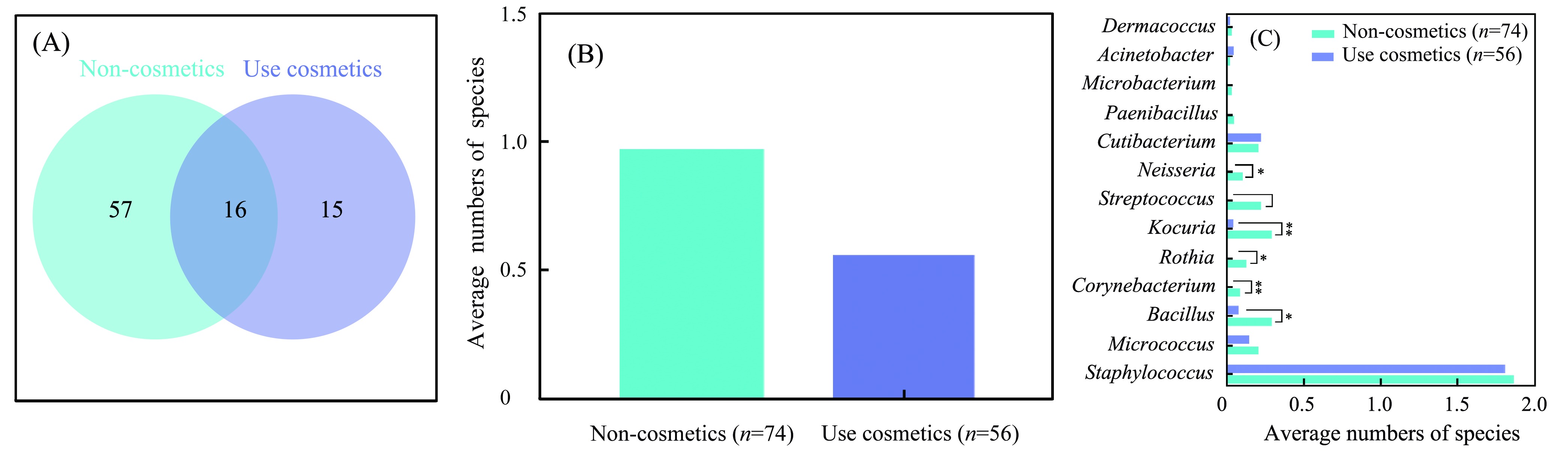
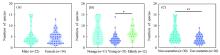
Fig.5
The number of culturable bacteria species on the face of different population: A: The number of culturable bacteria species on the face of different gender groups; B: The number of culturable bacteria species on the face of different age groups(*: Tamhane’s T2-test, P<0.05); C: The number of culturable bacteria species on the face of different cosmetic usage groups(*: Welch T检验, P<0.01)"
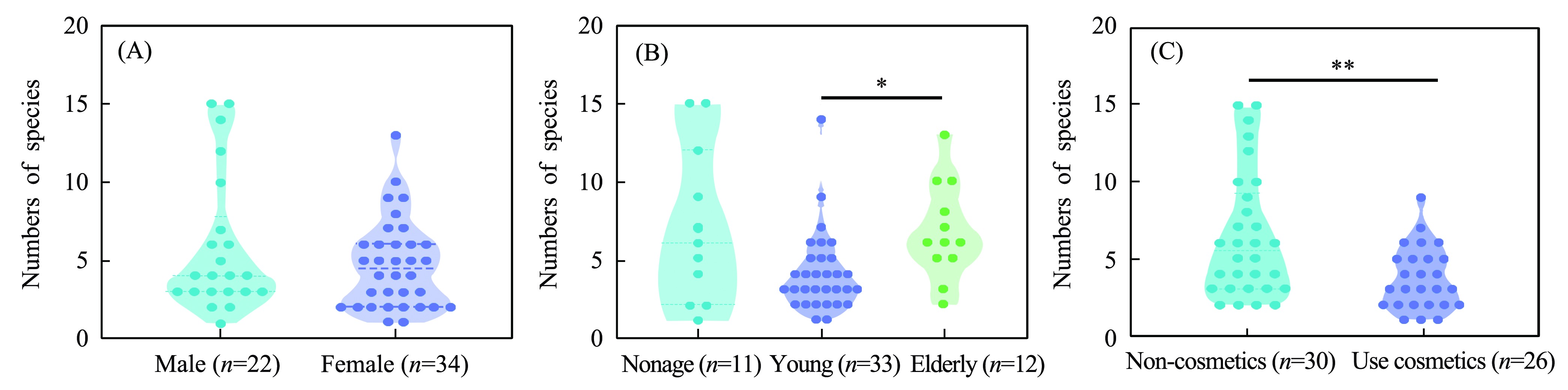
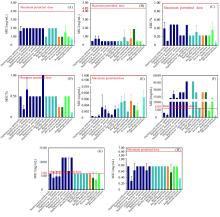
Fig.6
Inhibitory effects of different kinds of preservatives on culturable microorganisms in the face(A: 4-Hydroxybenzoic acid; B: Ethyl 4-hydroxybenzoate; C: Benzyl alcohol; D: Phenoxyethanol; E: CTAB; F: Dehydroacetic acid; G: Sodium salicylate; H: Imidazolidinyl urea)"

| [1] |
Adu Simms A, Naughton Patrick J, Marchant Roger, et al. Microbial biosurfactants in cosmetic and personal skincare pharmaceutical formulations[J]. Pharmaceutics, 2020, 12(11): 1099.
doi: 10.3390/pharmaceutics12111099 |
| [2] |
Matwiejczuk Natalia, Galicka Anna, Brzóska Małgorzata M. Review of the safety of application of cosmetic products containing parabens[J]. Journal of Applied Toxicology, 2020, 40(1): 176-210.
doi: 10.1002/jat.3917 pmid: 31903662 |
| [3] |
Halla Noureddine, Fernandes Isabel P, Heleno Sandrina A, et al. Cosmetics preservation: a review on present strategies[J]. Molecules, 2018, 23(7): 1571.
doi: 10.3390/molecules23071571 |
| [4] |
Wang Qian, Cui Shumei, Zhou Li, et al. Effect of cosmetic chemical preservatives on resident flora isolated from healthy facial skin[J]. Journal of Cosmetic Dermatology, 2019, 18(2): 652-658.
doi: 10.1111/jocd.12822 pmid: 30548758 |
| [5] | Edslev Sofie M, Agner Tove, Andersen Paal S. Skin microbiome in atopic dermatitis[J]. Acta Dermato-Venereologica, 2020, 100(12): 358-366. |
| [6] |
Koh Li Fang, Ong Ruo Yan, Common John E. Skin microbiome of atopic dermatitis[J]. Allergology International, 2022, 71(1): 31-39.
doi: 10.1016/j.alit.2021.11.001 |
| [7] |
Kapoor Bhupinder, Gulati Monica, Rani Pooja, et al. Psoriasis: Interplay between dysbiosis and host immune system[J]. Autoimmunity Reviews, 2022, 21(11): 103169.
doi: 10.1016/j.autrev.2022.103169 |
| [8] |
Zhang Wei, Wang Xueshuo, Zhao Linna, et al. Effect of leave-on cosmetic antimicrobial preservatives on healthy skin resident Staphylococcus epidermidis[J]. Journal of Cosmetic Dermatology, 2023, 22(7): 2115-2121.
doi: 10.1111/jocd.15690 pmid: 36895166 |
| [9] |
Bilen Melhem, Dufour Jean-Charles, Lagier Jean-Christophe, et al. The contribution of culturomics to the repertoire of isolated human bacterial and archaeal species[J]. Microbiome, 2018, 6: 1-11.
doi: 10.1186/s40168-017-0383-2 |
| [10] |
Bilen Melhem. Strategies and advancements in human microbiome description and the importance of culturomics[J]. Microbial Pathogenesis, 2020, 149: 104460.
doi: 10.1016/j.micpath.2020.104460 |
| [11] |
Lagier Jean-Christophe, Dubourg Grégory, Million Matthieu, et al. Culturing the human microbiota and culturomics[J]. Nature Reviews Microbiology, 2018, 16(9): 540-550.
doi: 10.1038/s41579-018-0041-0 |
| [12] |
Manus Melissa B, Kuthyar Sahana, Perroni-Marañón Ana Gabriela, et al. Comparing different sample collection and storage methods for field-based skin microbiome research[J]. American Journal of Human Biology, 2022, 34(1): e23584.
doi: 10.1002/ajhb.v34.1 |
| [13] |
Chen Yiyin Erin, Tsao Hensin. The skin microbiome: current perspectives and future challenges[J]. Journal of the American Academy of Dermatology, 2013, 69(1): 143-155.
doi: 10.1016/j.jaad.2013.01.016 pmid: 23489584 |
| [14] |
Hugon Perrine, Dufour Jean-Charles, Colson Philippe, et al. A comprehensive repertoire of prokaryotic species identified in human beings[J]. The Lancet Infectious Diseases, 2015, 15(10): 1211-1219.
doi: 10.1016/S1473-3099(15)00293-5 |
| [15] |
Fournière Mathilde, Latire Thomas, Souak Djouhar, et al. Staphylococcus epidermidis and Cutibacterium acnes: Two major sentinels of skin microbiota and the influence of cosmetics[J]. Microorganisms, 2020, 8(11): 1752.
doi: 10.3390/microorganisms8111752 |
| [16] |
Boxberger Manon, Cenizo Valérie, Cassir Nadim, et al. Challenges in exploring and manipulating the human skin microbiome[J]. Microbiome, 2021, 9: 1-14.
doi: 10.1186/s40168-020-00939-1 |
| [17] |
Li M, Budding Ae, Van Der Lugt-Degen M, et al. The influence of age, gender and race/ethnicity on the composition of the human axillary microbiome[J]. International Journal of Cosmetic Science, 2019, 41(4): 371-377.
doi: 10.1111/ics.12549 pmid: 31190339 |
| [18] |
Stamatas Georgios N, Roux Pierre-Francois, Boireau-Adamezyk Elise, et al. Skin maturation from birth to 10 years of age: Structure, function, composition and microbiome[J]. Experimental Dermatology, 2023, 32(9): 1420-1429.
doi: 10.1111/exd.v32.9 |
| [19] | Bonté Frédéric, Girard Dorothée, Archambault Jean-Christophe, et al. Skin changes during ageing[J]. Biochemistry and Cell Biology of Ageing: Part II Clinical Science, 2019: 249-280. |
| [20] |
Pagac Martin Patrick, Stalder Martin, Campiche Remo. Menopause and facial skin microbiomes: a pilot study revealing novel insights into their relationship[J]. Frontiers in Aging, 2024, 5: 1353082.
doi: 10.3389/fragi.2024.1353082 |
| [21] |
Kim Hye-Jin, Kim Jin Ju, Myeong Nu Ri, et al. Segregation of age-related skin microbiome characteristics by functionality[J]. Scientific Reports, 2019, 9(1): 1-11.
doi: 10.1038/s41598-018-37186-2 |
| [22] |
Santamaria Emilia, Åkerström Ulf, Berger-Picard Nicolas, et al. Randomized comparative double-blind study assessing the difference between topically applied microbiome supporting skincare versus conventional skincare on the facial microbiome in correlation to biophysical skin parameters[J]. International Journal of Cosmetic Science, 2023, 45(1): 83-94.
doi: 10.1111/ics.v45.1 |
| [23] |
Hwang Bo Kyoung, Lee Sado, Myoung Joonoh, et al. Effect of the skincare product on facial skin microbial structure and biophysical parameters: A pilot study[J]. Microbiology Open, 2021, 10(5): e1236.
doi: 10.1002/mbo3.v10.5 |
| [24] |
Bouslimani Amina, Da Silva Ricardo, Kosciolek Tomasz, et al. The impact of skin care products on skin chemistry and microbiome dynamics[J]. BMC Biology, 2019, 17: 1-20.
doi: 10.1186/s12915-018-0614-4 |
| [25] |
Skowron Krzysztof, Bauza-Kaszewska Justyna, Kraszewska Zuzanna, et al. Human skin microbiome: impact of intrinsic and extrinsic factors on skin microbiota[J]. Microorganisms, 2021, 9(3): 543.
doi: 10.3390/microorganisms9030543 |
| [26] |
Falk Nancy A. Surfactants as antimicrobials: a brief overview of microbial interfacial chemistry and surfactant antimicrobial activity[J]. Journal of Surfactants and Detergents, 2019, 22(5): 1119-1127.
doi: 10.1002/jsde.12293 pmid: 32336911 |
| [27] |
Głaz Patrycja, Rosińska Agata, Woźniak Sylwia, et al. Effect of commonly used cosmetic preservatives on healthy human skin cells[J]. Cells, 2023, 12(7): 1076.
doi: 10.3390/cells12071076 |
| [28] |
Balwierz Radosław, Biernat Paweł, Jasińska-Balwierz Agata, et al. Potential carcinogens in makeup cosmetics[J]. International Journal of Environmental Research and Public Health, 2023, 20(6): 4780.
doi: 10.3390/ijerph20064780 |
| [29] | Kim Minjae, Weigand Michael R, Oh Seungdae, et al. Widely used benzalkonium chloride disinfectants can promote antibiotic resistance[J]. Applied and Environmental Microbiology, 2018, 84(17): e01201-e01218. |
| [30] | Panico A, Serio F, Bagordo F, et al. Skin safety and health prevention: an overview of chemicals in cosmetic products[J]. Journal of Preventive Medicine and Hygiene, 2019, 60(1): E50-E57. |
| [1] | Hong Jiang,Shanshan Jiang,Chunying Yuan,Suzhen Yang,Tingting Han,Yan Li. Analysis of skin physiological parameters and microbial community characteristics of oily sensitive skin [J]. China Surfactant Detergent & Cosmetics, 2024, 54(8): 966-973. |
| [2] | Ma Laiji, Zhang Huan, Chen Huidan, Yang Suzhen, Li Yan, Shao Li. Age-related changes in skin physiological parameters and skin bacterial microbiome among 310 Shanghai women [J]. China Surfactant Detergent & Cosmetics, 2023, 53(4): 414-422. |
| [3] | Dou Xin. Analysis of supramolecular structure diversity of gel soft matter system [J]. China Surfactant Detergent & Cosmetics, 2022, 52(9): 945-950. |
| [4] | Ma Xue,Xian Zhiming,Dong Qiang,Zheng Chao,Pan Yao,Zhao Hua. Study on the effect of a fresh milk cream on facial skin bacterial diversity [J]. China Surfactant Detergent & Cosmetics, 2021, 51(9): 859-864. |
| [5] | ZHAO Xiao-min,QU Xin. Sensitive skin and skin microbiome [J]. China Surfactant Detergent & Cosmetics, 2019, 49(5): 335-340. |
|
