Welcome to China Surfactant Detergent & Cosmetics, Today is

China Surfactant Detergent & Cosmetics ›› 2026, Vol. 56 ›› Issue (10): 1297-1309.doi: 10.3969/j.issn.2097-2806.2026.10.002
• Lecture of science and technology • Previous Articles Next Articles
Yongli Lv1,Yujun Feng2,*( )
Received:2026-10-09
Online:2026-10-22
Published:2026-10-30
Contact:
E-mail: CLC Number:
Yongli Lv, Yujun Feng. Viscoelastic surfactants (X) Applications in oil and gas production[J].China Surfactant Detergent & Cosmetics, 2026, 56(10): 1297-1309.
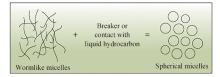
Fig.1
The gel-breaking mechanism of ClearFRAC clean hydrofracking fluids: The C22-tailed cationic surfactant EHAC forms wormlike micelles in brine, but the micelles collapse upon contacting hydrocarbon [5]"
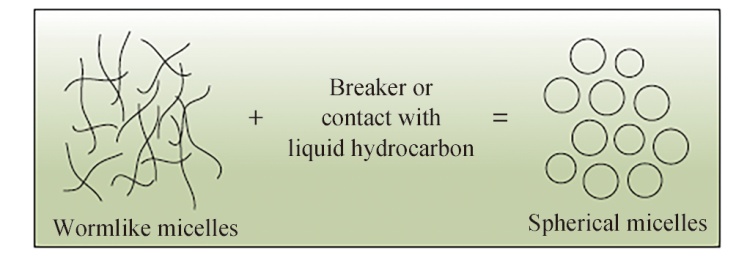
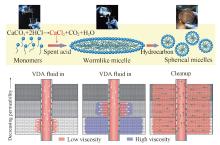
Fig.2
Schematic illustration of (a) stimulation acid thickened by VES and breaking of the wormlike micelles, (b) and the operation mechanism of viscoelastic diverting acid (VDA)[6]"
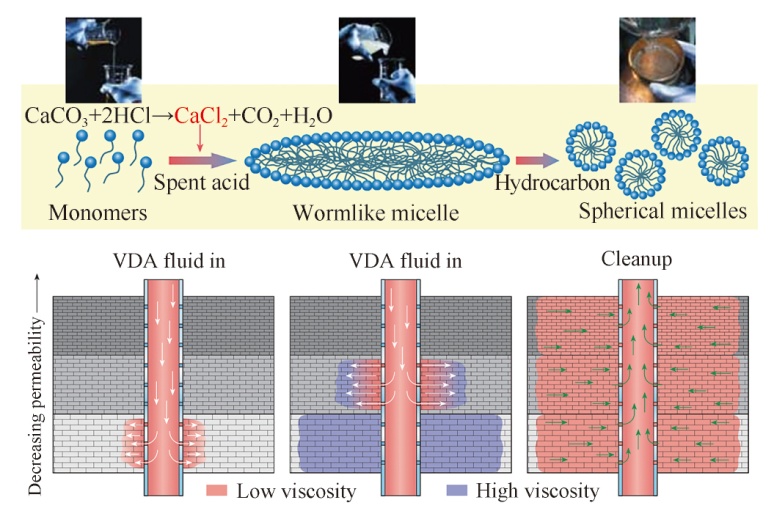
Fig.3
Comparison of conductivity development in cores with three different permeabilities after injection of (a) 15% hydrochloric acid and (b) VES self-diverting acid[23]"
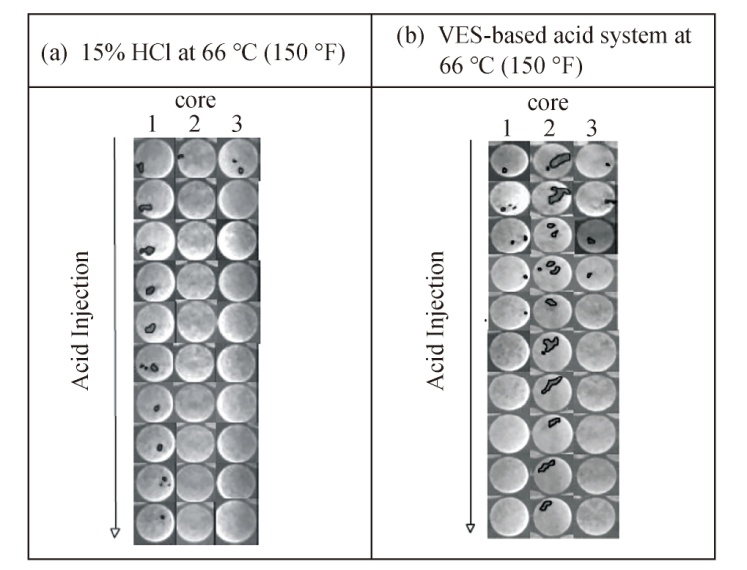
Fig.4
(a) Viscosity of 2.0% EDPA in hydrochloric acid and CaCl2 solutions of different mass fractions at 150 ℃ and 170 s-1;(b) Comparison of the acid-etching results of 20% HCl and 2.0% EDPA-20% HCl on carbonate rocks[30]"
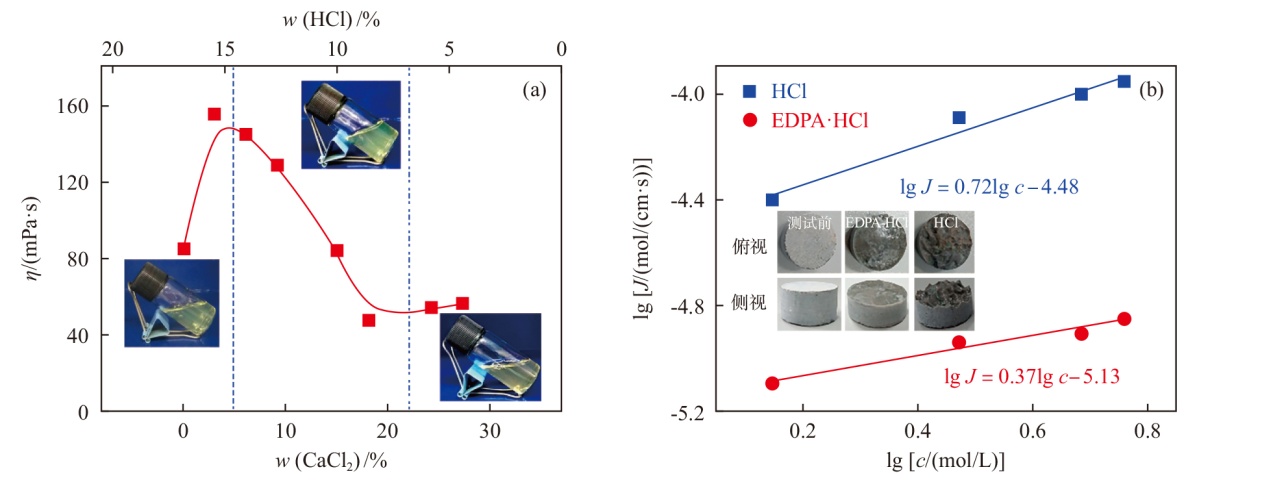
Fig.5
CO2-responsive surfactant UC22AMPM for gas channeling control during water-alternating-CO2 (WAG) flooding.(a) Mechanism by which UC22AMPM enhances gas channeling control and improves oil recovery in WAG flooding;(b) Apparent viscosity variation of UC22AMPM brine solutions under CO2 and N2 at 45 ℃ and 10 MPa;(c) High-pressure CO2-induced viscosity enhancement and shear-induced gelation mechanism of UC22AMPM;(d) Differential pressure across a three-layer heterogeneous core versus injection volume during conventional WAG flooding and UC22AMPM-enhanced WAG flooding under typical reservoir conditions of the Daqing Oilfield (45 ℃, 10 MPa, salinity 4 500 mg/L)[45]"
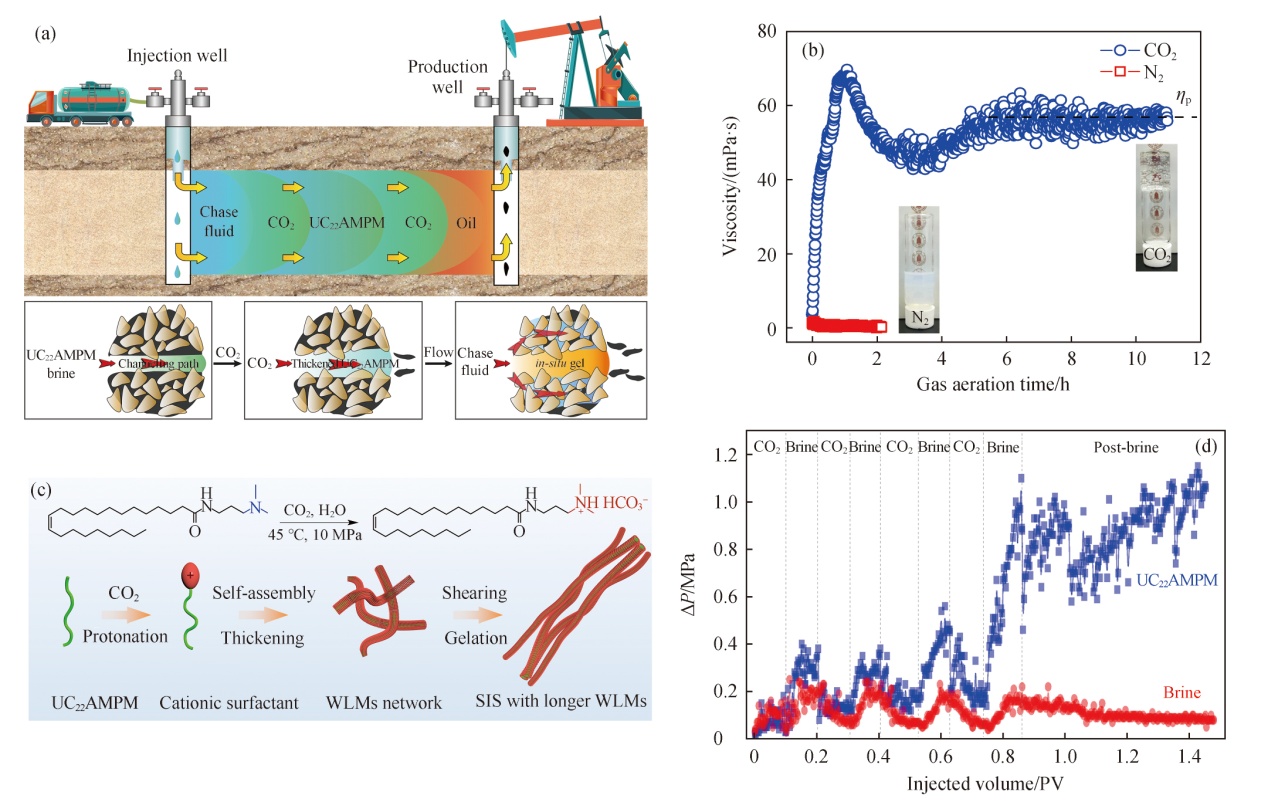
Fig.6
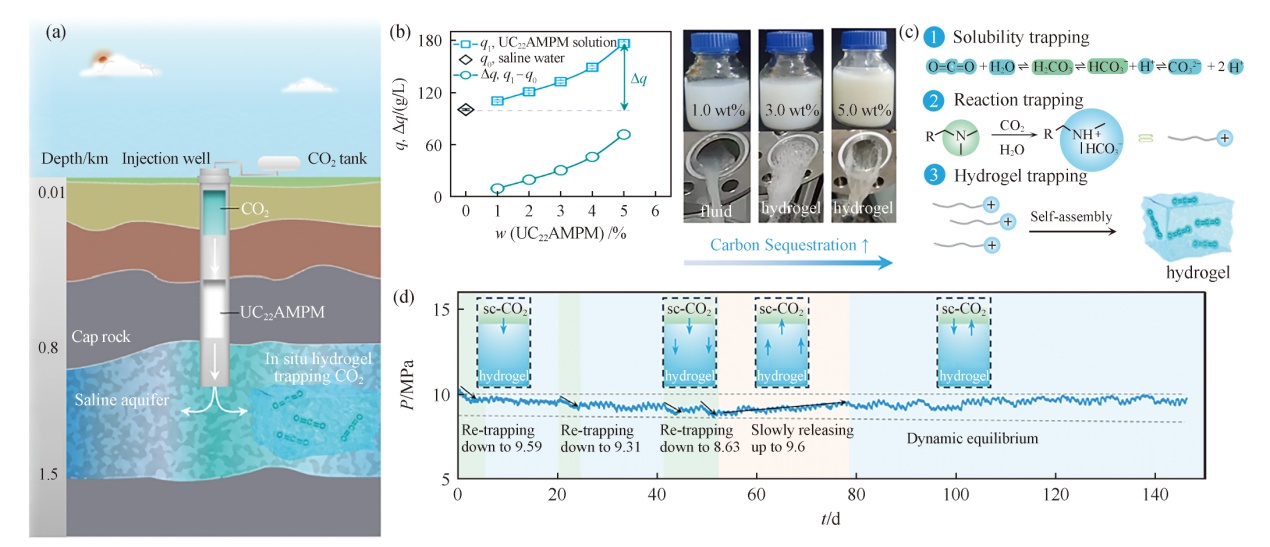
(a) Schematic illustration of in situ gelation for carbon storage induced by the CO2-responsive surfactant UC22AMPM;(b) Carbon storage capacity of UC22AMPM at different concentrations under reservoir conditions (45 ℃, 10 MPa) and the corresponding state changes before and after storage;(c) Threefold mechanisms for enhanced carbon storage;(d) Long-term stability of in situ gel-induced carbon storage[46]"
| [1] | Sullivan P, Nelson E B, Anderson V, et al. Oilfield applications of giant micelles. In: Zana R, Kaler E J, eds, Giant Micelles: Properties and Applications[M]. CRC Press, Boca Raton, 2007: 453-472. |
| [2] | Sullivan P F, Panga M K R, Lafitte V. Applications of wormlike micelles in the oilfield industry. In: Dreiss C, Feng Y, eds, Wormlike micelles: Advances in systems, characterisation and applications[M]. Royal Society of Chemistry, London, 2017: 330-352. |
| [3] | Kefi S, Lee J, Pope T L, et al. Expanding applications for viscoelastic surfactants[J]. Oilfield Review, 2004 (4) : 10-23. |
| [4] |
Maitland G C. Oil and gas production[J]. Current opinion in Colloid & Interface Science, 2001, 5 (5-6) : 301-311.
doi: 10.1016/S1359-0294(00)00069-8 |
| [5] | Chase B, Chmilowski W, Marcinew R, et al. Clear fracturing fluids for increased well productivity[J]. Oilfield Review, 1997 (3) : 20-33. |
| [6] | Al-Anzi E, Al-Mutawa M, Al-Habib N, et al. Positive reactions in carbonate reservoir stimulation[J]. Oilfield Review, 2003 (4) : 28-45. |
| [7] |
Wang J, Huang Y, Zhang Y, et al. Study of fracturing fluid on gel breaking performance and damage to fracture conductivity[J]. Journal of Petroleum Science and Engineering, 2020, 193: 107443.
doi: 10.1016/j.petrol.2020.107443 |
| [8] | Fink J F. Hydraulic fracturing chemicals and fluids technology[M]. Gulf Professional Publishing, 2013: 1-16. |
| [9] |
Jennings A R. Fracturing fluids-then and now[J]. Journal of Petroleum Technology, 1996, 48 (7) : 604-610.
doi: 10.2118/36166-JPT |
| [10] |
Raghavan S R, Kaler E W. Highly viscoelastic wormlike micellar solutions formed by cationic surfactants with long unsaturated tails[J]. Langmuir, 2001, 17 (2) : 300-306.
doi: 10.1021/la0007933 |
| [11] | Miller E, Rothstein J P. Transient evolution of shear-banding wormlike micellar solutions[J]. Journal of Non-Newtonian Fluid Mechanics, 2007, 142 (1) : 22-37. |
| [12] | Shibaev A V, Osiptsov A A, Philippova O E. Novel trends in the development of surfactant-based hydraulic fracturing fluids: A review[J]. Gels, 2021, 7 (4) : 258. |
| [13] |
Cawiezel K E, Gupta D V S. Successful optimization of viscoelastic foamed fracturing fluids with ultralightweight proppants for ultralow-permeability reservoirs[J]. SPE Production and Operations, 2010, 25 (1) : 80-88.
doi: 10.2118/119626-PA |
| [14] | Samuel M M, Card R J, Nelson E B, et al. Polymer-free fluid for fracturing applications[J]. SPE Drilling & Completion, 1999, 14 (4) : 240-246. |
| [15] | 刘新全, 易明新, 赵金钰, 等. 黏弹性表面活性剂(VES)压裂液[J]. 油田化学, 2001, 18 (3) : 273-277. |
| [16] |
Huang T, Crews J B. Nanotechnology applications in viscoelastic surfactant stimulation fluids[J]. SPE Production and Operations, 2008, 23 (4) : 512-517.
doi: 10.2118/107728-PA |
| [17] | Crews J B, Huang T. Performance enhancements of viscoelastic surfactant stimulation fluids with nanoparticles[C]// Paper SPE113533 presented at the Europec/EAGE Conference and Exhibition, Rome, Italy, June 2008. |
| [18] | Huang T, Crews J B, Agrawal G. Nanoparticle pseudocrosslinked micellar fluids: optimal solution for fluid-loss control with internal breaking[C]// Paper SPE128067 presented at the SPE International Symposium and Exhibition on Formation Damage Control, Lafayette, Louisiana, USA, February 2010. |
| [19] |
Philippova O E, Molchanov V S. Enhanced rheological properties and performance of viscoelastic surfactant fluids with embedded nanoparticles[J]. Current Opinion in Colloid & Interface Science, 2019, 43: 52-62.
doi: 10.1016/j.cocis.2019.02.009 |
| [20] | 黄胜铭, 蒋官澄, 焦庆立, 等. 黏弹性表面活性剂压裂液的制备及其对页岩气吸附/解吸性能的评价[J]. 钻井液与完井液, 2006, 43 (1) : 120-129. |
| [21] |
Fredd C N, Fogler H S. Influence of transport and reaction on wormhole formation in porous media[J]. AIChE Journal, 1998, 44(9) : 1933-1949.
doi: 10.1002/aic.v44:9 |
| [22] | Gomaa A M M, Nasr-El-Din H A. New insights into the viscosity of polymer-based in-situ-gelled acids[J]. SPE Production & Operation, 2010, 25 (3) : 367-375. |
| [23] | Chang F, Qu Q, Frenier W. A novel self-diverting-acid developed for matrix stimulation of carbonate reservoirs[C]// Paper SPE65033 presented at the SPE International Symposium on Oilfield Chemistry, 2001 (2) : 13-16. |
| [24] | Lungwitz B, Fredd C, Brady M, et al. Diversion and cleanup studies of viscoelastic surfactant-based self-diverting acid[J]. SPE Production & Operation, 2007, 22 (1) : 121-127. |
| [25] | Taylor D, Santhana K P, Fu D, et al. Viscoelastic surfactant based self-diverting acid for enhanced stimulation in carbonate reservoirs[C]// Paper SPE82263 presented at the SPE European Formation Damage Conference, The Hague, Netherlands, May 13-14, 2003. |
| [26] |
Afra S, Samouei H, Nasr-El-Din H A. NMR investigation of viscoelastic surfactant compatibility with corrosion inhibitors[J]. SPE Journal, 2021, 26 (3) : 1250-1260.
doi: 10.2118/204214-PA |
| [27] |
Liu P, Xue H, Zhao L Q, et al. Analysis and simulation of rheological behavior and diverting mechanism of in situ self-diverting acid[J]. Journal of Petroleum Science and Engineering, 2015, 132: 39-52.
doi: 10.1016/j.petrol.2015.04.042 |
| [28] |
Liu M, Zhang S, Mou J, et al. Diverting mechanism of viscoelastic surfactant-based self-diverting acid and its simulation[J]. Journal of Petroleum Science and Engineering, 2013, 105: 91-99.
doi: 10.1016/j.petrol.2013.03.001 |
| [29] | Al-Otaibi M A, Al-Muntasheri G A, Hussein I A, et al. Experimental evaluation of viscoelastic surfactant acid diversion for carbonate reservoirs: parameters and performance analysis[C]// Paper SPE141993 presented at the SPE Middle East Oil and Gas Show and Conference, Manama, Bahrain, September 25-28, 2011. |
| [30] |
Wang J, Qi N, Yin H Y, et al. A robust viscoelastic surfactant tolerating 20% HCl up to 150 ℃ for oil well stimulation[J]. Petroleum Science, 2024, 21 (3) : 1865-1874.
doi: 10.1016/j.petsci.2024.01.010 |
| [31] | Sarraf S A, Frigaard I A. Gravel packing: How does it work?[J]. Physics of Fluids, 2020, 32 (5) : 053308. |
| [32] | Brown J E, King L R, Nelson E B, et al. Use of a viscoelastic carrier fluid in frac-pack applications[C]// Paper SPE31114 presented at the SPE Formation Damage Control Symposium, Lafayette, Louisiana, February 14-15, 1996. |
| [33] | Jain S, Gadiyar B, Stamm B, et al. Friction pressure performance of commonly used viscous gravel-packing fluids[J]. SPE Drilling & Completion, 2011, 26 (2) : 227-237. |
| [34] | Joseph K P, Cawiezel K E, Wood N. Case history: Overcoming the challenges of deepwater gravel packing by using viscoelastic fluids in wells with concentric-annulus completions[C]// Paper SPE134087 presented at the SPE Annual Technical Conference and Exhibition, Florence, Italy, September 19-22, 2010. |
| [35] | Nasr-El-Din H A, Samuel M. Lessons learned from using viscoelastic surfactants in well stimulation[J]. SPE Production & Operation, 2007, 22 (1) : 112-120. |
| [36] | Messler D, Kippie D, Broach M, et al. A potassium formate milling fluid breaks the 400 °F barrier in a deep Tuscaloosa coiled tubing clean-out[C]// Paper SPE86503 presented at the SPE International Symposium and Exhibition on Formation Damage Control, Lafayette, Louisiana, February 18-20, 2004. |
| [37] | Tiffin D L, Stein M H, Wang X. Drawdown guidelines for sand control completions[C]// Paper SPE84495 presented at the SPE Annual Technical Conference and Exhibition, Denver, Colorado, October 5-8, 2003. |
| [38] | Samuel M, Polson D, Graham D, et al. Viscoelastic surfactant fracturing fluids: Applications in low permeability reservoirs[C]// Paper SPE60322 presented at the SPE Rocky Mountain Regional/Low-Permeability Reservoirs Symposium and Exhibition, Denver, Colorado, March 12-15, 2000. |
| [39] | Lakatos I, Toth J, Bodi T, et al. Application of viscoelastic surfactants as mobility-control agents in low-tension surfactant floods[C]// Paper SPE 106005 presented at the 2007 SPE International Symposium on Oilfield Chemistry held in Houston, USA, February 28-March 2, 2007. |
| [40] | Morvan M, Degré G, Leng J, et al. New viscoelastic fluid for chemical EOR[C]// Paper SPE 121675 presented at the 2009 SPE International Symposium on Oilfield Chemistry held in The Woodlands, Texas, USA, April 20-22, 2009. |
| [41] | Morvan M, Degré G, Beaumont J, et al. Optimization of viscosifying surfactant technology for chemical EOR[C]// Paper SPE 154053 presented at the Eighteenth SPE Improved Oil Recovery Symposium held in Tulsa, Oklahoma, USA, April 14-18, 2012. |
| [42] | Degré G, Morvan M, Beaumont J, et al. Viscosifying surfactant technology for chemical EOR: A reservoir case[C]// Paper SPE 154675 presented at the SPE EOR Conference at Oil and Gas West Asia held in Muscat, Oman, April 16-18, 2012. |
| [43] | Morvan M, Degré G, Beaumont J, et al. Viscosifying surfactant technology for heavy oil reservoirs[C]// Paper SPE 157729 presented at the SPE Heavy Oil Conference Canada held in Calgary, Alberta, Canada, June 12-14, 2012. |
| [44] |
Li M Y, Yin Q, Li B, et al. Enhanced oil recovery with a thermo-thickening viscoelastic surfactant: A comparison with polymer[J]. Petroleum Science, 2025, 22: 5176-5188.
doi: 10.1016/j.petsci.2025.08.007 |
| [45] |
Luo X J, Wei B, Gao K, et al. Gas channeling control with an in-situ smart surfactant gel during water-alternating-CO2 enhanced oil recovery[J]. Petroleum Science, 2023, 20 (5) : 2835-2851.
doi: 10.1016/j.petsci.2023.03.003 |
| [46] | Liu F, Luo X, Wu D, et al. In situ CO2-induced hydrogels for enhancing carbon sequestration in saline aquifers[J]. Advanced Science, 2026: e77958. |
| [47] |
Cao X, Guo W, Zhu Q, et al. Supramolecular self-assembly of robust, ultra-stable, and high-temperature-resistant viscoelastic worm-like micelles[J]. Journal of Colloid and Interface Science, 2023, 649: 403-415.
doi: 10.1016/j.jcis.2023.06.086 pmid: 37354797 |
| [48] |
Shang Y, Li Z, Zhu Q, et al. A salt-induced smart and tough clean hydrofracturing fluid with superior high-temperature and high-salinity resistance[J]. Energy, 2024, 286: 129685.
doi: 10.1016/j.energy.2023.129685 |
| [49] |
Fan H, Zheng T, Chen H, et al. Viscoelastic surfactants with high salt tolerance, fast-dissolving property, and ultralow interfacial tension for chemical flooding in offshore oilfields[J]. Journal of Surfactants and Detergents, 2018, 21 (4) : 475-488.
doi: 10.1002/jsde.2018.21.issue-4 |
| [1] | Lulu Liu, Qiang Chen, Yixiu Han, Yujun Feng. Viscoelastic surfactants (Ⅸ) Ultra-long-chain ionic surfactants [J]. China Surfactant Detergent & Cosmetics, 2026, 56(9): 1134-1143. |
| [2] | Lulu Liu, Qiang Chen, Yujun Feng. Viscoelastic surfactants (VIII) Ultra-long-chain nonionic surfactants [J]. China Surfactant Detergent & Cosmetics, 2026, 56(8): 977-983. |
| [3] | Yujun Feng. Viscoelastic surfactants (VII) CO2-responsive wormlike micelles [J]. China Surfactant Detergent & Cosmetics, 2026, 56(7): 833-840. |
| [4] | Zonglin Chu, Zhanpeng Jiang, Yujun Feng. Viscoelastic surfactants (VI) Smart wormlike micelles [J]. China Surfactant Detergent & Cosmetics, 2026, 56(6): 695-705. |
| [5] | Yujun Feng. Viscoelastic surfactants (V) Similarity and difference between wormlike micelles and polymers [J]. China Surfactant Detergent & Cosmetics, 2026, 56(5): 557-563. |
| [6] | Yujun Feng. Viscoelastic surfactants (III)Steady rheology and shear bandings [J]. China Surfactant Detergent & Cosmetics, 2026, 56(3): 277-283. |
| [7] | Yujun Feng. Viscoelastic surfactants(II)Formation mechanisms and system formulations of wormlike micelles [J]. China Surfactant Detergent & Cosmetics, 2026, 56(2): 137-148. |
| [8] | Yujun Feng. Viscoelastic surfactants (I)Evolution of micelles and discovery of wormlike micelles [J]. China Surfactant Detergent & Cosmetics, 2026, 56(1): 8-16. |
| [9] | Liang Yihuan,Du Jing. “Jelly” phenomenon rheology study and improvement in shampoo system [J]. China Surfactant Detergent & Cosmetics, 2022, 52(9): 920-929. |
| [10] | ZHANG Meng, QI Li-yun, LONG Yu, WANG Ji-yuan, QI Song-zhu, HUANG Yuan-lin, FANG Xue-jin. Study on rheological behaviors of pH-responsive wormlike micelles formed by an amine oxide surfactant [J]. China Surfactant Detergent & Cosmetics, 2017, 47(6): 301-306. |
| [11] | MIN Hong-bo, MEI Ping, LAI Lu, WU Xiao-mei, YANG Xian. Synthesis and rheological properties of multiple-quaternary ammonium surfactants [J]. China Surfactant Detergent & Cosmetics, 2015, 45(6): 301-305. |
| [12] | YUAN Min-jia, DONG Chao, SHEN Pei-lin, LU Hai-wei, WANG Jin-shuang, FANG Bo, GUO Yi-guang. Study on properties of self-thickening system composed of amphoteric surfactant and amino-acid based anionic surfactant [J]. China Surfactant Detergent & Cosmetics, 2015, 45(1): 11-16. |
| [13] | LI Xia-qing, ZHANG Chi, ZHANG Gui-cai, GE Ji-jiang, WANG Zong-sheng. Applications of viscoelastic surfactant in oilfield [J]. China Surfactant Detergent & Cosmetics, 2014, 44(9): 521-524. |
|
