Welcome to China Surfactant Detergent & Cosmetics, Today is


China Surfactant Detergent & Cosmetics ›› 2026, Vol. 56 ›› Issue (10): 1318-1326.doi: 10.3969/j.issn.2097-2806.2026.10.004
• Basic research • Previous Articles Next Articles
Rong Zhang1,2,Lijun Zheng1,2,Yan Wang1,2,Jun Wang1,2,Jiarui Hu3,4,Xu Yang3,4,*( ),Ping Zhao3,4,Bin Lv3,4,*()
Received:2025-12-24
Revised:2026-09-21
Online:2026-10-22
Published:2026-10-30
Contact:
E-mail: CLC Number:
Rong Zhang, Lijun Zheng, Yan Wang, Jun Wang, Jiarui Hu, Xu Yang, Ping Zhao, Bin Lv. Preparation and properties of the nanoemulsions stabilized by ternary surfactant mixtures of a POSS-based giant surfactant and two small-molecule surfactants[J].China Surfactant Detergent & Cosmetics, 2026, 56(10): 1318-1326.
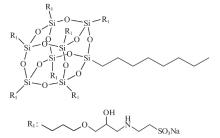
Fig.1
Molecular structure of the POSS-based giant surfactant functionalized with sulfonic acid groups"
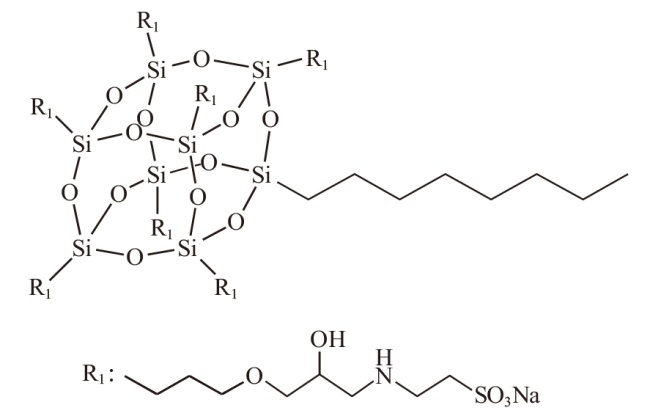
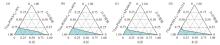
Fig.2
Pseudo-ternary phase diagrams of nanoemulsions prepared by using 7Tau-POSS-C8 blended with JFC (a), TO-4070 (b), APG0810 (c) and APG1214 (d) at a ratio of 1:1 as the main surfactant"
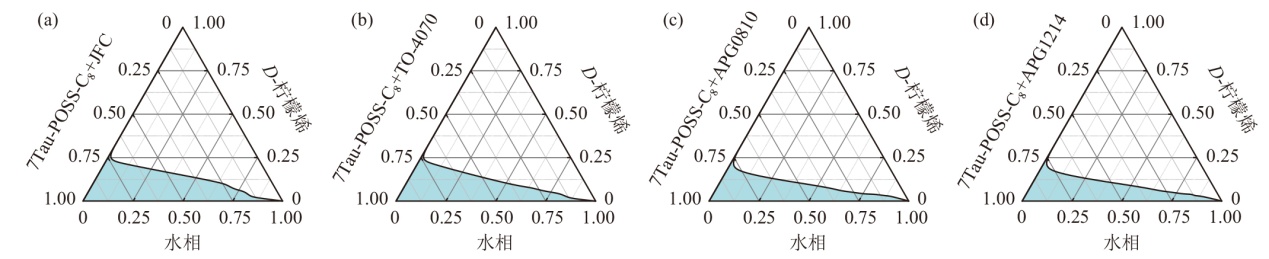
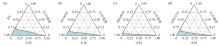
Fig.3
Pseudo-ternary phase diagrams of the nanoemulsions prepared with JFC (a), TO-4070 (b), APG0810 (c), and APG1214 (d) as the surfactants"
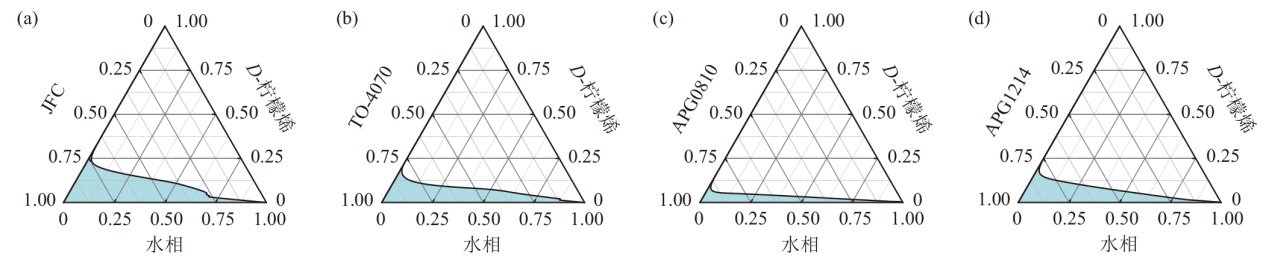
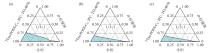
Fig.4
Pseudo-ternary phase diagrams of nanoemulsions with different mass ratios of mixed surfactants (m (7Tau-POSS-C8) : m (JFC) : m (TO-4070) = 1:1:1, 1:1:2, and 1:2:1)"
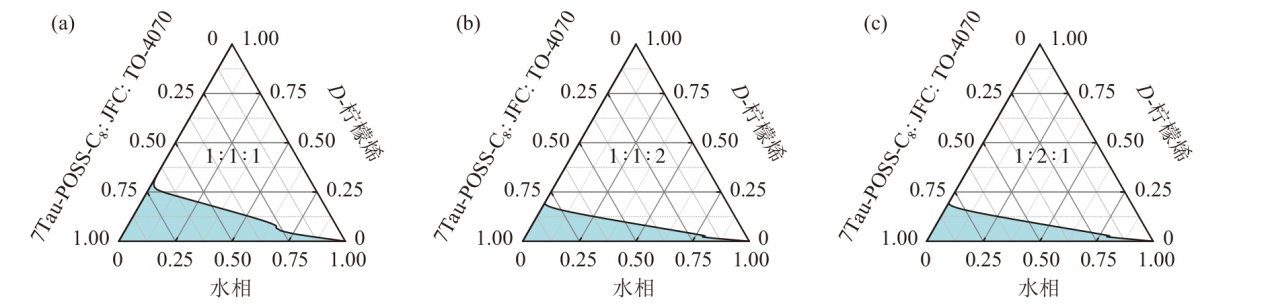
Fig.5
Pseudo-ternary phase diagrams of nanoemulsions with different mass ratios of mixed surfactants (m (JFC) :m (TO-4070) = 1:1, 1:2, and 2:1)"
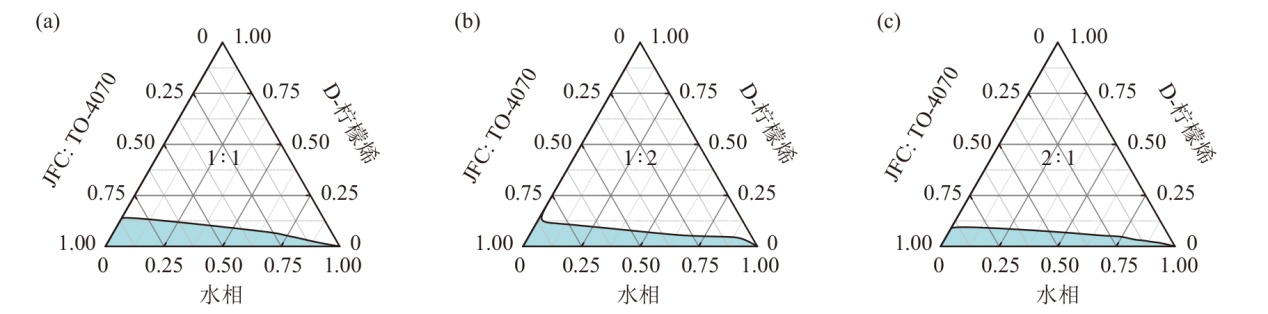
Fig.6
Particle size distribution of NANO-E and 7Tau-POSS-C8-NANO-E at 2% (w/%)"
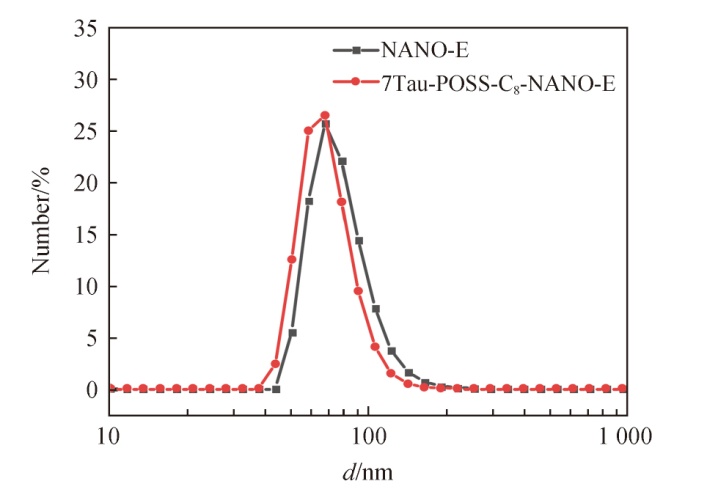
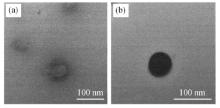
Fig.7
Morphology of NANO-E (a) and 7Tau-POSS-C8-NANO-E (b) at 1% (w/%)"
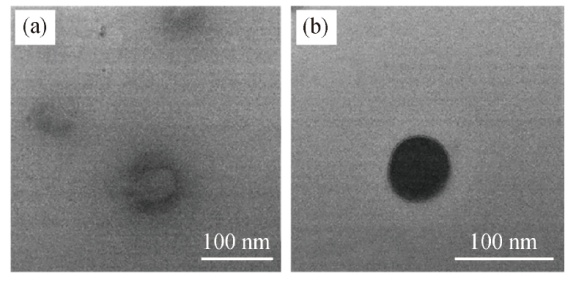
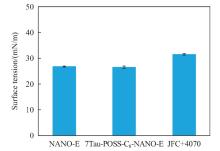
Fig.8
Surface tension of 2% (w/%) solutions of the aqueous solution of JFC+4070 and the 2% (w/%) NANO-E, 7Tau-POSS-C8-NANO-E"
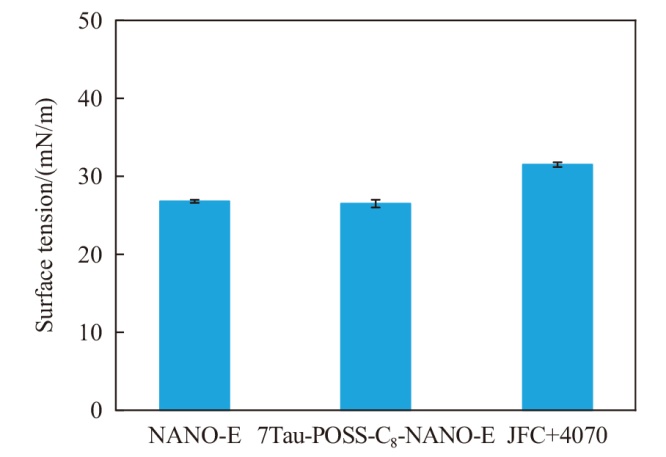
Fig.9
Interfacial tension of NANO-E and 7Tau-POSS-C8-NANO-E:(a) 2% (w/%) diluted solutions;(b) undiluted samples"
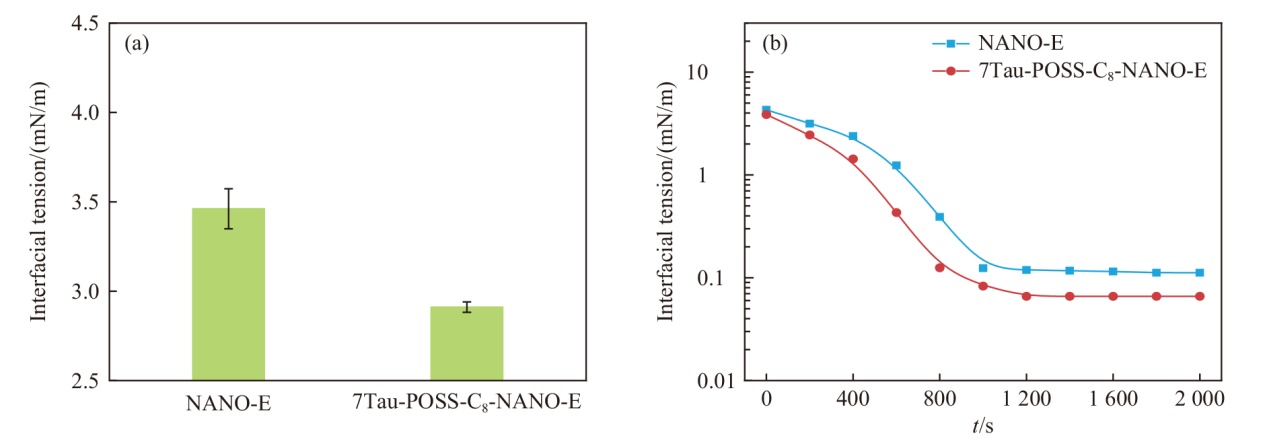
Fig.10
Effects of mass concentrations of NaCl (a) and CaCl2 (b) on the interfacial tension of 2% (w/%) NANO-E and 7Tau-POSS-C8-NANO-E"
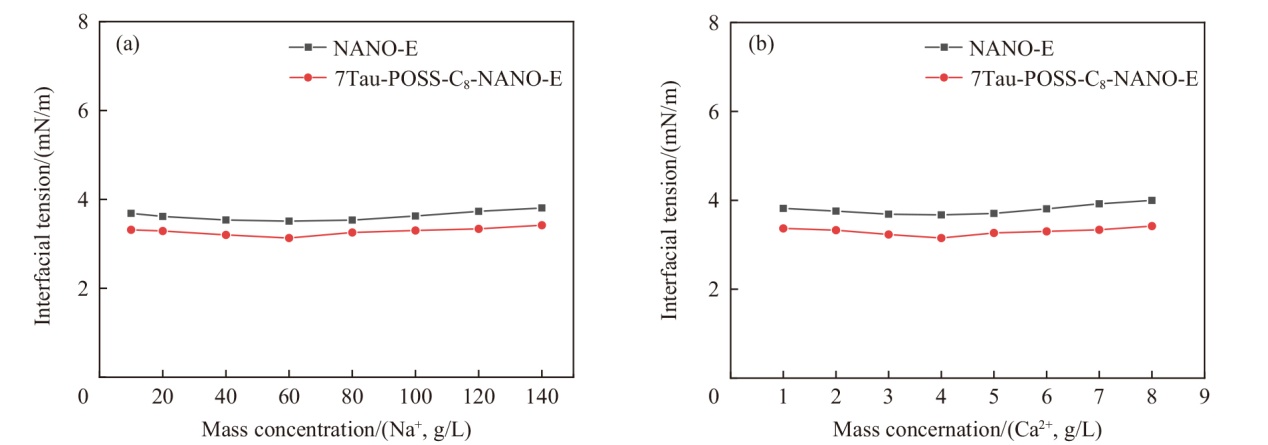
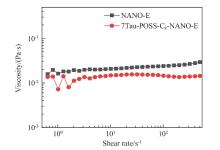
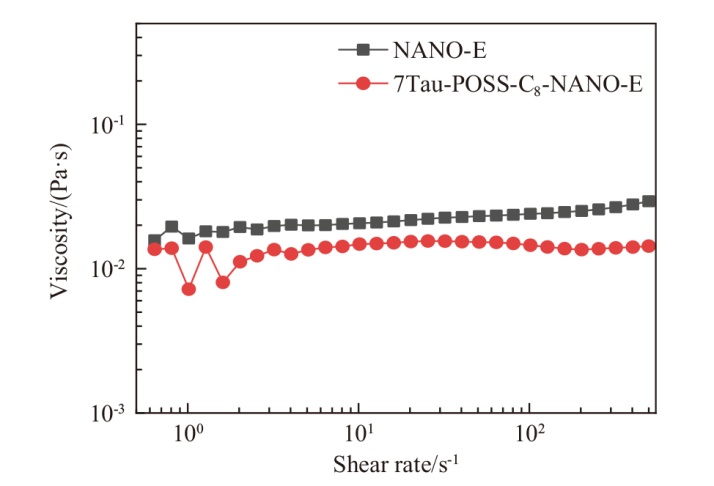
Fig.11
Viscosity-shear rate curves of the nanoemulsions with and without 7Tau-POSS-C8"
Tab.1
Oil-sand washing efficiency of different samples"
| 类型 | m1 /g | m2 /g | m3 /g | 洗油率/% |
|---|---|---|---|---|
| 7Tau-POSS-C8-NANO-E | 2.0 | 28.75 | 27.13 | 90.48 |
| TO-4070-NANO-E | 2.0 | 27.99 | 26.36 | 88.10 |
| JFC | 2.0 | 28.68 | 26.87 | 45.24 |
| TO-4070 | 2.0 | 28.55 | 26.75 | 47.62 |
| [1] | 蒋晓倩, 张丽亚, 宋爱新, 等. 鼠李糖脂稳定的纳米乳液及其凝胶的构筑和性能研究[J]. 日用化学工业, 2025, 55 (6) : 677-686. |
| [2] | 邓学峰, 强星, 魏开鹏, 等. 纳米乳液提高致密油藏渗吸效果评价及矿场应用[J]. 非常规油气, 2025, 12 (3) : 74-80. |
| [3] | 王鹏祥. 深层页岩气用纳米乳液排驱剂研究与应用[J]. 非常规油气, 2025, 12 (3) : 81-88. |
| [4] | 罗钰, 修伟业, 王峙力, 等. 纳米乳液的制备方法及其应用研究进展[J]. 粮食与油脂, 2023, 36 (7) : 5-9. |
| [5] |
Naseema A, Kovooru L, Behera A K, et al. A critical review of synthesis procedures, applications and future potential of nanoemulsions[J]. Advances in Colloid and Interface Science, 2021, 287: 102318.
doi: 10.1016/j.cis.2020.102318 |
| [6] | 曾丽亚, 王哲. Tween80纳米乳液体系影响因素分析[J]. 广东化工, 2023, 50 (11) : 1-5. |
| [7] |
Safaya M, Rotliwala Y. Neem oil based nano-emulsion formulation by low energy phase inversion composition method: Characterization and antimicrobial activity[J]. Materials Today: Proceedings, 2022, 57: 1793-1797.
doi: 10.1016/j.matpr.2021.12.478 |
| [8] |
Liu Q, Gao Y, Fu X, et al. Preparation of peppermint oil nanoemulsions: Investigation of stability, antibacterial mechanism and apoptosis effects[J]. Colloids and Surfaces B: Biointerfaces, 2021, 201: 111626.
doi: 10.1016/j.colsurfb.2021.111626 |
| [9] | 赵宇, 吴梓浩, 何丰谐, 等. 香芹酚纳米乳液结合ε-聚赖氨酸盐酸盐对冷鲜猪肉的保鲜效果[J]. 肉类研究, 2025, 39 (3) : 48-55. |
| [10] | 陈超, 李海波, 仇凤玲, 等. 双功能基多面体低聚倍半硅氧烷(POSS)的合成与表征[J]. 高分子材料科学与工程, 2012, 28(4) : 5-8. |
| [11] | 邓佩丽, 吴蕾. 八甲基乙烯基多面低聚倍半硅氧烷的合成[J]. 科技创新导报, 2018, 15 (26) : 91-92. |
| [12] |
王纯标, 冯宇, 迟庆国. 笼型聚倍半硅氧烷在聚合物改性领域的应用[J]. 化工新型材料, 2023, 51 (8) : 79-82.
doi: 10.19817/j.cnki.issn1006-3536.2023.08.015 |
| [13] |
Wang J, Zhou D L, Lin X, et al. Preparation of low-k poly (dicyclopentadiene) nanocomposites with excellent comprehensive properties by adding larger POSS[J]. Chemical Engineering Journal, 2022, 439: 135737.
doi: 10.1016/j.cej.2022.135737 |
| [14] | Wang Mingyue, Chi Hong, Joshy K S, et al. Progress in the synthesis of bifunctionalized polyhedral oligomeric silsesquioxane[J]. Polymers, 2019, 11 (12) : 2098. |
| [15] |
姚亚琳, 刘晶, 王胖胖, 等. POSS改性热固性酚醛树脂的性能研究[J]. 复合材料科学与工程, 2022 (5) : 92-97, 119.
doi: 10.19936/j.cnki.2096-8000.20220528.013 |
| [16] | 杜桢, 王岚, 叶祖山, 等. 巨型表面活性剂的溶液自组装[J]. 高分子材料科学与工程, 2021, 37 (1) : 157-168. |
| [17] |
Shan W, Zhang W, Huang M, et al. Fine-tuned order-order phase transitions in giant surfactants via interfacial engineering[J]. Giant, 2020, 1: 100002.
doi: 10.1016/j.giant.2020.100002 |
| [18] | 唐雯, 岳衎, 程正迪. 巨型表面活性剂的本体自组装研究和分子拓扑结构效应[J]. 高分子学报, 2018 (8) : 959-972. |
| [19] |
Li Z, Fu Y, Li Z, et al. Froth flotation giant surfactants[J]. Polymer, 2019, 162: 58-62.
doi: 10.1016/j.polymer.2018.12.023 |
| [20] |
Zhu L, Chen K, Hao J, et al. Synthesis and crystallization behavior of surfactants with hexamolybdate as the polar headgroup[J]. Inorganic Chemistry, 2015, 54 (13) : 6075-6077.
doi: 10.1021/acs.inorgchem.5b00903 pmid: 26067891 |
| [21] |
Xu X, Shao Y, Wang W, et al. Phase behaviors of giant surfactants with different numbers of fluorinated polyhedral oligomeric silsesquioxane “heads” and one poly (ethylene oxide) “tail” at the air-water interface[J]. Langmuir, 2021, 37 (37) : 11084-11092.
doi: 10.1021/acs.langmuir.1c01777 |
| [22] |
Bai Y, He S, Lian Y, et al. Giant surfactant-stabilized N2-foam for enhanced oil recovery after water flooding[J]. RSC Advances, 2019, 9 (54) : 31551-31562.
doi: 10.1039/C9RA06388A |
| [23] |
Wang Y, Cui J, Han Y, et al. Effect of chain architecture on phase behavior of giant surfactant constructed from nanoparticle monotethered by single diblock copolymer chain[J]. Langmuir, 2018, 35 (2) : 468-477.
doi: 10.1021/acs.langmuir.8b03756 |
| [24] |
陈光宇, 瞿昊宇, 谢梦洲, 等. 基于伪三元相图法探索湿疹纳米乳处方[J]. 中国药学杂志, 2023, 58 (12) : 1110-1116.
doi: 10.11669/cpj.2023.12.007 |
| [25] | 张峙, 胡徐彦, 袁辉, 等. 鼠李糖脂纳米乳液的构建及性能研究[J]. 日用化学工业, 2021, 51 (11) : 1067-1072. |
| [26] |
兰爽, 张顶学, 王勇, 等. 低渗透油藏微纳米乳液增注技术实验研究[J]. 石油化工, 2024, 53 (4) : 553-558.
doi: 10.3969/j.issn.1000-8144.2024.04.011 |
| [1] | Xiaofeng Song, Yihao Zhang, Xinxin Ren, Zhian Li, Ming Li, Hansong Fang. Preparation of peppermint essential oil nanoemulsion and evaluation of its anti-wrinkle efficacy [J]. China Surfactant Detergent & Cosmetics, 2026, 56(6): 776-782. |
| [2] | Xiaorong Ma, Jin Huang, Yan Xu, Feng Li, Qinghe Gao, Cuiqin Li. Emulsifying properties of an isomer of sodium cetyl-o-xylene sulfonate and its microscopic mechanism at oil-water interface [J]. China Surfactant Detergent & Cosmetics, 2026, 56(2): 158-168. |
| [3] | Yang Zhao, Yan Wang, Wenjie Tang, Shuohan Ren, Guihong Zhang, Jianggai Li. Preparation and evaluation of O/W microemulsions containing salicylic acid [J]. China Surfactant Detergent & Cosmetics, 2026, 56(2): 176-184. |
| [4] | Chunsheng Zhang, Changlong Liu, Bin Chen, Yanyue Li, Fantao Meng, Peng Zhao. Preparation and performance evaluation of the nanoemulsions stabilized with betaine surfactants [J]. China Surfactant Detergent & Cosmetics, 2026, 56(2): 201-207. |
| [5] | Xiaoqian Jiang, Liya Zhang, Aixin Song, Xiuping Sun. Preparation and properties of the nanoemulsions and nanoemulsion gels stabilized with rhamnolipid [J]. China Surfactant Detergent & Cosmetics, 2025, 55(6): 677-686. |
| [6] | Xingting Wang, Zhaojuan Shi, Jun Wu, Chuanxun Yuan, Risheng Jin. Preparation and study of Camellia oleifera seed oil-ceramide nanoemulsion [J]. China Surfactant Detergent & Cosmetics, 2025, 55(6): 739-746. |
| [7] | Yingying Wang, Zhenchao Ma, Zhe Li, Yibo Kong, Xinyi Zhao, Yaowen Xing, Xiahui Gui. Mechanism of enhanced low-rank coal flotation using a nanoemulsion collector based on zwitterionic/nonionic surfactants [J]. China Surfactant Detergent & Cosmetics, 2025, 55(12): 1534-1543. |
| [8] | Fei Yi, Fantao Meng, Bin Chen, Hao Xu, Xiaoyan Wu, Xiaoliang Li. Molecular simulation study on the behavior of long-alkyl-chain betaine surfactants at the interface between water and the oil [J]. China Surfactant Detergent & Cosmetics, 2024, 54(10): 1166-1171. |
| [9] | Zhao Zhijuan,Gong Peilong,Wang Xiahui,Yu Jiahui,Liu Xiaomei. Preparation and antioxidant properties of Elaeagnus mollis Diels seed oil nanoemulsions [J]. China Surfactant Detergent & Cosmetics, 2022, 52(7): 731-736. |
| [10] | Xie Zhihui,Liu Jianzhong,Ning Haoliang,Yu Yuanhao,Chen Yamin,Peng Shuge. Preparation of an O/W microemulsion nano-carrier and its performance in cannabidiol encapsulation [J]. China Surfactant Detergent & Cosmetics, 2022, 52(5): 514-520. |
| [11] | Zhang Hucheng,Yang Guowei,Yang Jun,Fan Haitao,Luo Shuai,Liu Linying. Preparation of cordycepin nanoemulsion and its repair mechanism on the photoaged skin [J]. China Surfactant Detergent & Cosmetics, 2022, 52(10): 1072-1080. |
| [12] | Zhang Zhi,Hu Xuyan,Yuan Hui,Li Yanchuang. Preparation and performance evaluation of the nanoemulsion based on rhamnolipid [J]. China Surfactant Detergent & Cosmetics, 2021, 51(11): 1067-1072. |
| [13] | Wu Zichao,Ye Chao,Piao Mingguan. Preparation of diol-type ginsenoside W/O nanoemulsion and research on anti-aging mechanism of skin [J]. China Surfactant Detergent & Cosmetics, 2021, 51(10): 963-968. |
| [14] | ZHAO Zhi-juan,GONG Pei-long,CUI Xiao-dong,WANG Zhuan-hua. Bacteriostatic properties of amino acid composite nanoemulsion [J]. China Surfactant Detergent & Cosmetics, 2020, 50(5): 309-313. |
| [15] | ZHANG Guo-rui,SONG Yong-ting,BAO Mu-tai,WANG Wei-dong,LI Xi-ming. Study of the performance of mixed whey protein-rhamnolipid bioemulsifier [J]. China Surfactant Detergent & Cosmetics, 2019, 49(12): 783-789. |
|
