Welcome to China Surfactant Detergent & Cosmetics, Today is


China Surfactant Detergent & Cosmetics ›› 2025, Vol. 55 ›› Issue (11): 1402-1407.doi: 10.3969/j.issn.2097-2806.2025.11.005
• Basic research • Previous Articles Next Articles
Xiuhua Yan,Lanqin Tang*( )
)
Received:2025-07-22
Revised:2025-10-24
Online:2025-11-22
Published:2025-12-22
CLC Number:
Xiuhua Yan, Lanqin Tang. Synthesis and properties of phosphobetaine-modified ZnO[J].China Surfactant Detergent & Cosmetics, 2025, 55(11): 1402-1407.
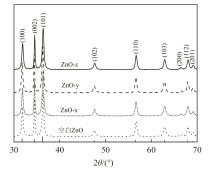
Fig. 1
XRD patterns of non-modified ZnO and PB modified samples (ZnO-x, ZnO-y and ZnO-z)"
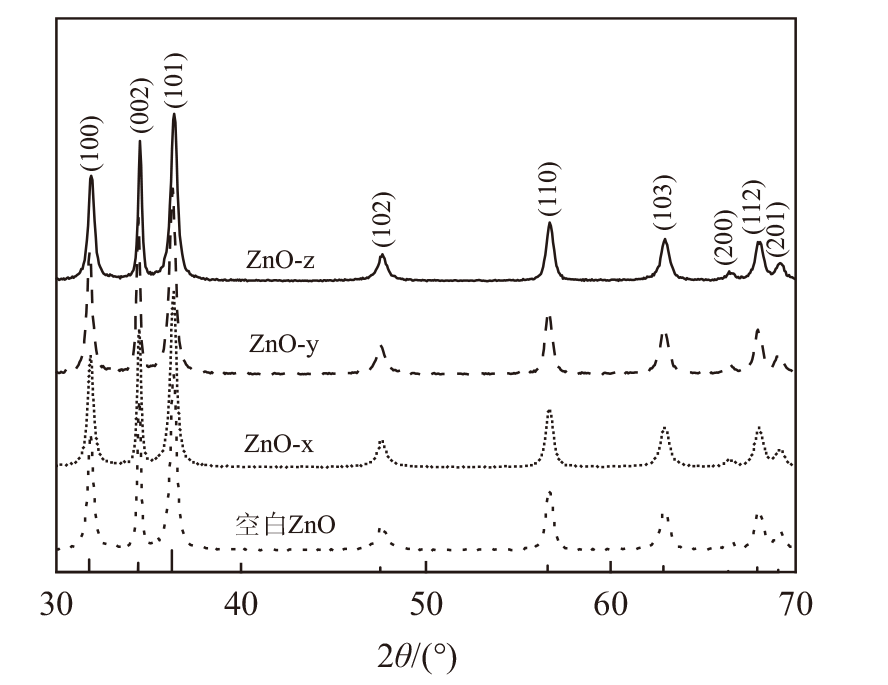
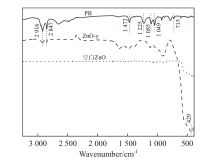
Fig. 2
FTIR spectra of non-modified ZnO, PB modified sample (ZnO-y), and PB"
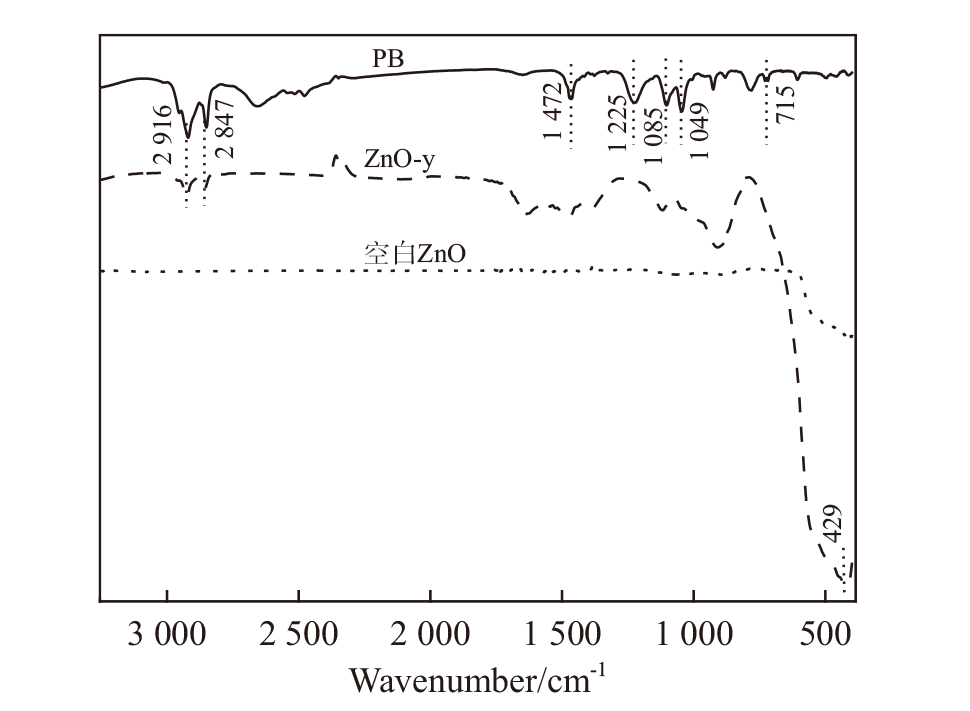
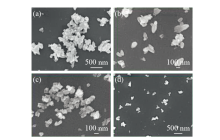
Fig. 3
FESEM images of non-modified ZnO (a) and PB modified samples (ZnO-x (b), ZnO-y (c), and ZnO-z (d))"
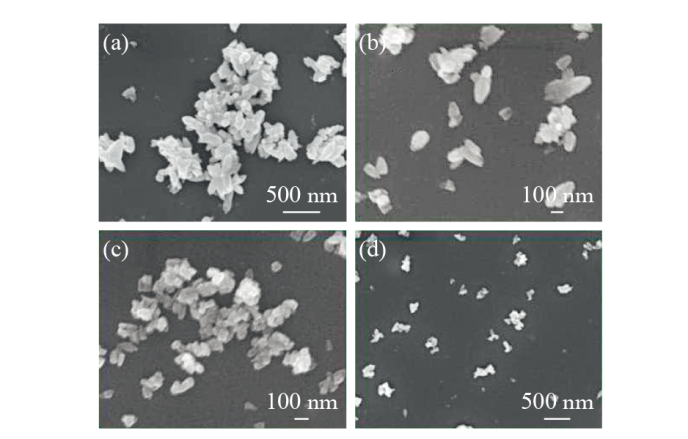
Fig. 4
FESEM images of samples ZnO-y1 (a) and ZnO-y2 (b)"
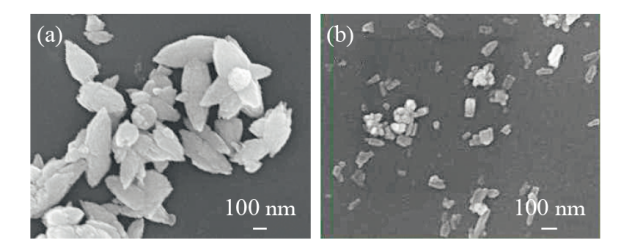
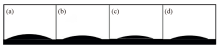
Fig. 5
Contact angles of non-modified ZnO (a) and PB modified ZnO (modified with different amount of PB: (b) 3.0%, (c) 5.0%, (d) 10.0%)"
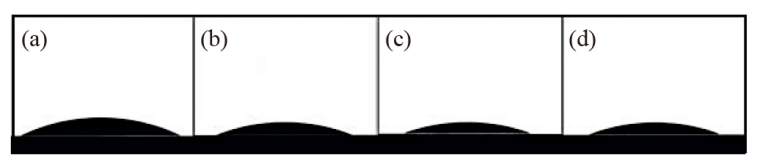
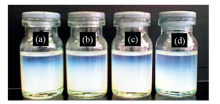
Fig. 6
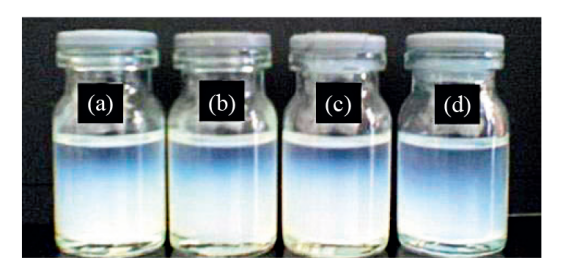
Photos of ZnO-x (a), ZnO-y (b), ZnO-z (c) and non-modified ZnO (d) dispersed in ethylene glycol for 20 days at room temperature"
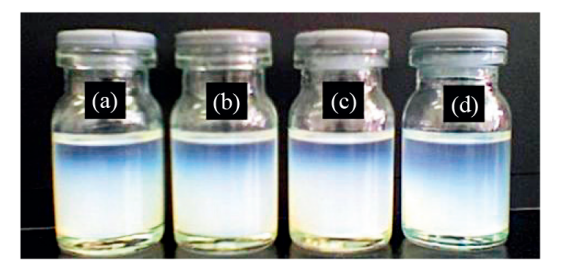
Fig. 7
Photos of ZnO-x (a), ZnO-y (b), ZnO-z (c) and non-modified ZnO (d) dispersed in ethylene glycol for 30 days at room temperature"
| [1] |
Li G, Cheng B L, Zhang H B, et al. Progress in UV photodetectors based on ZnO nanomaterials: A review of the detection mechanisms and their improvement[J]. Nanomaterials (Basel), 2025, 15 (644) : 1-16.
doi: 10.3390/nano15010001 |
| [2] | 张家彬, 邵伟平, 赵国阳, 等. 纳米ZnO的制备及应用研究[J]. 光学与光电技术, 2025, 23 (3) : 125-127. |
| [3] |
Baek N, Kim Y T, Marcy J E, et al. Physical properties of nanocomposite polylactic acid films prepared with oleic acid modified titanium dioxide[J]. Food Packaging and Shelf Life, 2018, 17: 30-38.
doi: 10.1016/j.fpsl.2018.05.004 |
| [4] |
Huong N T, Son N N, Thanh V M, et al. Glutamic acid-coated zinc oxide nanoparticles: synthesis, characterization, and anticancer activity[J]. Journal of Nanoparticle Research, 2025, 27 (15) : 1-16.
doi: 10.1007/s11051-024-06200-2 |
| [5] | 孙晓敏, 左士祥, 余瑶瑶, 等. 基于片状ZnO的功效性紫外屏蔽材料的制备及性能研究[J]. 日用化学工业(中英文), 2025, 55 (1) : 55-62. |
| [6] | 杨卓, 李春雷, 张鑫, 等. 纳米氧化锌液相法制备技术进展[J]. 无机盐工业, 2024, 56 (3) : 1-11. |
| [7] | Kwon D, Park J, Park J, et al. Effects of surface-modifying ligands on the colloidal stability of ZnO nanoparticle dispersions in in vitro cytotoxicity test media[J]. Int. J. Nanomedicine, 2014, 9 (Suppl 2): 57-65. |
| [8] | Khurana N, Arora P, Pente A S, et al. Surface modification of zinc oxide nanoparticles by vinyltriethoxy silane (VTES)[J]. Inorganic Chemistry Communications, 2021, 124: 1-8. |
| [9] | 王玲玲, 陈淼, 张志新, 等. 改性纳米氧化锌的制备及在环氧树脂中的应用[J]. 中国胶粘剂, 2025, 34 (1) : 65-70. |
| [10] |
Xue M S, Xu T, Xie X L, et al. Formation, transformation and superhydrophobicity of compound surfactant-assisted aligned ZnO nanoplatelets[J]. Applied Surface Science, 2015, 355: 1063-1068.
doi: 10.1016/j.apsusc.2015.07.202 |
| [11] | 刘建平, 李加兴, 吴志康, 等. 月桂酸改性氧化锌纳米颗粒的Pickering乳化性能研究[J]. 日用化学工业, 2020, 50 (8) : 542-546. |
| [12] | 卢国强, 穆蒙, 李洋, 等. 甜菜碱型表面活性剂的研究进展[J]. 中国洗涤用品工业, 2024 (1) : 30-45. |
| [13] | 刘红, 李国威, 魏少华. 磷酸酯甜菜碱表面活性剂的研究[J]. 科技进展, 1998, 12: 19-21. |
| [14] | 李文志, 刘慧, 马文萱, 等. 温度调控下纳米ZnO光催化剂的性能及机理研究[J]. 化工新型材料, 2025, 53 (Suppl.1): 285-289. |
| [15] | Srihari S, Sathyanath R, Kalpathy S K, et al. Effect of nanoscale surface modification on the interfacial mechanics of carbon fibers[J]. Advanced Materials Interfaces, 2024, 11 : 1-13. |
| [16] | Herrera-Rivera R, Olvera M D L L, Maldonado A. Synthesis of ZnO nanopowders by the homogeneous precipitation method: Use of taguchi’s method for analyzing the effect of different variables[J]. Journal of Nanomaterials, 2017: 1-9. |
| [17] |
刘丹, 邱华. 硅烷偶联剂IPTS改性纳米ZnO的制备及性能研究[J]. 化工新型材料, 2023, 51 (7) : 271-275.
doi: 10.19817/j.cnki.issn1006-3536.2023.07.049 |
| [18] | 刘佳佳, 许虎君. 脂肪酰胺丙基磷酸酯甜菜碱的合成和性能研究[J]. 日用化学工业, 2020, 52 (7) : 446-451. |
| [19] | 苗向阳, 刘可, 柯惟中, 等. 两种不同形貌的ZnO纳米粒子的制备和光学性质研究[J]. 南京师大学报, 2007, 30 (4) : 66-70. |
| [20] |
Ji P, Wang C S, Jiang Z L, et al. Influence of surface modification of zinc oxide nanoparticles on thermal behavior and hydrophilic property of PET-PEG composites[J]. Polymer Composites, 2015, 37 (6) : 1830-1838.
doi: 10.1002/pc.v37.6 |
| [21] |
Du H C, Yuan F L, Huang S L, et al. A new reaction to ZnO nanoparticles[J]. Chemistry Letters, 2004, 33 (6) : 770-771.
doi: 10.1246/cl.2004.770 |
| [22] |
Wood A, Giersig M, Hilgendorff M, et al. Size effects in ZnO: The cluster to quantum dot transition[J]. Aust. J. Chem., 2003, 56: 1051-1057.
doi: 10.1071/CH03120 |
| [23] |
Lamer B V, Dinegar R. Theory, production and mechanism of formation of monodispersed hydrosols[J]. Journal of the American Chemical Society, 1950, 72: 4847-4854.
doi: 10.1021/ja01167a001 |
| [24] |
Chen J B, Ma Y Y, Lin H P, et al. Fabrication of hydrophobic ZnO/PMHS coatings on bamboo surfaces: The synergistic effect of ZnO and PMHS on anti-mildew properties[J]. Coatings, 2018, 9 (1) : 1-10.
doi: 10.3390/coatings9010001 |
| [25] | 杨华, 夏润蒲, 卢秀萍, 等. 纳米氧化锌的改性及其对生物高分子P(3HB-co-4HB)的增韧增强作用[J]. 功能材料, 2015, 2 (46). |
| [26] | 张潇轩. 纳米ZnO的表面改性及其在抗菌涂料中的应用[D]. 西安: 西安理工大学, 2023. |
| [27] | 张婉萍, 关馨, 郑时莲, 等. PMTMS/TiO2复合材料的制备及其性能表征[J]. 日用化学工业(中英文), 2025, 54 (10) : 1227-1234. |
| [28] |
Zhou X Q, Hayat Z, Zhang D D, et al. Zinc oxide nanoparticles: Synthesis, characterization, modification, and applications in food and agriculture[J]. Processes, 2023, 11 (4) : 1-23.
doi: 10.3390/pr11010001 |
| [29] |
Sheng Y, Zhou B, Zhao J Z, et al. Influence of octadecyl dihydrogen phosphate on the formation of active super-fine calcium carbonate[J]. J. Colloid Interface Sci., 2004, 272 (2) : 326-329.
doi: 10.1016/j.jcis.2003.11.062 |
| [1] | Xiaomin Sun, Shixiang Zuo, Yaoyao Yu, Xin Wu, Yue Cai, Chao Yao. Preparation and properties of effective UV-shielding materials based on flake-shaped ZnO [J]. China Surfactant Detergent & Cosmetics, 2025, 55(1): 55-62. |
| [2] | Chang Xiangling, Chai Fei. Preparation and performance study of zinc oxide nanocomposite antibacterial materials [J]. China Surfactant Detergent & Cosmetics, 2023, 53(9): 1051-1056. |
| [3] | Tan Wenbo,Meng Yanqiang. Synthesis and UV absorption capacity of nano-zinc oxides [J]. China Surfactant Detergent & Cosmetics, 2023, 53(8): 908-914. |
| [4] | Zhang Zhenyang, He Yunyang. Syntheses of ZnO nanoparticles and their degradation activities on tetracycline hydrochloride [J]. China Surfactant Detergent & Cosmetics, 2023, 53(7): 781-788. |
| [5] | Zhang Yaru,Liu Dong,Zhang Yun,Chen Hao,Cao Yuhua. Preparation of SiO2-encapsulated TiO2 composite nanoparticles and evaluation of the sunscreen performance [J]. China Surfactant Detergent & Cosmetics, 2022, 52(1): 28-34. |
| [6] | LIU Jian-ping,LI Jia-xing,WU Zhi-kang,HU Chen-yu. Study on the Pickering emulsifying properties of zinc oxide nanoparticles modified by lauric acid [J]. China Surfactant Detergent & Cosmetics, 2020, 50(8): 542-546. |
| [7] | LIU Jia-jia,XU Hu-jun. Study on the synthesis and properties of fatty amido propyl phosphobetaine [J]. China Surfactant Detergent & Cosmetics, 2020, 50(7): 446-451. |
| [8] | FENG Mei-xi, YAN Hui-qiong, CHEN Xiu-qiong, LIN Liang-quan, YANG Zheng, LIN Qiang. Effects of benzyl-grafted alginate derivative on the dispersion stability of TiO2 nanoparticles [J]. China Surfactant Detergent & Cosmetics, 2018, 48(6): 341-347. |
| [9] | ZHAO Shu-fang, HOU Lei-xin, LIU Dan-dan, FANG Li, CHENG Fang-qin. Surface modification of rutile titania-silica nanocomposites by ammonium fluoride [J]. China Surfactant Detergent & Cosmetics, 2018, 48(5): 283-287. |
| [10] | SONG Jun-da, CHEN Hong-ling. Preparation of ZnO sol and its performance for bacteriostasis and photocatalytic degradation of organics [J]. China Surfactant Detergent & Cosmetics, 2017, 47(8): 452-457. |
| [11] | LIU Yu-min, LIU Yue. Modification research of the effect of coupling agent on surface of nano barium sulfate [J]. China Surfactant Detergent & Cosmetics, 2015, 45(2): 85-89. |
| [12] | SUN Jing-jing, SONG Wei-ming, SUN Li, MA Shuai, LIU Peng, WANG Fei. Controllable preparation and properties of Fe3O4-ZnO composites [J]. China Surfactant Detergent & Cosmetics, 2015, 45(1): 32-35. |
| [13] | CHEN Xiao-kang, XU Ka-qiu, MA Hong-peng, LU Er-kai, ZHANG Zhen. Study of suspension stability of mica titanium dioxide pearl pigment in hair shampoo system [J]. China Surfactant Detergent & Cosmetics, 2014, 44(5): 270-272. |
| [14] | CAO Zhi, ZHANG Dao-jun. Inorganic sunscreening agents [J]. China Surfactant Detergent & Cosmetics, 2014, 44(12): 700-705. |
|
