欢迎访问《日用化学工业(中英文)》,今天是


日用化学工业(中英文) ›› 2026, Vol. 56 ›› Issue (5): 687-694.doi: 10.3969/j.issn.2097-2806.2026.05.016

• 分析与检测 • 上一篇    

高效液相色谱法检测人参化妆品制剂中6种人参皂苷含量

秦松1,*(),李松宾2   

  1. 1.焦作市产品质量检验检测中心,河南 焦作 454000
    2.商丘市产品质量检验检测中心,河南 商丘 476000
  • 收稿日期:2026-01-08 修回日期:2026-05-08 出版日期:2026-05-22 发布日期:2026-06-22

Determination of the contents of six ginsenosides in ginseng cosmetic preparations by high performance liquid chromatography

Song Qin1,*(),Songbin Li2   

  1. 1. Jiaozuo Product Quality Inspection and Testing Center, Jiaozuo, Henan 454000, China
    2. Shangqiu Product Quality Inspection and Testing Center, Shangqiu, Henan 476000, China
  • Received:2026-01-08 Revised:2026-05-08 Online:2026-05-22 Published:2026-06-22
  • Contact: *E-mail: qinmugong@foxmail.com.

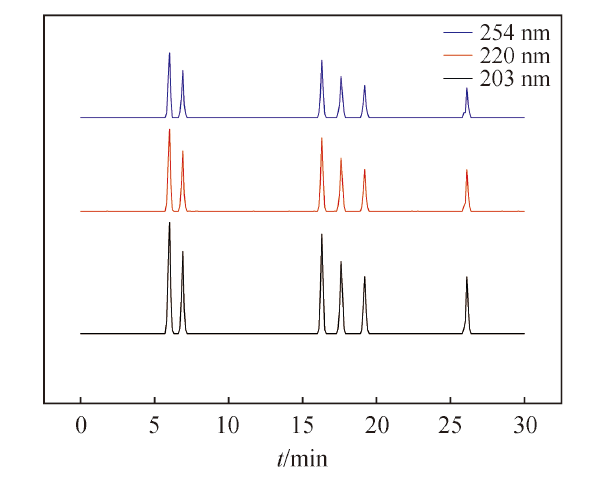
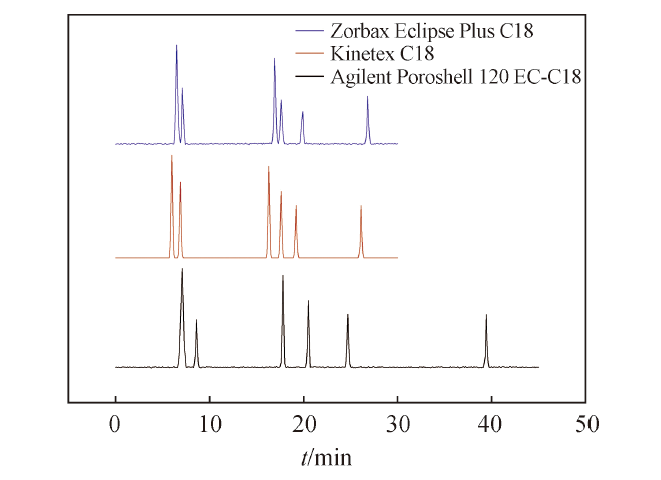
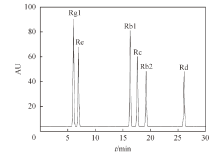
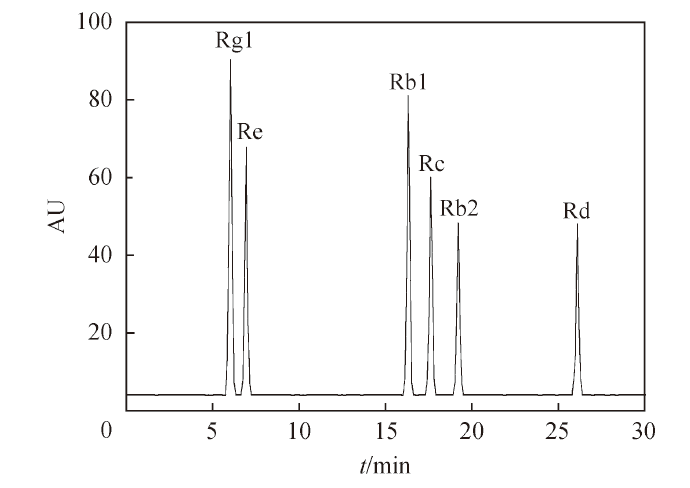
摘要: 构建了一种基于高效液相色谱法(HPLC)的人参化妆品制剂中6种人参皂苷(Rb1、Rb2、Rc、Rd、Re、Rg1)的同步定量分析方法。选用80%乙醇溶液作为提取溶剂,通过石油醚脱脂协同水饱和正丁醇萃取技术消除基质干扰,结合控温浓缩处理保护热敏性组分。样品在40 ℃下超声萃取40 min(功率300 W,频率40 kHz),期间每10 min涡旋10 s。采用核壳结构Kinetex C18色谱柱(100 mm×2.1 mm, 2.6 μm),以乙腈-0.1%磷酸水为流动相实施梯度洗脱,在203 nm波长下实现35 min内6种皂苷的基线分离。方法学验证表明,日内精密度相对标准偏差(RSD)为1.72%~4.65%,日间精密度RSD为2.24%~4.59%,RSD均小于5%。线性回归分析显示,6种人参皂苷的相关系数(r)均大于0.999,检测限(LOD)范围为0.11~0.23 μg/mL,定量限(LOQ)范围为0.33~0.70 μg/mL。6种人参皂苷在不同加标质量浓度下的平均回收率范围为95.73%~104.65%,RSD均优于5%。本研究依据优化后的HPLC检测方法对市售10种人参类化妆品(涵盖精华液、面霜、乳液三类)中6种人参皂苷进行定量分析,结果表明Rb1为优势皂苷,膏霜总皂苷(均值471.0~552.7 μg/g)高于精华液(均值178.7~418.4 μg/g)和乳液(均值212.1~347.6 μg/g)。该方法首次构建三重净化-快速分离联用体系,显著提升检测效率并克服化妆品乳化体系干扰,为人参功效成分质量控制提供技术支撑。

关键词: 高效液相色谱法, 人参, 化妆品, 人参皂苷, 同步定量分析

Abstract:

In this study, a synchronous quantitative analytical method for six ginsenosides (Rb1, Rb2, Rc, Rd, Re, Rg1) in ginseng cosmetics using high performance liquid chromatography (HPLC) was established. The method uses 80% ethanol solution as the extraction solvent. Matrix interference is eliminated by degreasing with petroleum ether combined with extraction with water-saturated n-butyl alcohol, and the thermosensitive components are protected by temperature-controlled concentration. Samples were ultrasonically extracted at 40 ℃ for 40 min (power 300 W, frequency 40 kHz), with vortexing for 10 s every 10 min. A Kinetex C18 chromatographic column with a core-shell structure (100 mm×2.1 mm, 2.6 μm) was used, and gradient elution was performed with acetonitrile-0.1% phosphoric acid aqueous solution as the mobile phase (the proportion of acetonitrile increases from 18% to 55% within 0-35 min), which achieved baseline separation of the six ginsenosides within 35 min at a wavelength of 203 nm. Method validation shows that the relative standard deviation (RSD) of intra-day precision is 1.72%-4.65%, and the RSD of inter-day precision is 2.24%-4.59%, both less than 5%. Linear regression analysis shows that the correlation coefficients (r) of the six ginsenosides are all greater than 0.999, the limit of detection (LOD) ranges from 0.11 to 0.23 μg/mL, and the limit of quantification (LOQ) ranges from 0.33 to 0.70 μg/mL. The average recoveries of the six ginsenosides at different spiked mass concentrations range from 95.73% to 104.65%, with RSDs all less than 5%. Using this optimized HPLC method, this study quantitatively analyzes the six ginsenosides in 10 commercially available ginseng cosmetics (including essences, creams, and lotions). The results show that Rb1 is the dominant ginsenoside, and the total ginsenoside content in creams (average 471.0-552.7 μg/g) is higher than that in essences (average 178.7-418.4 μg/g) and lotions (average 212.1-347.6 μg/g). This method, which combines triple purification with rapid separation, significantly improves detection efficiency and overcomes interference from the cosmetic emulsion system, providing technical support for quality control of the functional components of ginseng.

Key words: high performance liquid chromatography, ginseng, cosmetics, ginsenosides, synchronous quantitative analysis

中图分类号: 

  • TQ658