Welcome to China Surfactant Detergent & Cosmetics, Today is


China Surfactant Detergent & Cosmetics ›› 2026, Vol. 56 ›› Issue (7): 968-976.doi: 10.3969/j.issn.2097-2806.2026.07.016
• Analytical methods and testing • Previous Articles
Yarui Yang1,Yongpan Li2,Shengnan Ren2,Lin Wang2,Dandan Li1,*( ),Lili Luo1,*()
Received:2025-10-30
Revised:2026-07-01
Online:2026-07-22
Published:2026-08-06
Contact:
*E-mail: CLC Number:
Yarui Yang, Yongpan Li, Shengnan Ren, Lin Wang, Dandan Li, Lili Luo. Determination of six arsenic species in cosmetics by high-performance liquid chromatography-inductively coupled plasma mass spectrometry[J].China Surfactant Detergent & Cosmetics, 2026, 56(7): 968-976.
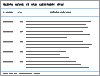
Tab.1
Gradient elution program of HPLC"
| Time/min | ?(Mobile phase A)/ % | ?(Mobile phase B)/ % | Flow rate/(mL/min) |
|---|---|---|---|
| 0 | 100 | 0 | 1.0 |
| 4.0 | 100 | 0 | 1.0 |
| 4.1 | 0 | 100 | 1.0 |
| 7.0 | 0 | 100 | 1.0 |
| 7.1 | 100 | 0 | 1.0 |
| 10 | 100 | 0 | 1.0 |
Tab.2
Optimized ICP-MS operating parameters"
| Operating parameters | Set values | Operating parameters | Set values |
|---|---|---|---|
| radio-frequency coil power/W | 1 550 | auxiliary gas flow rate/(L/min) | 0.8 |
| detector voltage/V | -1 650/+825 | coolant gas flow rate/(L/min) | 14 |
| nebulizer gas flow rate/(L/min) | 1.064 | acquisition time/s | 600 |
| collision gas flow rate(He)/(mL/min) | 4.586 | measurement mode | collision mode(KED) |
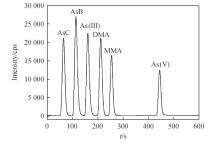
Fig.1
Standard chromatogram of six arsenic species"
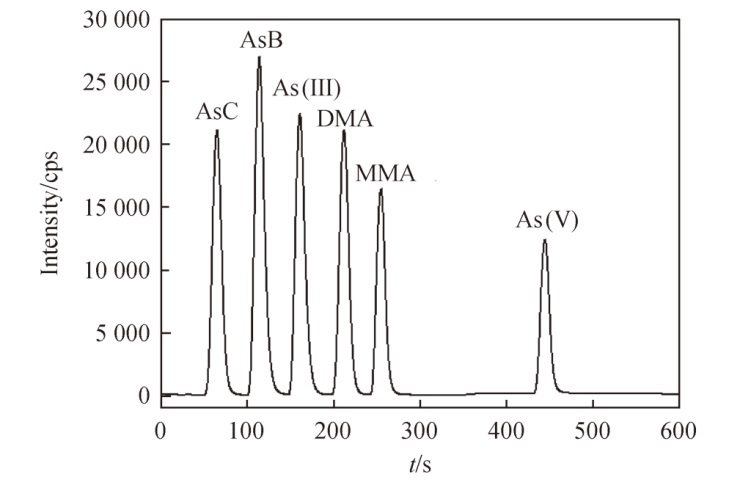
Tab.3
Extraction solution-recovery rate relationship"
| Extraction solution | Recoveries/% | |||||
|---|---|---|---|---|---|---|
| AsC | AsB | As(Ⅲ) | DMA | MMA | As(Ⅴ) | |
| 1% nitric acid + 1% ascorbic acid | 85.9-96.2 | 88.3-93.6 | 87.2-93.1 | 86.8-93.8 | 86.5-89.7 | 88.7-94.6 |
| nitric acid-simulated gastric fluid | 70.5-89.3 | 65.2-81.3 | 63.8-79.3 | 76.2-85.1 | 62.3-79.5 | 60.5-90.3 |
| pure water | 26.1-63.5 | 36.5-78.6 | 65.2-80.6 | 45.6-90.2 | 39.5-62.3 | 42.8-61.5 |
Tab.4
Extraction method-recovery rate relationship"
| Extraction method | Recoveries/% | |||||
|---|---|---|---|---|---|---|
| AsC | AsB | As(Ⅲ) | DMA | MMA | As(Ⅴ) | |
| ultrasound with heating | 87.2-93.5 | 88.2-93.1 | 87.4-92.3 | 86.9-95.3 | 86.4-92.8 | 89.2-97.3 |
| shaking with heating | 45.2-82.3 | 68.3-86.4 | 72.3-88.6 | 80.6-91.2 | 76.1-83.6 | 75.6-88.2 |
| heating alone | 61.2-81.2 | 62.1-85.7 | 75.1-84.3 | 71.2-85.1 | 59.3-76.4 | 66.5-85.1 |
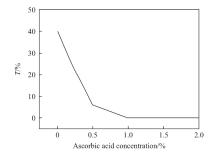
Fig.2
Effect of ascorbic acid concentration on the oxidation rate of arsenite [As(III)]"
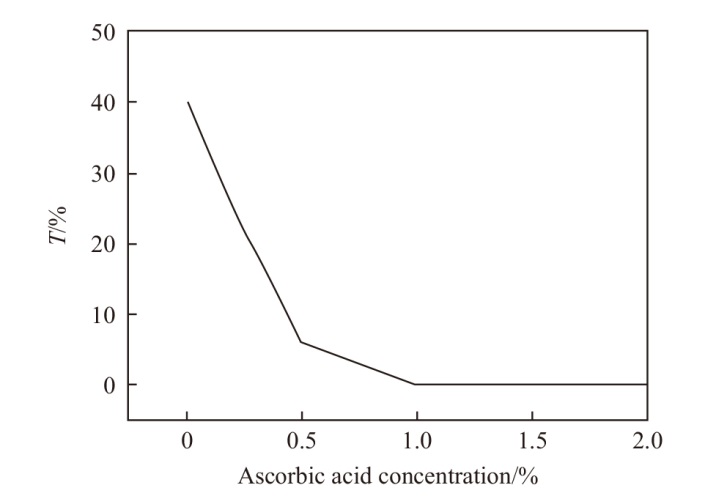
Fig.3
The relationship between extraction temperature and recovery rate"
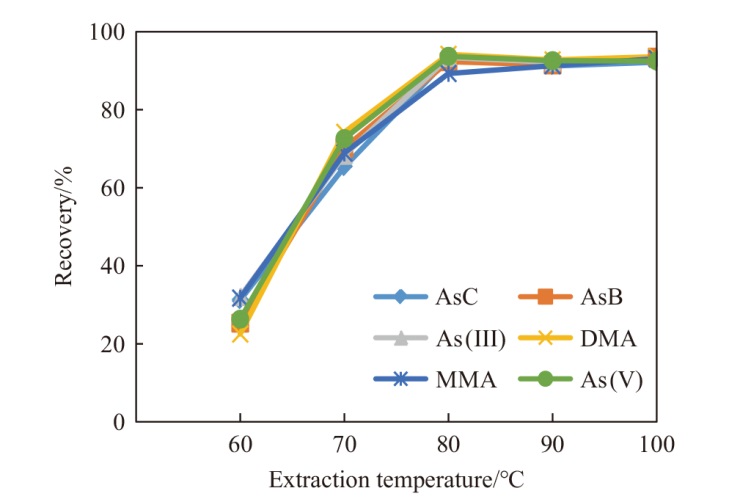
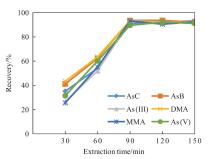
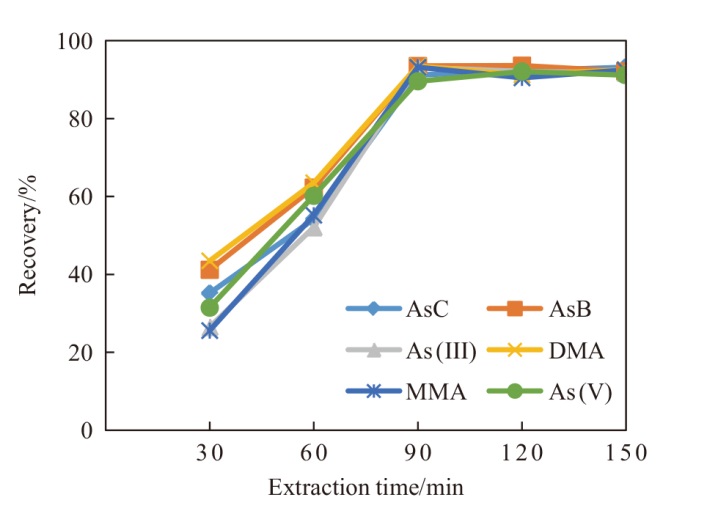
Fig.4
The relationship between extraction time and recovery rate"
Tab.5
Calibration curve, limits of detection and quantification"
| Compound | Linear range/ (μg/L) | Linear equation | Correlation coefficient (r 2) | Limit of detection/ (μg/kg) | Limit of quantification/ (μg/kg) |
|---|---|---|---|---|---|
| AsC | 1.0-100.0 | Y = 6 204.153X+134.265 | 0.996 | 1.1 | 3.5 |
| AsB | 1.0-100.0 | Y = 8 171.123X+315.128 | 0.997 | 1.3 | 4.1 |
| As(Ⅲ) | 1.0-100.0 | Y = 7 171.643X+602.198 | 0.998 | 1.5 | 4.6 |
| DMA | 1.0-100.0 | Y = 6 504.493X+394.281 | 0.996 | 1.3 | 4.1 |
| MMA | 1.0-100.0 | Y = 5 312.698X+882.960 | 0.998 | 0.9 | 2.9 |
| As(Ⅴ) | 1.0-100.0 | Y = 3 067.674X+1 318.615 | 0.999 | 1.6 | 5.0 |
Tab.6
Recovery and precision(n=6)"
| Compound | Facial essence | Toothpaste | Setting powder | ||||
|---|---|---|---|---|---|---|---|
| Fortification level/(mg/kg) | Spike recoveries/ % | Precision/ % | Spike recoveries/ % | Precision/ % | Spike recoveries/ % | Precision/ % | |
| AsC | 0.2 | 86.2-98.6 | 2.9 | 86.8-97.8 | 3.6 | 90.3-99.5 | 2.7 |
| 1.0 | 87.9-102.1 | 3.5 | 86.8-101.1 | 4.2 | 91.3-101.6 | 4.1 | |
| 2.0 | 87.1-96.8 | 2.8 | 86.9-99.3 | 3.6 | 86.9-96.8 | 2.7 | |
| AsB | 0.2 | 86.8-97.2 | 3.6 | 90.2-98.6 | 1.8 | 87.3-97.6 | 3.5 |
| 1.0 | 86.5-101.6 | 4.2 | 86.5-98.0 | 2.9 | 86.7-98.6 | 2.7 | |
| 2.0 | 87.5-98.9 | 3.8 | 87.6-97.8 | 3.2 | 90.2-99.5 | 3.5 | |
| As(Ⅲ) | 0.2 | 87.9-99.2 | 2.6 | 88.5-96.2 | 2.8 | 89.6-101.3 | 4.2 |
| 1.0 | 89.2-97.3 | 3.7 | 87.6-92.8 | 3.4 | 91.2-99.7 | 3.8 | |
| 2.0 | 86.3-98.3 | 4.1 | 86.9-98.4 | 1.9 | 89.3-98.7 | 1.9 | |
| DMA | 0.2 | 87.2-98.1 | 2.9 | 90.3-99.3 | 2.8 | 91.2-102.1 | 3.2 |
| 1.0 | 88.1-96.5 | 3.5 | 92.6-101.3 | 3.4 | 86.9-98.5 | 2.8 | |
| 2.0 | 89.2-95.6 | 4.2 | 86.9-99.8 | 2.6 | 88.7-99.1 | 3.5 | |
| MMA | 0.2 | 86.8-93.6 | 2.8 | 88.5-97.6 | 3.4 | 88.6-97.6 | 4.2 |
| 1.0 | 87.2-97.3 | 3.6 | 89.6-98.3 | 2.7 | 89.1-96.8 | 3.8 | |
| 2.0 | 86.2-98.1 | 4.3 | 90.3-99.1 | 2.3 | 90.3-99.1 | 2.8 | |
| As(Ⅴ) | 0.2 | 88.9-97.2 | 1.9 | 87.6-95.6 | 3.4 | 86.7-101.2 | 3.5 |
| 1.0 | 86.7-101.3 | 2.5 | 88.9-96.7 | 2.9 | 89.4-99.6 | 1.8 | |
| 2.0 | 88.3-98.6 | 3.5 | 87.6-99.5 | 3.5 | 91.5-100.5 | 2.9 | |
| [1] | Ran Maoxia, Wu Di, Shi Yongfu, et al. Research progress on arsenic’s bioaccumulation and biotransformation in aquatic organisms, and its metabolism and toxicology in other organisms[J]. Environmental Chemistry, 2024, 43(4): 1069-1084. |
| [2] | Li Yiling, Liu Jialin, Huang Jiao, et al. Construction of disease models for cancer and cardiovascular disease induced by dietary inorganic arsenic in China[J]. Chinese Journal of Food Hygiene, 2022, 34(5): 974-981. |
| [3] | Ma Zhibin, Xu Hongyu, Jiang Miao, et al. The apoptosis and expression of p53 and survivin in human gastrointestinal cancer cells induced by arsenic trioxide[J]. Chinese Journal of Gastroenterology and Hepatology, 2011, 20(1): 47-50. |
| [4] | Liu Tongtong, Xiao Ruolan, Cao Jin, et al. Study on stability and compatibility of rawmaterials in cosmetic quality and safety[J]. China Food & Drug Administration Magazine, 2025(9): 154-161. |
| [5] | Li Fang. Construction of a safety evaluation system for cosmetics raw materialsbased on risk assessment[J]. Chemical Engineering Management, 2025(25): 90-92. |
| [6] | Zhang Han, Song Hongjie, Lv Yi. “Heavy metal pollution case” in cosmetics world[J]. University Chemistry, 2022, 37(9): 264-268. |
| [7] |
Sadee B A, Galali Y, Zebari S M S. Toxicity, arsenic speciation and characteristics of hyphenated techniques used for arsenic determination in vegetables. A review[J]. RSC Advances, 2023, 13(44): 30959-30977.
doi: 10.1039/d3ra05770d pmid: 37876652 |
| [8] | Zhang Wei, Qi Lijuan, Ning Junyu, et al. Health hazard assessment of arsenic[J]. Journal of Toxicology, 2021, 35(5): 367-372, 378. |
| [9] | Li Shuai, Guo Han, Liang Long, et al. Analysis of arsenic and antimony detection results in 410 cosmetic raw materials[J]. Journal of Environment and Health, 2024, 41(8): 743-744. |
| [10] | Yakufu Pazilaiti, Li Xuan, Zhang Mingyue, et al. Monitoring and evaluation of mercury, arsenic and lead in cosmeticsproduced in Xinjiang Uygur Autonomous region during 2016-2017[J]. Modern Preventive Medicine, 2018, 45(14): 2662-2665. |
| [11] | National Medical Products Administration. Safety and Technical Standards for Cosmetics (2015 Edition)[S]. Beijing: The People’s Health Press, 2015. |
| [12] | Dai Jiayao, Tao Huai, Xiao Zuowei, et al. Determination of 8 heavy metals in cosmetics by inductively coupled plasma emission spectrometry[J]. China Surfactant Detergent & Cosmetics, 2025, 55(9): 1215-1220. |
| [13] | Wu Li, Pang Qinglin, Zhang Yulin, et al. Determination of 7 elements in children’s makeup by ICP-MS/MS[J]. China Surfactant Detergent & Cosmetics, 2025, 55(1): 98-103. |
| [14] | Xi Gan, Li Yang, Chen Lan, et al. Research progress on speciation analysis of arsenic in food by HPLC-ICP-MS[J]. Science and Technology of Food Industry, 2019, 40(20): 340-347. |
| [15] | Liu Huachun, Cheng Yangfang, Zhou Hongwei, et al. High-performance liquid chromatography coupled with inductively coupled plasma mass spectrometry for determining arsenic species and applications in seafood safety monitoring[J]. Analytical Methods: Advancing Methods and Applications, 2025, 17(34): 6800-6809. |
| [16] | Zhao Weixin, Wu Yue, Guo Wen, et al. Research advances of HPLC-ICP-MS in speciation analysis of heavy metal elements[J]. Chinese Journal of Inorganic Analytical Chemistry, 2025, 15(9): 1411-1417. |
| [17] |
Tanaka Y K, Matsuhashi K, Ogra Y. Analytical techniques for arsenic speciation[J]. Analytical Sciences, 2025, 41(4): 1-5.
doi: 10.1007/s44211-024-00689-2 |
| [18] | Xu Shudong, Xie Jian, Ding Gang, et al. Determination of five forms of arsenic in water by highperformance liquid chromatography-inductively coupled plasma mass spectrometry[J]. Chinese Journal of Inorganic Analytical Chemistry, 2025, 15(2): 178-184. |
| [19] | Wang Yiming, Liu Yang, Liu Liping, et al. Analysis of eight arsenic speciations in urine by high-performance liquid chroma-tography-inductively coupled plasma mass spectrometry[J]. Chinese Journal of Analysis Laboratory, 2025, 44(3): 383-389. |
| [20] |
Zheng Chenyang, Tang Jun, Pan Xiaodong, et al. Development and validation of a high-performance liquid chromatography-inductively coupled plasma mass spectrometry method for the simultaneous determination of arsenic and mercury species in human urine[J]. Chemosensors, 2025, 13(3): 78-78.
doi: 10.3390/chemosensors13030078 |
| [21] | Zhao Lijun. Simultaneous determination of six arsenic species in rice by high performance liquid chromatography-inductively coupled plasma mass spectrometry[J]. Physical Testing and Chemical Analysis (Part B: Chemical Analysis), 2024, 60(2): 238-241. |
| [22] |
Zhou Shaomin, Wang Heng, Tang Jun, et al. Simultaneous speciation analysis of arsenic and iodine in human urine by high performance liquid chromatography-inductively coupled plasma mass spectrometry[J]. Analytical Sciences: The International Journal of the Japan Society for Analytical Chemistry, 2024, 40(3): 555-562.
doi: 10.1007/s44211-023-00472-9 |
| [23] | Ge Ling, Chen Qiaolan, Zhang Zepeng, et al. Determination of six arsenic species in a large quantities of prefabricated dishes made of seafood by high performance liquid chromatography-inductively coupled plasma mass spectrometry with microwave digestion[J]. Chinese Journal of Inorganic Analytical Chemistry, 2025, 15(8): 1126-1134. |
| [24] | He Bingbing, Qiao Qing, Li Chen, et al. Determination of 5 arsenic species in livestock and poultry meat by high performance liquid chromatography-inductively coupled plasma mass spectrometry[J]. Physical Testing and Chemical Analysis (Part B: Chemical Analysis), 2024, 60(6): 593-597. |
|
