Welcome to China Surfactant Detergent & Cosmetics, Today is
China Surfactant Detergent & Cosmetics ›› 2026, Vol. 56 ›› Issue (9): 1125-1133.doi: 10.3969/j.issn.2097-2806.2026.09.001
• Invited paper • Next Articles
Zhaohui Zhou1,*( ),Shixiang Li2,Xudong Teng2,Lei Shi2,Yuankui Peng2,Jian Fan1
Received:2026-07-27
Online:2026-09-22
Published:2026-09-30
Contact:
*E-mail: CLC Number:
Zhaohui Zhou, Shixiang Li, Xudong Teng, Lei Shi, Yuankui Peng, Jian Fan. Effect of temperature on the ability of ethylhexyl extended sulfate to reduce interfacial tension[J].China Surfactant Detergent & Cosmetics, 2026, 56(9): 1125-1133.
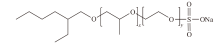
Fig.1
Structural formula of ethylhexyl extended sulfate C8PxEyS (x = 10, 15; y = 5, 10)"

Tab.1
Composition and formula of simulated formation water"
| Type | ρ/ (mg/L) | ||||||
|---|---|---|---|---|---|---|---|
| Cl- | SO42- | HCO3- | Na++K+ | Ca2+ | Mg2+ | TDS | |
| Content | 17 343 | 24 | 588 | 9 986 | 1 052 | 152 | 29 145 |
Fig.2
The dynamic interfacial tension between C8PxEyS and n-Decane at 60 ℃ (a-c) and the stable values of interfacial tension as a function of concentration (d)"
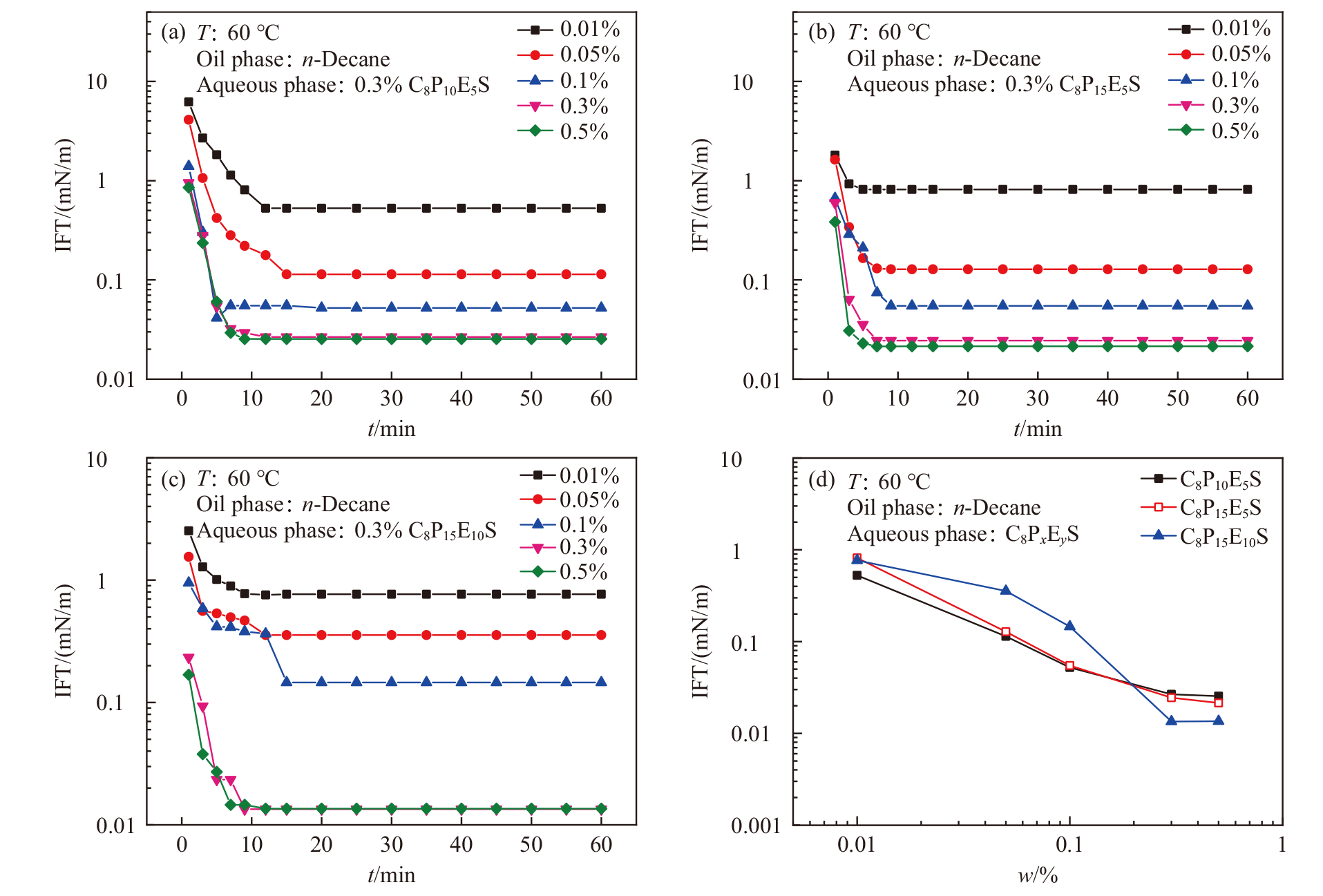
Fig.3
Dynamic interfacial tension of C8PxEyS against n-Decane at different temperatures (a-c) and the stable values of interfacial tension as a function of temperature (d)"
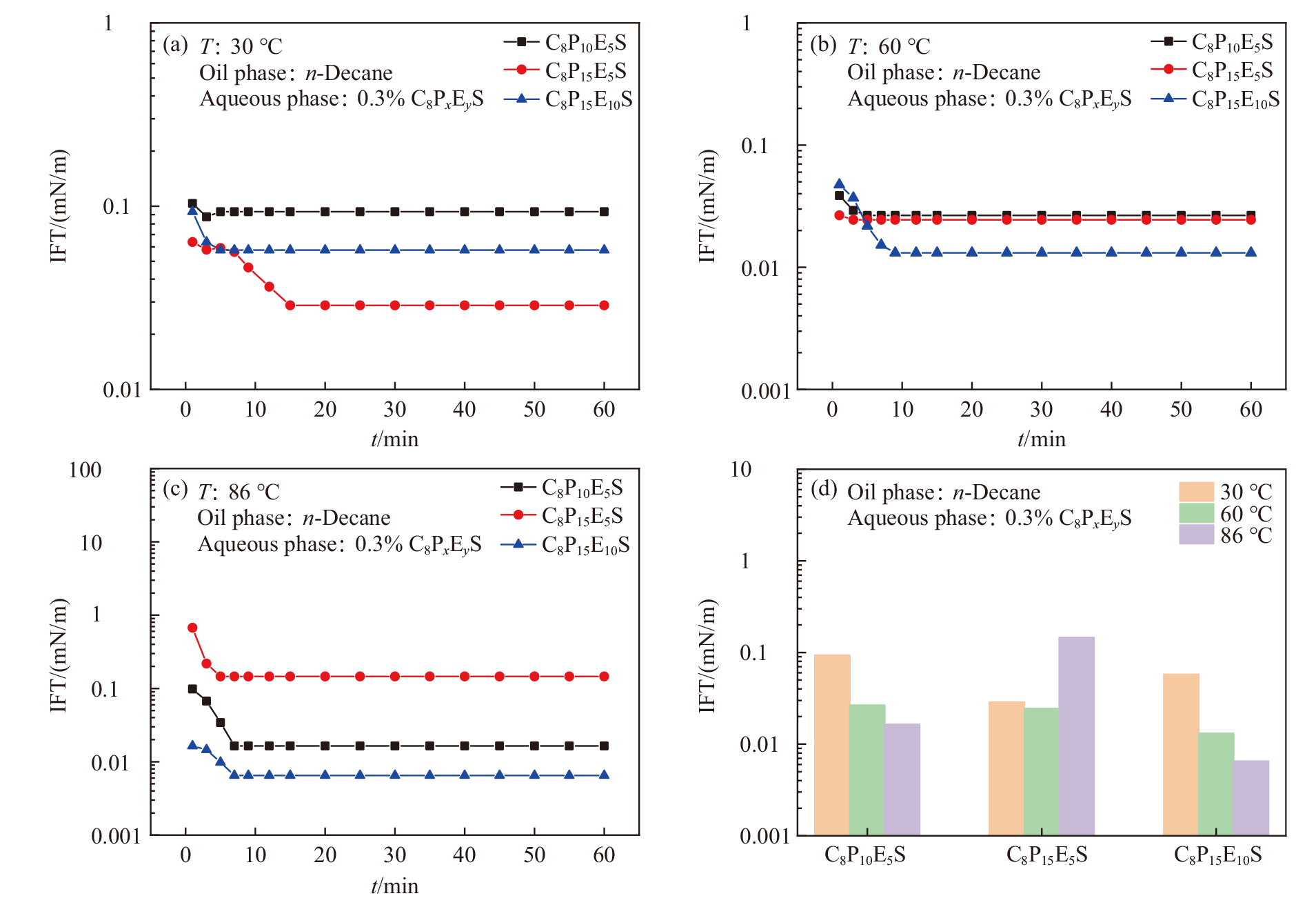
Fig.4
Dynamic interfacial tensions against n-Alkanes (a-c) and nmin change (d) of C8P10E5S at different temperatures"
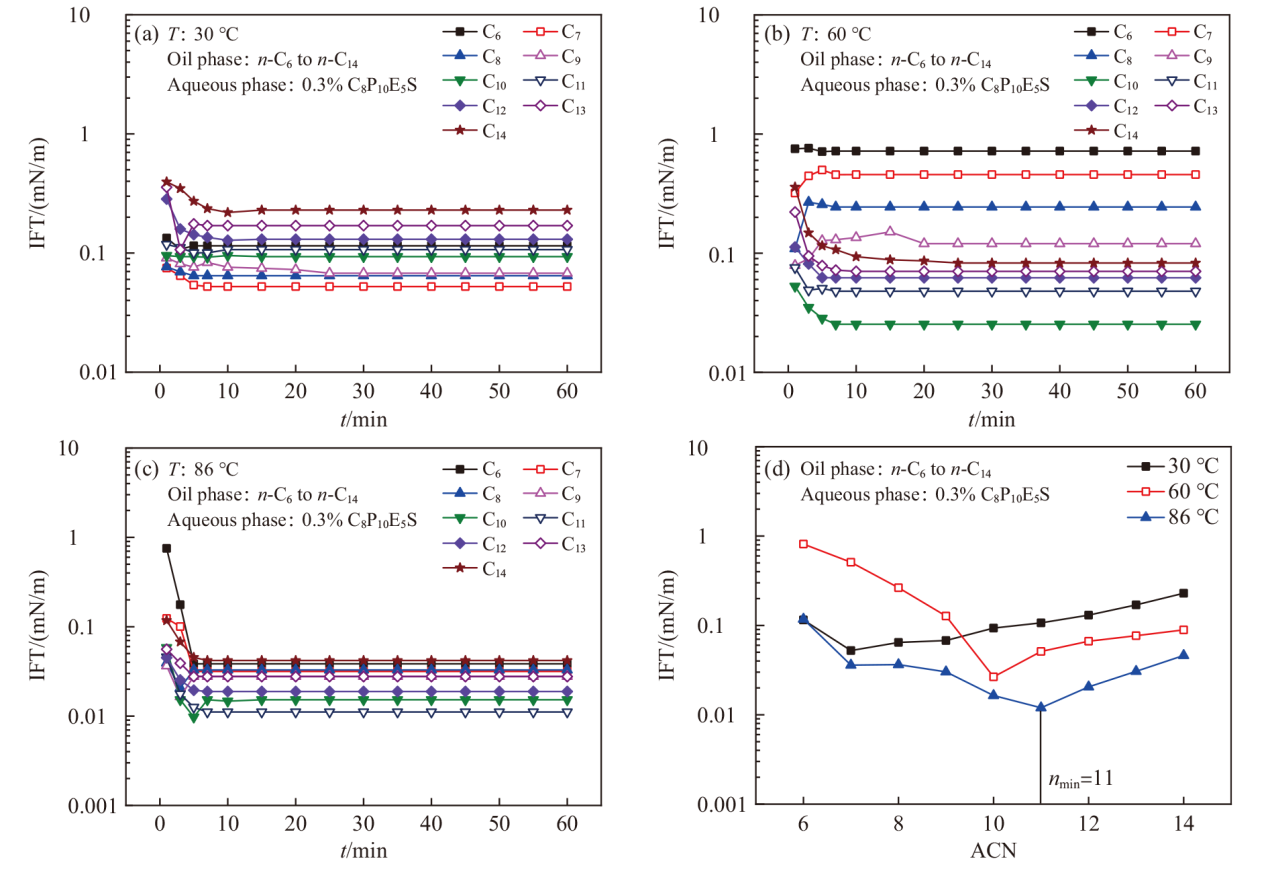
Fig.5
Dynamic interfacial tensions against n-Alkanes (a-c) and nmin change (d) of C8P15E5S at different temperatures"
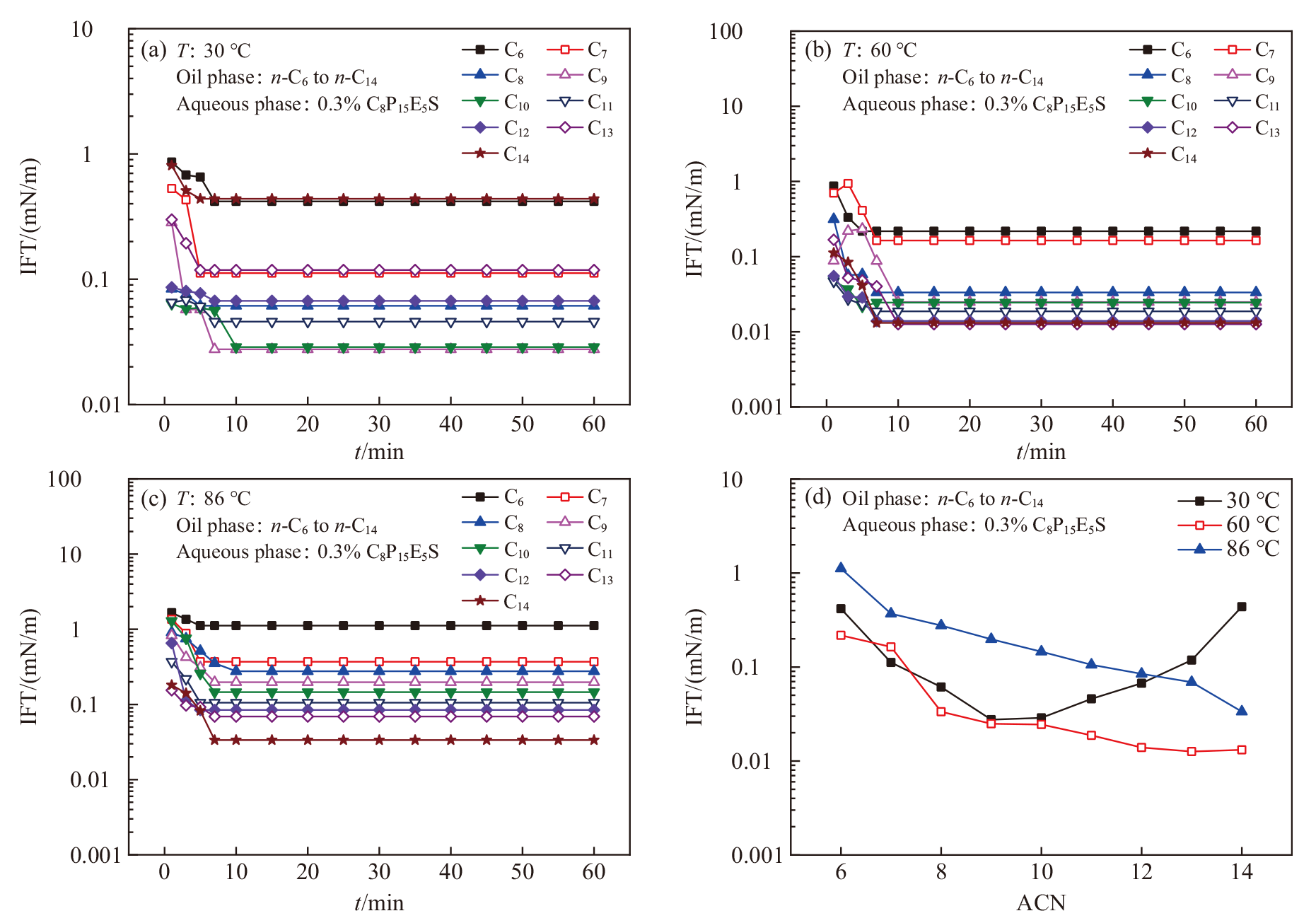
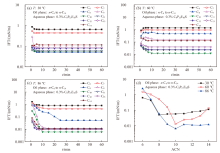
Fig.6
Dynamic interfacial tensions against n-Alkanes (a-c) and nmin change (d) of C8P15E10S at different temperatures"
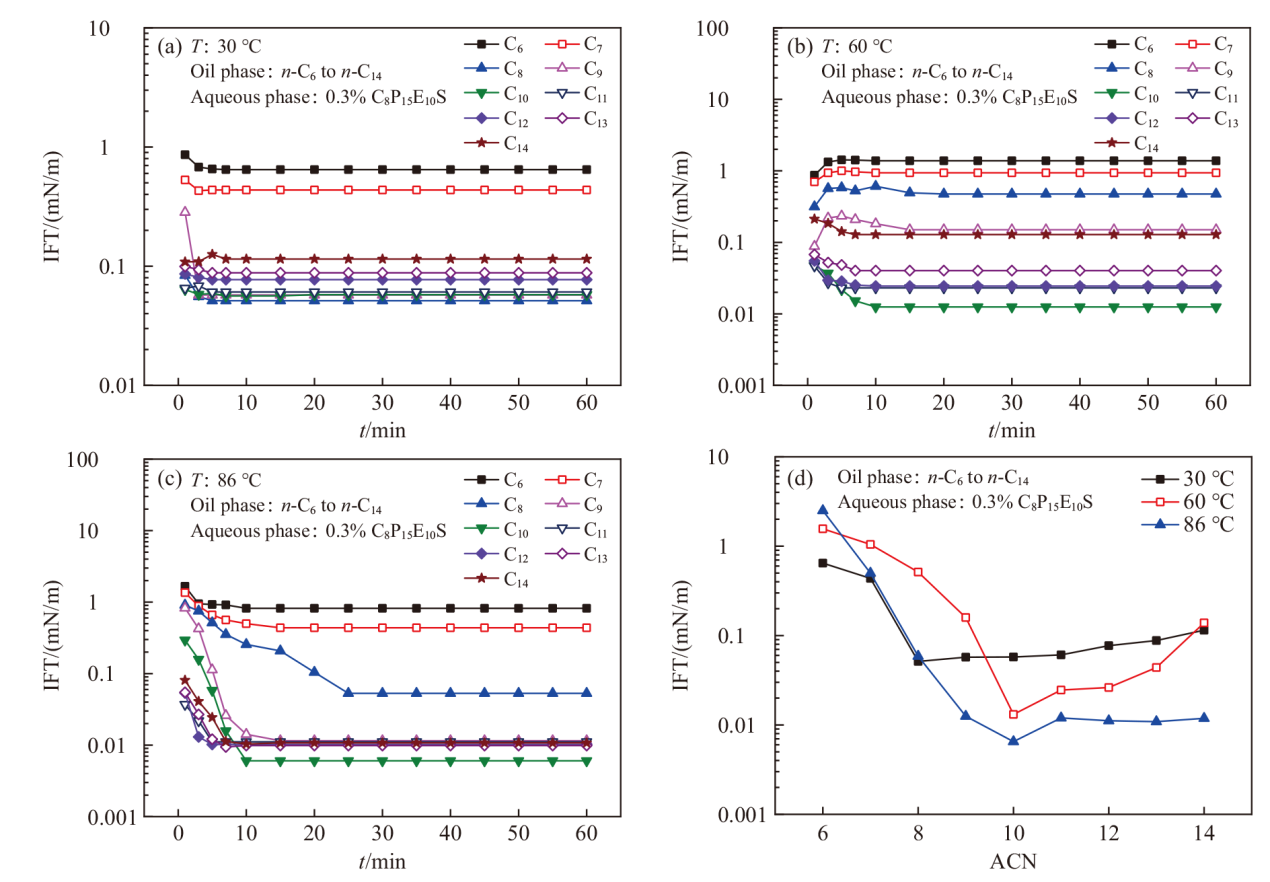
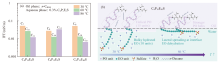
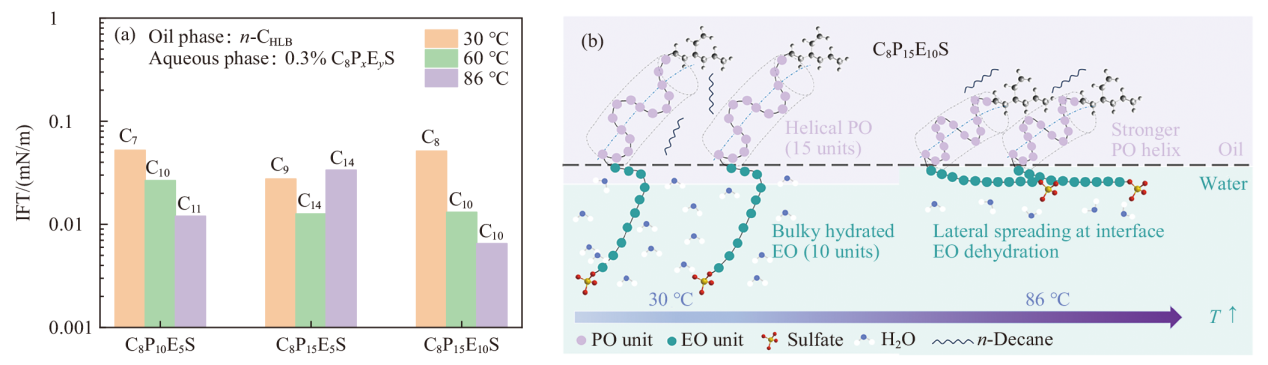
Fig.7
(a) The stable IFTs of C8PxEyS at different temperatures when it reaches optimal HLB; (b) Mechanism schematic diagram"
| [1] |
Sun Huanquan, Zhang Lei, Li Zhenquan, et al. Interfacial dilational rheology related to enhance oil recovery[J]. Soft Matter, 2011, 7: 7601-7611.
doi: 10.1039/c1sm05234a |
| [2] |
Massarweh O, Abushaikha A S. The use of surfactants in enhanced oil recovery: A review of recent advances[J]. Energy Reports, 2020, 6: 3150-3178.
doi: 10.1016/j.egyr.2020.11.009 |
| [3] |
An Huiming, Zhang Leilei, Zhao Li, et al. Characterized functional groups of temperature- and salt-resistant copolymers and surfactants and their relationships[J]. ACS Omega, 2023, 8 (35) : 32119-32129.
doi: 10.1021/acsomega.3c04369 pmid: 37692236 |
| [4] |
Salager Jean-Louis, Forgiarini Ana, Marquez Ronald. Extended surfactants including an alkoxylated central part intermediate producing a gradual polarity transition-A review of the properties used in applications such as enhanced oil recovery and polar oil solubilization in microemulsions[J]. Journal of Surfactants and Detergents, 2019, 22 (5) : 935-972.
doi: 10.1002/jsde.12331 |
| [5] |
Witthayapanyanon A, Acosta E J, Harwell J H, et al. Formulation of ultralow interfacial tension systems using extended surfactants[J]. Journal of Surfactants and Detergents, 2006, 9: 331-339.
doi: 10.1007/s11743-006-5011-2 |
| [6] |
Zhang Xiaojie, Zhou Zhaohui, Han Lu, et al. Mechanism responsible for the reduction of interfacial tension by extended surfactants[J]. Colloids and Surfaces A: Physicochemical and Engineering Aspects, 2022, 634: 128013.
doi: 10.1016/j.colsurfa.2021.128013 |
| [7] |
He Weidong, Ge Jijiang, Zhang Guicai, et al. Effects of extended surfactant structure on the interfacial tension and optimal salinity of dilute solutions[J]. ACS Omega, 2019, 4 (7) : 12410-12417.
doi: 10.1021/acsomega.9b00495 pmid: 31460359 |
| [8] |
Liu Ziyu, Zhang Lei, Cao Xulong, et al. Effect of electrolytes on interfacial tensions of alkyl ether carboxylate solutions[J]. Energy & Fuels, 2013, 27 (6) : 3122-3129.
doi: 10.1021/ef400458q |
| [9] |
Wang Chenguang, Pan Yi, Xu Zhicheng, et al. Ultralow interfacial tension achieved by extended anionic surfactants with a short hydrophobic chain[J]. Journal of Molecular Liquids, 2024, 400: 124514.
doi: 10.1016/j.molliq.2024.124514 |
| [10] | Pan Binlin. Study on the performance of extended surfactants in reducing interfacial tension under seawater conditions[J]. China Surfactant Detergent & Cosmetics, 2024, 54 (7) : 759-766. |
| [11] | Sun Qi, Zhao Zhengrong, Xu Zhicheng, et al. Effects of extended anionic surfactants on the wettability of polytetrafluoroethylene interface[J]. China Surfactant Detergent & Cosmetics, 2025, 55 (8) : 949-960. |
| [12] | Shi Jing, Zhang Lei, Chen Xingfeng, et al. Study on oil displacement mechanism of chemical flooding based on extended surfactant[J]. China Surfactant Detergent & Cosmetics, 2025, 55 (12) : 1501-1508. |
| [13] |
Wang Fuyong, Hua Haojie, Wang Lu, et al. Surfactant-enhanced assisted spontaneous imbibition for enhancing oil recovery in tight oil reservoirs: experimental investigation of surfactant types, concentrations, and temperature impact[J]. Energies, 2024, 17 (8) : 323-332.
doi: 10.3390/en17020323 |
| [14] | Liu Mengxin, Zhu Yangwen, Xiao Hongyan, et al. Molecular dynamics simulation of short hydrophobic chain extended surfactants: Effects of PO and EO groups[J]. Colloids and Surfaces A: Physicochemical and Engineering Aspects, 2025, 718: 57554. |
| [15] |
Wang Zhongsheng, Zhou Zhaohui, Han Lu, et al. The mechanism for lowering interfacial tension by extended surfactant containing ethylene oxide and propylene oxide groups[J]. Journal of Molecular Liquids, 2022, 359: 119364.
doi: 10.1016/j.molliq.2022.119364 |
| [16] |
Chen Ji, Hu Xueyi, Fang Yun, et al. Comparative study of conventional/ethoxylated/extended n-alkylsulfate surfactants[J]. Langmuir, 2019, 35 (8) : 3116-3125.
doi: 10.1021/acs.langmuir.8b04022 pmid: 30758969 |
| [17] |
Liu Xiaochen, Zhao Yongxiang, Li Qiuxiao, et al. Surface tension, interfacial tension and emulsification of sodium dodecyl sulfate extended surfactant[J]. Colloids and Surfaces A: Physicochemical and Engineering Aspects, 2016, 494: 201-208.
doi: 10.1016/j.colsurfa.2016.01.037 |
| [18] |
He Hongjia, Xiao Hongyan, Cao Xulong, et al. A helical shape of polyoxypropylene chain for extended surfactant molecule at the water/oil interface: Theoretical and experimental study[J]. Fuel, 2022, 312: 122835.
doi: 10.1016/j.fuel.2021.122835 |
| [19] |
Qiu Ying, Xiao Hongyan, Zhou Zhaohui, et al. Effect of H-bonds on the self-assembly behavior of sorbitan-based surfactants at the air-water interface: Insights from molecular dynamics simulation[J]. Colloids and Surfaces A: Physicochemical and Engineering Aspects, 2025, 727: 138203.
doi: 10.1016/j.colsurfa.2025.138203 |
| [20] |
He Hongjia, Xiao Hongyan, Zhou Zhaohui, et al. Effect of oxyethylene and oxypropylene groups on the interfacial structure and property of extended surfactants: Molecular simulation and experimental study[J]. Journal of Molecular Liquids, 2023, 382: 121944.
doi: 10.1016/j.molliq.2023.121944 |
| [21] |
Zhang Qun, Han Lu, Luan Huoxin, et al. Synergism for lowering interfacial tensions between betaines and extended surfactants: the role of self-regulating molecular size[J]. Journal of Molecular Liquids, 2023, 378: 121605.
doi: 10.1016/j.molliq.2023.121605 |
| [1] | Mingcheng Wu, Jing Li, Lishi Wu, Huaitong Xie, Xuedong Shi, Panfeng Zhou. Study on the performance of a low-irritation cleaning composition with reducing the irritancy of sodium laureth sulfate [J]. China Surfactant Detergent & Cosmetics, 2026, 56(7): 919-924. |
| [2] | Wenli Zhao, Yuxin Feng, Jiangling Tang, Hongwei Ren, Jing Yang, Yuanyuan Jia, Yanfei Wang. Research progress of the application of surfactants in flotation of soluble potassium salts [J]. China Surfactant Detergent & Cosmetics, 2026, 56(7): 952-959. |
| [3] | Lei Zhou, Dongxia Cao, Jingjing He, Jinling Chen, Gang Li, Nafeng Su. Rapid quantitative analysis of sodium dodecyl sulfate in toothpaste based on near-infrared spectroscopy [J]. China Surfactant Detergent & Cosmetics, 2026, 56(6): 804-810. |
| [4] | Zheng Wang, Jiajun Qian, Yumei Fan, Peixue Ling. Physiological functions and applications of dermatan sulfate in skin tissue [J]. China Surfactant Detergent & Cosmetics, 2026, 56(4): 529-538. |
| [5] | Zhengyu Li,Degang Xing,Yancheng Zheng,Hongyun Zhao,Fuchang You. Synergism in the mixture of sodium dodecyl block polyether sulfonate and Gemini betaine surfactant for oil displacement [J]. China Surfactant Detergent & Cosmetics, 2026, 56(3): 284-292. |
| [6] | Chunsheng Zhang, Changlong Liu, Bin Chen, Yanyue Li, Fantao Meng, Peng Zhao. Preparation and performance evaluation of the nanoemulsions stabilized with betaine surfactants [J]. China Surfactant Detergent & Cosmetics, 2026, 56(2): 201-207. |
| [7] | Haiyong Tang, Yueqing Huo, Enze Li, Shengti Cao, Chunxin Gao, Chuangxin Ji, Xiaochen Liu. Excellent temperature/salt resistant foam by alcohol ether sulfates(AEnS)for gas well deliquification [J]. China Surfactant Detergent & Cosmetics, 2026, 56(1): 28-40. |
| [8] | Guoqiang Lu, Meng Mu, Ye Fan, Xuefeng Liu, Yongmin Zhang. Study on the synthesis and properties of sulfate-spacered gemini surfactants [J]. China Surfactant Detergent & Cosmetics, 2025, 55(9): 1085-1092. |
| [9] | Chao Tang, Jiaojiao Guan, Shouping Zhang, Wenliang Cai, Yulian Lin, Shuixiang Xie, Yunfei Xiang. Effects of asphaltene, resin, and petroleum acid on the phase transition and interfacial properties of emulsions [J]. China Surfactant Detergent & Cosmetics, 2025, 55(9): 1129-1136. |
| [10] | Yanping Chu, Feng Gao, Weihua Zhang, Lei Zhang, Lu Zhang. Study on interfacial dilational rheology of surfactant flooding with low-interfacial-tension surfactants [J]. China Surfactant Detergent & Cosmetics, 2025, 55(8): 961-968. |
| [11] | Yawen Li, Weixin Li, Fenglun Zhang, Shihong Ma, Jianxin Jiang, Liwei Zhu. Synergistic properties of the binary mixed system of natural green surfactants: Camellia oleifera saponin and sodium cocoyl glycinate [J]. China Surfactant Detergent & Cosmetics, 2025, 55(7): 831-843. |
| [12] | Hui Xu. Effects of microcapsulated emulsion polymer on the interfacial tension of extended surfactants [J]. China Surfactant Detergent & Cosmetics, 2025, 55(4): 407-414. |
| [13] | Binlin Pan. Study on the performance of extended surfactants in reducing interfacial tension under seawater conditions [J]. China Surfactant Detergent & Cosmetics, 2024, 54(7): 759-766. |
| [14] | Xiaojie Zhang, Mingzhe Zhang, Zhicheng Xu, Qingtao Gong, Lei Zhang, Lu Zhang. Study on oil displacement mechanism of alkyl carboxyl betaine [J]. China Surfactant Detergent & Cosmetics, 2024, 54(2): 123-130. |
| [15] | Xiaoding Zeng, Yancheng Zheng, Guoqing Zhang, Lingchi Zeng, Jian Mu. Performance of branched-chain extended surfactant mixed with zwitterionic or cationic surfactant [J]. China Surfactant Detergent & Cosmetics, 2024, 54(12): 1405-1413. |
|
