Welcome to China Surfactant Detergent & Cosmetics, Today is


China Surfactant Detergent & Cosmetics ›› 2026, Vol. 56 ›› Issue (7): 952-959.doi: 10.3969/j.issn.2097-2806.2026.07.014
• Reviews • Previous Articles Next Articles
Wenli Zhao1,3,4,Yuxin Feng1,Jiangling Tang1,Hongwei Ren2,Jing Yang1,3,4,*( ),Yuanyuan Jia1,3,4,Yanfei Wang1,3,4,*()
Revised:2026-06-29
Online:2026-07-22
Published:2026-08-06
Contact:
*E-mail: CLC Number:
Wenli Zhao, Yuxin Feng, Jiangling Tang, Hongwei Ren, Jing Yang, Yuanyuan Jia, Yanfei Wang. Research progress of the application of surfactants in flotation of soluble potassium salts[J].China Surfactant Detergent & Cosmetics, 2026, 56(7): 952-959.
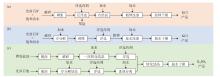
Fig.1
Processes of potassium chloride and potassium sulfate production.(a)Reverse flotation-cold crystallization process;(b)cold decomposition-direct flotation process;(c)preparation of potassium sulfate by schoenite conversion method"
Tab.1
Classification and application of collectors"
| 捕收剂 类型 | 分类 | 代表性药剂 | 作用机理 | 应用与优劣 | 参考 文献 |
|---|---|---|---|---|---|
| 阳离子捕收剂 | 脂肪胺类 | 十八胺(ODA)、十二烷基盐酸盐(DAH) | 分子结构含长链胺基团,水中解离为RNH3+,吸附于矿物表面 | 疏水性强,选择性好,常用于钾盐浮选中;低温性能较差 | [ |
| 季铵盐类 | 十八烷基三甲基溴化铵、双子季铵盐 | 季铵正电荷与KCl晶体表面负电荷缺陷位发生静电吸附 | 适用于低温环境;羟乙基改性可降低临界胶束浓度,提高浮选性能 | [ | |
| 阴离子捕收剂 | 烷基磺酸盐类、烷基硫酸盐类 | 十二烷基磺酸钠、十二烷基硫酸钠(SDS) | -SO3-、-OSO3-阴离子通过静电作用与钾盐表面暴露的K+位点结合水溶性好 | 能提高钾浸出率,与其他药剂复配效果更佳 | [ |
| 两性/弱阳离子捕收剂 | 烷基吗啉类(十二烷基吗啉DMP) | DMP分子与NaCl界面水结构的氢键作用吸附在NaCl表面 | DMP兼具叔胺阳离子与醚氧极性头,在饱和卤水中仍能保持良好分散性,对NaCl选择性高,主要用于反浮选工艺除钠 | [ | |
| 其他捕收剂 | 氢化咪唑衍生物 | 带脂肪族取代基 | 水解相应的氨基酰胺在氯化钾晶体表面形成疏水薄膜使之浮起 | 实验研究中使用,分子结构新颖,改善浮选性能 | [ |
| 组合捕收剂组合 | 例:十八胺+十二烷基磺酸钠 | 阳/阴离子协同作用,ODA-NH3+与SLS-SO3-在溶液中形成疏水离子对,表面活性增强,更易定向吸附在KCl晶体表面提升表面疏水性 | 提高选择性和回收率,降低药剂用量,适应低温浮选 | [ | |
| Gemini表面活性剂 | 具有两个疏水基和两个亲水基的结构 | 双季铵阳离子能与KCl晶体表面暴露的Cl?位点强烈吸附间隔基连接双基团,提升浮选活性 | 捕收能力强,选择性高,优于传统单体表面活性剂 | [ | |
| CB、YC系列新型捕收剂 | “胺、酸、醇三合一”结构;高水溶性、高起泡性 | 改进传统基于十八胺性能进行改性,适配不同光卤石矿 | 环保、高效、适用性强,简化使用流程,已在青海和老挝矿山成功应用 | [ |
Tab.2
Classification and application of common frothers"
| 起泡剂类型 | 分类 | 特点 | 适用条件 | 参考文献 |
|---|---|---|---|---|
| 醇类 | 松醇油(2#油) | 起泡性适中,泡沫稳定,成本低,选择性好,兼具微弱捕收性 | 矿浆pH=5.5~7.5,温度20~25 ℃,矿泥含量较低的氯化物型钾盐浮选,用量10~30 g/吨 | [ |
| 甲基异丁基甲醇(MIBC) | 起泡力强,泡沫脆、消泡快,选择性高,无捕收性,适合高浓度矿浆 | 酸性或中性矿浆,高矿浆浓度,常用于实验室标准浮选 | [ | |
| 醇醚类 | 二乙二醇乙醚(DEE) | 低挥发、环保,泡沫稳定性高,可减少药剂挥发对环境的影响,与胺类捕收剂协同性好 | 中性至弱碱性矿浆,适合硫酸盐型钾盐浮选,用量5~20 g/吨 | [ |
| 二丙二醇丁醚(DPNB) | 高效起泡,用量仅为MIBC的50%,泡沫稳定性优于传统起泡剂,KCl回收率可达94.8%~98.6% | 矿浆pH值6~7,适用浮选温度5~25 ℃ | [ | |
| 新型合成类 | CB/YC/CS系列 | 兼具捕收性与起泡性,可直接水溶,减少盐酸用量,适用于硫酸盐型和氯化物型钾盐浮选 | 矿浆pH值为6~8,选矿粒度范围宽 | [ |
| 醚胺类起泡剂(如DPEA) | 低温性能优异,在0 ℃仍能保持KCl回收率(93.66%),泡沫稳定性高,分子结构含羟基与醚基,增强与水的相互作用 | 低温矿浆(0~10 ℃),氯化物型钾盐浮选,用量2.5×10⁻⁴ mol/L即可实现高效分离 | [ |
Tab.3
Classification and application of other surfactants"
| 分类 | 药剂名称/类型 | 主要作用机制 | 应用情况与特点 | 参考文献 |
|---|---|---|---|---|
| 抑制剂 | 天然抑制剂:糊精、淀粉、古尔胶、磷酸盐、丹宁、胺醛树脂、硫酸铝、CMC(羧甲基纤维素) | 在矿物表面形成亲水膜,降低疏水性,减少捕收剂吸附 | 正浮选工艺中通常为80~200 g/吨,根据原矿杂质含量调控用量 | [ |
| 合成抑制剂:木素磺酸盐、淀粉-醚基仲胺缩合物、脲素-甲醛共聚物、SL抑制剂、KS-MF(尿素与甲醛副产物) | 与矿泥表面相互作用,抑制矿泥活性,减少钾盐损失,改善环境 | KS-MF效果显著,基准用量为80 g/吨 | [ | |
| 活化剂 | 铅盐、亚铁氰化钾(K4Fe(CN)6)、二甲苯 | 改变矿物表面组成,提高疏水性或提供活性位点,增强捕收剂吸附 | 在钾盐浮选中应用较少,因捕收剂效果较好,通常不需添加 | [ |
| 其他介质调整剂 | 非离子表面活性剂:聚乙二醇(PEG)、PEG-800 | 调节泡沫稳定性,作为辅助药剂使用 | 有一定应用,配合药剂使用改善浮选性能 | [ |
Tab.4
Influencing factors in flotation"
| 影响因素 | 对浮选过程的影响 | 对表面活性剂作用机理的影响 | 应对策略/最佳条件 | 参考文献 |
|---|---|---|---|---|
| 矿泥等不溶物 | 捕收剂无效消耗、选择性降低 | 矿泥大量吸附捕收剂,降低其有效浓度;改变矿物表面性质 | 脱泥预处理、使用矿泥抑制剂 | [ |
| 矿浆pH值 | 表面活性剂电离形态、矿物表面电荷、药剂间协同作用 | 胺类捕收剂质子化程度;影响静电吸附和化学吸附平衡 | 根据选用浮选剂确定,通常控制pH值在6.5~7.5 | [ |
| 离子特应性 | 高离子强度压缩双电层;特定离子影响表面活性剂作用 | 改变静电作用强度;离子特异性效应调控水化层和胶体间作用力 | 控制溶液中c(Ca2+)≤0.1 mol/L;c(Na+)≤0.3 mol/L;开发抗高盐药剂 | [ |
| 温度 | 影响离子型表面活性剂溶解度、分散性、物理状态 | 低于Krafft点时,长链胺溶解度低、分散差、活性降低;高温可能影响吸附或泡沫稳定性 | 温度控制最佳20~32 ℃;低温时采用改性胺、短链胺或Gemini等;调控矿浆温度 | [ |
| 表面活性剂浓度/用量 | 影响表面张力、胶束/胶体形成,影响回收成本 | 捕收剂用量影响疏水化程度和覆盖率;起泡剂浓度影响泡沫性质 | 用量一般250~1 000 g/t矿石的范围;研发新型高效低用量药剂 | [ |
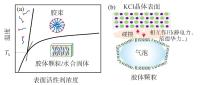
Fig.2
Illustrations of the Krafft point of surfactants(a)and the colloid precipitation theory(b)"
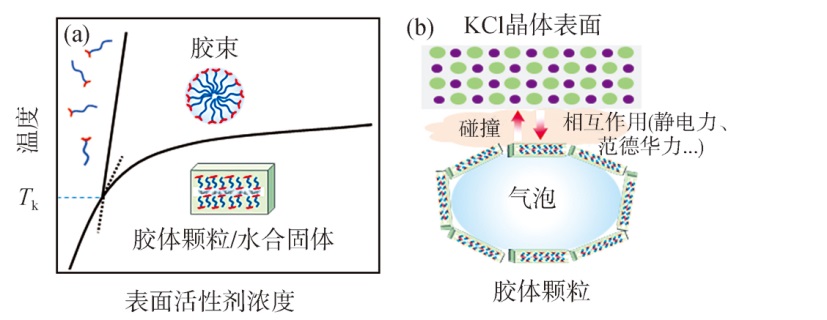
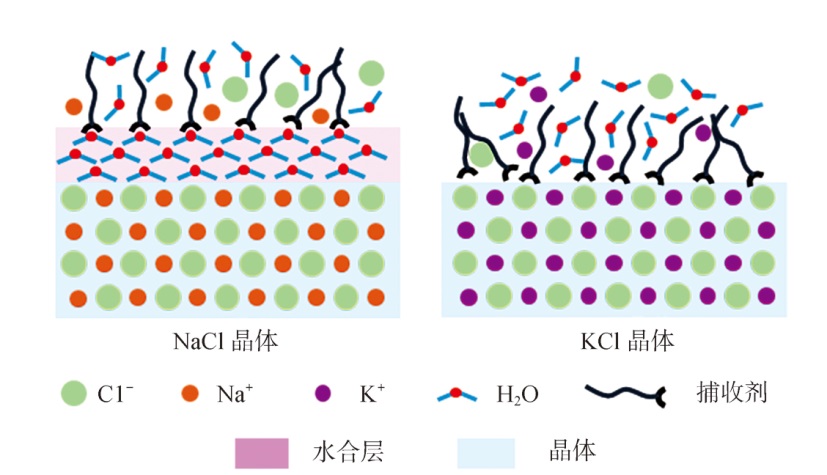
Fig.3
Schematic diagram of theoretical mechanism of interfacial water structure"
| [1] | 伊跃军, 张秀峰, 张利珍, 等. 中国钾盐资源开发利用现状及建议[J]. 无机盐工业, 2024, 56(10): 12-19. |
| [2] |
Cheng C, Huang Z, Zhang R, et al. Synthesis of an emerging morpholine-typed Gemini surfactant and its application in reverse flotation carnallite ore for production of potash fertilizer at low temperature[J]. Journal of Cleaner Production, 2020, 261: 121121.
doi: 10.1016/j.jclepro.2020.121121 |
| [3] | 雷津美, 张莉, 杜凤沛. 表面活性剂类农药助剂在农药中的应用研究进展[J]. 日用化学工业 (中英文), 2025, 55(2): 131-141. |
| [4] | Foot D G, Huiatt J L, Froisland L J. Potash recovery from process and waste brines by solar evaporation and flotation[R]. U.S. Department of the Interior, Bureau of Mines, 1984. |
| [5] | Rattanakawin C, Lakantha W, Kajai I. Flotation of sylvinite from Thakhek, Lao, PDR[J]. Songklanakarin J. Sci. Technol., 2019, 41: 545-550. |
| [6] | 熊学恒, 谭勤俭, 卢志斌. 钾盐浮选药剂研究进展[J]. 现代矿业, 2016, 32(5): 51-54. |
| [7] | 盖晓宏, 黎国亮. 基于五元体系Na+, K+, Mg2+//Cl-, SO42--H2O相图的硫酸钾生产工艺研究及应用[J]. 化工矿物与加工, 2024, 53(11): 53-59. |
| [8] | 张永, 钟宏, 谭鑫, 等. 阳离子捕收剂研究进展[J]. 矿产保护与利用, 2011, 3: 44-49. |
| [9] | 闫雅雯, 罗惠华, 赵军, 等. 胺类捕收剂的应用现状及发展前景[J]. 矿产保护与利用, 2022, 42(2): 59-66. |
| [10] | 杨耀辉, 张裕书, 刘淑君. 季铵盐类表面活性剂在矿物浮选中应用[J]. 矿产保护与利用, 2011, 6: 108-112. |
| [11] |
Borse M, Sharma V, Aswal V K, et al. Effect of head group polarity and spacer chain length on the aggregation properties of gemini surfactants in an aquatic environment[J]. Journal of Colloid and Interface Science, 2005, 284(1): 282-288.
pmid: 15752815 |
| [12] | 韩海生, 王宣, 汪荣瑞, 等. 一种组合浮选药剂及其作为结晶型硫酸钾盐浮选捕收剂的应用: CN118305012A[P]. 2024-07-09. |
| [13] |
Ozdemir O, Du H, Karakashev S I, et al. Understanding the role of ion interactions in soluble salt flotation with alkylammonium and alkylsulfate collectors[J]. Advances in Colloid and Interface Science, 2011, 163(1): 1-22.
doi: 10.1016/j.cis.2011.01.003 pmid: 21353193 |
| [14] | Liu R, Lu H, Wang L, et al. Utilization of ammonium chloride as a novel selective depressant in reverse flotation of potassium chloride[J]. Minerals, 2019, 9(1): 41. |
| [15] | 王丽娟, 刘够生, 宋兴福, 等. 十二烷基吗啉选择性吸附氯化钠的分子模拟[J]. 物理化学学报, 2009, 25(5): 963-969. |
| [16] | 甘顺鹏, 季荣, 汤建良. 钾盐浮选药剂研究进展[J]. 金属矿山, 2014(1): 80-83. |
| [17] | 靳莹皓, 王思远, 于雪峰, 等. 氯化钾浮选阴阳离子混合型捕收剂的复配与应用[J]. 无机盐工业, 2023, 55(10): 93-99. |
| [18] |
Huang Z, Shuai S, Wang H, et al. Froth flotation separation of lepidolite ore using a new Gemini surfactant as the flotation collector[J]. Separation and Purification Technology, 2022, 282: 119122.
doi: 10.1016/j.seppur.2021.119122 |
| [19] | 化工部长沙设计研究院. 一种低品位钾混盐的两段浮选工艺: CN 201410458477.4[P]. 2017-07-28. |
| [20] | 洪欣, 罗溪梅, 蒋旺强, 等. 浮选起泡剂研究进展[J]. 矿产保护与利用, 2023, 43(3): 22-33. |
| [21] | 李守江, 赵云良, 雷光元, 等. 一种硫酸镁亚型盐湖氯化钾的浮选工艺: CN111282718A[P]. 2020-06-16. |
| [22] | 宋兴福, 陈杭, 杨颖, 等. 一种适用于氯化钾正浮选生产的高效浮选药剂: CN115025883A[P]. 2022-09-09. |
| [23] | 王林润, 常黎明, 陈杭, 等. 氯化钾浮选中通气量和温度对二丙二醇丁醚起泡性能的影响[J]. 无机盐工业, 2023, 55(5): 1-8. |
| [24] | Wang L, Xu Y, Song X. Froth stability and entrainment evaluation of a novel frothier for KCl/NaCl flotation[J]. AIChE Journal, 2023, 69(6): e18039. |
| [25] |
Wu Y, Chen H, Wang R, et al. A novel ether amine reagent for the low-temperature flotation separation of KCl[J]. Industrial & Engineering Chemistry Research, 2025, 64(16): 8403-8413.
doi: 10.1021/acs.iecr.5c00109 |
| [26] | 李守江. 罗布泊硫酸盐型盐湖钾盐浮选的理论与工艺研究[D]. 武汉: 武汉理工大学, 2019. |
| [27] | 惠庆华, 权朝明, 张慧芳, 等. 我国盐湖浮选提钾技术及机理[J]. 应用化工, 2021, 50(12): 3414-3419. |
| [28] |
Yu X, Fu Z, Ma Y, et al. Polyethylene glycol regulated carnallite decomposition-crystallization: Experimental and theoretical analysis[J]. Minerals Engineering, 2023, 195: 108021.
doi: 10.1016/j.mineng.2023.108021 |
| [29] | 程芳琴, 赵仲鹤, 马金元, 等. 含泥钾矿浮选分离技术研究[J]. 环境工程学报, 2011, 5(3): 703-708. |
| [30] | Oliazadeh M, Aghamirian M, Grammatikopoulos T, et al. An overview of potash flotation[M]. Ottawa: Canadian Institute of Mining, etallurgy and Petroleum, 2012. |
| [31] | 赵静, 赵仲鹤, 边红利, 等. 盐酸十八胺在氯化钾浮选中的胶体化学研究[J]. 山西大学学报 (自然科学版), 2012(3): 6. |
| [32] | Tursunov S, Khojamkulov S. Importance of flotation reagents in the separation of potassium chloride from silvinite[J]. Universum: Технические Науки, 2024, 12(11): 32-36. |
| [33] | 切知加, 董伟兵, 杜景灵, 等. 低钠光卤石冷结晶法制备氯化钾的收率研究[J]. 无机盐工业, 2022, 54(5): 7-12. |
| [34] | 王思远. 氯化钾低温浮选捕收剂的制备及机理探究[D]. 兰州: 西北师范大学, 2023. |
| [35] | Crozier R D. Non-metallic mineral flotation[J]. Industrial Minerals, 1990(269): 55-65. |
| [36] | 赵元勋, 李陈敏, 李小娣, 等. 表面活性剂在矿物浸出中的强化作用:原理、应用与展望[J]. 矿山工程, 2025, 13(2): 352-361. |
| [37] |
Ai Z, Li S, Zhao Y, et al. Atomic insights into flotation separation of KCl and NaCl from a new viewpoint of hydration layer: A molecular dynamic study[J]. Colloids and Surfaces A: Physicochemical and Engineering Aspects, 2020, 602: 125071.
doi: 10.1016/j.colsurfa.2020.125071 |
| [38] | Rogers J, Schulman J H. Proceedings of the Second International Congress of Surface Activity: Vol.3[C]// London: Butterworths, 1957: 243-251. |
| [39] | Nakama Y. Surfactants[M]. SakamotoK, LochheadR, MaibachH, et al. Cosmetic Science and Technology. Philadelphia: Elsevier, 2017: 231-244. |
| [40] | Sun Kangkang. Bubble particle interaction and the flotation of water-soluble minerals[D]. Brisbane: The University of Queensland, 2024. |
| [41] |
Schreithofer N, Laskowski J S. Investigation of KCl crystal/NaCl-KCl saturated brine interface and octadecylamine deposition with the use of AFM[J]. Canadian Metallurgical Quarterly, 2007, 46(3): 285-293.
doi: 10.1179/cmq.2007.46.3.285 |
| [42] |
Laskowski J S. From amine molecules adsorption to amine precipitate transport by bubbles: Apotash ore flotation mechanism[J]. Minerals Engineering, 2013, 45: 170-179.
doi: 10.1016/j.mineng.2013.02.010 |
| [43] | Salehi R. Microflotation investigations of soluble salts[M]. University of Nevada, Reno, 1989. |
| [44] |
Sun K, Nguyen C V, Nguyen N N, et al. Flotation surface chemistry of water-soluble salt minerals: From experimental results to new perspectives[J]. Advances in Colloid and Interface Science, 2022, 309: 102775.
doi: 10.1016/j.cis.2022.102775 |
| [45] |
Weedon D, Grano S, Akroyd T, et al. Effects of high Mg2+concentration on KCl flotation: Part I-Laboratory research[J]. Minerals Engineering, 2007, 20(7): 675-683.
doi: 10.1016/j.mineng.2007.01.006 |
| [46] |
Yalamanchili M R, Kellar J J, Miller J D. Adsorption of collector colloids in the flotation of alkali halide particles[J]. International Journal of Mineral Processing, 1993, 39(1-2): 137-153.
doi: 10.1016/0301-7516(93)90058-I |
| [47] |
Hancer M, Celik M S, Miller J D. The significance of interfacial water structure in soluble salt flotation systems[J]. Journal of Colloid and Interface Science, 2001, 235(1): 150-161.
pmid: 11237454 |
| [48] |
Du H, Miller J D. Interfacial water structure and surface charge of selected alkali chloride salt crystals in saturated solutions: A molecular dynamics modeling study[J]. The Journal of Physical Chemistry C, 2007, 111(27): 10013-10022.
doi: 10.1021/jp071702e |
| [49] |
Li E, Du Z, Yuan S, et al. Low temperature molecular dynamic simulation of water structure at sylvite crystal surface in saturated solution[J]. Minerals Engineering, 2015, 83: 53-58.
doi: 10.1016/j.mineng.2015.08.012 |
| [50] |
Sun K, Nguyen C V, Nguyen N N, et al. Crucial roles of ion-specific effects in the flotation of water-soluble KCl and NaCl crystals with fatty acid salts[J]. Journal of Colloid and Interface Science, 2023, 636: 413-424.
doi: 10.1016/j.jcis.2023.01.038 pmid: 36640552 |
| [51] |
Li E, Du Z, Li D, et al. Specific ion effects of salt solutions on colloidal properties of octadecylamine hydrochloride[J]. Journal of Surfactants and Detergents, 2017, 20(2): 483-491.
doi: 10.1007/s11743-016-1923-7 |
| [52] |
Karakashev S, Tsekov R, Manev E. Adsorption of alkali dodecyl sulfates on air/water surface[J]. Langmuir, 2001, 17(17): 5403-5405.
doi: 10.1021/la010584y |
| [53] | Singewald A. The mechanism of selective salt flotation and discussion of underlying theories[J]. Colorado School of Mines Quarterly, 1961, 56(3): 65-88. |
| [1] | Yujun Feng. Viscoelastic surfactants (VII) CO2-responsive wormlike micelles [J]. China Surfactant Detergent & Cosmetics, 2026, 56(7): 833-840. |
| [2] | Hongyang Wang, Huibin Liang, Chunyu Wang, Ke Zhang, Jingjie Zhou, Tao Geng. Investigating the impact of propylene oxide and 1, 2-butylene oxide on the structure-activity relationship offatty alcohol ethers [J]. China Surfactant Detergent & Cosmetics, 2026, 56(7): 841-852. |
| [3] | Yunian Huang, Qi Wen, Bingqing Yu, Yao Qin, Tingzhi Zhang, Jingru Qian. Innovative application of amino acid surfactants in bath oil systems [J]. China Surfactant Detergent & Cosmetics, 2026, 56(7): 925-934. |
| [4] | Xin Jiang, Kun Liu, Bo Jiang, Yanfeng Liu. Research progress in quantitative detection, high-efficient synthesis, and applications of surfactin [J]. China Surfactant Detergent & Cosmetics, 2026, 56(7): 960-967. |
| [5] | Zonglin Chu, Zhanpeng Jiang, Yujun Feng. Viscoelastic surfactants (VI) Smart wormlike micelles [J]. China Surfactant Detergent & Cosmetics, 2026, 56(6): 695-705. |
| [6] | Ruirui Guo, Haifeng Liu. Research on a novel supramolecular clean fracturing fluid suitable for deep coalbed methane wells [J]. China Surfactant Detergent & Cosmetics, 2026, 56(6): 739-746. |
| [7] | Shu Zhou, Zhiyong Luo, Yiyue Wang, Yuyao Wan, Sa Zeng, Tao Meng. Pickering emulsions stabilized by silica nanoparticles in combination with surfactant for the enhancement of the stability of anthocyanins [J]. China Surfactant Detergent & Cosmetics, 2026, 56(6): 706-716. |
| [8] | Jiao Fang, Bo Xing. Study on the preparation of a quaternary ammonium surfactant and its effects on fabric antibacterial and finishing properties [J]. China Surfactant Detergent & Cosmetics, 2026, 56(5): 571-579. |
| [9] | Liming Xue, Jiale Xu, Jingxian Zhou, Yu’e Jin. Advances of surfactants in the development of formulations of pesticide carbendazim [J]. China Surfactant Detergent & Cosmetics, 2026, 56(5): 666-673. |
| [10] | Yunan Wan, Zhen Ren, Yichun Zhang. Study on the modification mechanism and performance of nonionic surfactants in the dispersion process of SiO2 aerogels [J]. China Surfactant Detergent & Cosmetics, 2026, 56(4): 441-448. |
| [11] | Zhengyu Li,Degang Xing,Yancheng Zheng,Hongyun Zhao,Fuchang You. Synergism in the mixture of sodium dodecyl block polyether sulfonate and Gemini betaine surfactant for oil displacement [J]. China Surfactant Detergent & Cosmetics, 2026, 56(3): 284-292. |
| [12] | Li Liu,Yongchun Liu. Experimental study on the performance of CO2 foam channeling plugging system in ultra-low permeability reservoir [J]. China Surfactant Detergent & Cosmetics, 2026, 56(3): 314-322. |
| [13] | Yujun Feng. Viscoelastic surfactants(II)Formation mechanisms and system formulations of wormlike micelles [J]. China Surfactant Detergent & Cosmetics, 2026, 56(2): 137-148. |
| [14] | Ruochen Wu, Zhenbang Xu, Chengjun Pan, Lei Wang. Preparation and performance study of a special low-foaming cleaning surfactant for agricultural film [J]. China Surfactant Detergent & Cosmetics, 2026, 56(2): 226-235. |
| [15] | Ziying Liao, Fan Min, Zonglin Chu. Smart wormlike micelles based on the surfactants with dynamic imine bonds [J]. China Surfactant Detergent & Cosmetics, 2026, 56(1): 1-7. |
|
