Welcome to China Surfactant Detergent & Cosmetics, Today is


China Surfactant Detergent & Cosmetics ›› 2025, Vol. 55 ›› Issue (10): 1299-1305.doi: 10.3969/j.issn.2097-2806.2025.10.010
• Development and application • Previous Articles Next Articles
Qitian Fu1,Ying Wei2,Xiaochun Lin2,Ying Ye2,Liqun Guo2,Yao Pan1,*( )
)
Received:2024-10-25
Revised:2025-09-29
Online:2025-10-22
Published:2025-12-03
Contact:
Yao Pan
E-mail:panyao@btbu.edu.cn
CLC Number:
Qitian Fu,Ying Wei,Xiaochun Lin,Ying Ye,Liqun Guo,Yao Pan. Multi-dimensional comprehensive assessment of apparent pore state: establishing a hierarchical system based on exploratory factor analysis[J].China Surfactant Detergent & Cosmetics, 2025, 55(10): 1299-1305.
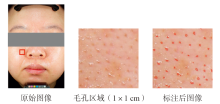
Fig. 1
Partial image of annotated pores"

Tab. 1
Bartlett sphericity test and KMO test results"
| KMO取样适切性量数 | 0.751 | |
|---|---|---|
| 巴特利特球形度检验 | 近似卡方 | 1 930.715 |
| 自由度 | 28 | |
| 显著性 | 0 | |
Tab. 2
Initial solution of factor analysis"
| 原始指标 | 初始 | 提取 |
|---|---|---|
| B1 | 1 | 0.895 |
| B2 | 1 | 0.848 |
| B3 | 1 | 0.755 |
| B4 | 1 | 0.619 |
| B5 | 1 | 0.833 |
| B6 | 1 | 0.979 |
| B7 | 1 | 0.979 |
| B8 | 1 | 0.972 |
Tab. 3
Factors explain the results of the total variance of the original variables"
| 成分 | 初始特征值 | 提取载荷平方和 | 旋转载荷平方和 | ||||||
|---|---|---|---|---|---|---|---|---|---|
| 总计 | 方差百分比/% | 累积/% | 总计 | 方差百分比/% | 累积/% | 总计 | 方差百分比/% | 累积/% | |
| 1 | 3.760 | 46.995 | 46.995 | 3.760 | 46.995 | 46.995 | 3.759 | 46.990 | 46.990 |
| 2 | 2.040 | 25.499 | 72.493 | 2.040 | 25.499 | 72.493 | 2.040 | 25.501 | 72.490 |
| 3 | 1.081 | 13.517 | 86.010 | 1.081 | 13.517 | 86.010 | 1.082 | 13.520 | 86.010 |
| 4 | 0.634 | 7.927 | 93.937 | ||||||
| 5 | 0.260 | 3.246 | 97.183 | ||||||
| 6 | 0.205 | 2.558 | 99.741 | ||||||
| 7 | 2.10×10⁻² | 0.259 | 100.000 | ||||||
| 8 | 9.51×10⁻⁶ | 0.000 | 100.000 | ||||||
Tab. 4
Factor load matrix after rotation"
| 指标 | 因子 | ||
|---|---|---|---|
| 1 | 2 | 3 | |
| B1 | 0.018 | 0.031 | 0.945 |
| B2 | -0.021 | -0.919 | -0.051 |
| B3 | -0.096 | 0.841 | 0.197 |
| B4 | 0.075 | 0.696 | -0.359 |
| B5 | 0.905 | -0.043 | -0.115 |
| B6 | 0.988 | 0.012 | 0.048 |
| B7 | 0.988 | 0.012 | 0.048 |
| B8 | 0.986 | 0.008 | 0.012 |
Tab. 5
Factor score coefficient matrix"
| 因子 | |||
|---|---|---|---|
| 1 | 2 | 3 | |
| B1 | 0.011 | 0.016 | 0.874 |
| B2 | -0.008 | -0.451 | -0.048 |
| B3 | -0.023 | 0.412 | 0.182 |
| B4 | 0.019 | 0.341 | -0.331 |
| B5 | 0.240 | -0.019 | -0.101 |
| B6 | 0.263 | 0.008 | 0.051 |
| B7 | 0.263 | 0.008 | 0.050 |
| B8 | 0.262 | 0.006 | 0.017 |
Tab. 6
Descriptive statistical results of apparent pore index F"
| N | 全距 | 均值 | 标准差 | 最大值 | 最小值 | |
|---|---|---|---|---|---|---|
| F | 120 | 3.09 | 0.000 166 7 | 0.640 5 | 1.75 | -1.34 |
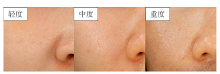
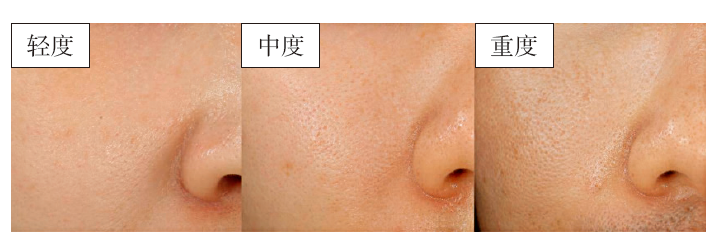
Fig. 2
The pore classification altas"
Tab. 7
The pore classification criteria"
| 毛孔等级 | 描述词 |
|---|---|
| 轻 | 毛孔个数稀疏,大小细微难察,暗沉轻微几乎不见,皮肤表面油脂较少,不见油光反射 |
| 中 | 毛孔个数增多,大小适中可见,伴有轻微暗沉现象,可见轻度油光反射 |
| 重 | 毛孔个数密集,大小显著扩张,暗沉明显,皮肤覆盖明显油光 |
Tab. 8
F-value and its range of the pore grades"
| 毛孔等级 | F值 | F范围 |
|---|---|---|
| 轻 | -0.32 | <-0.32 |
| 中 | 0.65 | -0.32~0.92 |
| 重 | 1.75 | >0.92 |
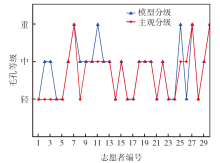
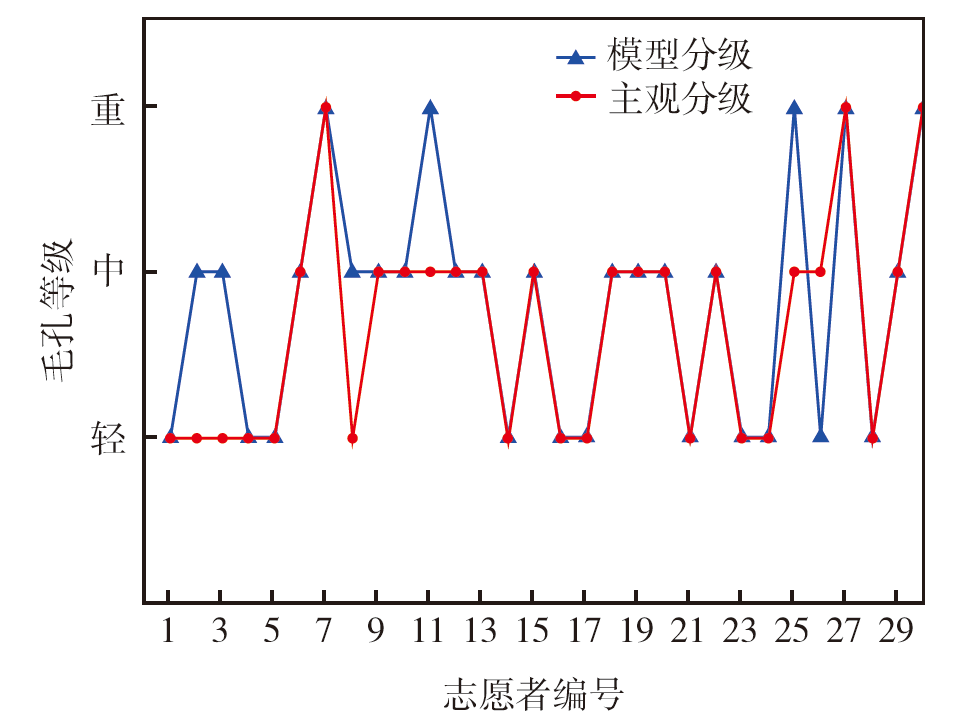
Fig. 3
Results of comparison between subjective grading and model grading"
| [1] | 王青, 周成霞, 孟慧敏, 等. 面部毛孔标准照片评价及毛孔粗大影响因素分析[J]. 四川大学学报(医学版), 2010, 41 (5) : 865-868. |
| [2] | 冯相辉. 人脸图像中毛孔的检测及定量评价研究[D]. 重庆: 重庆邮电大学, 2019. |
| [3] |
Jang S I, Kim E J, Lee H K. A method of evaluating facial pores using optical 2D images and analysis of age-dependent changes in facial pores in Koreans[J]. Skin Research and Technology, 2018, 24 (2) : 304-308.
doi: 10.1111/srt.12430 pmid: 29383766 |
| [4] | 浙江省健康产品化妆品行业协会. T/ZHCA 023-2023面部毛孔紧致类化妆品功效评价方法[S]. 北京: 中国标准出版社, 2023. |
| [5] | Sun J Y, Kim S W, Lee S H, et al. Automatic facial pore analysis system using multi-scale pore detection[J]. Skin Research & Technology, 2017, 23 (3) : 354-362. |
| [6] | Bae J, Jeon J, Lee J, et al. Skin condition estimation using mobile handheld camera[J]. Etri Journal, 2016, 38 (4) : 776-786. |
| [7] | Kim B Y, Choi J W, Park K C, et al. Sebum, acne, skin elasticity, and gender difference-which is the major influencing factor for facial pores?[J]. Skin Research & Technology, 2013, 19 (1) : 45-53. |
| [8] | Kim S J, Shin M K, Back J H, et al. Pore volume is most highly correlated with the visual assessment of skin pores[J]. Skin Research & Technology, 2014, 20 (4) : 429-434. |
| [9] | Messaraa C, Metois A, Walsh M, et al. Antera 3D capabilities for pore measurements[J]. Skin Research & Technology, 2018, 24 (4) : 606-613. |
| [10] | 于文心, 徐慧, 马刚, 等. 毛孔粗大的病因及治疗[J]. 中国激光医学杂志, 2016, 25 (6) : 368-373. |
| [11] |
Roh M, Han M, Kim D, et al. Sebum output as a factor contributing to the size of facial pores[J]. British Journal of Dermatology, 2006, 155 (5) : 890-894.
doi: 10.1111/j.1365-2133.2006.07465.x pmid: 17034515 |
| [12] | 毛爱迪, 尹锐. 毛孔粗大的治疗研究进展[J]. 中国美容医学, 2021, 30 (5) : 173-177. |
| [13] | 黄冰婷, 马琳, 孙丽丽, 等. 探索图像分析中适用于评估皮肤毛孔的指标[J]. 日用化学品科学, 2024, 47 (5) : 30-34. |
| [14] | Sugata K, Nishijima T, Kitahara T, et al. Confocal laser microscopic imaging of conspicuous facial pores in vivo: relation between the appearance and the internal structure of skin[J]. Skin Research & Technology, 2008, 14 (2) : 208-212. |
| [15] | 门月华, 臧琳, 吴雯婷, 等. 皮肤镜毛孔检测方法在2 940 nm铒像素激光治疗毛孔粗大疗效观察中的应用[J]. 中华皮肤科杂志, 2019, 52 (2) : 111-114. |
| [16] |
Masaki H, Mizutani T, Ogawa N, et al. Carbonylated proteins contribute to the darkness around facial pores[J]. Journal of Dermatological Science, 2018, 89 (3) : 299-301.
doi: S0923-1811(17)30987-8 pmid: 29217298 |
| [17] | 白晓云, 符移才, 马艳凤, 等. 一款男士控油洁面泥的功效研究[C]// 第十届中国化妆品学术研讨会. 浙江: 杭州, 2014: 5. |
| [18] |
Dissanayake B, Miyamoto K, Purwar A, et al. New image analysis tool for facial pore characterization and assessment[J]. Skin Research and Technology, 2019, 25 (5) : 631-638.
doi: 10.1111/srt.12696 pmid: 30865350 |
| [19] | 孙振球. 医学统计学[M]. 人民卫生出版社, 2010. |
| [20] | 柳伟伟, 胡良平. 主成分分析与探索性因子分析的SAS软件实现[J]. 中西医结合学报, 2010, 8 (6) : 589-593. |
| [21] | Han Y, Li C, Wang R, et al. A new Chinese crow’s feet grading scale based on the DermaTOP system[J]. Scientific Reports, 2023, 13 (1) : 18903. |
| [22] | 岑晓娟, 王颖, 周荷益, 等. 口红持久度评价体系的建立[J]. 日用化学工业, 2021, 51 (8) : 748-753. |
| [23] | 王慧, 简绍勇, 李娟, 等. 三种统计分析方法在数学建模中的应用浅谈[J]. 科学咨询, 2020 (42) : 95-96. |
| [24] |
Lu F, Xue L, Hu Y. Robust estimation for the correlation matrix of multivariate longitudinal data[J]. Journal of Statistical Computation and Simulation, 2020, 90 (13) : 2473-2496.
doi: 10.1080/00949655.2020.1780234 |
| [25] | Chen X Y, Hu X Q, Wu Y X. Application of principal component analysis method in the performance evaluation of core courses of biotechnology[J]. Journal of Anhui Agricultural Sciences, 2020, 48 (16) : 262-264. |
| [26] |
Landis J R, Koch G G. The measurement of observer agreement for categorical data[J]. Biometrics, 1977, 33 (1) : 159-174.
pmid: 843571 |
| [1] | Bao Li,Xinyu Zhao,Lixin Wu. Applications of metal-organic framework materials in cosmetics [J]. China Surfactant Detergent & Cosmetics, 2025, 55(10): 1221-1235. |
| [2] | Lingcan Kong,Yi Han. Synthesis, luminescence, and bacteriostatic performance of Ag(I) nanocluster 2D assembly [J]. China Surfactant Detergent & Cosmetics, 2025, 55(10): 1236-1244. |
| [3] | Wenlin Geng,Ming Li,Yuhua Cao. Studies on the antioxidant properties of Staphylococcus epidermidis fermentation broth [J]. China Surfactant Detergent & Cosmetics, 2025, 55(10): 1275-1283. |
| [4] | Lixia Huang,Zile Liu,Bingzhen Pan,Jiasheng Bao,Xiwu Qiao,Zhiming Zhou. Assessment of eye irritation of cosmetic ingredients based on machine learning [J]. China Surfactant Detergent & Cosmetics, 2025, 55(10): 1284-1290. |
| [5] | Xianxian Cao,Yonglei Yuan,Feifei Wang. Study on the antioxidant and anti-inflammatory activities of extracts from Salvia plebeia R. Br. [J]. China Surfactant Detergent & Cosmetics, 2025, 55(10): 1291-1298. |
| [6] | Qingyu Guo,Dan Cao,Dong Chen. Evaluation of the whitening effect and antioxidant activity of isorosmanol, an active ingredient of Rosmarinus officinalis L. [J]. China Surfactant Detergent & Cosmetics, 2025, 55(10): 1306-1312. |
| [7] | Taijun Zhang,Haiqi Chen,Jiechun Yin,Li Kang,Rourou Li,Ruyu Deng. Raspberry ketone treats acne vulgaris by suppressing sebum and inflammation [J]. China Surfactant Detergent & Cosmetics, 2025, 55(10): 1313-1322. |
| [8] | Linrui Fu,Haiyan Wang,Yong Lu. Research status and prospect of new pollutants in cosmetics [J]. China Surfactant Detergent & Cosmetics, 2025, 55(10): 1323-1332. |
| [9] | Xinzheng Wang,Yan Liu. Research on the integration of women’s aesthetic psychology and cosmetics packaging design [J]. China Surfactant Detergent & Cosmetics, 2025, 55(10): 1333-1343. |
| [10] | Zhishan Wu,Chengjun Jiang,Weicheng Yin,Yanchao Wang,Jiaojiao Wu,Shuai Yin,Xiaohong Pan. Determination of 23 preservatives in rinse-off cosmetics with quantitative analysis of multi-components by single marker [J]. China Surfactant Detergent & Cosmetics, 2025, 55(10): 1344-1351. |
| [11] | Xue Zuo,Ling Yang,Ruipeng Yu,Zheng Di,Huajun Zhang. Determination of 14 prohibited ingredients in hair dye products by HPLC and verification by LC-MS/MS [J]. China Surfactant Detergent & Cosmetics, 2025, 55(10): 1352-1360. |
| [12] | Xuefeng Wang, Qian Jiang, Zuowang Fan, Xiaoli Xie, Fulai Yu, Dan Wang. Study on the construction, stability and antifungal activity of microemulsion system of Noni essential oil [J]. China Surfactant Detergent & Cosmetics, 2025, 55(9): 1120-1128. |
| [13] | Yali Shen, Peilin Liu, Linli Liu, Limin Fan, Huanying Li. Effects of black bean peptide on UVB-induced activity and collagen secretion of human skin fibroblasts [J]. China Surfactant Detergent & Cosmetics, 2025, 55(9): 1179-1186. |
| [14] | Siyue Xie, Can Qin, Junmin Lin, Xiaochun Luo. The activity and skin-caring efficacy of amino acids/peptides fermented from meal protein [J]. China Surfactant Detergent & Cosmetics, 2025, 55(9): 1187-1197. |
| [15] | Qian Li, Wen Jiang. Research on the integration and application of emotional elements in the packaging design of children’s toiletries [J]. China Surfactant Detergent & Cosmetics, 2025, 55(9): 1207-1214. |
|
||
