Welcome to China Surfactant Detergent & Cosmetics, Today is


China Surfactant Detergent & Cosmetics ›› 2025, Vol. 55 ›› Issue (11): 1452-1559.doi: 10.3969/j.issn.2097-2806.2025.11.011
• Development and application • Previous Articles Next Articles
Fei Liu,Qian Wang,Hui Liu,Suzhen Yang*( ),Tingting Han,Tao Wu
Received:2024-11-25
Revised:2025-11-20
Online:2025-11-22
Published:2025-12-22
CLC Number:
Fei Liu, Qian Wang, Hui Liu, Suzhen Yang, Tingting Han, Tao Wu. Study on the effect of recombinant human collagen Ⅲ on anti-skin photoaging[J].China Surfactant Detergent & Cosmetics, 2025, 55(11): 1452-1559.
Tab. 1
The effect of RHC-Ⅲ on NHEKs and NHDFs cell viability"
| ρ(RHC-Ⅲ)/ (mg/mL) | Cell viability/% | |
|---|---|---|
| NHEKs | NHDFs | |
| 0 | 100.00±1.99 | 100.00±3.89 |
| 0.08 | 96.05±4.47 | 101.30±4.92 |
| 0.16 | 96.36±6.26 | 101.04±2.61 |
| 0.31 | 95.60±1.74 | 99.06±3.77 |
| 0.63 | 95.92±3.16 | 99.69±3.34 |
| 1.25 | 94.26±4.34 | 99.69±4.86 |
| 2.50 | 93.49±3.47 | 97.29±3.38 |
| 5.00 | 90.88±2.55 | 96.30±4.02 |
| 10.00 | 72.19±3.18 | 96.04±6.32 |
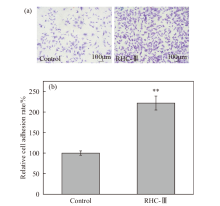
Fig. 1
The effect of RHC-Ⅲ on the adhesion ability of NHDFs cells. (a) Representative results of adhesion ability of NHDFs cells. (b) Relative cell adhesion * P<0.05, ** P<0.01, vs. Control"

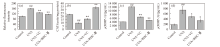
Fig. 2
The results of ROS levels (a), CAT enzyme activity (b), MMP-1 (c) and MMP-3 (d) in UVA-induced NHDFs cells with different treatments # P<0.05, ## P<0.01, vs. Control. * P<0.05, ** P<0.01, vs. UVA"
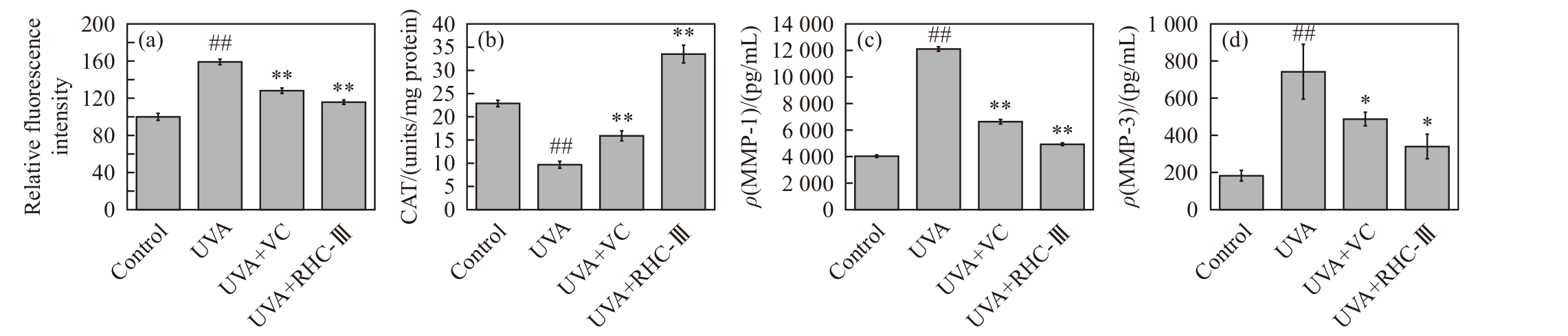
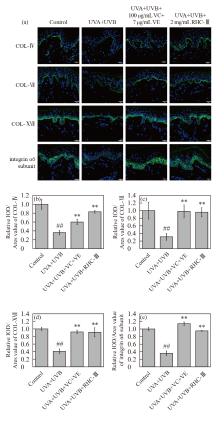
Fig. 3
The results of DEJ structure-related protein content in UVA and UVB-induced ex vivo human skin tissue model with different treatments. # P<0.05, ## P<0.01, vs. Control. * P<0.05, ** P<0.01, vs. UVA+UVB"
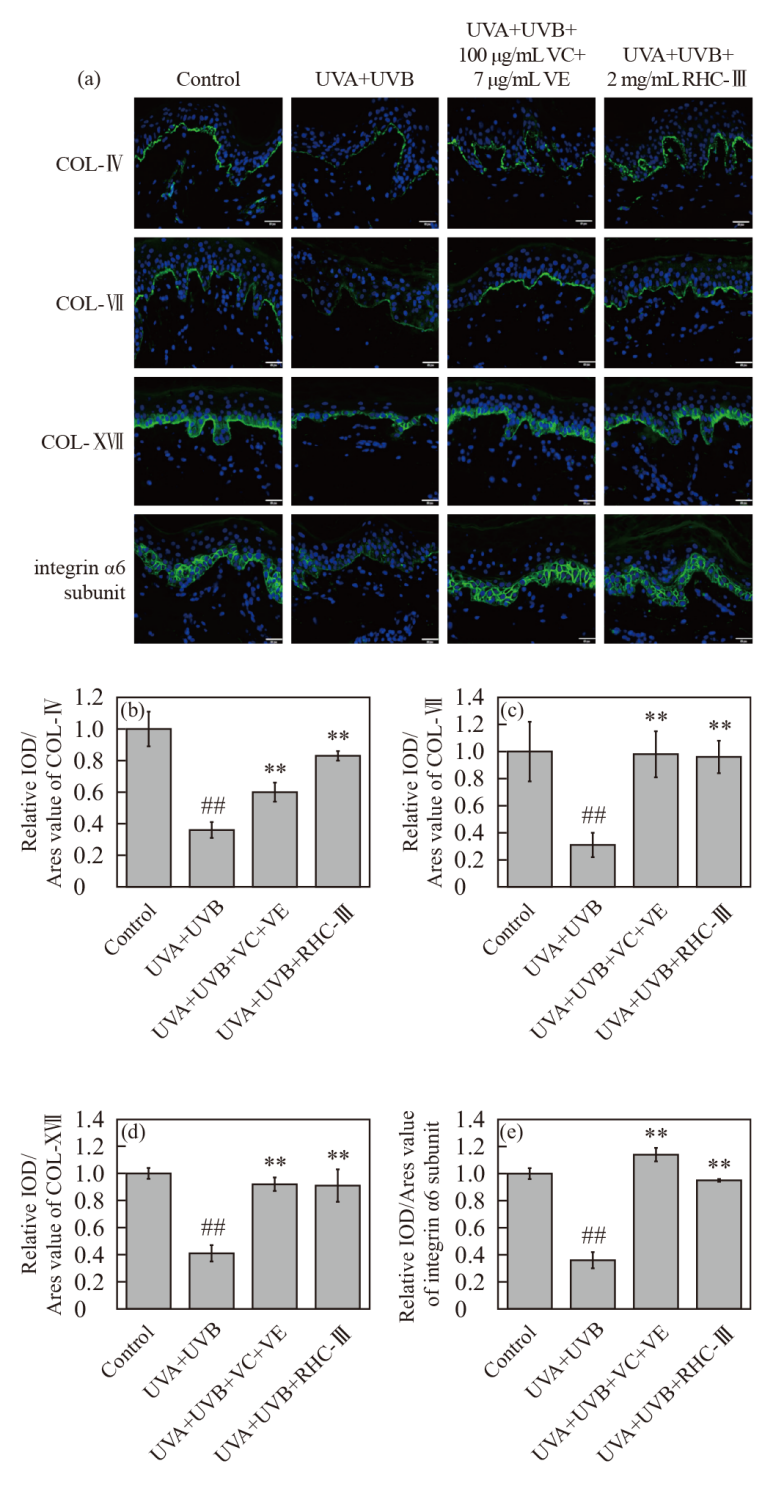
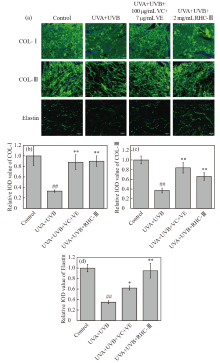
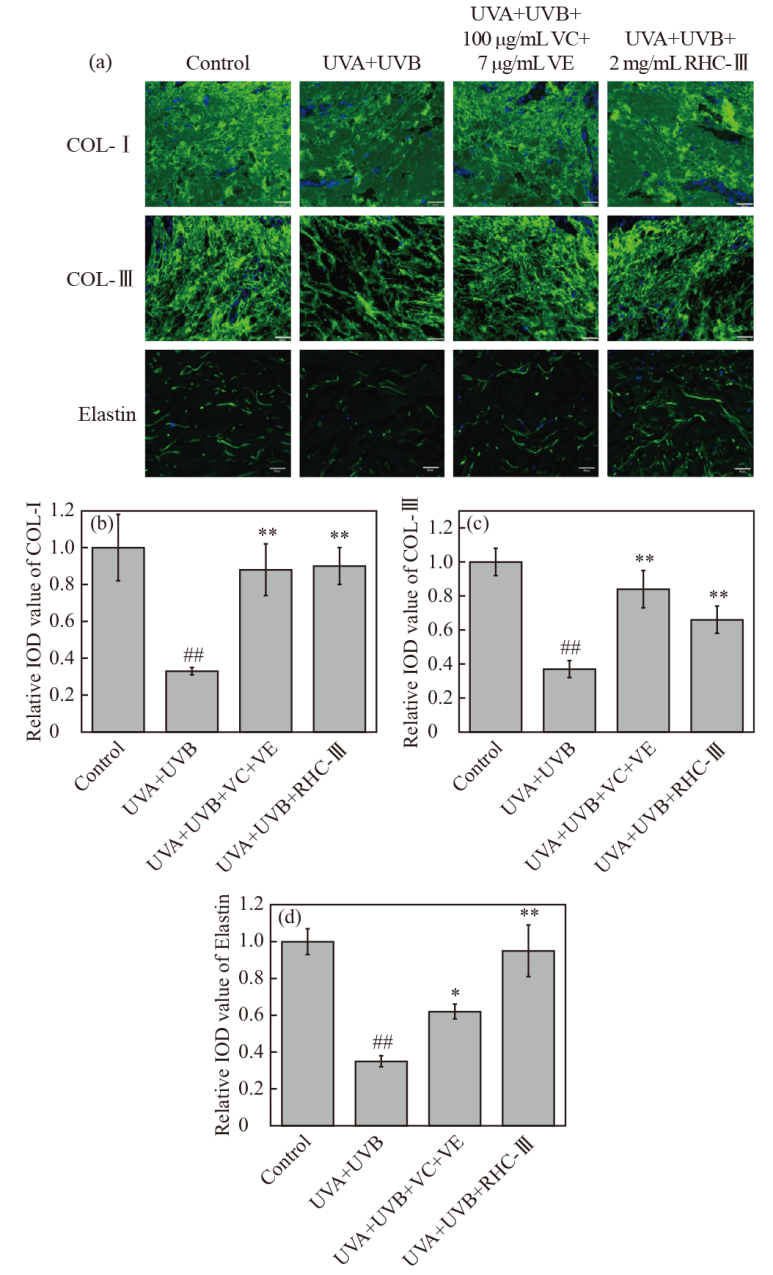
Fig. 4
The results of key dermal ECM proteins content in UVA and UVB-induced ex vivo human skin tissue model with different treatments. (a) Representative immunofluorescence results of key dermal ECM proteins (Scale bar: 50 μm). (b) COL-Ⅰ content. (c) COL-Ⅲ content. (d) Elastin content # P<0.05, ## P<0.01, vs. Control. * P<0.05, ** P<0.01, vs. UVA+UVB"
| [1] | Bosch R, Philips N, Suárez-pérez J A, et al. Mechanisms of photoaging and cutaneous photocarcinogenesis, and photoprotective strategies with phytochemicals[J]. Antioxidants (Basel), 2015, 4 (2) : 248-268. |
| [2] | 王小燕, 刘子菁, 马仁燕, 等. 皮肤光老化研究新进展[J]. 中国麻风皮肤病杂志, 2019, 35 (5) : 305-308, 312. |
| [3] | 齐放, 印志琪, 曾三武, 等. 酵母重组胶原蛋白液体敷料对面部敏感性皮肤患者疗效分析及对患者皮肤屏障功能障碍的影响[J]. 中外医疗, 2023, 42 (16) : 9-13. |
| [4] | 崔路路, 陈贝, 乔琨, 等. 海洋生物胶原肽的制备及其皮肤保护活性研究进展[J]. 福建师范大学学报(自然科学版), 2023, 39 (3) : 44-52. |
| [5] |
Zhuang Y, Hou H, Zhao X, et al. Effects of collagen and collagen hydrolysate from jellyfish (rhopilema esculentum) on mice skin photoaging induced by UV irradiation[J]. Journal of Food Science, 2009, 74 (6) : 183-188.
doi: 10.1111/j.1750-3841.2009.01236.x pmid: 19723203 |
| [6] |
Sun W, He J, Zhang Y, et al. Comprehensive functional evaluation of a novel collagen for the skin protection in human fibroblasts and keratinocytes[J]. Bioscience Biotechnology and Biochemistry, 2023, 87 (7) : 724-735.
doi: 10.1093/bbb/zbad054 |
| [7] | Liu Z, Li Y, Song H, et al. Collagen peptides promote photoaging skin cell repair by activating the TGF-β/Smad pathway and depressing collagen degradation[J]. Food & Function, 2019, 10 (9) : 6121-6134. |
| [8] | 苏星星, 贾垚, 张宝林. 重组人源Ⅲ型胶原蛋白在整形美容外科的应用前景[J]. 中华医学美学美容杂志, 2023, 29 (4) : 322-324. |
| [9] |
Hua C, Zhu Y, Xu W, et al. Characterization by high-resolution crystal structure analysis of a triple-helix region of human collagen type Ⅲ with potent cell adhesion activity[J]. Biochemical and Biophysical Research Communications, 2019, 508 (4) : 1018-1023.
doi: 10.1016/j.bbrc.2018.12.018 |
| [10] | 张亚, 孙欣, 王瑞妍. 重组Ⅲ型胶原蛋白在护肤品和药械领域的应用综述[J]. 上海轻工业, 2024 (4) : 133-135. |
| [11] | 蔡思泽, 王斌. 人源Ⅲ型胶原蛋白在毕赤酵母中的多拷贝重组表达、鉴定及抗氧化活性分析[J]. 现代食品科技, 2023, 39 (3) : 129-137. |
| [12] | 范婷, 赵健烽, 常烨珺, 等. 重组Ⅲ型胶原蛋白对皮肤功能性相关基因表达的影响[J]. 日用化学工业(中英文), 2022, 52 (12) : 1326-1332. |
| [13] |
Wang J, Qiu H, Xu Y, et al. The biological effect of recombinant humanized collagen on damaged skin induced by UV-photoaging: an in vivo study[J]. Bioactive Materials, 2021, 11: 154-165.
doi: 10.1016/j.bioactmat.2021.10.004 |
| [14] | Shin J W, Kwon S H, Choi J Y, et al. Molecular mechanisms of dermal aging and antiaging approaches[J]. International Journal of Molecular Sciences, 2019, 20 (9) : 2126. |
| [15] |
Fisher G J, Shao Y, He T, et al. Reduction of fibroblast size/mechanical force down-regulates TGF-beta type ii receptor: Implications for human skin aging[J]. Aging Cell, 2016, 15: 67-76.
doi: 10.1111/acel.12410 pmid: 26780887 |
| [16] |
Qin Z, Balimunkwe R M, Quan T. Age-related reduction of dermal fibroblast size upregulates multiple matrix metalloproteinases as observed in aged human skin in vivo[J]. British Journal of Dermatology, 2017, 177: 1337-1348.
doi: 10.1111/bjd.2017.177.issue-5 |
| [17] |
Shirato K, Takanari J, Ogasawara J, et al. Enzyme-treated asparagus extract attenuates hydrogen peroxide-induced matrix metalloproteinase-9 expression in murine skin fibroblast L929 cells[J]. Natural Product Communications, 2016, 11 (5) : 677-680.
pmid: 27319149 |
| [18] | 吴斯敏, 杨慧龄. 紫外线引起皮肤光老化机制及防治的研究进展[J]. 医学综述, 2018, 24 (2) : 341-346. |
| [19] |
Cole M A, Quan T, Voorhees J J, et al. Extracellular matrix regulation of fibroblast function: redefining our perspective on skin aging[J]. Journal of Cell Communication and Signaling, 2018, 12 (1) : 35-43.
doi: 10.1007/s12079-018-0459-1 pmid: 29455303 |
| [20] |
Varani J, Schuger L, Dame M K, et al. Reduced fibroblast interaction with intact collagen as a mechanism for depressed collagen synthesis in photodamaged skin[J]. Journal of Investigative Dermatology, 2004, 122 (6) : 1471-1479.
doi: 10.1111/j.0022-202X.2004.22614.x pmid: 15175039 |
| [21] | 钟烨. 真表皮连接处与皮肤衰老相关的研究进展[J]. 日用化学品科学, 2022, 45 (11) : 54-59. |
| [22] |
Aumailley M. Laminins and interaction partners in the architecture of the basement membrane at the dermal-epidermal junction[J]. Experimental Dermatology, 2021, 30 (1) : 17-24.
doi: 10.1111/exd.14239 pmid: 33205478 |
| [23] |
Contet-audonneau J L, Jeanmaire C, Pauly G. A histological study of human wrinkle structures: comparison between sun exposed areas of the face, with or without wrinkles, and sun-protected areas[J]. The British Journal of Dermatology, 1999, 140 (6) : 1038-1047.
doi: 10.1046/j.1365-2133.1999.02901.x |
| [24] |
Xiang Y, Liu Y, Yang Y, et al. Reduced expression of collagen 17A1 in naturally aged, photoaged, and UV-irradiated human skin in vivo: potential links to epidermal aging[J]. Journal of Cell Communication and Signaling, 2022, 16 (3) : 421-432.
doi: 10.1007/s12079-021-00654-y pmid: 35060094 |
| [25] | Amano S, Ogura Y, Akutsu N, et al. Protective effect of matrix metalloproteinase inhibitors against epidermal basement membrane damage: skin equivalents partially mimic photoageing process[J]. The British Journal of Dermatology, 2005, 153(Suppl 2): 37-46. |
| [26] |
Rodius S, Indra G, Thibault C, et al. Loss of alpha6 integrins in keratinocytes leads to an increase in TGF beta and AP1 signaling and in expression of differentiation genes[J]. Journal of Cellular Physiology, 2007, 212 (2) : 439-449.
doi: 10.1002/jcp.v212:2 |
| [27] |
Varani J, Spearman D, Perone P, et al. Inhibition of type Ⅰ procollagen synthesis by damaged collagen in photoaged skin and by collagenase-degraded collagen in vitro[J]. American Journal of Pathology, 2001, 158 (3) : 931-942.
doi: 10.1016/S0002-9440(10)64040-0 pmid: 11238041 |
| [1] | Yali Shen, Peilin Liu, Linli Liu, Limin Fan, Huanying Li. Effects of black bean peptide on UVB-induced activity and collagen secretion of human skin fibroblasts [J]. China Surfactant Detergent & Cosmetics, 2025, 55(9): 1179-1186. |
| [2] | Gaiying He, Jinghui Tang, Xuying Liu, Guirong Sun, Yi Wang. The protective effect of recombinant human collagen against UV-induced skin photoaging in mice [J]. China Surfactant Detergent & Cosmetics, 2025, 55(11): 1444-1451. |
| [3] | Qingyu Guo,Dan Cao,Dong Chen. Evaluation of the whitening effect and antioxidant activity of isorosmanol, an active ingredient of Rosmarinus officinalis L. [J]. China Surfactant Detergent & Cosmetics, 2025, 55(10): 1306-1312. |
| [4] | Zixuan Lai, Yuxuan Song, Xuewei Duan, Shiyun Liu, Bing Liu, Minjun Zhang, Huiwen Yang. The protective effect and mechanism of crude polysaccharide from Broussonetia papyrifera flower on UV-induced skin photodamage [J]. China Surfactant Detergent & Cosmetics, 2024, 54(9): 1069-1077. |
| [5] | Lin Sun, Man Zhang. Study on the anti-photoaging effect of Paulownia fortunei leaf extract [J]. China Surfactant Detergent & Cosmetics, 2024, 54(9): 1092-1098. |
| [6] | Ya Zhang, Hao Zhou, Rong Wang, Zengmiao Hou, Wentao Huang, Lu Yang. Characterization of recombinant elastin and its roles in ultraviolet-induced skin photoaging [J]. China Surfactant Detergent & Cosmetics, 2024, 54(9): 1106-1116. |
| [7] | Meiling He,Limin Fan. Evaluation of anti-aging effect of percutaneous application of Silybum marianum extract [J]. China Surfactant Detergent & Cosmetics, 2024, 54(8): 981-987. |
| [8] | Guanru Shao, Kunyang Zhang. Rhein attenuates UVB-induced skin photoaging injury by inhibiting p38 MAPK phosphorylation [J]. China Surfactant Detergent & Cosmetics, 2024, 54(7): 836-843. |
| [9] | Gengtao Han, Zhuo Dong, Renhui Yao. Effects of sesamolin on AQP3 expression and Nrf2 signaling pathway activation in skin photoaging mice [J]. China Surfactant Detergent & Cosmetics, 2024, 54(4): 431-438. |
| [10] | Hui Liu, Fang Liu. Study on the whitening effect and antioxidation of isoastilbin [J]. China Surfactant Detergent & Cosmetics, 2024, 54(11): 1368-1374. |
| [11] | Anna Wang, Mengjie Fang, Chao Tang, Tianxiang Yue. Protective effect and antioxidant mechanism of Danshensu on UVB-induced skin photoaging in mice [J]. China Surfactant Detergent & Cosmetics, 2024, 54(1): 65-72. |
| [12] | Fan Jiayi, Ma Ling, Chen Timson, Chang Kuan, Wang Jing. Scientific foundations of hair and scalp care (Ⅴ)Hair photoaging and its protection [J]. China Surfactant Detergent & Cosmetics, 2023, 53(5): 503-510. |
| [13] | Chen Yiwen, Wen Xia, Huang Jiancong, Zhang Shuyao, Zheng Yali, Xie Xiaobao. The research progress of skin microecology and probiotic for skin anti-photoaging [J]. China Surfactant Detergent & Cosmetics, 2023, 53(4): 459-464. |
| [14] | Yu Ding, Yi Wu, Mingshi Ren, Zihan Li, Bo Liu. Protective effect of compound clove volatile oil on UV induced skin photoaging damage in mice [J]. China Surfactant Detergent & Cosmetics, 2023, 53(12): 1385-1391. |
| [15] | Tang Jinghui,Wang Yi,Ma Shuhua,Sun Yanan,He Gaiying,He Zhongmei. Protective effect of pilose antler extracts against UVB-induced skin photoaging in mice [J]. China Surfactant Detergent & Cosmetics, 2022, 52(9): 969-974. |
|
