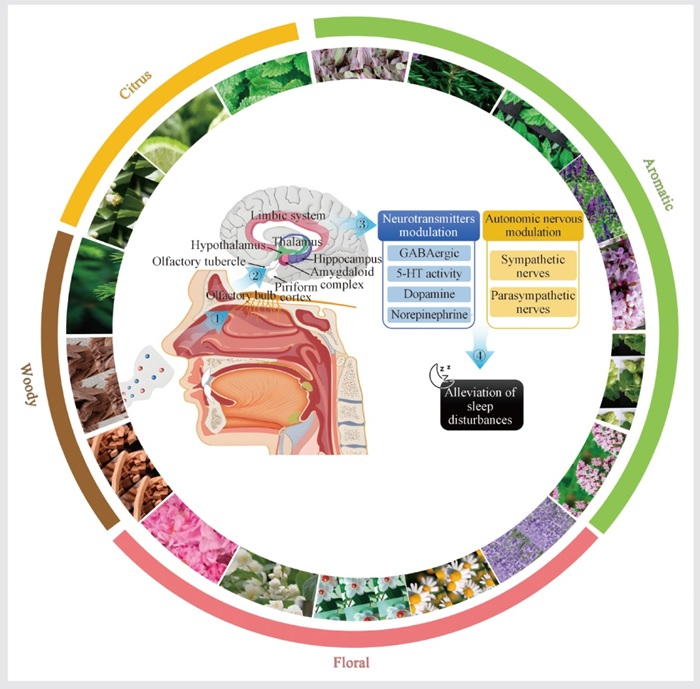
当代社会失眠问题突出,已成为一项影响人类身心健康的重要公共卫生挑战,而嗅觉吸入作为便捷、高效且安全的非药物干预策略,在改善睡眠健康方面展现出广阔应用前景。系统梳理嗅觉干预助眠的相关研究,对开发高效稳定的助眠日化产品具有重要意义。文章从嗅觉干预的作用机制、效果评价方法、活性成分三个维度,系统综述了嗅觉吸入干预助眠的研究进展;通过香调特征与助眠活性的深入分析,构建了涵盖花香调、木质调、芳香调与柑橘调的“安眠香调轮”,为个性化助眠产品的香气选择与配方设计提供了科学分类依据;同时阐释了单方天然精油的助眠特性与作用靶点,分析了复方精油“多成分-多靶点-多通路”的协同优势,并探讨了基于天然精油开发标准化合成香料的技术价值。旨在通过梳理多维证据与香调体系,为开发高效、稳定且个性化的助眠产品提供理论依据,推动嗅觉调节在睡眠健康管理中的科学应用。
Insomnia has become a prominent issue in contemporary society, posing a significant public health challenge to human physical and mental health. Olfactory inhalation, as a convenient, efficient, and safe non-pharmacological intervention strategy, exhibits broad application prospects in improving sleep health. Systematically reviewing research on olfactory inhalation for sleep promotion is of great importance for the development of effective, stable, and safe somnogenic products. This review comprehensively summarizes the research progress from three dimensions: mechanisms of action, evaluation methods, and bioactive ingredients. Through an analysis of fragrance characteristics and sedative properties, a “Sleep-aid Fragrance Wheel” encompassing floral, woody, aromatic, and citrus notes is constructed, providing a scientific classification framework for the fragrance selection and formulation design of personalized sleep-promoting products. Furthermore, the sedative profiles and action targets of single natural essential oils are explained, the synergistic advantages of compound essential oils with the characteristics of “multi-component, multi-target and multi-pathway” are analyzed, and the technical advantages of developing standardized synthetic fragrances based on natural essential oils are discussed. By synthesizing this multidimensional evidence with the proposed fragrance classification system, this review provides a theoretical foundation for the design of efficient, stable, and personalized somnogenic products, thereby promoting the scientific application of olfactory regulation in sleep health management.