Welcome to China Surfactant Detergent & Cosmetics, Today is


China Surfactant Detergent & Cosmetics ›› 2026, Vol. 56 ›› Issue (7): 833-840.doi: 10.3969/j.issn.2097-2806.2026.07.001
• Lecture of science and technology • Next Articles
Yujun Feng*( )
)
Received:2026-07-20
Online:2026-07-22
Published:2026-08-06
Contact:
*E-mail: CLC Number:
Yujun Feng. Viscoelastic surfactants (VII) CO2-responsive wormlike micelles[J].China Surfactant Detergent & Cosmetics, 2026, 56(7): 833-840.
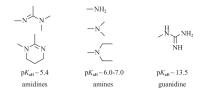
Fig.1
The organobases that can be protonated by CO2 aqueous solution"
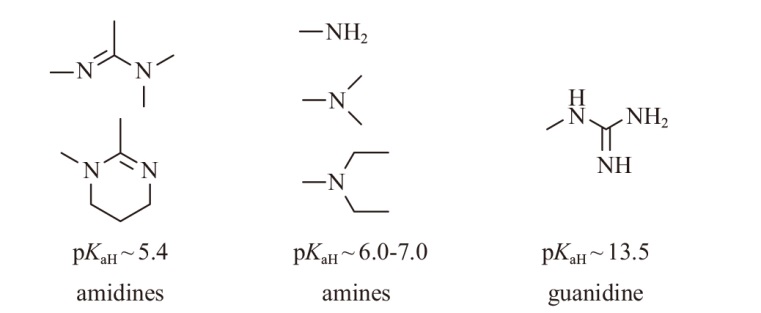
Fig.2
The rheological and switchable results of 250 mmol SDS-TMPDA solution.(A)Steady-state rheogram;(B)Concentration-dependence of the zero-shear viscosity;(C)Dynamic rheogram;(D)Reversible switchability over four repetitive cycles of alternately bubbling CO2 and N2. The gas flow rate is fixed at 0.1 L/min; CO2 is bubbled at 25 ℃, while N2 bubbling is accompanied by heating at 75 ℃[9]"
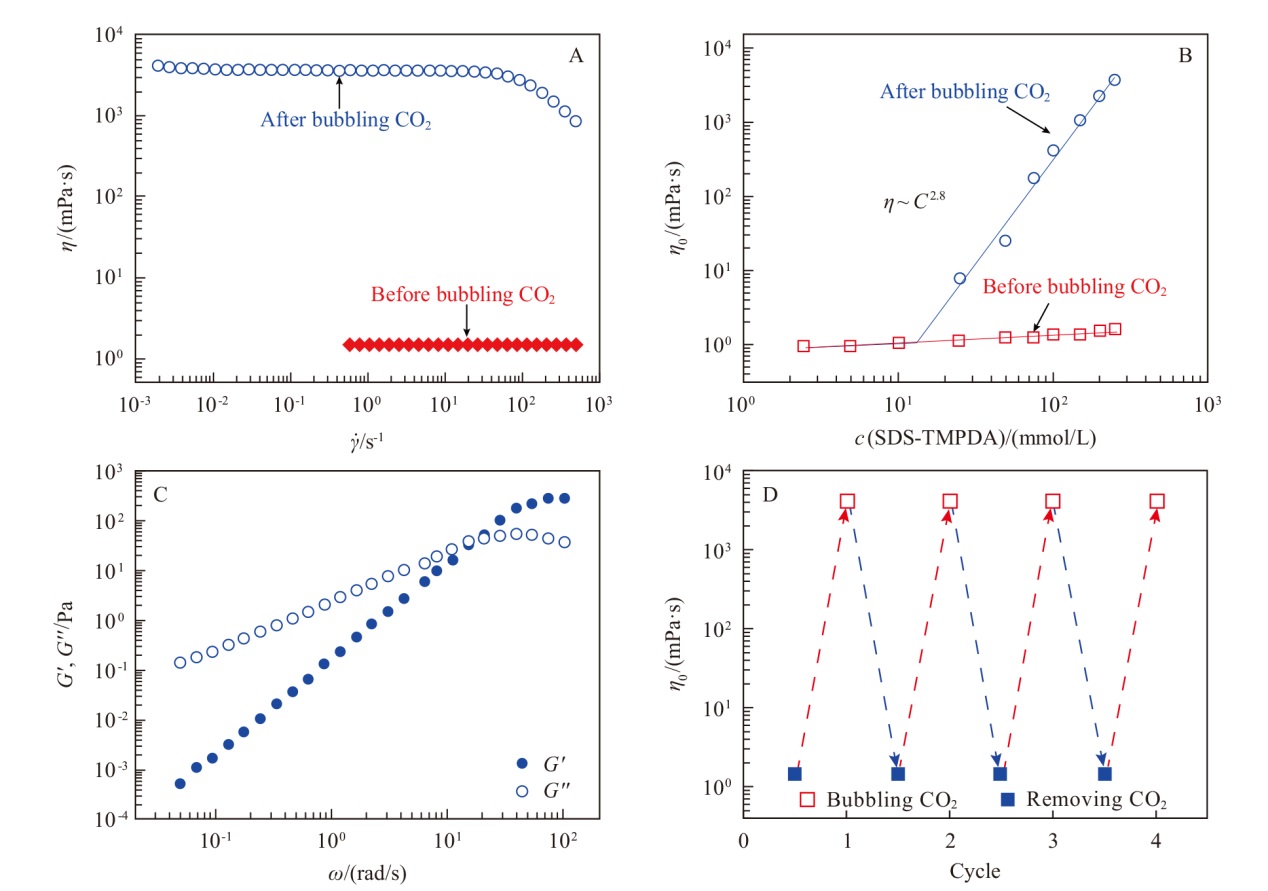
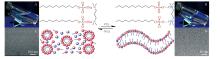
Fig.3
Schematic illustration of the CO2-switchability of the “pseudo-gemini” model composed of SDS and TMPDA[9]"
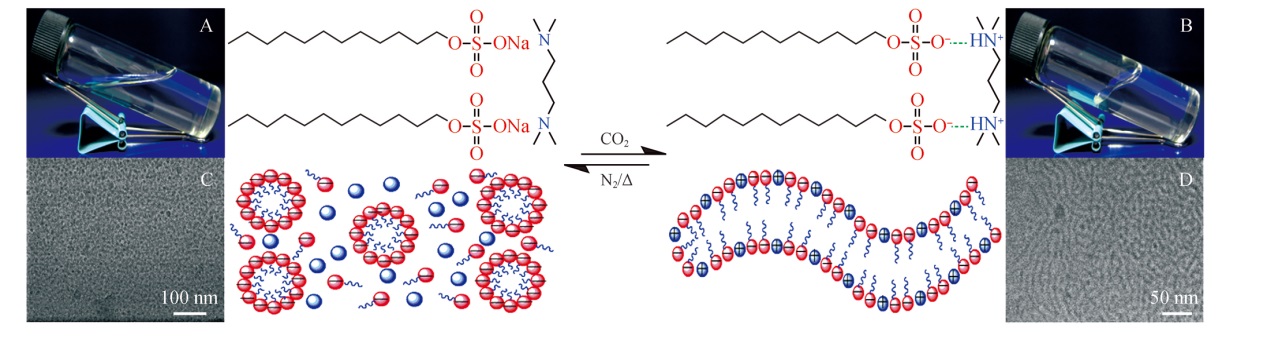
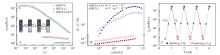
Fig.4
(A)Steady state and(B)dynamic rheology, as well as(C)zero-shear viscosity(η0)of a 2.0 wt% ODPTA dispersion measured over repeated cycles of bubbling and removing CO2 .[11]Insets: snapshots of the original 2.0% ODPTA aqueous dispersion, after bubbling CO2(0.1 MPa), displacing CO2 by N2(0.1 MPa)at 75 ℃, and adjusting to the same equilibrium pH with HCl"
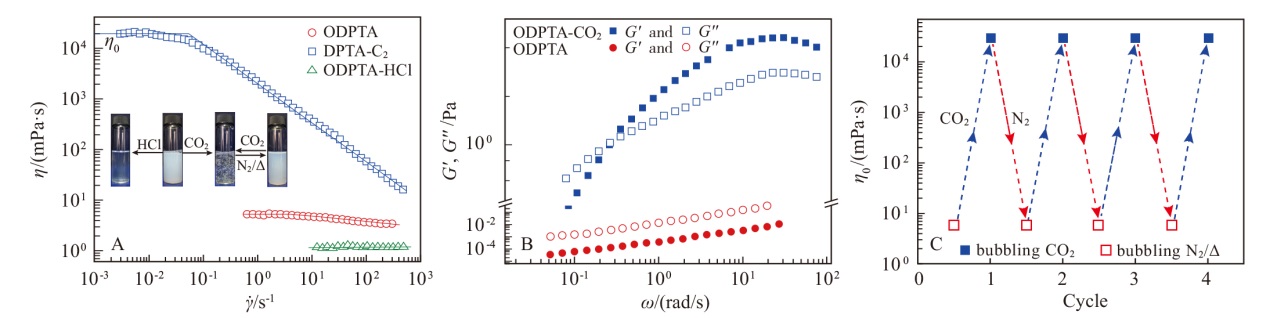
Fig.5
Cryo-TEM micrographs of 2.0 wt% ODPTA at 30 ℃.(A)Before bubbling CO2;(B)and(C), after bubbling CO2;(D)removing CO2;(E)with HCl to adjust the pH[11]"
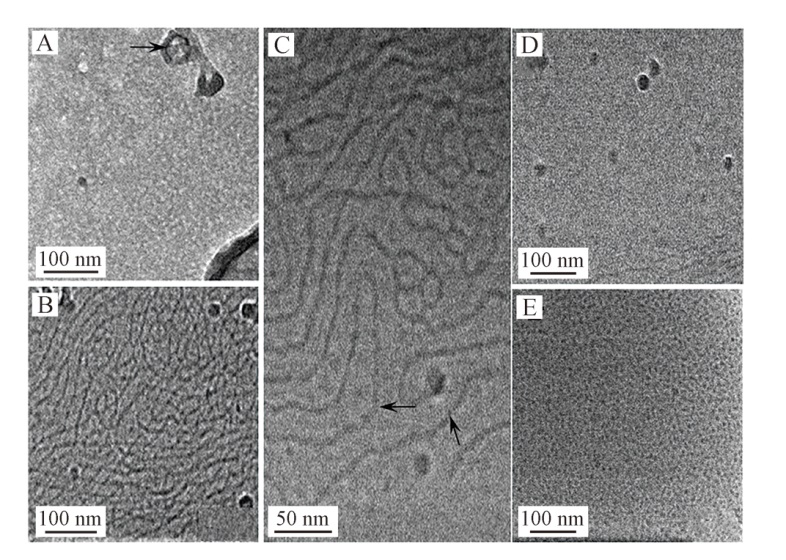
Fig.6
(A)Zero-shear viscosity(η0)of the 100 mmol/L UC22AMPM solution measured during the repeated cycles of bubbling CO2 and air at 25 ℃;(B)micrographs of UC22AMPM-CO2 and(C)UC22AMPM-air observed by Cryo-TEM [12]"
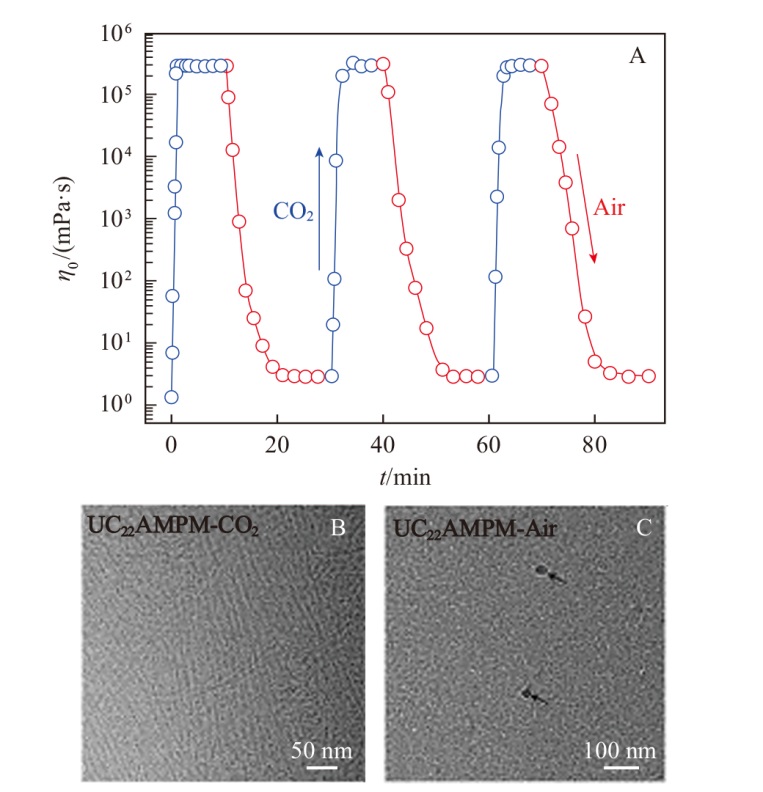
Fig.7
(A)Evolution of the appearance of 100 mmol/L UC22AMPM-CO2 solutions over time when exposed to air;(B)high viscosity is still evidenced after 6 months of storage of the 100 mmol/L UC22AMPM-CO2 solution sealed in a vial[12]"
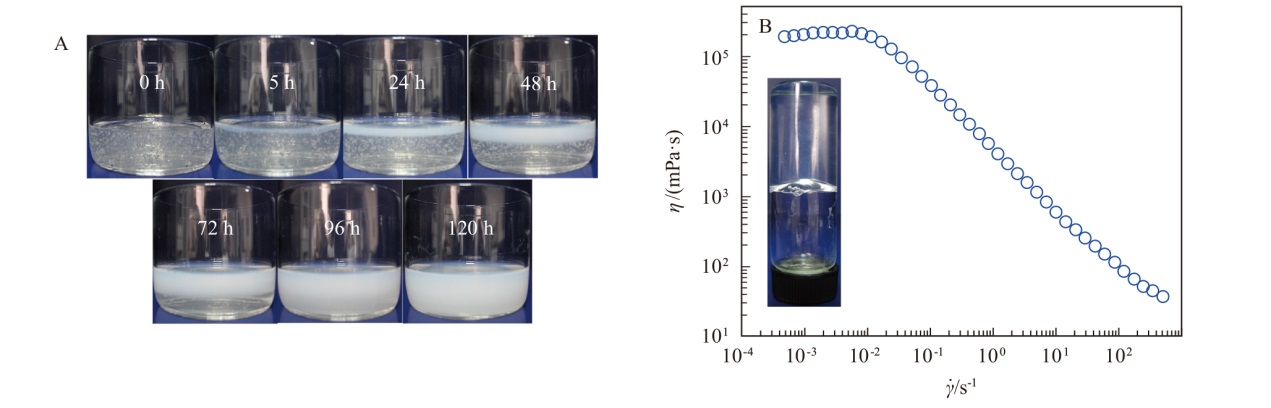
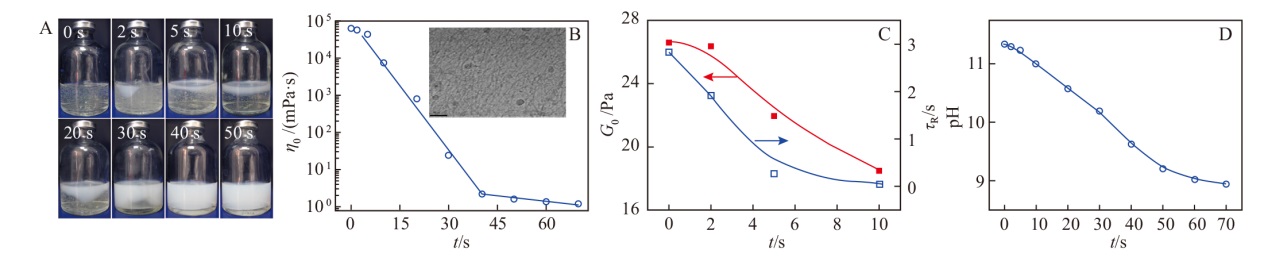
Fig.8
Evolution of(A)appearance,(B)zero-shear viscosity(η0),(C)plateau modulus(G0)and relaxation time(τR), and(D)pH of 100 mmol/L NaOEr solution(pH=11.34)as a function of CO2 bubbling time at 60 ℃[13]"
| [1] | 楚宗霖, 姜展鹏, 冯玉军. 黏弹性表面活性剂(VI)——智能蠕虫状胶束[J]. 日用化学工业 (中英文), 2026, 56(6): 696-705. |
| [2] | Feng Y, Chu Z, Dreiss C A. Smart wormlike micelles: Design, characteristics and applications[M]. Springer, Heidelberg, 2015. |
| [3] |
Chu Z, Dreiss C A, Feng Y. Smart wormlike micelles[J]. Chemical Society Reviews, 2013, 42(17): 7174-7203.
doi: 10.1039/c3cs35490c pmid: 23545844 |
| [4] |
Liu Y X, Jessop P G, Cunningham M, et al. Switchable surfactants[J]. Science, 2006, 313: 958-960.
pmid: 16917059 |
| [5] |
Liu H, Lin S, Feng Y, et al. CO2-responsive polymer materials[J]. Polym. Chem., 2017, 8(1): 12-23.
doi: 10.1039/C6PY01101B |
| [6] |
Yin H, Feng Y, Liu H, et al. Insights into the relationship between CO2 switchability and basicity: examples of melamine and its derivatives[J]. Langmuir, 2014, 30(33): 9911-9919.
doi: 10.1021/la501461n |
| [7] |
Chu Z, Feng Y. pH-Switchable wormlike micelles[J]. Chem. Commun., 2010, 46(47): 9028-9030.
doi: 10.1039/C0CC02415E |
| [8] |
Feng Y, Chu Z. pH-Tunable wormlike micelles based on an ultra-long-chain “pseudo” gemini surfactant[J]. Soft Matter, 2015, 11: 4614-4620.
doi: 10.1039/C5SM00677E |
| [9] |
Zhang Y, Feng Y, Wang Y, et al. CO2-switchable viscoelastic fluids based on a pseudogemini surfactant[J]. Langmuir, 2013, 29(13): 4187-4192.
doi: 10.1021/la400051a pmid: 23514006 |
| [10] |
Su X, Cunningham M F, Jessop P G. Switchable viscosity triggered by CO2 using smart worm-like micelles[J]. Chem. Commun., 2013, 49: 2655-2657.
doi: 10.1039/c3cc37816k |
| [11] |
Zhang Y, Feng Y, Wang J, et al. CO2-switchable wormlike micelles[J]. Chem. Commun., 2013, 49: 4902-4904.
doi: 10.1039/c3cc41059e |
| [12] |
Zhang Y, Chu Z, Dreiss C A, et al. Smart wormlike micelles switched by CO2 and air[J]. Soft Matter, 2013, 9: 6217-6221.
doi: 10.1039/c3sm50913c |
| [13] | Zhang Y, Yin H, Feng Y. CO2-responsive anionic wormlike micelles based on natural erucic acid[J]. Green Mater., 2014, 2: 95-103. |
| [1] | Zonglin Chu, Zhanpeng Jiang, Yujun Feng. Viscoelastic surfactants (VI) Smart wormlike micelles [J]. China Surfactant Detergent & Cosmetics, 2026, 56(6): 695-705. |
| [2] | Yujun Feng. Viscoelastic surfactants (V) Similarity and difference between wormlike micelles and polymers [J]. China Surfactant Detergent & Cosmetics, 2026, 56(5): 557-563. |
| [3] | Yujun Feng. Viscoelastic surfactants (III)Steady rheology and shear bandings [J]. China Surfactant Detergent & Cosmetics, 2026, 56(3): 277-283. |
| [4] | Yujun Feng. Viscoelastic surfactants(II)Formation mechanisms and system formulations of wormlike micelles [J]. China Surfactant Detergent & Cosmetics, 2026, 56(2): 137-148. |
| [5] | Yujun Feng. Viscoelastic surfactants (I)Evolution of micelles and discovery of wormlike micelles [J]. China Surfactant Detergent & Cosmetics, 2026, 56(1): 8-16. |
| [6] | Wanping Zhang, Dexu Meng, Kaikai Liu, Pingli Wang, Qianjie Zhang, Chengliang Li. Assembly behavior and emulsification property of dopamine modified sodium hyaluronate based on ionic coordination [J]. China Surfactant Detergent & Cosmetics, 2025, 55(8): 1006-1016. |
| [7] | Fengqin Li, Tao Geng, Jingjie Zhou, Jinyuan Sun, Ke Zhang, Chunyu Wang. Study on the mechanism and performance of different catalysts in the reaction between dodecanol and 1, 2-epoxybutane [J]. China Surfactant Detergent & Cosmetics, 2025, 55(8): 998-1005. |
| [8] | Qianjie Zhang, Zhenzhi Zhao, Shanshan Wang, Jie Gu, Zhi Lv, Wanping Zhang. Effect of hydrophobic groups of polyglycerol ester emulsifiers on liquid crystal formation and its promotion mechanism [J]. China Surfactant Detergent & Cosmetics, 2025, 55(12): 1552-1559. |
| [9] | Zeyi Wang, Shuli Dong. Nuclear magnetic resonance studies of G-quadruplex [J]. China Surfactant Detergent & Cosmetics, 2025, 55(11): 1361-1377. |
| [10] | Linlin Zhao, Yutian Jiao, Li Zhao, Ce Wang, Baocai Xu. Synthesis and self-assembly of an azobenzene-containing dipeptide surfactant [J]. China Surfactant Detergent & Cosmetics, 2024, 54(5): 507-513. |
| [11] | Liang Yihuan,Du Jing. “Jelly” phenomenon rheology study and improvement in shampoo system [J]. China Surfactant Detergent & Cosmetics, 2022, 52(9): 920-929. |
| [12] | Dou Xin. Analysis of supramolecular structure diversity of gel soft matter system [J]. China Surfactant Detergent & Cosmetics, 2022, 52(9): 945-950. |
| [13] | LI Jun,ZHANG Xing-fang,ZHANG Cheng-wei,XU Na. Mesoscale Brownian dynamics simulation on the self-assembly behaviors of rodlike micelles of CTAC/NaSal surfactants [J]. China Surfactant Detergent & Cosmetics, 2020, 50(4): 213-219. |
| [14] | SUN Na,ZHENG Li-qiang,SUN Ji-chao. Self-assembly of surfactants regulated by weak interactions(IV)Application in ionic conduction [J]. China Surfactant Detergent & Cosmetics, 2019, 49(4): 214-219. |
| [15] | Yang YU,Li-qiang ZHENG,Ji-chao SUN. Self-assembly of surfactants controlled by weak interactions(Ⅲ) Responsive surfactants [J]. China Surfactant Detergent & Cosmetics, 2019, 49(3): 141-149. |
|
