Welcome to China Surfactant Detergent & Cosmetics, Today is

China Surfactant Detergent & Cosmetics ›› 2026, Vol. 56 ›› Issue (5): 557-563.doi: 10.3969/j.issn.2097-2806.2026.05.001

• Lecture of science and technology •     Next Articles

Viscoelastic surfactants (V) Similarity and difference between wormlike micelles and polymers

Yujun Feng()   

  1. State Key Laboratory of Advanced Polymer Materials, Polymer Research Institute, Sichuan University, Chengdu, Sichuan 610065, China
  • Received:2026-05-18 Online:2026-05-22 Published:2026-06-22
  • Contact: *E-mail: yjfeng@scu.edu.cn

Abstract:

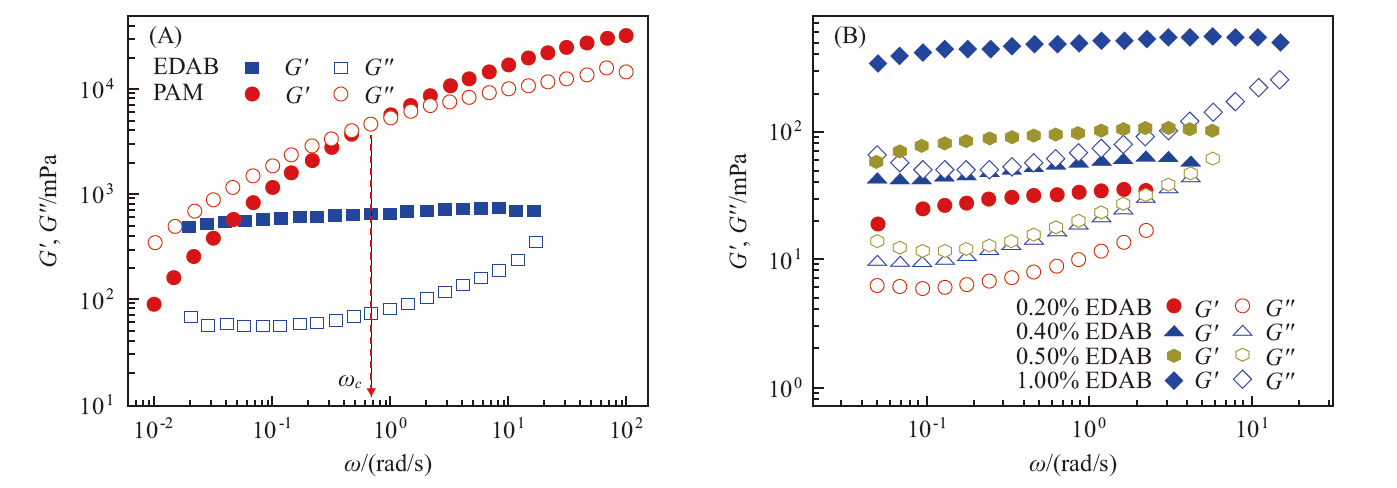
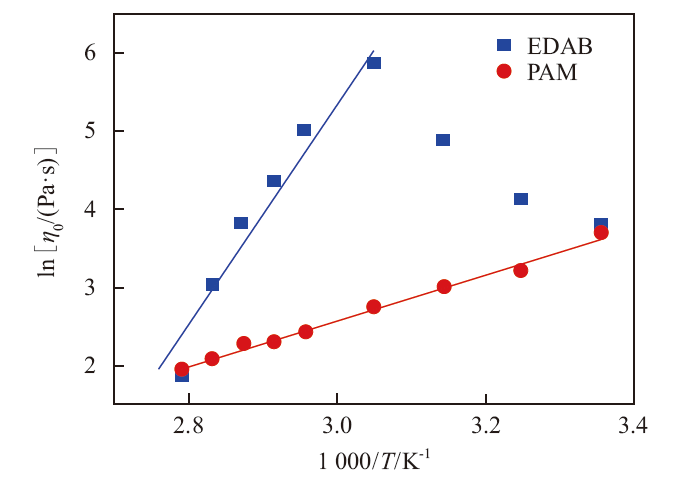
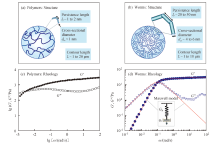
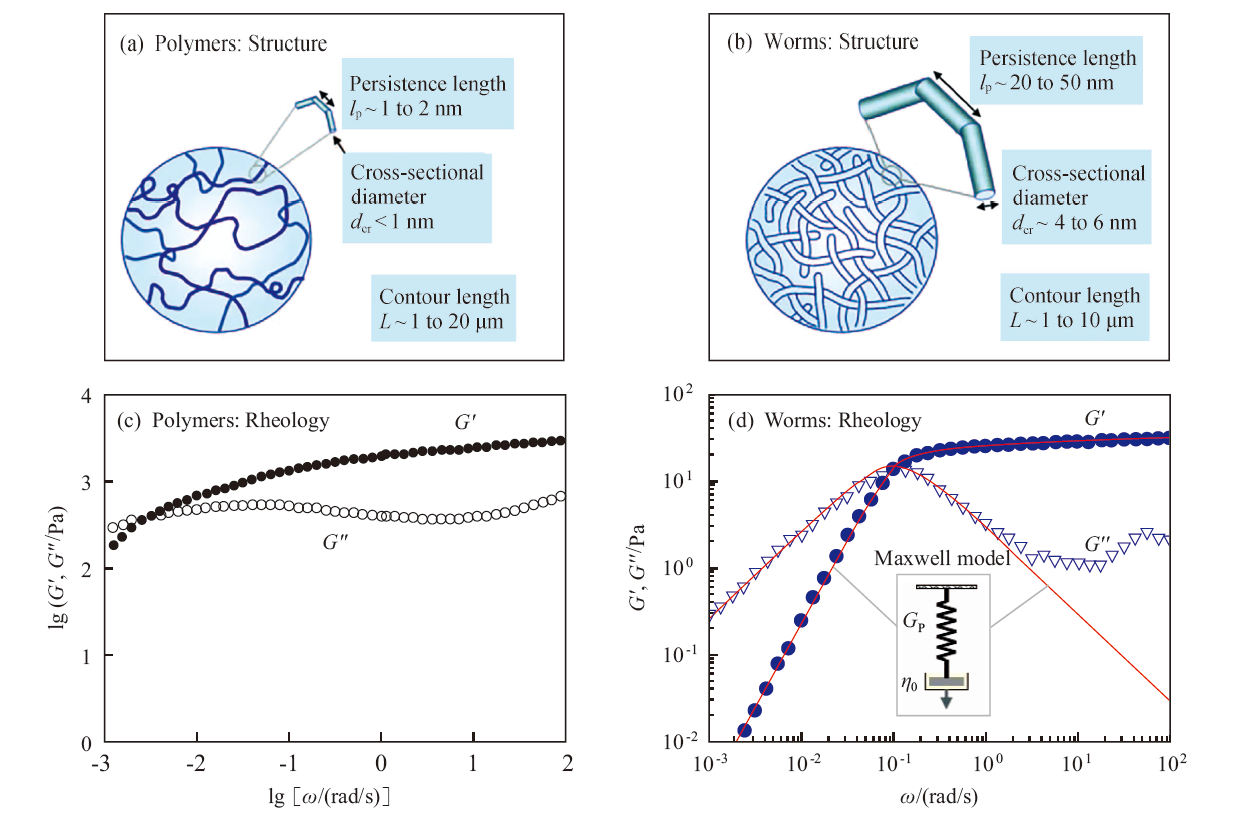
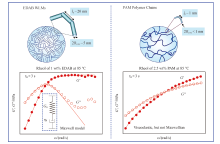
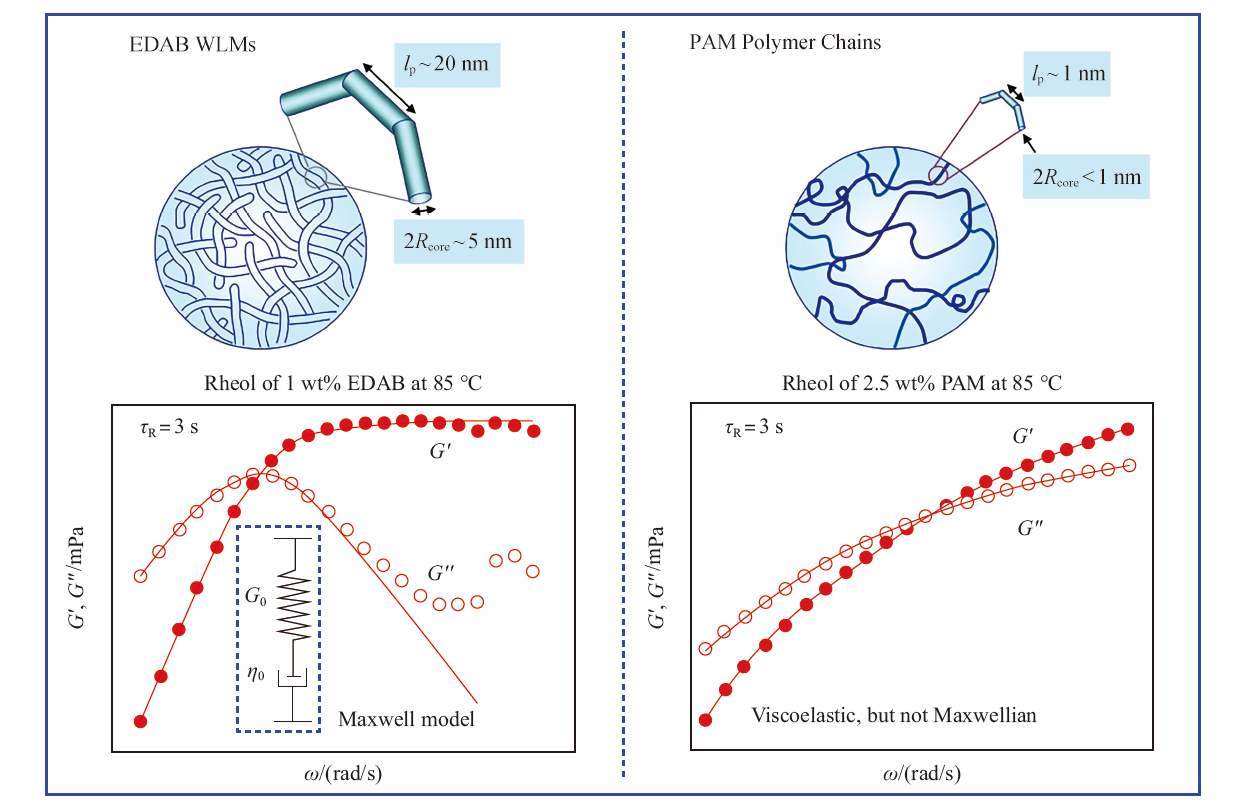
Wormlike micelles (WLMs) are self-assembled, one-dimensional aggregates that form transient entangled networks in aqueous solutions, exhibiting macroscopic rheology akin to that of traditional water-soluble polymers. This behavioral resemblance has fostered the “living polymer” analogy, yet the underlying assembly mechanisms differ fundamentally—a source of persistent ambiguity in both theory and application. To clarify these similarities and distinctions, a comparative study was reviewed on C22-tailed ultra-long zwitterionic EDAB wormlike micelles and ultra-high molecular weight (12×106 g/mol) polyacrylamide (PAM) using macroscopic rheology, small-angle neutron scattering, cryo-transmission electron microscopy, and reptation theory. Both systems behave as semi-flexible chains that form entangling networks above a critical overlap concentration, display shear thinning at high rates, and follow Arrhenius temperature dependence (25-85 ℃), with optimal zero-shear viscosity reaching 40 000 mPa·s. Despite these parallels, their internal assembly modes diverge fundamentally. Traditional polymers rely on permanent covalent bonds—fixed chain length, molecular weight, and single reptation relaxation. In contrast, WLMs arise from reversible non-covalent hydrophobic and electrostatic interactions, yielding a thermodynamically balanced dynamic system with continuous breakage-reorganization and molecular exchange. Consequently, EDAB micelles exhibit 2.5-fold higher thickening efficiency and a lower critical overlap concentration (0.04 wt%) than PAM. They also show markedly higher temperature sensitivity (flow activation energy: 145 kJ/mol for EDAB vs. 24 kJ/mol for PAM). While polymers display a multi-mode relaxation spectrum, WLMs obey Maxwell single-relaxation behavior at elevated temperatures and feature a dual relaxation mechanism coupling breakage with reptation. Morphologically, WLMs possess a larger core radius (~2.9 nm) and persistence length (≥20 nm), with temperature-induced reversible transitions (shortening, branching, cyclization) ; polymer structures remain stable. Thus, the similarity between wormlike micelles and polymer solutions is only superficial under low concentrations and mild conditions; their essential dynamic and thermodynamic differences govern performance under complex environments. This analysis delineates the valid scope of the “living polymer” analogy and offers a theoretical basis for targeted design and application of both rheology modifiers.

Key words: wormlike micelles, polymer, rheology, microstructure, rheology modifier

CLC Number: 

  • TQ423