Welcome to China Surfactant Detergent & Cosmetics, Today is


China Surfactant Detergent & Cosmetics ›› 2026, Vol. 56 ›› Issue (2): 137-148.doi: 10.3969/j.issn.2097-2806.2026.02.001
• Lecture of science and technology • Next Articles
Yujun Feng*( )
)
Received:2026-01-31
Online:2026-02-22
Published:2026-03-09
Contact:
E-mail: CLC Number:
Yujun Feng. Viscoelastic surfactants(II)Formation mechanisms and system formulations of wormlike micelles[J].China Surfactant Detergent & Cosmetics, 2026, 56(2): 137-148.
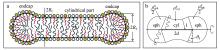
Fig.1
(a) Schematic presentation of a two-component spherocylindrical surfactant aggregate-wormlike (rodlike) micelle; Rc and Rs are the radii of the cylindrical part and the spherical endcaps. (b) Illustration of a cross section along the axis of symmetry of a short cylindrical (denoted by “cyl”) micelle with two end caps (denoted by “sph”)[7]"
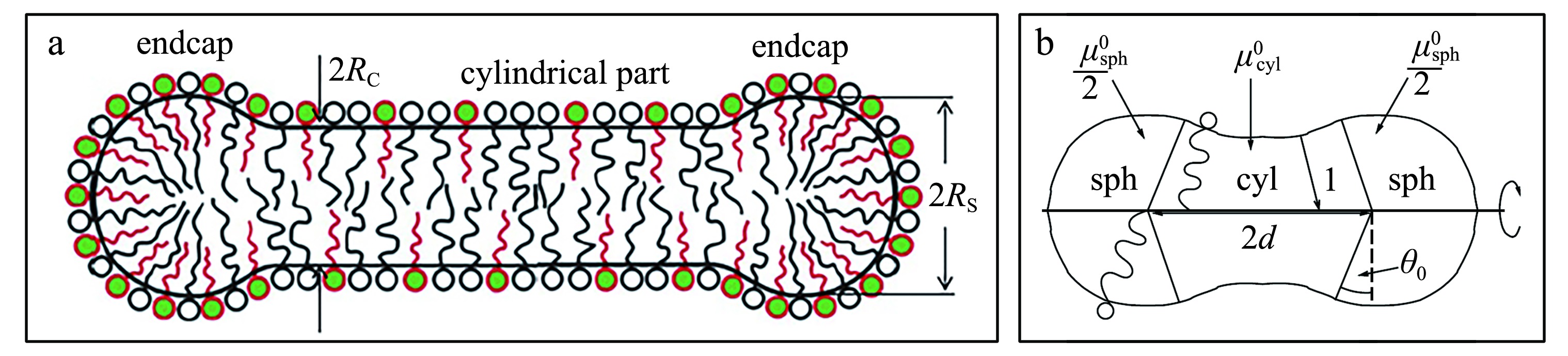
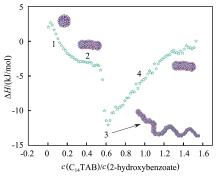
Fig.2
Variation of enthalpy as a function of c(C14TAB)/c(2-hydroxybenzoate). The variation of enthalpy associated with the formation of WLM is indicated together with four steps:[4](1)mixed-micelle formation;(2)partial micelle growth;(3)WLM formation;(4)shortening of the WLM"
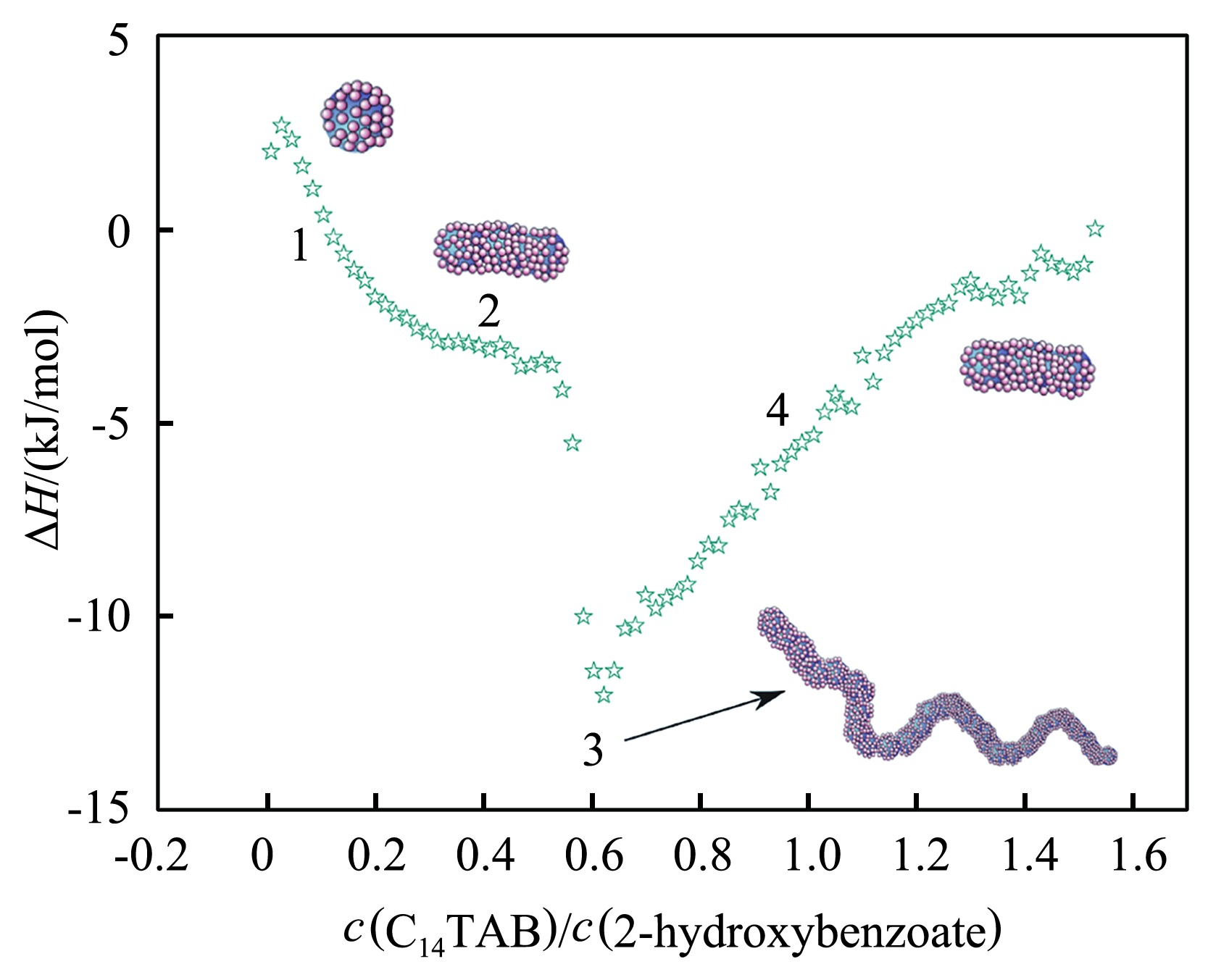
Fig.3
Variation with time of:(a)the core aspect ratio(ε), at fixed NaCl(0.5 mmol/L)and different SDS concentrations;(b)the fraction of ellipsoidal micelles( ?e), at fixed NaCl(1.0 mmol/L)and different SDS concentrations;(c)the average contour length(Lave)at fixed NaCl(1.0 mmol/L)and different SDS concentrations[10]"
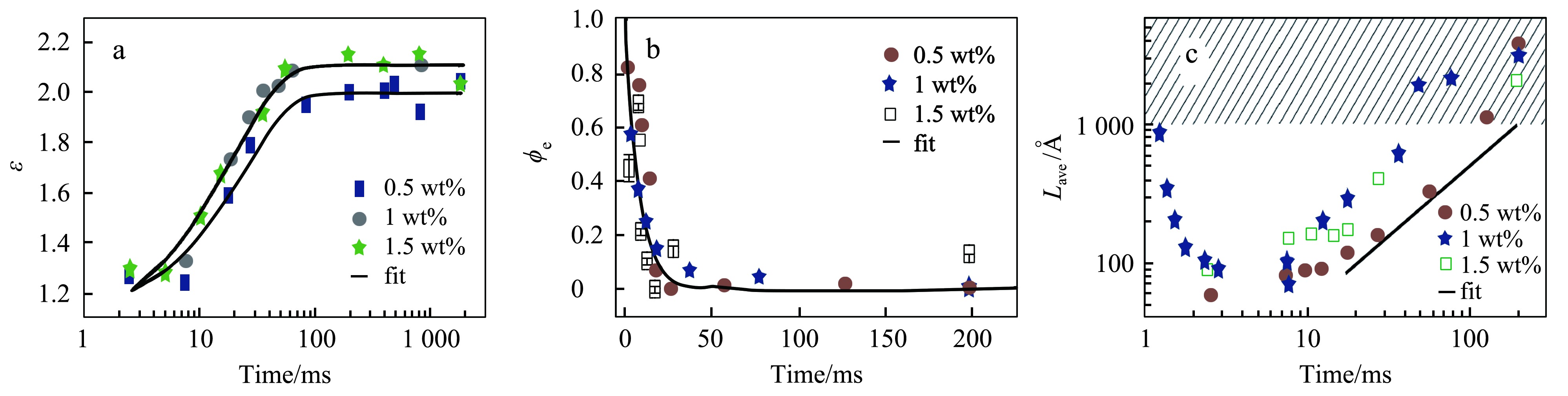
Fig.4
Schematic representation of the transition from spherical/ellipsoidal micelles to wormlike mcielles[10]"
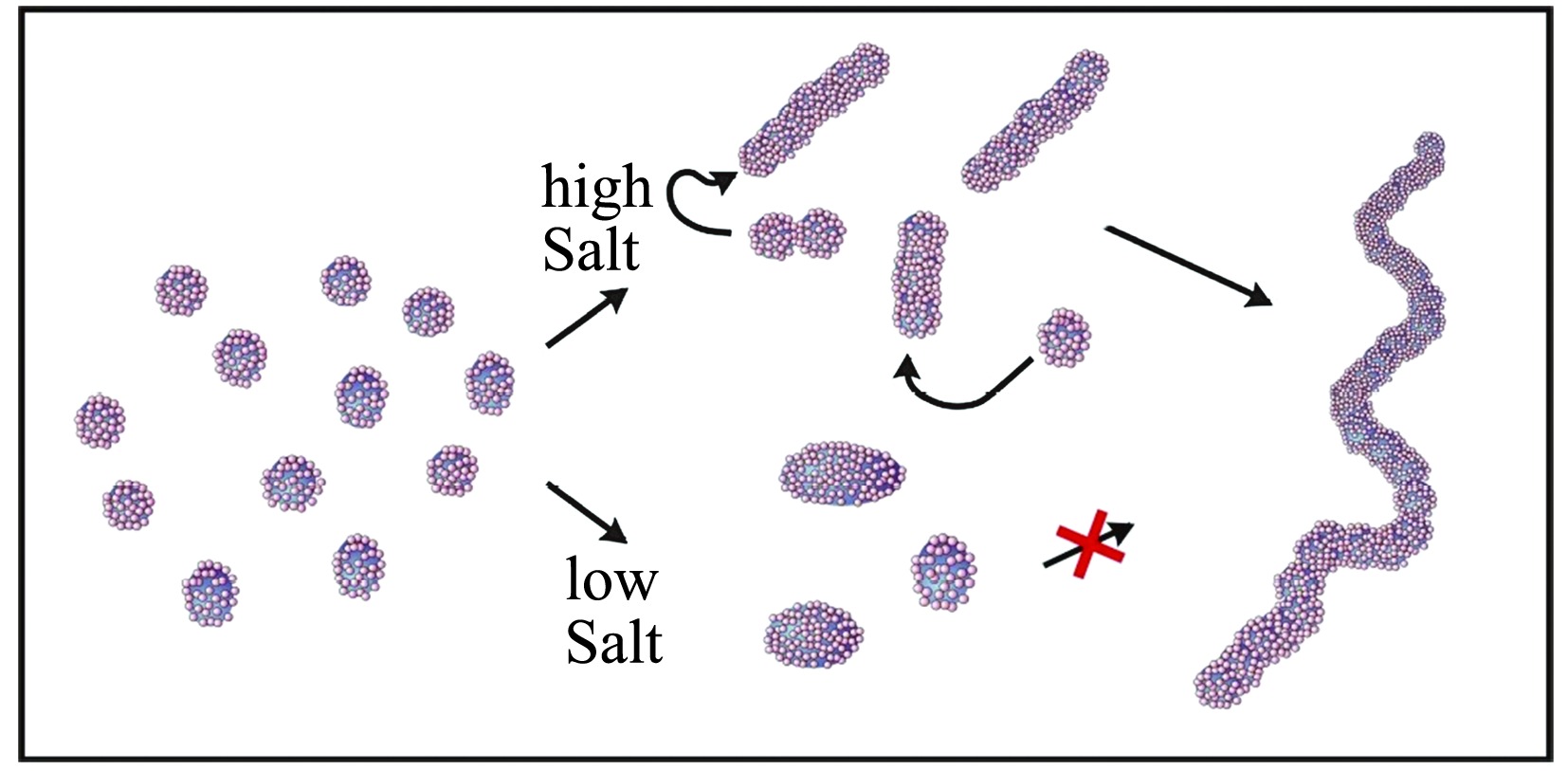
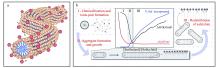
Fig.5
(a)Schematic illustration of wormlike micelle formation from cetyltrimethylammonium bromide induced by sodium salicylate insertion into the micellar palisade layer[4];(b)Three-stage process for the formation of wormlike micelles from tetradecyltrimethylammonium bromide(DTAB)and sodium salicylate[3]"

| [1] | 冯玉军. 黏弹性表面活性剂(I)——百年胶束发展史及蠕虫状胶束的发现[J]. 日用化学工业(中英文), 2026, 56(1): 8-16. |
| [2] | Nagarajan R. Molecular thermodynamics of giant micelles. In: Zana R, Kaler E, eds. Giant micelles: properties and applications[M]. CRC Press, Boca Raton, 2007: 1-40. |
| [3] |
de Souza R N, Jora M Z, Alves D L G T, et al. A new interpretation of the mechanism of wormlike micelle formation involving a cationic surfactant and salicylate[J]. J. Colloid Interface Sci., 2019, 552: 794-800.
doi: 10.1016/j.jcis.2019.05.025 |
| [4] | Sabadini E, Clinckspoor K J. New insights into the formation of wormlike micelles: kinetics and thermodynamics. In: Dreiss C A, Feng Y, eds. Wormlike micelles: advances in systems, characterisation and applications. Soft Matter Series No.6[M]. The Royal Society of Chemistry, London, 2017: 298-329. |
| [5] | Israelachvili J N. Intermolecular and surface forces (3rd ed.)[M]. Academic Press, San Diego, 2011. |
| [6] |
Danov K D, Kralchevsky P A, Stoyanov S D, et al. Analytical modeling of micelle growth. 2. Molecular thermodynamics of mixed aggregates and scission energy in wormlike micelles[J]. J. Colloid Interface Sci., 2019, 551, 227-241.
doi: 10.1016/j.jcis.2019.05.017 |
| [7] |
May S, Ben-Shaul A. Molecular theory of the sphere-to-rod transition and the second CMC in aqueous micellar solutions[J]. J. Phys. Chem. B, 2001, 105(3): 630-640.
doi: 10.1021/jp003021o |
| [8] |
Cates M E, Candau S J. Statics and dynamics of worm-like surfactant micelles[J]. J. Phys.: Condens. Matter, 1990, 2: 6869-6892.
doi: 10.1088/0953-8984/2/33/001 |
| [9] |
Spenley N A, Cates M E, McLeish T C B. Nonlinear rheology of wormlike micelles[J]. Phys. Rev. Lett., 1993, 71: 939-942.
pmid: 10055406 |
| [10] |
Jensen G V, Lund R, Gummel J, et al. Monitoring the transition from spherical to polymer-like surfactant micelles using small-angle X-ray scattering[J]. Angew. Chem. Int. Ed., 2014, 53(43): 11524-11528.
doi: 10.1002/anie.201406489 pmid: 25197008 |
| [11] |
Löf D, Niemiec A, Schillén K, et al. A calorimetry and light scattering study of the formation and shape transition of mixed micelles of EO20PO68EO20 triblock copolymer (P123) and nonionic surfactant (C12EO6)[J]. J. Phys. Chem. B, 2007, 111(21): 5911-5920.
doi: 10.1021/jp071101n |
| [12] |
Ito T H, Clinckspoor K J, de Souza R N, et al. The thermal signature of wormlike micelles[J]. J. Chem. Thermodynamics, 2016, 94: 61-66.
doi: 10.1016/j.jct.2015.10.021 |
| [13] |
Zilman A, Safran S A, Stottmann T, et al. Temperature dependence of the thermodynamics and kinetics of micellar solutions[J]. Langmuir, 2004, 20(6): 2199-2207.
pmid: 15835671 |
| [14] |
Reiss-Husson F, Luzzati V. The structure of micellar solutions of some amphiphilic compounds in pure water as determined by absolute small-angle X-ray scattering experiments[J]. J. Phys. Chem., 1964, 68: 3504-3511.
doi: 10.1021/j100794a011 |
| [15] |
Ekwall P, Mandell L, Solyom P. The aqueous cetyl trimethylammonium bromide solutions[J]. J. Colloid Interface Sci., 1971, 35: 519-527.
doi: 10.1016/0021-9797(71)90210-4 |
| [16] |
Fontell K, Khan A, Lindström B, et al. Phase equilibria and structures in ternary systems of a cationic surfactant (C16TABr or (C16TA)2SO4), alcohol and water[J]. Colloid Polym. Sci., 1991, 269: 727-742.
doi: 10.1007/BF00657411 |
| [17] |
Porte G, Poggi Y, Appell J, et al. Large micelles in concentrated solutions. The second critical micellar concentration[J]. J. Phys. Chem., 1984, 88: 5713-5720.
doi: 10.1021/j150667a051 |
| [18] |
Gravsholt S. Viscoelasticity in highly dilute aqueous solutions of pure cationic detergents[J]. J. Colloid Interface Sci., 1976, 57(3): 575-577.
doi: 10.1016/0021-9797(76)90236-8 |
| [19] |
Debye P, Anacker E W. Micelle shape from dissymmetry measurements[J]. J. Phys. Colloid Chem., 1951, 55: 644-655.
pmid: 14832754 |
| [20] |
Candau S J, Hirsch E, Zana R, et al. Network properties of semidilute aqueous KBr solutions of cetyltrimethylammonium bromide[J] J. Colloid Interface Sci., 1988, 122(2): 430-440.
doi: 10.1016/0021-9797(88)90377-3 |
| [21] |
Quirion F, Magid L J. Growth and counterion binding of cetyltrimethylammonium bromide aggregates at 25 ℃: A neutron and light scattering study[J]. J. Phys. Chem., 1986, 90(21): 5435-5441.
doi: 10.1021/j100412a108 |
| [22] |
Raghavan S R, Kaler E W. Highly viscoelastic wormlike micellar solutions formed by cationic surfactants with long unsaturated tails[J]. Langmuir, 2001, 17(2): 300-306.
doi: 10.1021/la0007933 |
| [23] |
Croce V, Cosgrove T, Maitland G, et al. Rheology, cryogenic transmission electron spectroscopy, and small-angle neutron scattering of highly viscoelastic wormlike micellar solutions[J]. Langmuir, 2003, 19(20): 8536-8541.
doi: 10.1021/la0345800 |
| [24] |
Siriwatwechakul W, Lafleur T, Prud’homme R K, et al. Effects of organic solvents on the scission energy of rodlike micelles[J]. Langmuir, 2004, 20(21): 8970-8974.
pmid: 15461475 |
| [25] |
Schubert B A, Wagner N J, Kaler E W, et al. Shear-induced phase separation in solutions of wormlike micelles[J]. Langmuir, 2004, 20(9): 3564-3573.
pmid: 15875385 |
| [26] |
Imai S, Shikata T. Viscoelastic Behavior of Surfactant Threadlike Micellar Solutions: Effect of Additives 3[J]. J. Colloid Interface Sci., 2001, 244(2): 399-404.
doi: 10.1006/jcis.2001.7992 |
| [27] |
Rehage H, Hoffmann H. Rheological properties of viscoelastic surfactant systems[J]. J. Phys. Chem., 1988, 92(16): 4712-4719.
doi: 10.1021/j100327a031 |
| [28] |
Oelschlaeger C, Waton G, Candau S J. Rheological behavior of locally cylindrical micelles in relation to their overall morphology[J]. Langmuir, 2003, 19(25): 10495-10500.
doi: 10.1021/la035082u |
| [29] |
Dreiss C A. Wormlike micelles: where do we stand? Recent developments, linear rheology and scattering techniques[J]. Soft Matter, 2007, 3: 956-970.
doi: 10.1039/b705775j pmid: 32900044 |
| [30] |
Bijma K, Engberts J B F N. Effect of counterions on properties of micelles formed by alkylpyridinium surfactants. 1. conductometry and 1H NMR chemical shifts[J]. Langmuir, 1997, 13(18): 4843-4849.
doi: 10.1021/la970171q |
| [31] |
Bijma K, Blandamer K J, Engberts J B F N. Effect of counterions and headgroup hydrophobicity on properties of micelles formed by alkylpyridinium surfactants. 2. Microcalorimetry[J]. Langmuir, 1998, 14(1): 79-83.
doi: 10.1021/la970216n |
| [32] |
Bachofer S J, Turbitt R M. The orientational binding of substituted benzoate anions at the cetyltrimethyl ammonium bromide interface[J]. J. Colloid Interface Sci., 1990, 135(2): 325-334.
doi: 10.1016/0021-9797(90)90003-7 |
| [33] |
Brown W, Johansson K, Almgren M. Threadlike micelles from cetyltrimethylammonium bromide in aqueous sodium naphthalene sulfonate solutions studied by static and dynamic light scattering[J]. J. Phys. Chem., 1989, 93(15): 5888-5894.
doi: 10.1021/j100352a047 |
| [34] |
Singh M, Ford C, Agarwal V, et al. Structural evolution in cationic micelles upon incorporation of a polar organic dopant[J]. Langmuir, 2004, 20(23): 9931-9937.
pmid: 15518477 |
| [35] |
Couillet I, Hughes T, Maitland G, et al. Growth and scission energy of wormlike micelles formed by a cationic surfactant with long unsaturated tails[J]. Langmuir, 2004, 20(22): 9541-9550.
pmid: 15491184 |
| [36] |
Porte G, Gomati R, El H O, et al. Morphological transformations of the primary surfactant structures in brine-rich mixtures of ternary systems (surfactant/alcohol/brine)[J]. J. Phys. Chem., 1986, 90(22): 5746-5751.
doi: 10.1021/j100280a055 |
| [37] |
Magid L J, Li Z, Butler P D. Flexibility of elongated sodium dodecyl sulfate micelles in aqueous sodium chloride: A small-angle neutron scattering study[J]. Langmuir, 2000, 16(26): 10028-10036.
doi: 10.1021/la0006216 |
| [38] |
Arleth L, Bergström M, Pedersen J S. Small-angle neutron scattering study of the growth behavior, flexibility, and intermicellar interactions of wormlike SDS micelles in NaBr aqueous solutions[J]. Langmuir, 2002, 18(14): 5343-5353.
doi: 10.1021/la015693r |
| [39] |
Mu J H, Li G Z, Jia X L, et al. Rheological properties and microstructures of anionic micellar solutions in the presence of different inorganic salts[J]. J. Phys. Chem. B, 2002, 106(44): 11685-11693.
doi: 10.1021/jp014096a |
| [40] |
von Berlepsh H, Dautzenberg H, Rother G, et al. An investigation of the micellar phase of sodium sulfopropyl octadecyl maleate in aqueous sodium chloride solutions by light scattering techniques. evidence of nearly rodlike micelles[J]. Langmuir, 1996, 12(15): 3613-3625.
doi: 10.1021/la960036y |
| [41] |
Bergström M, Pedersen J S. Formation of tablet-shaped and ribbonlike micelles in mixtures of an anionic and a cationic surfactant[J]. Langmuir, 1999, 15(7): 2250-2253.
doi: 10.1021/la981495x |
| [42] |
Raghavan S R, Fritz G, Kaler E W. Wormlike micelles formed by synergistic self-assembly in mixtures of anionic and cationic surfactants[J]. Langmuir, 2002, 18(10): 3797-3803.
doi: 10.1021/la0115583 |
| [43] |
Ziserman L, Abezgauz L, Ramon O, et al. Origins of the viscosity peak in wormlike micellar solutions. 1. mixed catanionic surfactants. A cryo-transmission electron microscopy study[J]. Langmuir, 2009, 25(18): 10483-10489.
doi: 10.1021/la901189k pmid: 19572608 |
| [44] |
Hassan P A, Raghavan S R, Kaler E W. Microstructural changes in SDS micelles induced by hydrotropic salt[J]. Langmuir, 2002, 18(7): 2543-2548.
doi: 10.1021/la011435i |
| [45] |
Nakamura K, Shikata T. Threadlike micelle formation of anionic surfactants in aqueous solution[J]. Langmuir, 2006, 22(24): 9853-9859.
pmid: 17106973 |
| [46] |
Thiele T, Berret J F, Muller S, et al. Rheology and nuclear magnetic resonance measurements under shear of sodium dodecyl sulfate/decanol/water nematics[J]. J. Rheol., 2001, 45(1): 29-48.
doi: 10.1122/1.1332387 |
| [47] |
Douliez J P, Navailles L, Nallet F. Self-assembly of fatty acid-alkylboladiamine salts[J]. Langmuir, 2006, 22(2): 622-627.
doi: 10.1021/la052377u |
| [48] |
Hoffmann H, Rauschera A, Gradzielski M, et al. Influence of ionic surfactants on the viscoelastic properties of zwitterionic surfactant solutions[J]. Langmuir, 1992, 8(9): 2140-2146.
doi: 10.1021/la00045a013 |
| [49] |
Fischer P, Rehage H, Grüning B. Linear flow properties of dimer acid betaine solutions with and without changed ionic strength[J]. J. Phys. Chem. B, 2002, 106(42): 11041-11046.
doi: 10.1021/jp0127263 |
| [50] |
Jerke G, Pedersen J S, Egelhaaf S U, et al. Flexibility of charged and uncharged polymer-like micelles[J]. Langmuir, 1998, 14(21): 6013-6024.
doi: 10.1021/la980390r |
| [51] |
Bernheim-Groswasser A, Wachtel E, Talmon Y. Micellar growth, network formation, and criticality in aqueous solutions of the nonionic surfactant C12E5[J]. Langmuir, 2000, 16(9), 4131-4140.
doi: 10.1021/la991231q |
| [52] |
Imanishi K, Einaga Y. Wormlike micelles of polyoxyethylene alkyl ether mixtures C10E5+ C14E5 and C14E5 + C14E7: hydrophobic and hydrophilic chain length dependence of the micellar characteristics[J]. J. Phys. Chem. B, 2007, 111(1): 62-73.
doi: 10.1021/jp065317l |
| [53] |
Miyake M, Einaga Y. Characteristics of wormlike pentaoxyethylene decyl ether C10E5 micelles containing n-dodecanol[J]. J. Phys. Chem. B, 2007, 111(3): 535-542.
doi: 10.1021/jp0664465 |
| [54] |
Kumar R, Kalur G C, Ziserman L, et al. Wormlike micelles of a C22-tailed zwitterionic betaine surfactant: from viscoelastic solutions to elastic gels[J]. Langmuir, 2007, 23(26): 12849-12856.
pmid: 18004899 |
| [55] |
Han Y, Feng Y, Sun H, et al. Wormlike micelles formed by sodium erucate in the presence of a tetraalkylammonium hydrotrope[J]. J. Phys. Chem. B, 2011, 115(21): 6893-6902.
doi: 10.1021/jp2004634 |
| [56] |
Han Y, Chu Z, Sun H, et al. “Green” anionic wormlike micelles induced by choline[J]. RSC Adv., 2012, 2(8): 3396-3402.
doi: 10.1039/c2ra20136d |
| [57] |
Chu Z, Feng Y, Su X, et al. Wormlike micelles and solution properties of a C22-tailed amidosulfobetaine surfactant[J]. Langmuir, 2010, 26(11): 7783-7791.
doi: 10.1021/la904582w pmid: 20429541 |
| [58] |
Zhang Y, Luo Y, Wang Y, et al. Single-component wormlike micellar system formed by a carboxylbetaine surfactant with C22 saturated tail[J]. Colloid Surf. A-Physicochem. Eng. Asp., 2013, 436: 71-79.
doi: 10.1016/j.colsurfa.2013.06.016 |
| [59] |
Feng Yujun, Wang Ying, Yan Wei, et al. Wormlike micelles formed by ultra-long-chain nonionic surfactant[J]. Colloid Polym. Sci., 2021, 299: 1295-1304.
doi: 10.1007/s00396-021-04848-z |
| [1] | Yujun Feng. Viscoelastic surfactants (I)Evolution of micelles and discovery of wormlike micelles [J]. China Surfactant Detergent & Cosmetics, 2026, 56(1): 8-16. |
| [2] | Wanping Zhang, Dexu Meng, Kaikai Liu, Pingli Wang, Qianjie Zhang, Chengliang Li. Assembly behavior and emulsification property of dopamine modified sodium hyaluronate based on ionic coordination [J]. China Surfactant Detergent & Cosmetics, 2025, 55(8): 1006-1016. |
| [3] | Fengqin Li, Tao Geng, Jingjie Zhou, Jinyuan Sun, Ke Zhang, Chunyu Wang. Study on the mechanism and performance of different catalysts in the reaction between dodecanol and 1, 2-epoxybutane [J]. China Surfactant Detergent & Cosmetics, 2025, 55(8): 998-1005. |
| [4] | Qianjie Zhang, Zhenzhi Zhao, Shanshan Wang, Jie Gu, Zhi Lv, Wanping Zhang. Effect of hydrophobic groups of polyglycerol ester emulsifiers on liquid crystal formation and its promotion mechanism [J]. China Surfactant Detergent & Cosmetics, 2025, 55(12): 1552-1559. |
| [5] | Jian Zhao, Bumin Guo, Jinwei Shen, Li Wang, Tianpeng Xu, Wenhui Bao. Study on the mechanism and kinetics of crosslinking in high-temperature-resistant seawater-based plant gum fracturing fluid [J]. China Surfactant Detergent & Cosmetics, 2025, 55(12): 1560-1566. |
| [6] | Zeyi Wang, Shuli Dong. Nuclear magnetic resonance studies of G-quadruplex [J]. China Surfactant Detergent & Cosmetics, 2025, 55(11): 1361-1377. |
| [7] | Linlin Zhao, Yutian Jiao, Li Zhao, Ce Wang, Baocai Xu. Synthesis and self-assembly of an azobenzene-containing dipeptide surfactant [J]. China Surfactant Detergent & Cosmetics, 2024, 54(5): 507-513. |
| [8] | Liang Yihuan,Du Jing. “Jelly” phenomenon rheology study and improvement in shampoo system [J]. China Surfactant Detergent & Cosmetics, 2022, 52(9): 920-929. |
| [9] | Dou Xin. Analysis of supramolecular structure diversity of gel soft matter system [J]. China Surfactant Detergent & Cosmetics, 2022, 52(9): 945-950. |
| [10] | Xuan Chao,Hu Changrong,Yi Yun,Liu Fei,Cao Jianxin,Pan Hongyan. Analysis of phosphorus adsorption performance and adsorption kinetics of phosphogypsum in loess soil [J]. China Surfactant Detergent & Cosmetics, 2022, 52(6): 606-612. |
| [11] | Zhang Kaiqiang,Xu Hujun. Study on the synthesis and performance of diglucosyl gallic acid [J]. China Surfactant Detergent & Cosmetics, 2022, 52(2): 140-146. |
| [12] | ZHANG Gong-yan,ZHANG Yan-song,CHEN Kun,ZHANG Xin-yan,HUANG Xing-wang. Study on the behavior and mechanism of pyrolysis of lauric acid bymodel-fitting and model-free methods [J]. China Surfactant Detergent & Cosmetics, 2021, 51(4): 265-271. |
| [13] | Ma Baifeng,Zhen Weijun,Ouyang Chenguang,Abulajiang Yusupu,Ou Quansheng. Synthesis, characterization and esterification kinetics of epoxidized soybean oil based water soluble alkyd resin [J]. China Surfactant Detergent & Cosmetics, 2021, 51(11): 1080-1087. |
| [14] | LI Jun,ZHANG Xing-fang,ZHANG Cheng-wei,XU Na. Mesoscale Brownian dynamics simulation on the self-assembly behaviors of rodlike micelles of CTAC/NaSal surfactants [J]. China Surfactant Detergent & Cosmetics, 2020, 50(4): 213-219. |
| [15] | WANG Fei-fei,WANG Min-zhu,WANG Han,HUANG Shan,DANZENG Jiang-bai,LI Bin. The effect of extract of Nepeta angustifolia C.Y.Wu on tyrosinase activity and kinetics [J]. China Surfactant Detergent & Cosmetics, 2019, 49(5): 315-319. |
|
