Welcome to China Surfactant Detergent & Cosmetics, Today is
China Surfactant Detergent & Cosmetics ›› 2026, Vol. 56 ›› Issue (9): 1134-1143.doi: 10.3969/j.issn.2097-2806.2026.09.002
• Lecture of science and technology • Previous Articles Next Articles
Lulu Liu1,Qiang Chen2,Yixiu Han3,Yujun Feng2,*( )
Received:2026-09-01
Online:2026-09-22
Published:2026-09-30
Contact:
*E-mail: CLC Number:
Lulu Liu, Qiang Chen, Yixiu Han, Yujun Feng. Viscoelastic surfactants (Ⅸ) Ultra-long-chain ionic surfactants[J].China Surfactant Detergent & Cosmetics, 2026, 56(9): 1134-1143.
Fig.1
Synthesis routes toward preparation of ultralong-chain ionic surfactants"
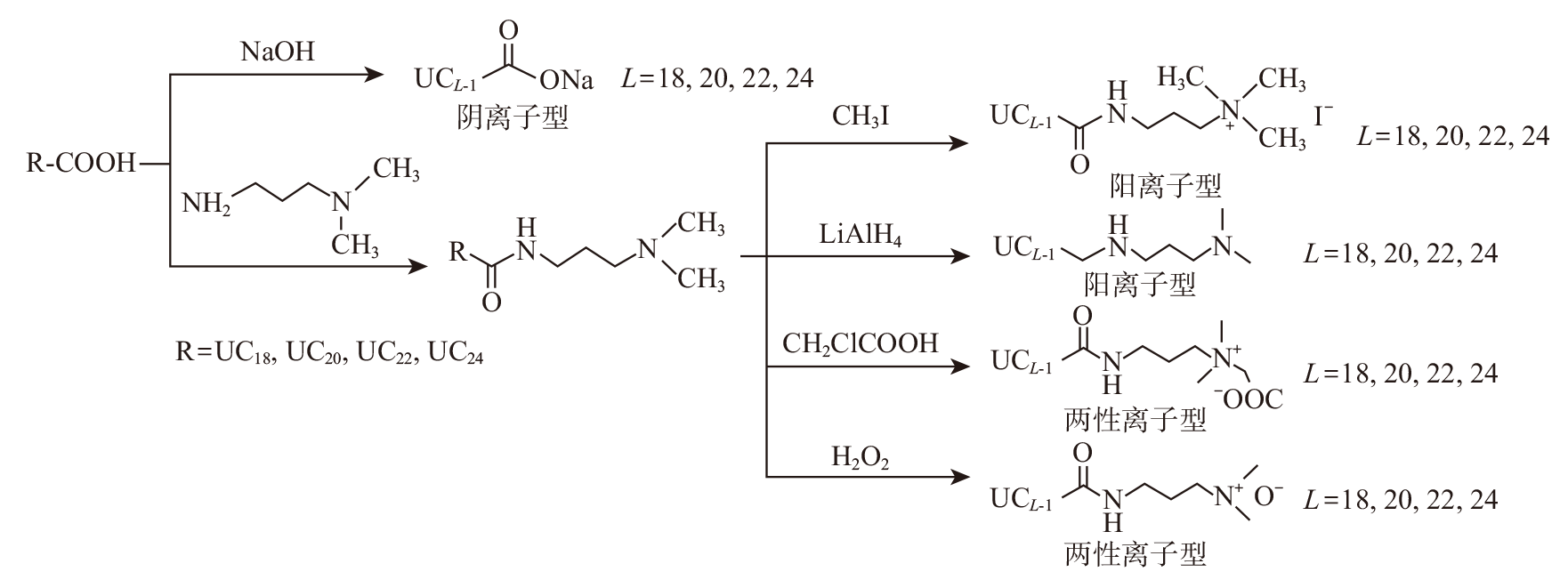
Fig.2
Krafft point (TK) plotted as a function of molar ratio of hydrotropic salt to NaOEr, CS/CD, where CD is fixed at 1 wt%. Photographs A and B, corresponding to the same sample at CS/CD = 3 of the NaOEr-BTAB system, represent the typical clear micellar solution above TK and crystals below TK, respectively"
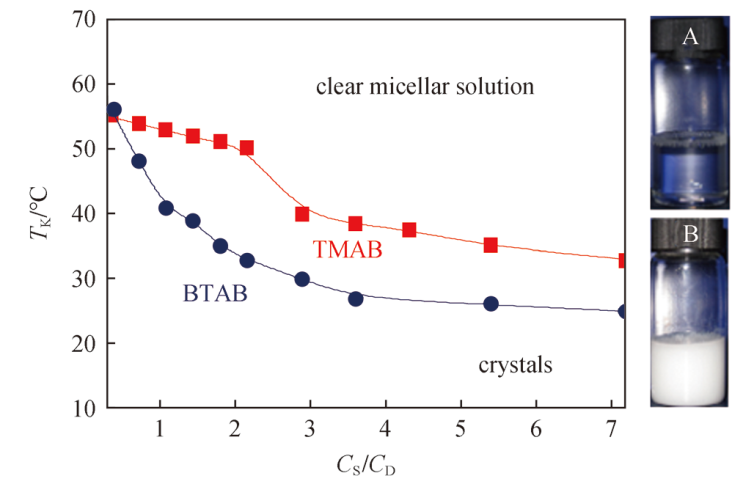
Fig.3
Effects of chain length and NaCl addition on the solubility of amidosulfobetaine surfactants [14]:(A) Effect of NaCl concentration on the Krafft temperature of long-chain amidosulfobetaines n-DAS (n = 18, 20, 22, and 24) ;(B) Schematic illustration of the sharp decrease in the Krafft temperature of long-chain amidosulfobetaines induced by a small amount of added salt;(C) Plot of the Krafft temperature (TK) of n-DAS versus surfactant tail length (n) in 3 000 mmol/L NaCl aqueous solution. Effects of chain length and NaCl addition on the solubility of amidocarboxybetaine surfactants [16] :(D) Effect of NaCl concentration on the TK of long-chain carboxybetaines CnDAB (n = 18, 20, 22, and 24) ;(E) Schematic illustration of the possible structures of ultra-long-chain carboxybetaines in aqueous solution"
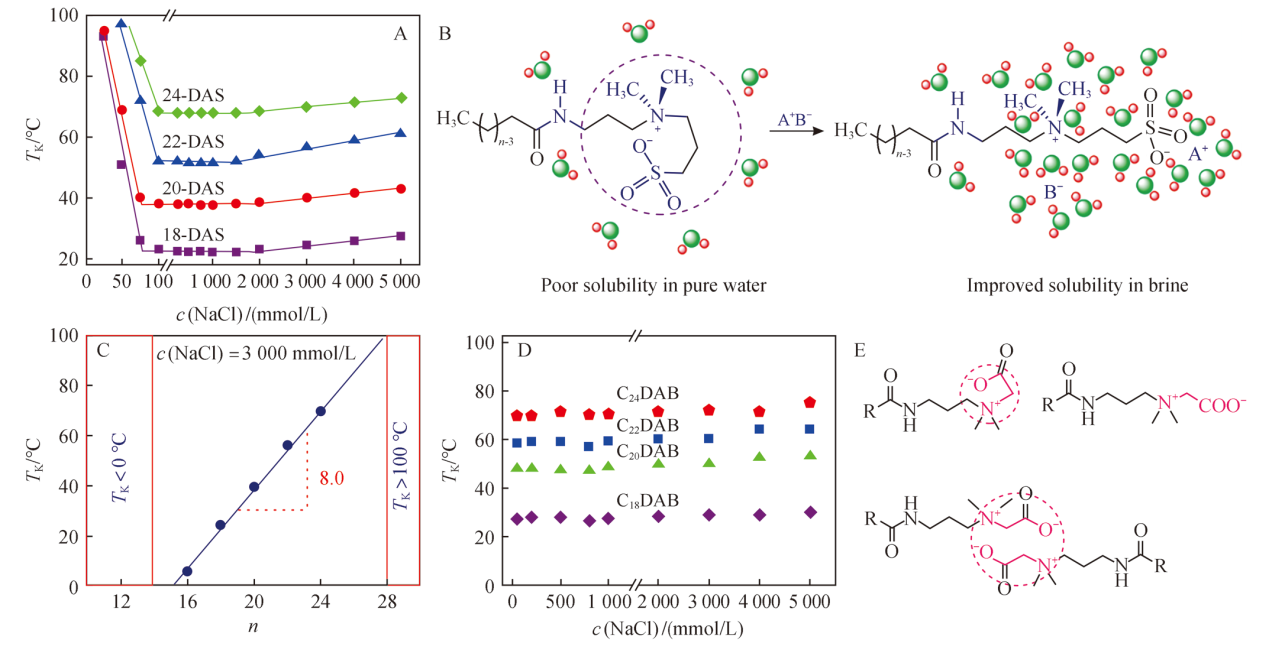
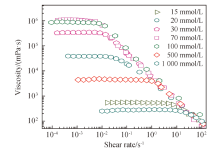
Fig.4
Steady rheology of the NaOEr-BTAB system at different BTAB concentrations (NaOEr concentration: 70 mmol/L)"
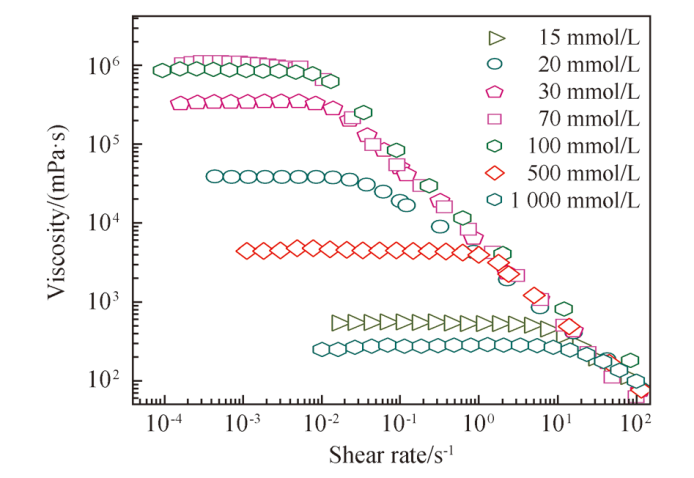
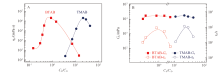
Fig.5
Effect of organic salt concentration on (A) zero-shear viscosity (η0) and (B) plateau modulus (G0) and relaxation time (τR) at 50 ℃ for NaOEr-BTAB and NaOEr-TMAB systems. The NaOEr concentration is fixed at 70 mmol/L"
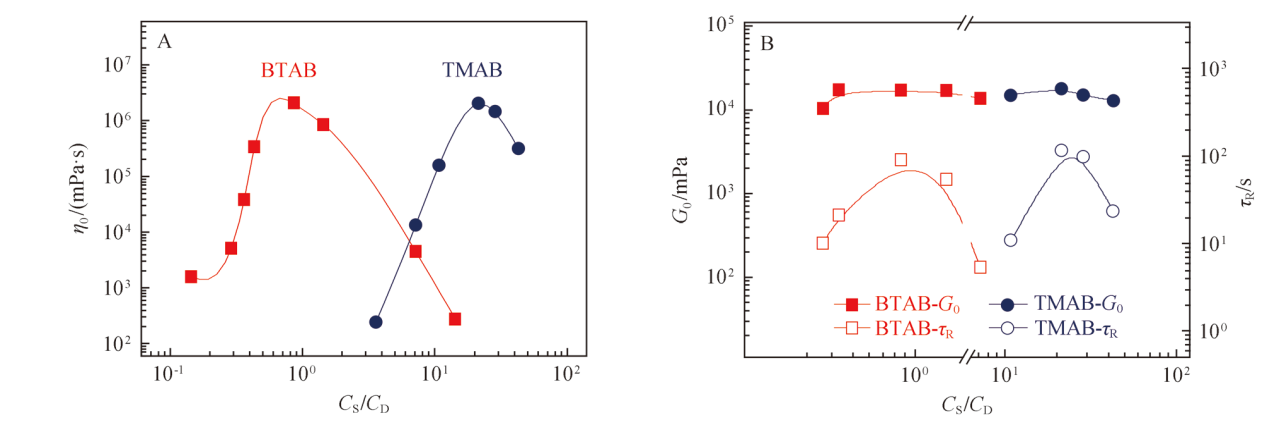
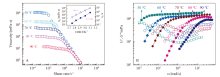
Fig.6
Effect of temperature on the steady and dynamic rheology of the 70 mmol/L NaOEr + 70 mmol/L BTAB system (insets: Arrhenius plots of η0 and τR)"
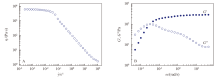
Fig.7
Shear viscosity and dynamic viscoelasticity of 250 mmol/L EDAI solution at 30 ℃"
Fig.8
Temperature (A) - and time-dependent (B) apparent viscosity of EDAB and EDPA systems in 20 wt% HCl"
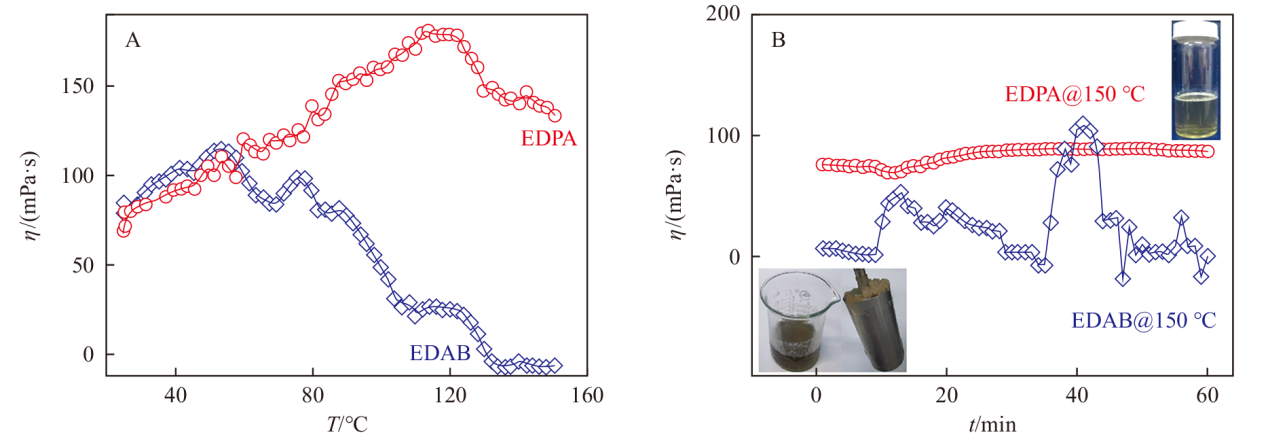
Fig.9
(A) Shear viscosity (η) of 100 mmol/L n-DAS solutions at 80 ℃ as a function of shear rate ($ \dot{\gamma}$). Influence of pH on rheological behaviours of EMAO solution at 30 ℃.(B) Steady rheology and (C) zero-shear viscosity versus pH curve. Steady-shear rheology and zero-shear viscosity of 0.5 wt% C22AO in EG-water (50/50, v/v)[18]. Steady-shear viscosity versus shear rate at differen temperatures for samples at (D) pH 2.0, (E) pH 6.8, and (F) pH 13.0[19]"
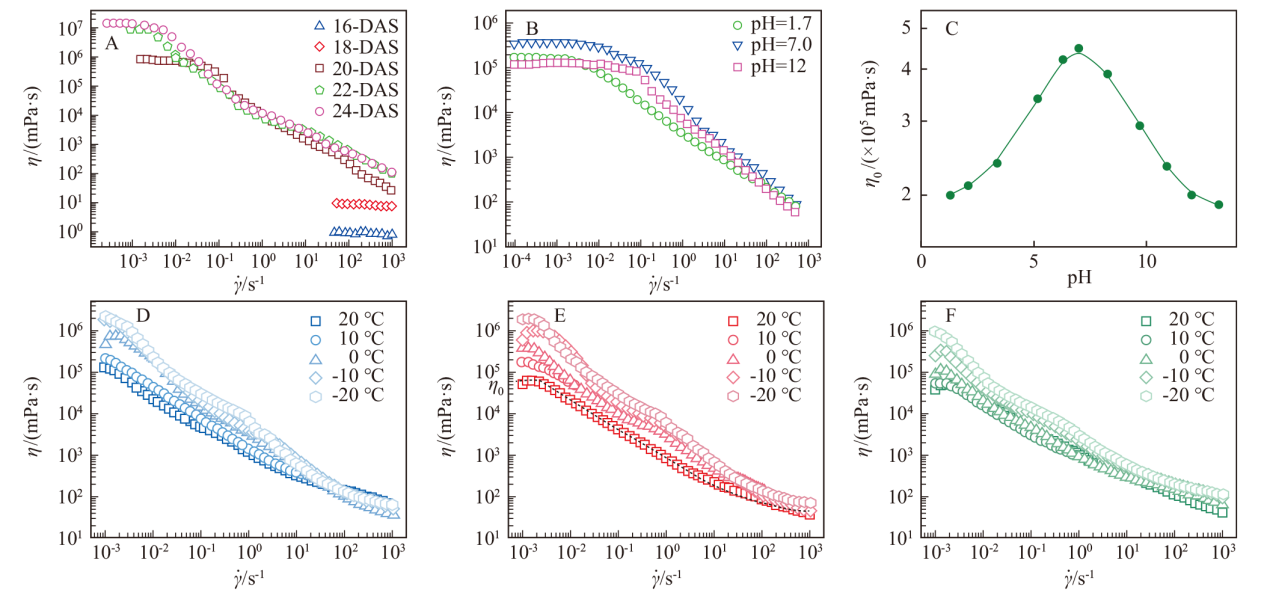
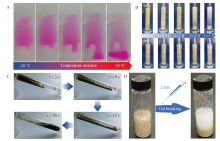
Fig.10
Performances evaluation of EDAB cryo-VES fluid containing GL when employed as an aircraft deicing/anti-icing fluid and an anti-icing clear fracturing fluid [21].(A) A 30 mmol/L EDAB VES fluid with 50 vol% EG attached to a glass substrate with ~ 30 ℃ inclination upon temperature increase from -20 to 20 ℃. With rising temperature, the fluid viscosity declines, and the fluid ultimately drains off the substrate.(B) Proppant-suspending capability of the 60 mmol/L EDAB fluid at 60 and 90 ℃.(C) Flow behaviour of ceramsite dispersed in the 60 mmol/L EDAB fluid at -20 ℃.(D) Gel breaking of 60 mmol/L EDAB fluid with ceramsite using 2-ethyl-1-hexanol as a breaker at 20 ℃"

| [1] | Tadros T F. Applied Surfactants: Principles and Applications[M]. Wiley-VCH, Weinheim, 2005. |
| [2] | Myers D. Surfactant Science and Technology, 3rd ed[M]. John Wiley & Sons, Hoboken, 2006. |
| [3] | 冯玉军. 黏弹性表面活性剂(II)--蠕虫状胶束形成机理及体系构成[J]. 日用化学工业 (中英文), 2026, 56 (2) : 137-148. |
| [4] |
Dreiss C A. Wormlike micelles: where do we stand? Recent developments, linear rheology and scattering techniques[J]. Soft Matter, 2007, 3 (8) : 956-970.
doi: 10.1039/b705775j pmid: 32900044 |
| [5] | Chu Z, Feng Y. A facile route towards the preparation of ultra-long-chain amidosulfobetaine surfactants[J]. Synthelett, 2009 (16) : 2655-2658. |
| [6] |
Chu Z, Feng Y, Su X, et al. Wormlike micelles and solution properties of a C22-tailed amidosulfobetaine surfactant[J]. Langmuir, 2010, 26(11) : 7783-7791.
doi: 10.1021/la904582w pmid: 20429541 |
| [7] |
Zhang Y, Luo Y, Wang Y, et al. Single-component wormlike micellar system formed by acarboxylbetaine surfactant with C22 saturated tail[J]. Colloids Surf. A, 2013, 436: 71-79.
doi: 10.1016/j.colsurfa.2013.06.016 |
| [8] | 刘璐璐, 陈强, 冯玉军. 黏弹性表面活性剂(VIII)--超长链非离子表面活性剂[J]. 日用化学工业 (中英文), 2026, 56 (8) : 978-983. |
| [9] |
Han Y X, Feng Y J, Sun H Q, et al. Wormlike micelles formed by sodium erucate in the presence of a tetraalkylammonium hydrotrope[J]. J. Phys. Chem. B, 2011, 115 (21) : 6893-6902.
doi: 10.1021/jp2004634 |
| [10] | 楚宗霖, 张永民, 韩玉贵, 等. 长链阳离子表面活性剂蠕虫状胶束的剪切带转变行为研究[J]. 化学学报, 2012, 70 (15) : 1551-1554. |
| [11] |
Wang J, Qi N, Yin H Y, et al. A robust viscoelastic surfactant tolerating 20% HCl up to 150 ℃ for oil well stimulation[J]. Pet. Sci., 2024, 21: 1865-1874.
doi: 10.1016/j.petsci.2024.01.010 |
| [12] |
Zhang Y, Luo Y, Wang Y, et al. Single-component wormlike micellar system formed by acarboxylbetaine surfactant with C22 saturated tail[J]. Colloids Surf. A, 2013, 436: 71-79.
doi: 10.1016/j.colsurfa.2013.06.016 |
| [13] |
Liu L, Chen Q, Qian Z, et al. Cryogenic self-assembly of ultra-long-chain zwitterionic surfactants into lyotropic liquid crystals in dilute solution[J]. Colloids Surf. A, 2026, 741: 140241.
doi: 10.1016/j.colsurfa.2026.140241 |
| [14] |
Chu Z, Feng J. Empirical correlations between Kraft temperature and tail length for amidosulfobetaine surfactants in the presence of inorganic salt[J]. Langmuir, 2011, 28 (4) : 1175-1181.
doi: 10.1021/la204316g |
| [15] | 冯丹. 超长链羧酸甜菜碱表面活性剂的制备及溶液性能研究[D]. 北京: 中国科学院大学, 2012. |
| [16] |
Wang Y, Zhang Y, Liu X, et al. Effect of a hydrophilic head group on Krafft temperature, surface activities and rheological behaviors of erucyl amidobetaines[J]. J. Surfact. Deterg., 2014, 17: 295-301.
doi: 10.1007/s11743-013-1496-7 |
| [17] | 楚宗霖. 基于长链磺酸甜菜碱表面活性剂的蠕虫状胶束的研究[D]. 北京: 中国科学院大学, 2011. |
| [18] |
Zhang Y, An P, Liu X. A “worm”-containing viscoelastic fluid based on single amine oxide surfactant with an unsaturated C22-tail[J]. RSC Adv., 2015, 5: 19135-19144.
doi: 10.1039/C4RA16772D |
| [19] |
Chen Q, Xu W, Liu L, et al. Cryogenic viscoelasticity of a C22-tailed amine oxide across an extremely broad pH range[J]. J. Phys. Chem. B, 2026, 130 (36) : 9338-9349.
doi: 10.1021/acs.jpcb.6c05256 |
| [20] |
Yin H, Feng Y, Li P, et al. Cryogenic wormlike micelles[J]. Soft Matter, 2019, 15 (12) : 2511-2516.
doi: 10.1039/c9sm00068b pmid: 30839046 |
| [21] |
Yin H, Feng Y, Li P, et al. Cryogenic viscoelastic surfactant fluids: Fabrication and application in a subzero environment[J]. J. Colloid Interface Sci., 2019, 551: 89-100.
doi: 10.1016/j.jcis.2019.05.011 |
| [22] | 冯玉军, 刘璐璐, 陈强, 等. 超长链氧化胺表面活性剂增稠的飞机除防冰液及其制备方法: CN 120888275 A[P]. 2025-11-04. |
| [1] | Mengyao Yan, Huibin Liang, Yongjie Zhao, Jinyuan Sun, Ke Zhang, Jingjie Zhou, Tao Geng. Research and analysis of ethoxylated modified oils for improving skin moisturizing effect [J]. China Surfactant Detergent & Cosmetics, 2026, 56(9): 1144-1157. |
| [2] | Lulu Liu, Qiang Chen, Yujun Feng. Viscoelastic surfactants (VIII) Ultra-long-chain nonionic surfactants [J]. China Surfactant Detergent & Cosmetics, 2026, 56(8): 977-983. |
| [3] | Yujun Feng. Viscoelastic surfactants (VII) CO2-responsive wormlike micelles [J]. China Surfactant Detergent & Cosmetics, 2026, 56(7): 833-840. |
| [4] | Zonglin Chu, Zhanpeng Jiang, Yujun Feng. Viscoelastic surfactants (VI) Smart wormlike micelles [J]. China Surfactant Detergent & Cosmetics, 2026, 56(6): 695-705. |
| [5] | Yujun Feng. Viscoelastic surfactants (V) Similarity and difference between wormlike micelles and polymers [J]. China Surfactant Detergent & Cosmetics, 2026, 56(5): 557-563. |
| [6] | Yunan Wan, Zhen Ren, Yichun Zhang. Study on the modification mechanism and performance of nonionic surfactants in the dispersion process of SiO2 aerogels [J]. China Surfactant Detergent & Cosmetics, 2026, 56(4): 441-448. |
| [7] | Yujun Feng. Viscoelastic surfactants (III)Steady rheology and shear bandings [J]. China Surfactant Detergent & Cosmetics, 2026, 56(3): 277-283. |
| [8] | Zhengyu Li,Degang Xing,Yancheng Zheng,Hongyun Zhao,Fuchang You. Synergism in the mixture of sodium dodecyl block polyether sulfonate and Gemini betaine surfactant for oil displacement [J]. China Surfactant Detergent & Cosmetics, 2026, 56(3): 284-292. |
| [9] | Yujun Feng. Viscoelastic surfactants(II)Formation mechanisms and system formulations of wormlike micelles [J]. China Surfactant Detergent & Cosmetics, 2026, 56(2): 137-148. |
| [10] | Yujun Feng. Viscoelastic surfactants (I)Evolution of micelles and discovery of wormlike micelles [J]. China Surfactant Detergent & Cosmetics, 2026, 56(1): 8-16. |
| [11] | Shuai Gao, Yajie Jiang, Lu Zhang, Jun Li, Yakui Wang, Zhifei Wang, Tao Geng. Interactions, surface activity and applications of the mixed system of polyhydroxy cationic surfactant and AES [J]. China Surfactant Detergent & Cosmetics, 2025, 55(5): 554-562. |
| [12] | Yifeng Jiang,Hong Li,Wenchao Yuan. Synthesis of a quaternary ammonium cationic surfactant and its application in diesel desulfurization technology [J]. China Surfactant Detergent & Cosmetics, 2025, 55(2): 202-208. |
| [13] | Yingying Wang, Zhenchao Ma, Zhe Li, Yibo Kong, Xinyi Zhao, Yaowen Xing, Xiahui Gui. Mechanism of enhanced low-rank coal flotation using a nanoemulsion collector based on zwitterionic/nonionic surfactants [J]. China Surfactant Detergent & Cosmetics, 2025, 55(12): 1534-1543. |
| [14] | Lei Dong, Huanjin Zou, Xuefeng Liu. Synthesis of pH-switchable nonionic polyether surfactant and its potential application in removing phenanthrene from soil [J]. China Surfactant Detergent & Cosmetics, 2025, 55(11): 1388-1394. |
| [15] | Enbo Qin, Lei Zhou, Jue Wang, Huilin Chen, Yuxing Gu, Yuanyou Wang. Study on the synthesis and properties of quaternary ammonium cationic surfactants [J]. China Surfactant Detergent & Cosmetics, 2025, 55(1): 49-54. |
|
