Welcome to China Surfactant Detergent & Cosmetics, Today is


China Surfactant Detergent & Cosmetics ›› 2025, Vol. 55 ›› Issue (11): 1486-1492.doi: 10.3969/j.issn.2097-2806.2025.11.015
• Analytical methods and testing • Previous Articles Next Articles
Jianhua Xiang1,2,Xu Gong1,Li Lu1,3,*( ),Fang Fang1,*(),Youlong Feng1,Xinhong Shi2
Received:2024-11-06
Revised:2025-10-29
Online:2025-11-22
Published:2025-12-22
CLC Number:
Jianhua Xiang, Xu Gong, Li Lu, Fang Fang, Youlong Feng, Xinhong Shi. Spectroscopic identification of 10 α-hydroxy acid substances in cosmetics[J].China Surfactant Detergent & Cosmetics, 2025, 55(11): 1486-1492.
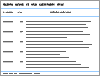
Tab. 1
Gradient elution procedure"
| Time/min | Flow rate / (mL/min) | ?(Mobile phase A)/% | ?(Mobile phase B)/% |
|---|---|---|---|
| 0 | 0.7 | 100 | 0 |
| 7 | 0.7 | 100 | 0 |
| 7.1 | 1 | 100 | 0 |
| 17 | 1 | 40 | 60 |
| 28 | 1 | 40 | 60 |
| 28.1 | 0.7 | 100 | 0 |
| 45 | 0.7 | 100 | 0 |
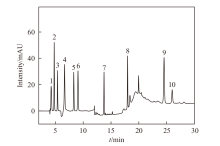
Fig. 1
Chromatograms of the standards of 10 α-hydroxy acids 1 D-Glucuronic acid;2 D (-) -Tartaric acid;3 Glycolic acid;4 Malicacid;5 Lactic acid;6 Citric acid;7 Sodium 2-hydroxybutyrate;8 DL-Mandelic acid;9 Benzilic acid;10 2-Hydroxycaprylic acid(下图中序号同)"
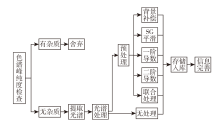
Fig. 2
HPLC-DAD-UV spectral database establishment process"
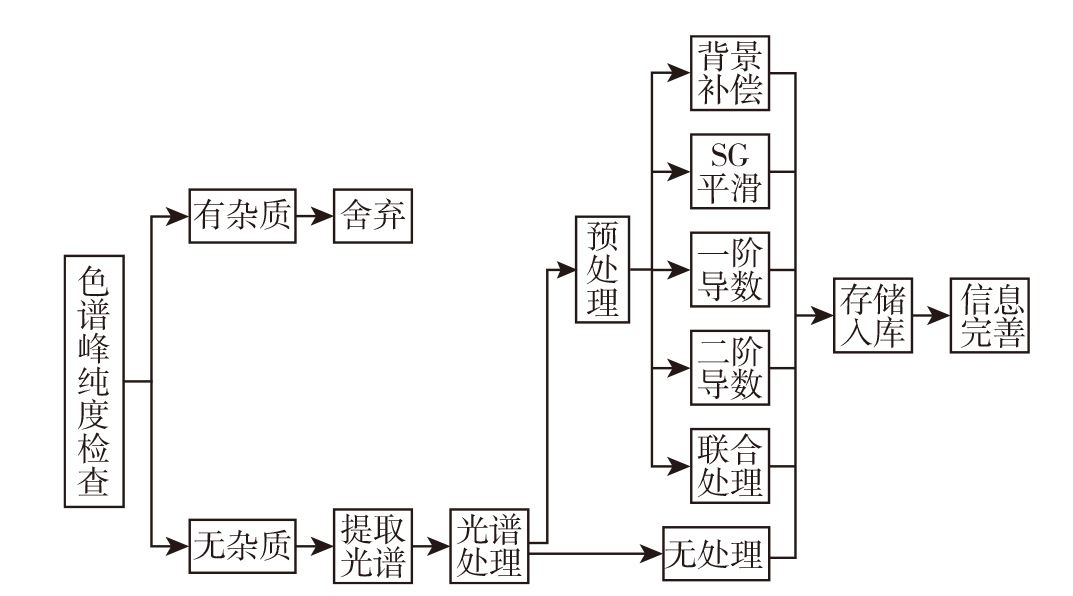
Fig. 3
Results of different similarity algorithms on the spectral similarity of 10 α-hydroxy acids ($\bar{x} \pm s$, n=60, **P<0.01 vs Cosine)"
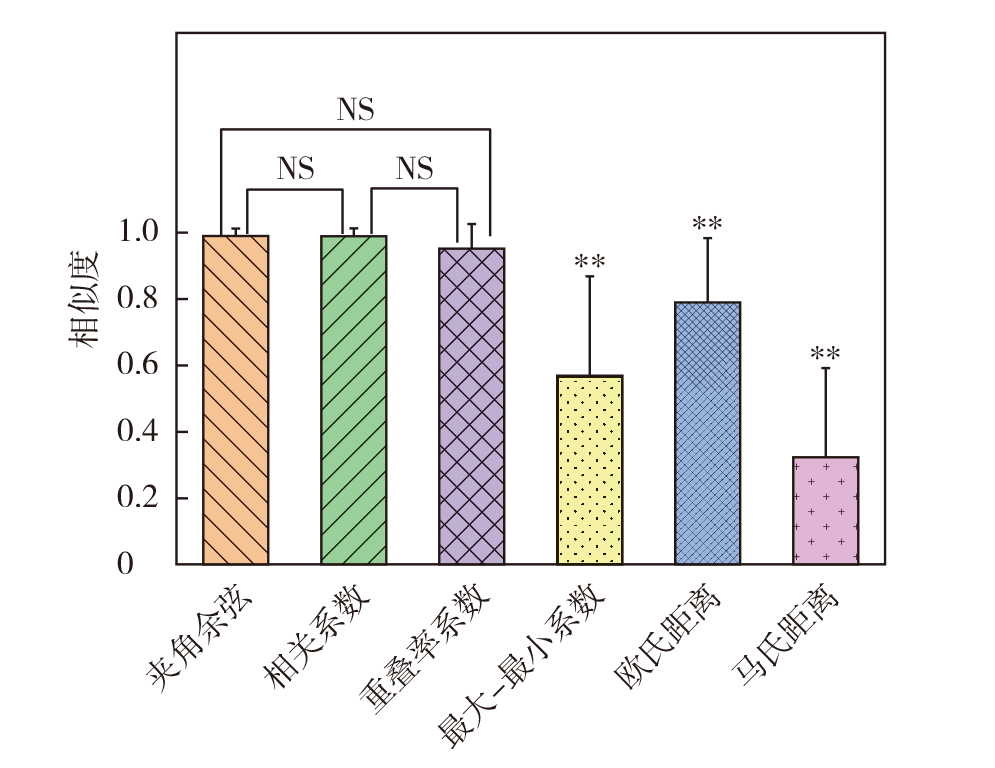
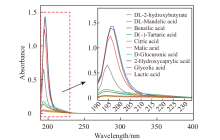
Fig. 4
UV spectra of 10 α-hydroxy acids collected by diode array detector"
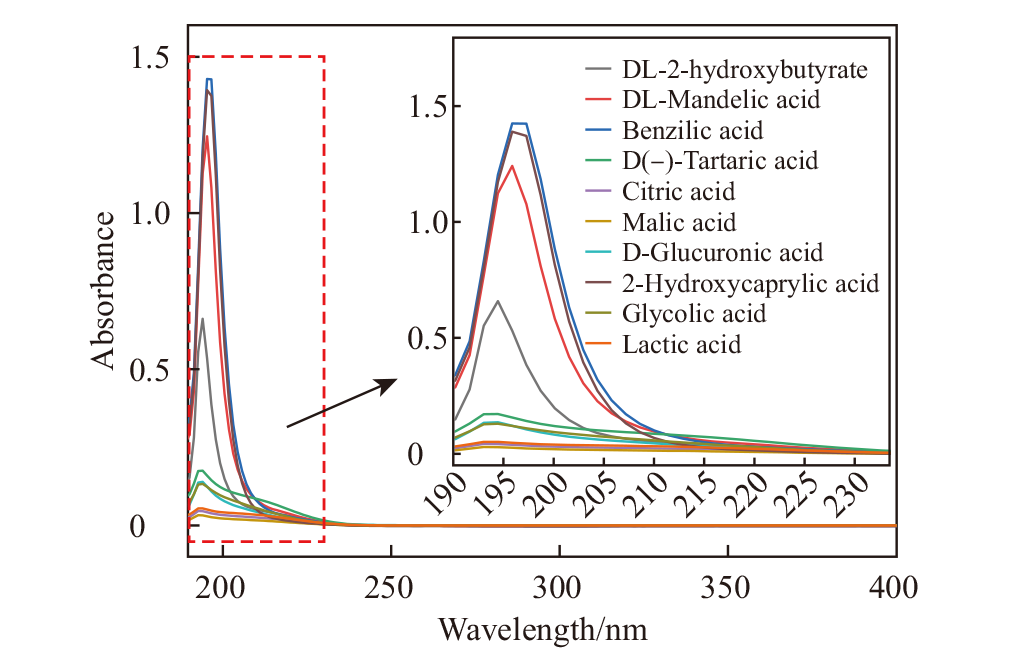
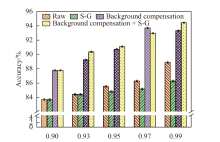
Fig. 5
Effect of spectral processing method and similarity threshold setting on the accuracy of chromatographic peak identification ($\bar{x} \pm s$, n=10)"
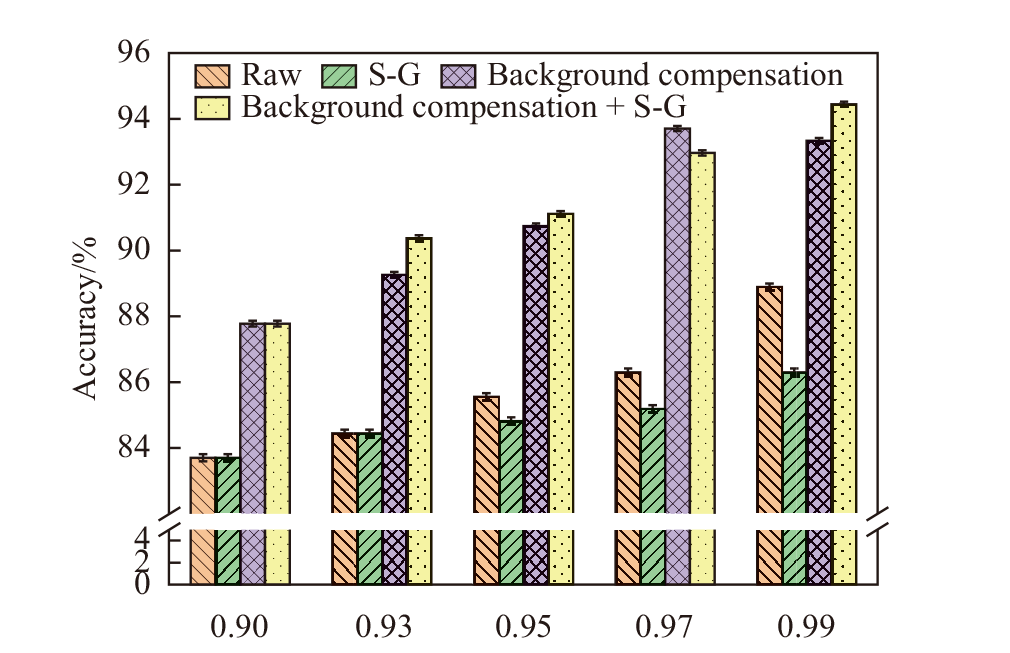
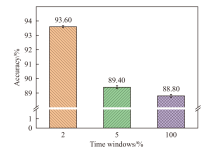
Fig. 6
Effect of time window size on the accuracy of chromatographic peak identification ($\bar{x} \pm s$, n=10)"
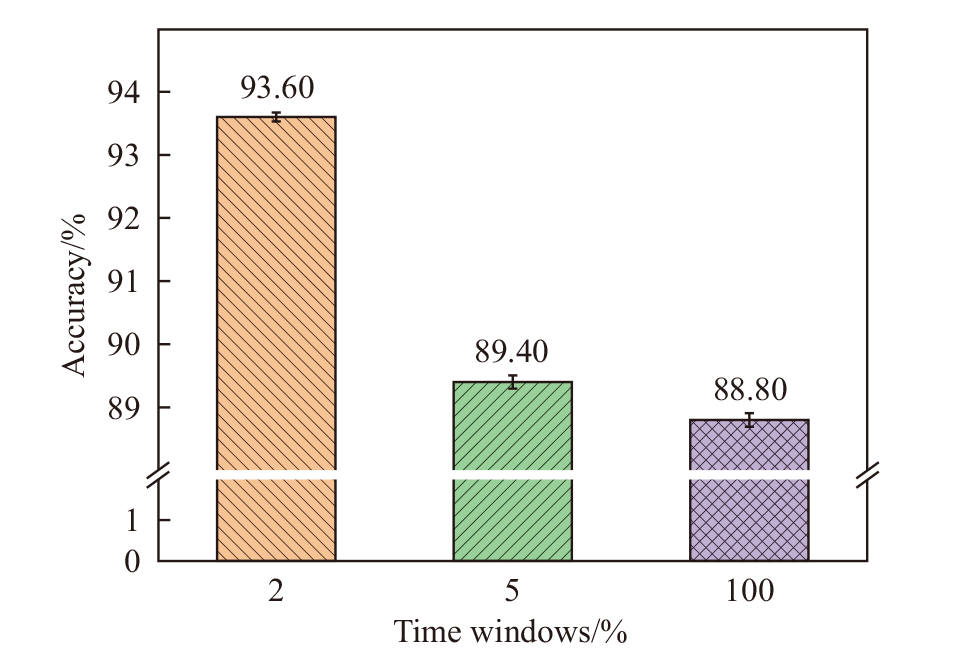
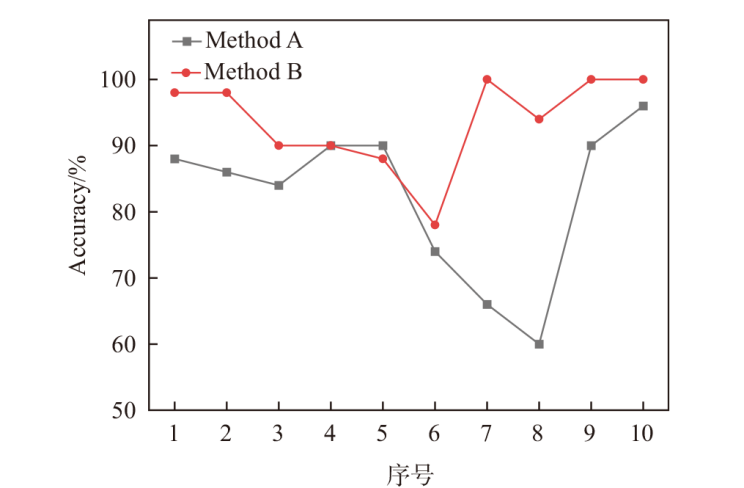
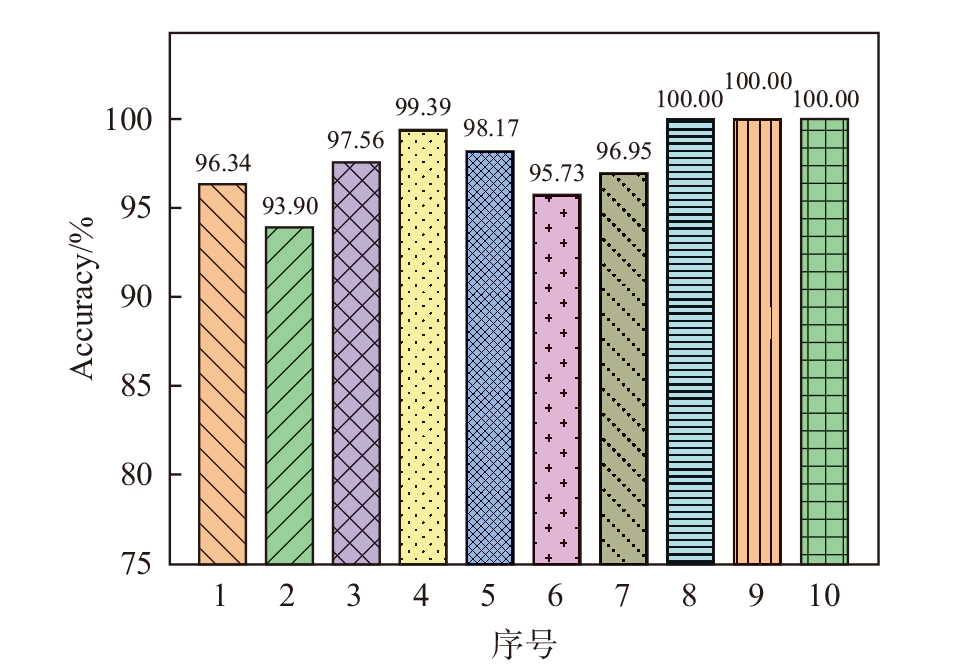
Fig. 7
Accuracy results of method A and method B for the identification of 10 α-hydroxy acid peaks in samples"
Tab. 2
Detection limits of 10 α-hydroxy acid"
| Compound | Detection Limits/(μg/g) |
|---|---|
| D-Glucuronic acid | 150 |
| D(-)-Tartaric acid | 60 |
| Glycolic acid | 40 |
| Malic acid | 40 |
| Lactic acid | 100 |
| Citric acid | 40 |
| 2-Hydroxybutyric acid | 80 |
| DL-Mandelic acid | 2 |
| Benzilic acid | 1 |
| 2-Hydroxycaprylic acid | 40 |
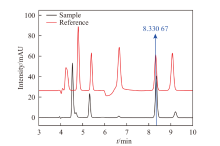
Fig. 8
Partial intercept chromatogram of a sample containing lactic acid"
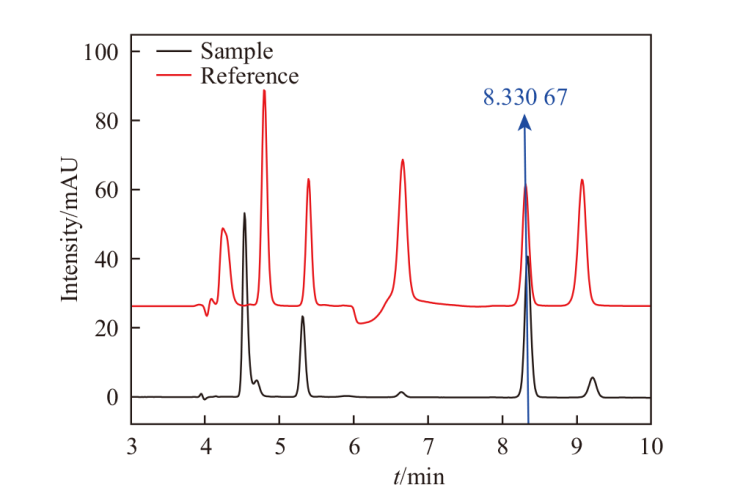
Fig. 9
Results of the identification of the peaks in a cosmetic sample by applying Method B"
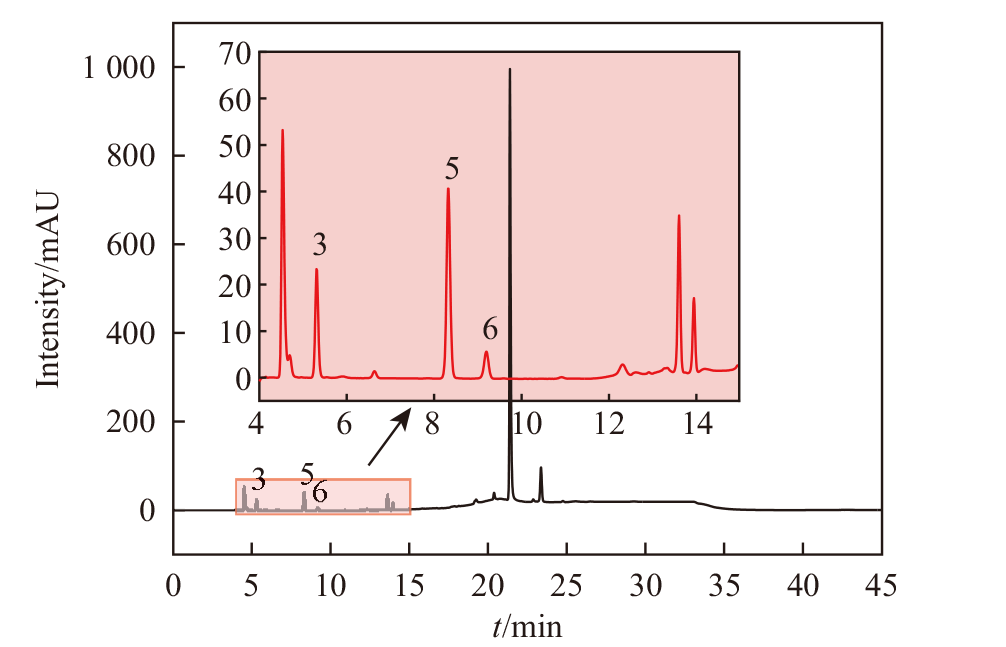
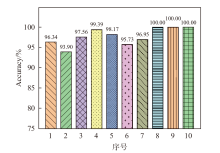
Fig. 10
Chromatographic peak identification results of 10 α-hydroxy acids in 164 batches of cosmetics by Method B"
| [1] |
陈海滨, 李玲玲, 王红梅. HPLC-MS/MS法测定化妆品中α-羟基酸的含量[J]. 药物分析杂志, 2017, 37 (11) : 2057-2061.
doi: 10.16155/j.0254-1793.2017.11.22 |
| [2] | 陈张好, 伍英英, 关漪莲, 等. 羟基酸在化妆品中的使用情况监测[J]. 日用化学品科学, 2022, 45 (1) : 23-26, 31. |
| [3] | 梁雪. 植物提取物在抗衰老化妆品中的应用及研究进展[J]. 太原科技, 2009 (10) : 66-67. |
| [4] | 茹歌, 许勇, 韩晶, 等. 超高效液相色谱-串联质谱法测定化妆品中13种α-羟基酸[J]. 上海预防医学, 2024, 36 (4) : 399-408. |
| [5] | 高天阳, 蒋亚奇, 林钰镓, 等. 超高效液相色谱-三重四极杆质谱法同时测定化妆品中13种α-羟基酸的含量[J]. 理化检验-化学分册, 2023, 59 (9) : 1014-1020. |
| [6] |
魏国辉, 张丰聪, 付先军, 等. 中药成分相似性量化建模及寒热药性预测分析[J]. 数据分析与知识发现, 2020, 4 (5) : 75-83.
doi: 10.11925/infotech.2096-3467.2019.0974 |
| [7] | 第五鹏瑶, 卞希慧, 王姿方, 等. 光谱预处理方法选择研究[J]. 光谱学与光谱分析, 2019, 39 (9) : 2800-2806. |
| [1] | Lin Cao,Mingwei Liu. Simultaneous determination of multiple antibacterial components in mouthwash by high performance liquid chromatography [J]. China Surfactant Detergent & Cosmetics, 2025, 55(11): 1493-1500. |
| [2] | Xuze Liu, Chang Xu, Liangliang Lin, Hujun Xu. Synthesis and microencapsulation of oleic acid sterol ester liquid crystals for its application in sunscreen formulations [J]. China Surfactant Detergent & Cosmetics, 2025, 55(11): 1408-1418. |
| [3] | Sha Li, Zumrat Aziz, Jiaqi Pang, Kun Dong. To explore the antioxidant mechanism of Hylocereus undatus root based on LC-MS/MS and network pharmacology [J]. China Surfactant Detergent & Cosmetics, 2025, 55(11): 1419-1427. |
| [4] | Zhihui Zheng, Minjia Yuan, Wenxing Wang. Synthesis of open-pored mesoporous silica and its application in cosmetics [J]. China Surfactant Detergent & Cosmetics, 2025, 55(11): 1428-1434. |
| [5] | Xianqi Chen, Timson Chen, Ling Ma, Ya Chen, Zhizhen Li, Guangli Wang, Jing Wang. Study on the polyol extraction process of Platycladus orientalis leaf extract and its effects on human dermal papilla cells [J]. China Surfactant Detergent & Cosmetics, 2025, 55(11): 1435-1443. |
| [6] | Gaiying He, Jinghui Tang, Xuying Liu, Guirong Sun, Yi Wang. The protective effect of recombinant human collagen against UV-induced skin photoaging in mice [J]. China Surfactant Detergent & Cosmetics, 2025, 55(11): 1444-1451. |
| [7] | Fei Liu, Qian Wang, Hui Liu, Suzhen Yang, Tingting Han, Tao Wu. Study on the effect of recombinant human collagen Ⅲ on anti-skin photoaging [J]. China Surfactant Detergent & Cosmetics, 2025, 55(11): 1452-1559. |
| [8] | Peipei Li, Xiaoming Xu, Qiang Zhang, Yangyang Fang, Huiliang Li. Study on anti-aging and soothing effects of lily flower peptides [J]. China Surfactant Detergent & Cosmetics, 2025, 55(11): 1460-1467. |
| [9] | Yinghui Wang, Gaojie Zheng, Huadong Liu. Research on the practice and strategy of skincare packaging design under consumer psychological guidance [J]. China Surfactant Detergent & Cosmetics, 2025, 55(11): 1476-1485. |
| [10] | Xianxian Cao,Yonglei Yuan,Feifei Wang. Study on the antioxidant and anti-inflammatory activities of extracts from Salvia plebeia R. Br. [J]. China Surfactant Detergent & Cosmetics, 2025, 55(10): 1291-1298. |
| [11] | Qitian Fu,Ying Wei,Xiaochun Lin,Ying Ye,Liqun Guo,Yao Pan. Multi-dimensional comprehensive assessment of apparent pore state: establishing a hierarchical system based on exploratory factor analysis [J]. China Surfactant Detergent & Cosmetics, 2025, 55(10): 1299-1305. |
| [12] | Qingyu Guo,Dan Cao,Dong Chen. Evaluation of the whitening effect and antioxidant activity of isorosmanol, an active ingredient of Rosmarinus officinalis L. [J]. China Surfactant Detergent & Cosmetics, 2025, 55(10): 1306-1312. |
| [13] | Taijun Zhang,Haiqi Chen,Jiechun Yin,Li Kang,Rourou Li,Ruyu Deng. Raspberry ketone treats acne vulgaris by suppressing sebum and inflammation [J]. China Surfactant Detergent & Cosmetics, 2025, 55(10): 1313-1322. |
| [14] | Linrui Fu,Haiyan Wang,Yong Lu. Research status and prospect of new pollutants in cosmetics [J]. China Surfactant Detergent & Cosmetics, 2025, 55(10): 1323-1332. |
| [15] | Xinzheng Wang,Yan Liu. Research on the integration of women’s aesthetic psychology and cosmetics packaging design [J]. China Surfactant Detergent & Cosmetics, 2025, 55(10): 1333-1343. |
|
