Welcome to China Surfactant Detergent & Cosmetics, Today is


China Surfactant Detergent & Cosmetics ›› 2026, Vol. 56 ›› Issue (10): 1403-1412.doi: 10.3969/j.issn.2097-2806.2026.10.013
• Analytical methods and testing • Previous Articles Next Articles
Xue Geng1,Ping Liu2,Kaiji Wang3,Ning Chen4,Yanqin Song5,Qingfen Zhu1,*( )
Received:2025-12-01
Revised:2026-09-10
Online:2026-10-22
Published:2026-10-30
Contact:
E-mail: CLC Number:
Xue Geng, Ping Liu, Kaiji Wang, Ning Chen, Yanqin Song, Qingfen Zhu. Establishment and inter-laboratory validation of the kDPRA method for skin sensitization assessment[J].China Surfactant Detergent & Cosmetics, 2026, 56(10): 1403-1412.
Tab.1
Information on validation compounds"
| 序号 | 名称 | CAS号 | 品牌 | 货号 | 批号 | 储存条件 | 致敏性分级 |
|---|---|---|---|---|---|---|---|
| 1 | 氯苯 | 108-90-7 | 1 | C119461-100 mL | E2520340 | 室温 | 极强致敏剂 |
| 2 | 4-乙氧基亚甲基-2-苯基噁唑啉-5-酮 | 15646-46-5 | 1 | E486138-200 mg | K2418269 | 2~8 ℃ | 极强致敏剂 |
| 3 | 4-甲氧基苯乙酮 | 100-06-1 | 1 | M103875-25 g | G24122482 | 2~8 ℃ | 非致敏剂 |
| 4 | 2-甲基-4-异噻唑啉-3-酮 | 2682-20-4 | 2 | M813550-5 g | C16365214 | 室温 | 极强致敏剂 |
| 5 | 庚炔羧酸甲酯 | 111-12-6 | 1 | M107624-25 mL | K2110412 | 室温 | 强致敏剂 |
| 6 | 异丁香酚 | 97-54-1 | 3 | 17206-5 g | 1003458343 | 室温 | 中等致敏剂 |
| 7 | 2, 3-丁二酮 | 431-03-8 | 1 | B104601-100 mL | F23161023 | 2~8 ℃ | 弱致敏剂 |
| 8 | 4-甲氧基苯乙酮 | 100-06-1 | 3 | 11734-5 g | BCCF5045 | 室温 | 非致敏剂 |
| 9 | 二甲基丙烯酸乙二醇酯 | 97-90-5 | 1 | E106223-100 mL | J2327543 | 2~8 ℃ | 弱致敏剂 |
| 10 | 2, 4-二硝基氯苯 | 97-00-7 | 4 | C0162 | CPSOG-NA | 室温 | 极强致敏剂 |
| 11 | 咪唑烷基脲 | 39236-46-9 | 3 | 15133-25 g | 102657137 | 2~8 ℃ | 弱致敏剂 |
| 12 | 4-苯基-3-丁烯-2-酮 | 122-57-6 | 3 | 147885-25 g | SHBL9127 | 室温 | 非致敏剂 |
| 13 | 二苯基环丙烯酮 | 886-38-4 | 1 | A115107-5 g | B2302498 | 2~8 ℃ | 极强致敏剂 |
Tab.2
Effects of different brands of monobromobimane on test results"
| 时间/min | lg kmax | |||||
|---|---|---|---|---|---|---|
| 阿拉丁试剂(上海)有限公司 | 上海源叶生物科技有限公司 | Millipore公司 | ||||
| 受试物 | 阳性对照 | 受试物 | 阳性对照 | 受试物 | 阳性对照 | |
| 10 | -0.27 | -0.84 | -0.28 | — | -0.32 | — |
| 30 | -0.50 | -1.27 | -0.52 | -1.44 | -0.52 | -1.39 |
| 90 | -0.63 | -1.49 | -0.88 | -1.56 | -0.65 | -1.65 |
| 150 | -1.28 | -1.58 | -1.07 | -1.62 | -1.13 | -1.72 |
| 210 | -1.37 | -1.66 | -1.38 | -1.71 | -1.31 | -1.91 |
| 1 440 | -2.41 | -2.48 | -2.48 | -2.54 | -2.45 | -2.71 |
| 结果 判定 | GHS 1A类 | GHS 1A类 | GHS 1A类 | |||
Tab.3
Comparison of test results using commercial buffer 1 and laboratory-prepared phosphate buffer"
| 市售缓冲液1 | 自制缓冲液 | |||
|---|---|---|---|---|
| 4-乙氧基亚甲基-2-苯基噁唑啉-5-酮 | 4-甲氧基苯乙酮 | 4-乙氧基亚甲基-2-苯基噁唑啉-5-酮 | 4-甲氧基苯乙酮 | |
| lg kmax | -0.27 | n-r | -0.32 | n-r |
| 结果判定 | GHS 1A类 | 非GHS 1A类 | GHS 1A类 | 非GHS 1A类 |
Tab.4
Compositional comparison of two commercial phosphate buffers"
| 名称 | pH | 配方组成 |
|---|---|---|
| 磷酸盐缓冲液1 | 7.5 | 0.1 mol/L NaH2PO4 0.1 mol/L Na2HPO4 |
| 磷酸盐缓冲液2 | 7.4 | 2.0 mmol/L KH2PO4 137 mmol/L NaCI 10.0 mmol/L Na2HPO4 2.7 mmol/L KCl |
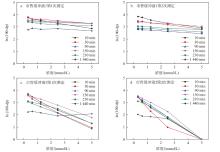
Fig.1
Test results of commercially available buffer 1 and 2"
Tab.5
Predicted results for 10 reference validation compounds in our in-house laboratory"
| 序号 | 受试物名称 | lg kmax值 | 试验是否成立 | kDPRA试验结果 | 结果是否与OECD 442C一致 |
|---|---|---|---|---|---|
| 1 | 2-甲基-4-异噻唑啉-3-酮 | -0.51 | 是 | 1A | 是 |
| 2 | 庚炔羧酸甲酯 | -1.13 | 是 | 1A | 是 |
| 3 | 异丁香酚 | -0.40 | 是 | 1A | 是 |
| 4 | 2, 3-丁二酮 | -2.03 | 是 | 非1A类 | 是 |
| 5 | 4-甲氧基苯乙酮 | n-r | 是 | 非1A类 | 是 |
| 6 | 二甲基丙烯酸乙二醇酯 | -2.36 | 是 | 非1A类 | 是 |
| 7 | 2, 4-二硝基氯苯 | -0.34 | 是 | 1A | 是 |
| 8 | 氯苯 | n-r | 是 | 非1A类 | 是 |
| 9 | 4-乙氧基亚甲基-2-苯基噁唑啉-5-酮 | -0.28 | 是 | 1A | 是 |
| 10 | 4-甲氧基苯乙酮 | n-r | 是 | 非1A类 | 是 |
Tab.6
Results of the kDPRA assay for blind-coded samples"
| 编号 | 样品名 | lg kmax | 致敏机制[ | |||
|---|---|---|---|---|---|---|
| 实验室1 | 实验室2 | 实验室3 | 实验室4 | |||
| 盲样1 | 2-甲基-4-异噻唑啉-3-酮 | n-r | -0.26 | -0.68 | -0.47 | 双分子亲核取代反应 |
| 盲样2 | 庚炔羧酸甲酯 | -1.92 | -1.23 | -0.30 | -0.82 | 迈克尔加成 |
| 盲样3 | 异丁香酚 | -1.62 | -0.71 | -0.13 | -0.34 | 醌甲基化物/亚胺类 |
| 盲样4 | 2, 3-丁二酮 | n-r | -2.40 | n-r | -2.30 | 双分子亲核取代反应 |
| 盲样5 | 4-甲氧基苯乙酮 | n-r | n-r | n-r | n-r | — |
| 盲样6 | 二甲基丙烯酸乙二醇酯 | -2.83 | -2.17 | n-r | -2.52 | 迈克尔加成 |
| 盲样7 | 2, 4-二硝基氯苯 | -0.91 | -0.17 | -0.26 | -0.31 | 酰基转移 |
| 盲样8 | 咪唑烷基脲 | n-r | n-r | -1.94 | -1.80 | 迈克尔加成 |
| 盲样9 | 4-苯基-3-丁烯-2-酮 | -2.37 | -1.80 | -1.65 | -1.84 | 苯环亲电取代反应(巯基反应) |
| 盲样10 | 二苯基环丙烯酮 | -1.67 | -0.56 | -0.62 | -0.57 | 亲核加成 |
Tab.7
GHS skin sensitization classification results for blind-coded samples"
| 受试物 | 本实验室 | 实验室1 | 实验室2 | 实验室3 | 实验室4 | 人体试验GHS分类 | kDPRA GHS 分类[ |
|---|---|---|---|---|---|---|---|
| 盲样1 | 1A类 | 非1A类 | 1A类 | 1A类 | 1A类 | 1A | 1A |
| 盲样2 | 1A类 | 1A类 | 1A类 | 1A类 | 1A类 | 1A | 1A |
| 盲样3 | 1A类 | 1A类 | 1A类 | 1A类 | 1A类 | 1A | 1A |
| 盲样4 | 非1A类 | 非1A类 | 非1A类 | 非1A类 | 非1A类 | 1B | 非1A类 |
| 盲样5 | 非1A类 | 非1A类 | 非1A类 | 非1A类 | 非1A类 | NC | 非1A类 |
| 盲样6 | 非1A类 | 非1A类 | 非1A类 | 非1A类 | 非1A类 | 1B | 非1A类 |
| 盲样7 | 1A类 | 非1A类 | 非1A类 | 1A类 | 1A类 | 1B | 1A类 |
| 盲样8 | 1A类 | 非1A类 | 1A类 | 1A类 | 1A类 | 1A | 1A类 |
| 盲样9 | 1A类 | 1A类 | 1A类 | 1A类 | 1A类 | 1A | 1A类 |
| 盲样10 | 1A类 | 1A类 | 1A类 | 1A类 | 1A类 | 1A | 1A类 |
Tab.8
Inter-laboratory predictive performance of the method for sensitization potency classification"
| 指标 | 本实验室 | 实验室1 | 实验室2 | 实验室3 | 实验室4 |
|---|---|---|---|---|---|
| 灵敏度 | 100% (6/6) | 67% (4/6) | 100% (6/6) | 100% (6/6) | 100% (6/6) |
| 特异度 | 75% (3/4) | 100% (4/4) | 100% (4/4) | 75% (3/4) | 75% (3/4) |
| 准确率 | 90% (9/10) | 80% (8/10) | 100% (10/10) | 90% (9/10) | 90% (9/10) |
Tab.9
Results of the kDPRA test for cinnamaldehyde"
| lg k90 min | lg k150 min | lg kmax | 分类结果 | ||
|---|---|---|---|---|---|
| 实验室1 | 试验1 | — | -1.55 | -1.55 | GHS 1A |
| 试验2 | -1.76 | -2.05 | -1.76 | GHS 1A | |
| 试验3 | -1.69 | -1.98 | -1.69 | GHS 1A | |
| 试验4 | -1.73 | -2.32 | -1.73 | GHS 1A | |
| 试验5 | -1.75 | -2.28 | -1.75 | GHS 1A | |
| 实验室2 | 试验1 | -1.53 | -1.62 | -1.32 | GHS 1A |
| 试验2 | -1.56 | -1.54 | -1.20 | GHS 1A | |
| 试验3 | -1.48 | -1.57 | -0.52 | GHS 1A | |
| 试验4 | -1.37 | -1.56 | -1.11 | GHS 1A | |
| 实验室3 | 试验1 | -1.54 | -1.61 | -0.88 | GHS 1A |
| 试验2 | -1.49 | -1.62 | -1.03 | GHS 1A | |
| 试验3 | -1.57 | -1.69 | -0.91 | GHS 1A | |
| 试验4 | -1.50 | -1.52 | -0.92 | GHS 1A | |
| 实验室4 | 试验1 | -1.53 | -1.62 | -0.99 | GHS 1A |
| 试验2 | -1.56 | -1.61 | -0.93 | GHS 1A | |
| 试验3 | -1.56 | -1.61 | -0.94 | GHS 1A | |
| 试验4 | -1.50 | -1.64 | -1.14 | GHS 1A | |
| 试验5 | -1.49 | -1.62 | -0.98 | GHS 1A |
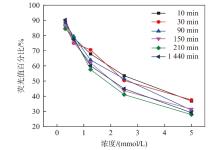
Fig.2
Time- and concentration-dependent changes in fluorescence intensity of the berberine control solution"
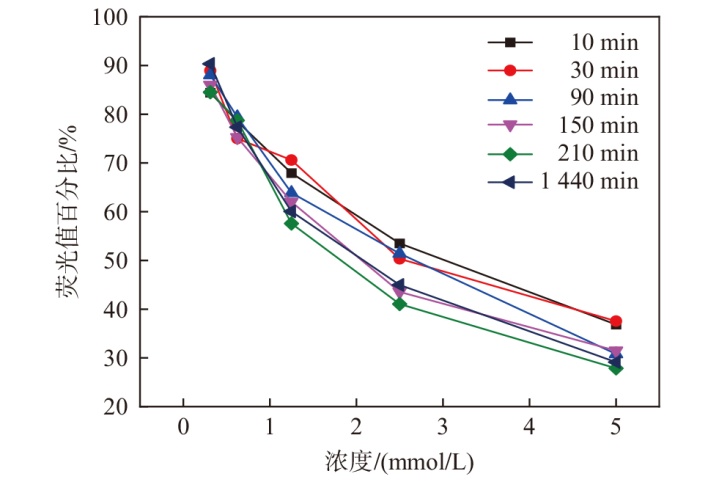
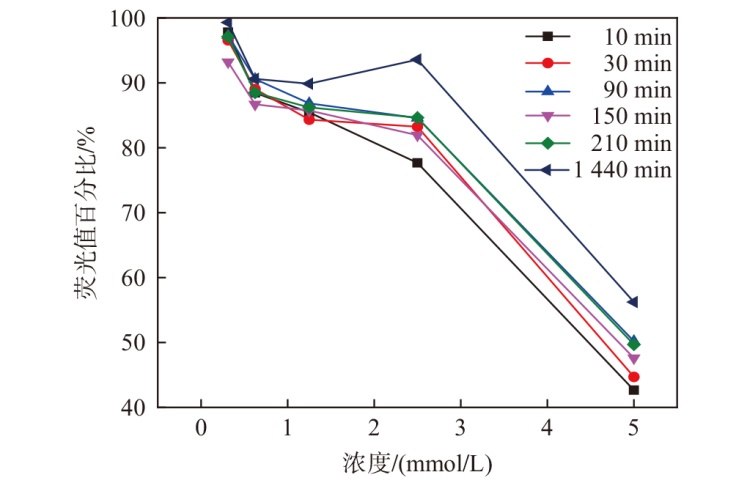
Fig.3
Time- and concentration-dependent changes in fluorescence intensity of the 2, 4-dinitrochlorobenzene control solution"
Tab.10
Concentrations of the test substance and corresponding CD86-RFI values"
| 组别 | 受试物终质量浓度/ (μg/mL) | 同型对照组MFI | 试验组MFI | RFI | 结果 |
|---|---|---|---|---|---|
| 溶剂对照组 | — | 386.2 | 1 805.1 | — | — |
| 小檗碱1 | 26.96 | 17 491.7 | 20 481.3 | 210.7 | 阳性 |
| 小檗碱2 | 22.46 | 14 906.7 | 18 466.8 | 250.9 | 阳性 |
| 小檗碱3 | 18.72 | 12 924.9 | 15 568.5 | 186.3 | 阳性 |
| 小檗碱4 | 15.60 | 10 722.3 | 13 539.1 | 198.5 | 阳性 |
| 小檗碱5 | 13.00 | 9 362.7 | 11 662.5 | 162.1 | 阳性 |
| 小檗碱6 | 10.83 | 8 134.9 | 9 783.6 | 116.2 | 阴性 |
| 小檗碱7 | 9.03 | 7 007.5 | 8 232.3 | 86.3 | 阴性 |
| 小檗碱8 | 7.52 | 5 976.6 | 7 089.6 | 78.4 | 阴性 |
| [1] |
Magnusson B, Kligman A M. The identification of contact allergens by animal assay. The guinea pig maximization test[J]. Journal of Investigative Dermatology, 1969, 52 (3) : 268-276.
doi: 10.1038/jid.1969.42 pmid: 5774356 |
| [2] |
Buehler E V. Delayed contact hypersensitivity in the guinea pig[J]. Archives of Dermatology, 1965, 91 (2) : 171-177.
doi: 10.1001/archderm.1965.01600080079017 |
| [3] | Russell W M S, Burch R L. The principles of humane experimental technique[M]. London: Methuen & Co., Ltd., 1959. |
| [4] | OECD. OECD guideline for the testing of chemicals No. 442A: skin sensitisation: local lymph node assay (LLNA)[R]. Paris, France: Organisation for Economic Co-operation and Development, 2024. |
| [5] | OECD. OECD guideline for the testing of chemicals No. 442B: skin sensitisation: local lymph node assay: BrdU-ELISA or -FCM[R]. Paris, France: Organisation for Economic Co-operation and Development, 2024. |
| [6] | OECD. OECD guideline for the testing of chemicals No. 442C: In chemico skin sensitisation: assays addressing the adverse outcome pathway key even on covalent binding to proteins) in chemico[R]. Paris, France: Organisation for Economic Co-operation and Development, 2024. |
| [7] | OECD. OECD guideline for the testing of chemicals No. 442D: in vitro skin sensitisation: ARE-Nrf2 luciferase test method[R]. Paris, France: Organisation for Economic Co-operation and Development, 2024. |
| [8] | OECD. OECD guideline for the testing of chemicals No. 442E: updating guideline for skin sensitisation and case examples[R]. Paris, France: Organisation for Economic Co-operation and Development, 2024. |
| [9] | National Medical Products Administration. Safety and technical standards for cosmetics (2015 Edition)[S]. Beijing, China: People’s Medical Publishing House, 2015. |
| [10] | European Commission, Joint Research Centre. DB-ALM protocol 217:the kinetic direct peptide reactivity assay (kDPRA)[EB/OL]. (2020-10-27) [2025-12-01]. https://jeodpp.jrc.ec.europa.eu/ftp/jrc-opendata/EURL-ECVAM/datasets/DBALM/LATEST/online/DBALM_docs/217_P_kDPRA_update_28Jan2026.pdf. |
| [11] | United Nations. Globally harmonized system of classification and labelling of chemicals (GHS)[S/OL]. Ninth revised edition. New York and Geneva: United Nations, 2021. https://unece.org/sites/default/files/2021-09/GHS_Rev9E_0.pdf. |
| [12] | OECD. Validation report: Kinetic direct peptide reactivity assay (kDPRA)[R]. Series on testing and sssessment No.337. Paris, France: Organisation for Economic Co-operation and Development, 2021. |
| [13] | Natsch A, Haupt T, Wareing B, et al. Predictivity of the kinetic direct peptide reactivity assay (kDPRA) for sensitizer potency assessment and GHS subclassification[J]. Alternatives to Animal Experimentation, 2020, 37 (4) : 652-664. |
| [14] | Natsch A, Gerberick G F. Integrated skin sensitization assessment based on OECD methods (I) : Deriving a point of departure for risk assessment[J]. Alternatives to Animal Experimentation, 2022, 39(4) : 636-646. |
| [15] |
Sudaki H, Fujimoto K, Wada K, et al. Phosphate buffer interferes dissolution of prazosin hydrochloride in compendial dissolution testing[J]. Drug Metab Pharmacokinet, 2023, 51: 100519.
doi: 10.1016/j.dmpk.2023.100519 |
| [16] | Wareing B, Kolle S N, Birk B, et al. The kinetic direct peptide reactivity assay (kDPRA) : Intra- and inter-laboratory reproducibility in a seven-laboratory ring trial[J]. Alternatives to Animal Experimentation, 2020, 37 (4) : 639-651. |
| [17] |
Roberts D W. A critical review of the kinetic direct peptide reactivity assay (kDPRA) for skin sensitizer potency assessment-taking it forward[J]. Critical Reviews in Toxicology, 2021, 51 (10) : 805-819.
doi: 10.1080/10408444.2021.2020212 pmid: 35166165 |
| [18] |
Tan W, Li Y, Chen M, et al. Berberine hydrochloride: anticancer activity and nanoparticulate delivery system[J]. International Journal of Nanomedicine, 2011, 6: 1773-1777.
doi: 10.2147/IJN.S22683 pmid: 21931477 |
| [19] | Cometa S, Bonifacio M A, Licini C, et al. Innovative eco-friendly hydrogel film for berberine delivery in skin applications[J]. Molecules, 2021, 26 (16) : 4901. |
| [1] | Ting Liu, Shibu Liu, Li Zhang, Hui Duo, Yong Lu, Luyong Zhang. Skin sensitisation in vitro method: kinetic direct peptide reactivity assay (kDPRA) transformation and validation [J]. China Surfactant Detergent & Cosmetics, 2025, 55(6): 723-730. |
| [2] | Hongling Zhang, Lin Cheng, Haiyan Wang, Feiya Luo, Huiliang Zhang, Lei Sun. Using DPRA alternative method to evaluate the skin sensitization of 3 coumarins [J]. China Surfactant Detergent & Cosmetics, 2024, 54(2): 156-160. |
| [3] | Ding Shixuan, Li Xiaolin, Chen Yu, Yu Jie. Application of amino acid derivative reactivity assay for skin sensitization prediction of cosmetics [J]. China Surfactant Detergent & Cosmetics, 2023, 53(10): 1166-1172. |
| [4] | Sun Fanghui,Song Xiaojie,Huo Gang. Current situation and prospect of integrated strategies for skin sensitization testing [J]. China Surfactant Detergent & Cosmetics, 2021, 51(8): 782-788. |
| [5] | YANG Ting-ting,YI Lu-yao,WANG Yi,LI Jie,JI Wei-jia,ZHANG Hong. Evaluation of skin sensitization of three perfumes by using DPRA alternative method [J]. China Surfactant Detergent & Cosmetics, 2021, 51(5): 438-442. |
| [6] | MEI Cheng-han,TAN Hong,YANG Hong-bo,CHEN Bei-bei,LIU Shi-bu,LIU Ting. Research progress on alternative methods for skin sensitization tests [J]. China Surfactant Detergent & Cosmetics, 2019, 49(6): 393-397. |
| [7] | CHAN Jian, KE Yi-hui, TAN Wei-jun. A preliminary study on in vitro skin sensitization test based on skin model and THP-1 cell co-culture [J]. China Surfactant Detergent & Cosmetics, 2018, 48(5): 288-292. |
| [8] | WANG Ying, WU Yue. Establishment and application of non-animal test method for skin sensitization (DPRA) [J]. China Surfactant Detergent & Cosmetics, 2017, 47(2): 90-95. |
|
