欢迎访问《日用化学工业(中英文)》,今天是

日用化学工业(中英文) ›› 2026, Vol. 56 ›› Issue (7): 833-840.doi: 10.3969/j.issn.2097-2806.2026.07.001

• 科技讲座 •    下一篇

黏弹性表面活性剂(VII)—— CO2响应蠕虫状胶束

冯玉军*()   

  1. 四川大学 高分子研究所 先进高分子材料工程全国重点实验室四川 成都 610065
  • 收稿日期:2026-07-20 出版日期:2026-07-22 发布日期:2026-08-06
  • 基金资助:
    国家自然科学基金项目(U22A20395);国家自然科学基金项目(21173207)

Viscoelastic surfactants (VII) CO2-responsive wormlike micelles

Yujun Feng*()   

  1. State Key Laboratory of Advanced Polymer Materials, Polymer Research Institute, Sichuan University, Chengdu, Sichuan 610065, China
  • Received:2026-07-20 Online:2026-07-22 Published:2026-08-06
  • Contact: *E-mail: yjfeng@scu.edu.cn.

摘要:

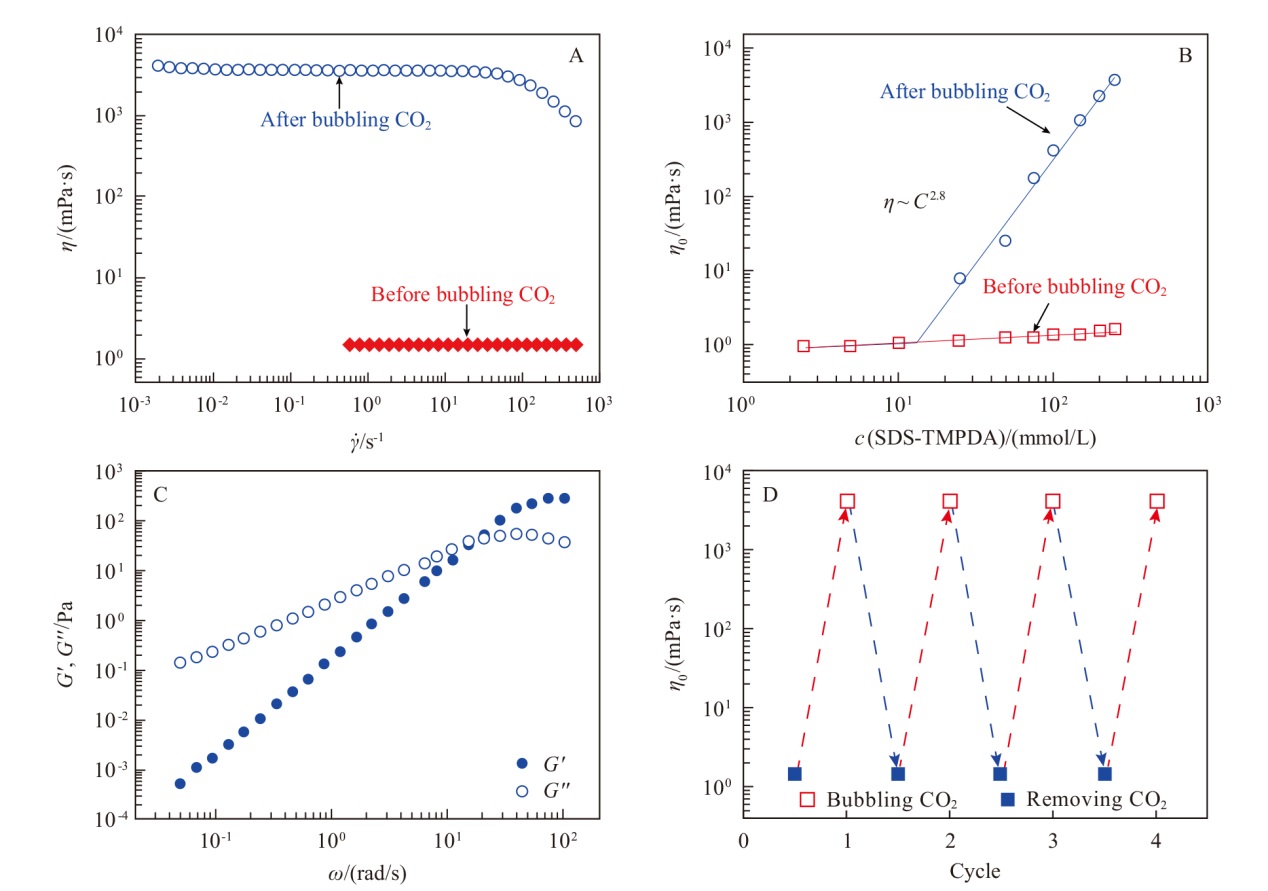
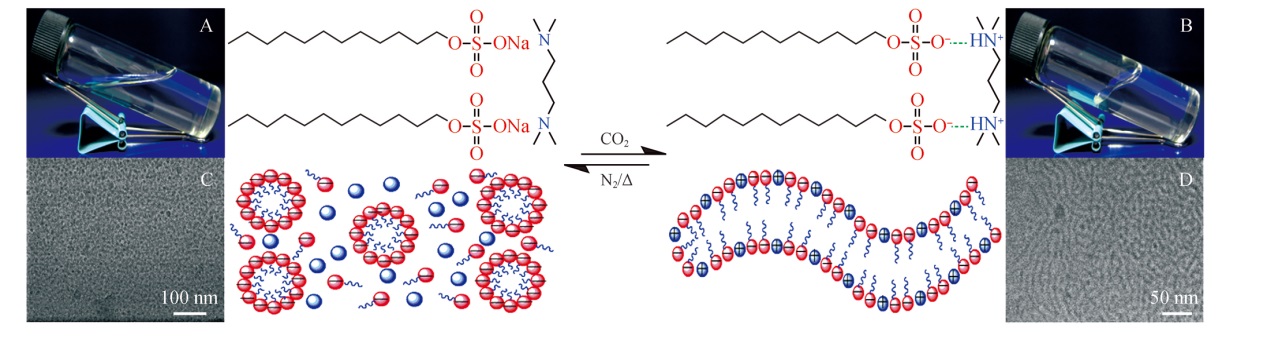
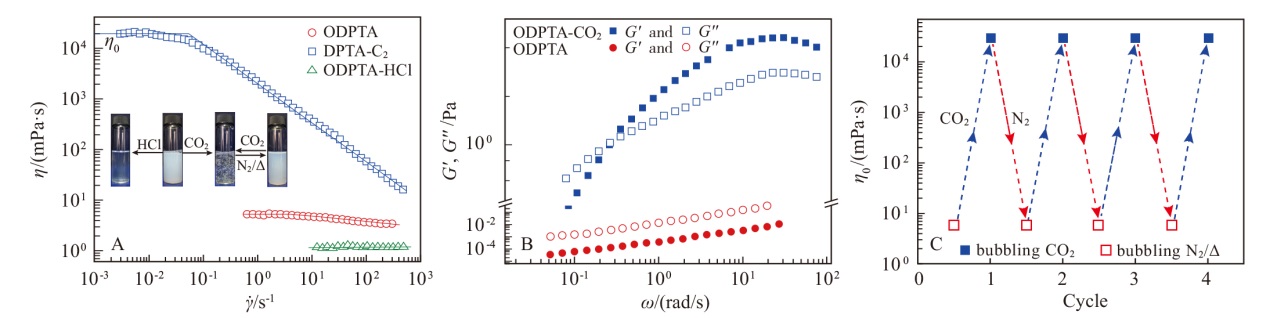
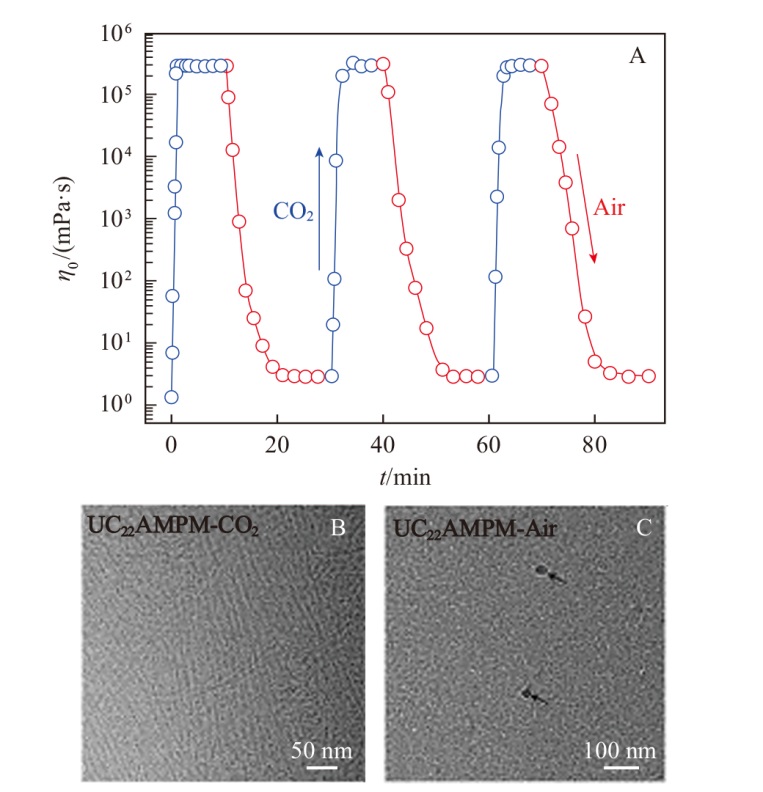
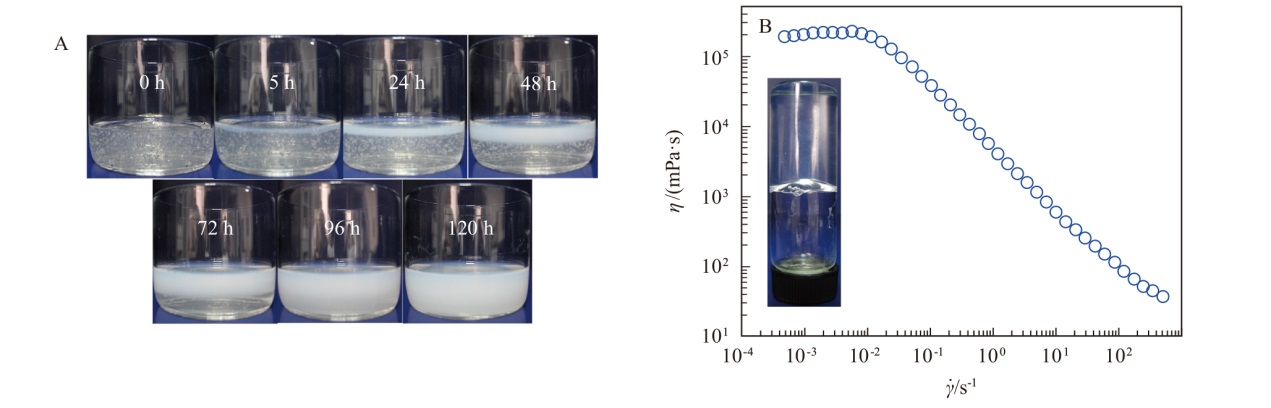
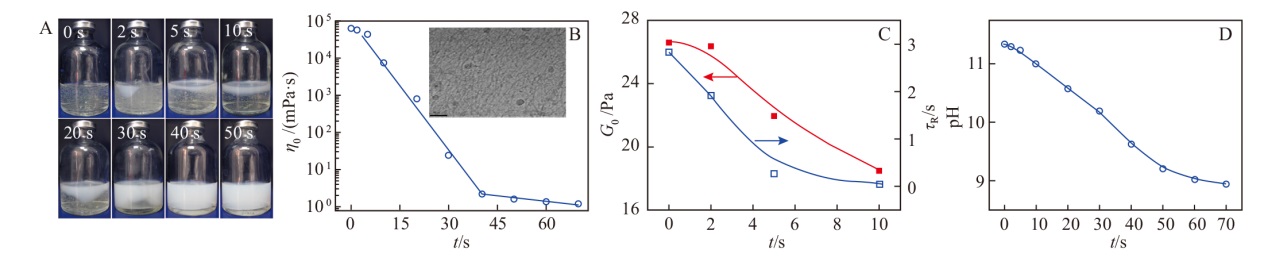
黏弹性表面活性剂领域的核心发展方向之一,在于赋予体系对外部刺激的智能响应能力,从而实现流变性能的可逆按需调控。CO2因其来源广泛、环境友好且去除简便、无盐副产物累积等优势,已成为传统pH调节手段的理想替代触发因子。本讲系统梳理了CO2响应型蠕虫状胶束的设计策略、自组装机制及流变行为特征。CO2响应的本质在于其溶于水后生成碳酸,使长链有机碱发生可逆质子化,进而驱动表面活性剂前体转化为阳离子或“拟双子”型表面活性剂,并自组装为缠结网络,赋予体系高黏弹性;而去除CO2后,去质子化过程使胶束瓦解,体系恢复低黏态。依据分子结构差异,可将现有体系归纳为三类典型模式:阴离子表面活性剂与叔胺助溶物的二元体系,依赖静电构筑动态拟双子结构;单一长链多胺体系,经CO2触发后由囊泡转变为蠕虫状胶束,其质子化产物与碳酸氢根抗衡离子协同促进胶束生长,此为单纯酸滴定所无法实现;超长链叔胺体系,可在常温常压下仅通过CO2与空气的交替鼓泡实现溶胶-凝胶的可逆转变。此外,预先形成的阴离子蠕虫状胶束亦可因CO2诱导羧基质子化而显著降黏,呈现“关闭”型响应。上述研究表明,CO2响应行为不仅依赖于分子堆积参数的协同调控,更受质子化路径及抗衡离子种类的深刻影响,为智能流体设计提供了系统的理论依据与实用范例。

关键词: 黏弹性表面活性剂, 蠕虫状胶束, CO2响应, 自组装, 溶胶-凝胶转变

Abstract:

Stimuli-responsive wormlike micelles(WLMs)represent a frontier in viscoelastic surfactant research, enabling on-demand modulation of rheological properties. Among various triggers, CO2 has emerged as an attractive alternative to conventional pH regulation due to its ready availability, environmental benignity, and reversible removal without salt accumulation. This review systematically addresses CO2-responsive WLMs, focusing on molecular design principles, assembly mechanisms, and rheological characteristics. The response behaviour hinges on the reversible protonation of organobases—primarily tertiary amines—upon CO2 sparging, which generates cationic or pseudo-gemini surfactants that self-assemble into entangled networks. Conversely, CO2 removal by inert gas purging or mild heating reverses the protonation, dismantling the micellar network and restoring low viscosity. Three prototypical systems are delineated:(i)binary mixtures of anionic surfactants with amine-based hydrotropes, which form CO2-switchable pseudo-gemini species through electrostatic linkages;(ii)single-component long-chain polyamines, where CO2 induces a vesicle-to-wormlike transition via mixed protonated species and bicarbonate counterions, a pathway unattainable by simple acid titration; and(iii)ultra-long-chain tertiary amine surfactants, which enable reversible sol-gel transitions at ambient conditions using only CO2 and air. Notably, CO2 can also destroy pre-formed anionic WLMs by converting carboxylate headgroups into neutral acid forms, thereby reducing viscosity—a distinct “turn-off” mechanism. In summary, these systems exhibit robust cyclability, precise rheological switching, and structure-property correlations governed by molecular packing parameters and counterion effects. The findings underscore the critical role of protonation pathways and ionic speciation in dictating WLM formation, offering a versatile platform for applications in oilfield chemistry, drug delivery, and smart materials.

Key words: viscoelastic surfactant, wormlike micelles, CO2-responsive, self-assembly, sol-gel transition

中图分类号: 

  • TQ423