Welcome to China Surfactant Detergent & Cosmetics, Today is


China Surfactant Detergent & Cosmetics ›› 2026, Vol. 56 ›› Issue (4): 425-432.doi: 10.3969/j.issn.2097-2806.2026.04.002
• Lecture of science and technology • Previous Articles Next Articles
Yujun Feng*( )
)
Received:2026-04-21
Online:2026-04-22
Published:2026-05-27
Contact:
* E-mail: CLC Number:
Yujun Feng. Viscoelastic surfactants (IV) Dynamic rheology[J].China Surfactant Detergent & Cosmetics, 2026, 56(4): 425-432.
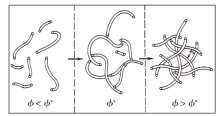
Fig.1
According to the critical volume fraction (φ*), the wormlike micellar solutions are divided into three regions with increasing surfactant volume fraction"
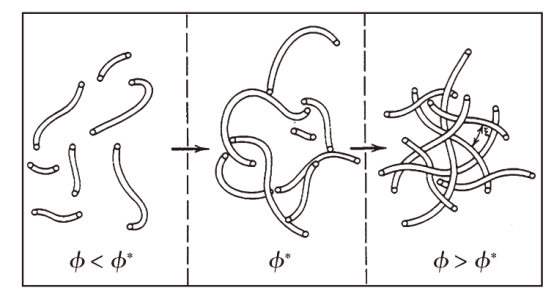
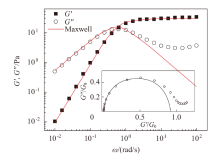
Fig.2
The moduli of the binary wormlike micellar system of 100 mmol/L cetylpyridinium chloride (CPyCl) - 60 mmol/L sodium salicylate (NaSal) at 24 ℃ conform to the typical Maxwell model and Cole-Cole mode fitting (inset)[15]"
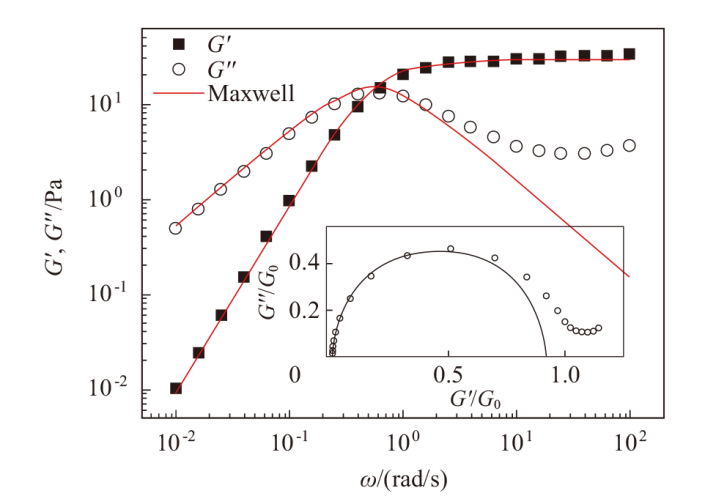
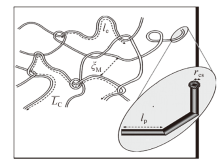
Fig.3
The topological structure of wormlike micelles and related mesoscopic parameters [19]"
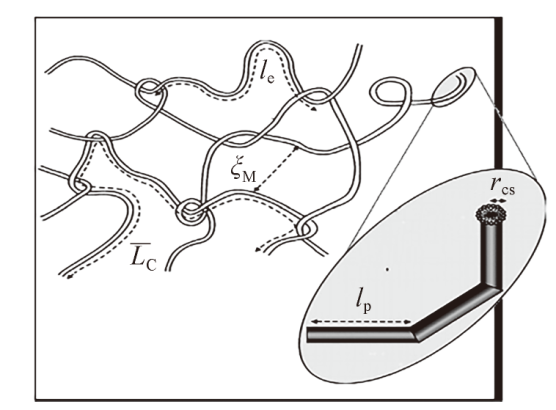
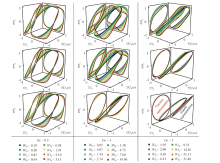
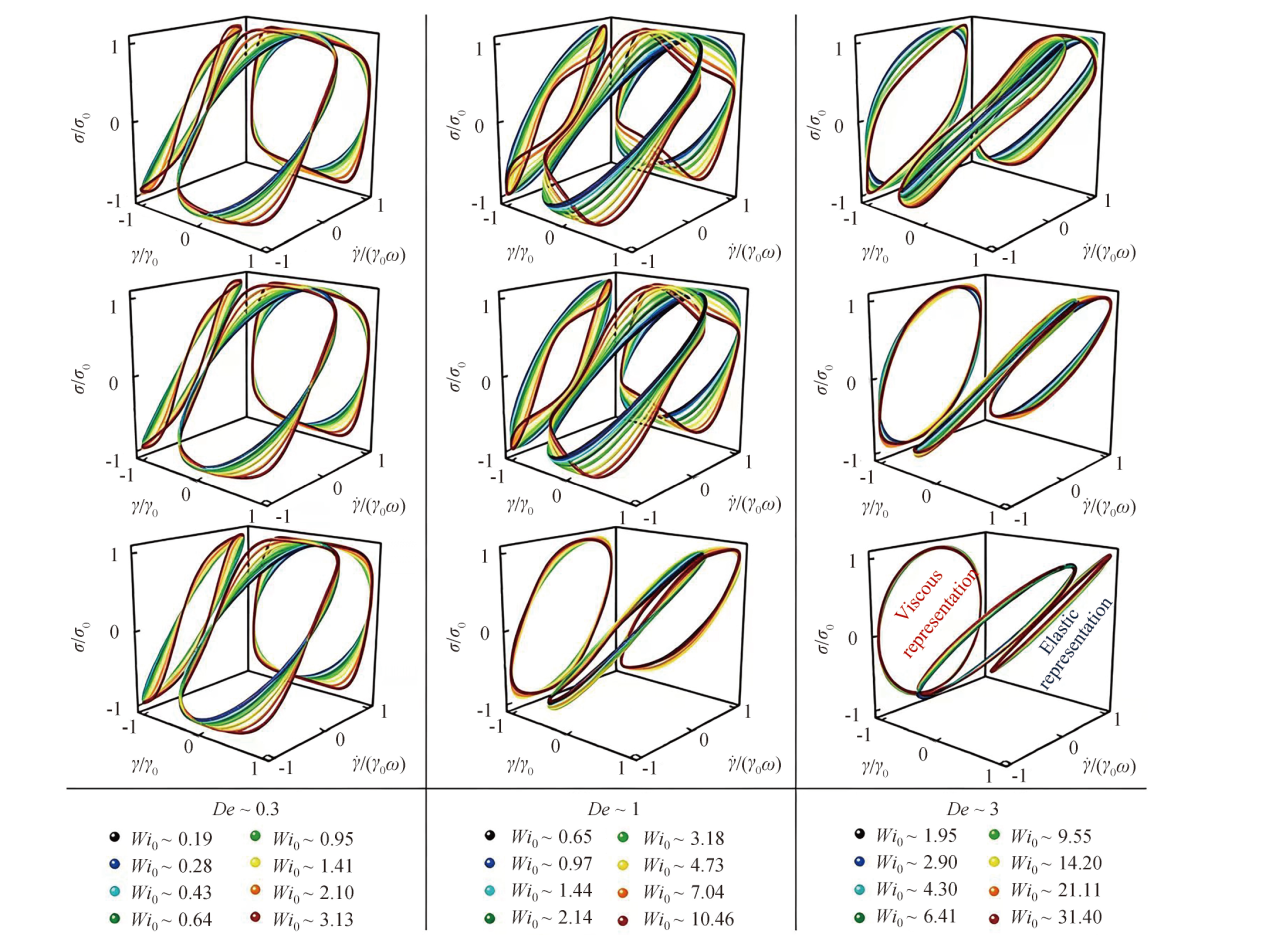
Fig.4
The normalized three-dimensional Lissajous-Bowditch curves and their projections (σ/σ0 vs. γ/γ0 reflecting elasticity; σ/σ0 vs. / (γ0ω) reflecting viscosity) of CTAB/NaNO3 micellar solutions at different Wi0 (=τRωγ0) and De (=τRω). The CTAB concentrations from top to bottom are 0.3, 0.2 and 0.1 mol/L; c (NaNO3) = 0.3 mol/L, T= 30 ℃"
| [1] | 冯玉军. 黏弹性表面活性剂(I)——百年胶束发展史及蠕虫状胶束的发现[J]. 日用化学工业(中英文), 2026, 56(1): 8-16. |
| [2] | 冯玉军. 黏弹性表面活性剂(II)——蠕虫状胶束形成机理及体系构成[J]. 日用化学工业(中英文), 2026, 56(2): 137-148. |
| [3] | 冯玉军. 黏弹性表面活性剂(III)——稳态流变与剪切带现象[J]. 日用化学工业(中英文), 2026, 56(3): 278-283. |
| [4] |
Candau S J, Oda R. Linear viscoelasticity of salt-free wormlike micellar solutions[J]. Colloids Surf. A: Physicochem. Eng. Asp., 2001, 183-185: 5-14.
doi: 10.1016/S0927-7757(01)00535-0 |
| [5] |
Mackintosh F C, Safran S A, Pincus P A. Self-assembly of linear aggregates: the effect of electrostatics on growth[J]. Europhys. Lett., 1990, 12(8): 697-702.
doi: 10.1209/0295-5075/12/8/005 |
| [6] | Hoffmann H. Viscoelastic surfactant solutions. In: Herb C, Prudhomme R, Eds. Structure and flow in surfactant solutions[M]. ACS Symposium Series, No. 578, The Americal Chemical Society, Washington, DC, 1994 Chapter 1: 2-31. |
| [7] |
Safran S A, Pincus P A, Cates M E, et al. Growth of charged micelles[J]. J. Phys. France, 1990, 51(6): 503-510.
doi: 10.1051/jphys:01990005106050300 |
| [8] |
Cates M E, Candau S J. Statics and dynamics of worm-like surfactant micelles[J]. J. Phys. Condens. Matter, 1990, 2: 6869-6892.
doi: 10.1088/0953-8984/2/33/001 |
| [9] |
Cates M E. Dynamics of living polymers and flexible surfactant micelles: Scaling laws for dilution[J]. J. Phys. France, 1988, 49(9): 1593-1606.
doi: 10.1051/jphys:019880049090159300 |
| [10] |
Cates M E. Reptation of living polymers: dynamics of entangled polymers in the presence of reversible chain-scission reactions[J]. Macromolecules, 1987, 20: 2289-2296.
doi: 10.1021/ma00175a038 |
| [11] |
Lequeux F. Reptation of connected wormlike micelles[J]. Europhys. Lett., 1992, 19(8): 675-681.
doi: 10.1209/0295-5075/19/8/003 |
| [12] |
Cates M E, Turner M. Flow-induced gelation of rodlike micelles[J]. Europhys. Lett., 1990, 11(7): 681-686.
doi: 10.1209/0295-5075/11/7/017 |
| [13] |
Turner M S, Cates M E. The relaxation spectrum of polymer length distributions[J]. J. Phys. France, 1990, 51(4): 307-316.
doi: 10.1051/jphys:01990005104030700 |
| [14] |
Granek R, Cates M E. Stress relaxation in living polymers: Results from a Poisson renewal model[J]. J. Chem. Phys., 1992, 96(6): 4758-4767.
doi: 10.1063/1.462787 |
| [15] |
Haward S J, Kitajima N, Toda-Peters K, et al. Flow of wormlike micellar solutions around microfluidic cylinders with high aspect ratio and low blockage ratio[J]. Soft Matter, 2019, 15: 1927-1941.
doi: 10.1039/c8sm02099j pmid: 30657156 |
| [16] |
Peterson J D, Cates M E. Constitutive models for well-entangled living polymers beyond the fast-breaking limit[J]. J. Rheol., 2021, 65(4): 633-662.
doi: 10.1122/8.0000199 |
| [17] |
Tan G, Larson R G. Quantitative modeling of threadlike micellar solution rheology[J]. Rheol. Acta, 2022, 61: 443-457.
doi: 10.1007/s00397-022-01341-4 |
| [18] |
Salipante P F, Cromer M, Hudson S D. Two-species model for nonlinear flow of wormlike micelle solutions. Part II: Experiment[J]. J. Rheol., 2024, 68: 895-911.
doi: 10.1122/8.0000776 |
| [19] | Pasquino R, Castillo R. Open issues in the linear and nonlinear rheology of wormlike micelles[J]. Curr. Opi. Colloid Interface Sci., 2025, 77: 101919. |
| [20] |
Hyun K, Wilhelm M, Klein C O, et al. A review of nonlinear oscillatory shear tests: analysis and application of large amplitude oscillatory shear (LAOS)[J]. Prog. Polym. Sci., 2011, 36: 1697-1753.
doi: 10.1016/j.progpolymsci.2011.02.002 |
| [21] |
Gaudino D, Costanzo S, Ianniruberto G, et al. Linear wormlike micelles behave similarly to entangled linear polymers in fast shear flows[J]. J. Rheol., 2020, 64: 879-888.
doi: 10.1122/8.0000003 |
| [22] |
Rogers S, Kohlbrecher J, Lettinga M P. The molecular origin of stress generation in worm-like micelles, using a rheo-SANS LAOS approach[J]. Soft Matter, 2012, 8: 7831-7839.
doi: 10.1039/c2sm25569c |
| [23] |
Carter K A, Girkin J M, Fielding S M. Shear banding in large amplitude oscillatory shear (LAOStrain and LAOStress) of polymers and wormlike micelles[J]. J. Rheol., 2016, 60: 883-904.
doi: 10.1122/1.4960512 |
| [24] |
Zou W, Larson R G. A mesoscopic simulation method for predicting the rheology of semi-dilute wormlike micellar solutions[J]. J. Rheol., 2014, 58: 681-721.
doi: 10.1122/1.4868875 |
| [25] |
López-Santiago R F, Delgado J, Castillo R. Micellar entanglement and its relation to the elastic behavior of wormlike micelle fluids[J]. J. Colloid Interface Sci., 2022, 626: 1015-1027.
doi: 10.1016/j.jcis.2022.07.003 |
| [26] |
Davoodi S, Al-Shargabi M, Wood D A, et al. A comprehensive review of beneficial applications of viscoelastic surfactants in wellbore hydraulic fracturing fluids[J]. Fuel, 2023, 338: 127228.
doi: 10.1016/j.fuel.2022.127228 |
| [27] |
Yusof N S M, Ashokkumar M. Ultrasonic transformation of micelle structures: Effect of frequency and power[J]. Ultrasonics Sonochemistry, 2015, 24: 8-12.
doi: 10.1016/j.ultsonch.2014.11.003 pmid: 25465878 |
| [28] |
Miki R, Takei C, Ohtani Y, et al. Glucose responsive rheological change and drug release from a novel worm-like micelle gel formed in cetyltrimethylammonium bromide/phenylboronic acid/water system[J]. Mol. Pharmaceutics, 2018, 15(3): 1097-1104.
doi: 10.1021/acs.molpharmaceut.7b00988 |
| [1] | Yujun Feng. Viscoelastic surfactants (III)Steady rheology and shear bandings [J]. China Surfactant Detergent & Cosmetics, 2026, 56(3): 277-283. |
| [2] | Yujun Feng. Viscoelastic surfactants(II)Formation mechanisms and system formulations of wormlike micelles [J]. China Surfactant Detergent & Cosmetics, 2026, 56(2): 137-148. |
| [3] | Ziying Liao, Fan Min, Zonglin Chu. Smart wormlike micelles based on the surfactants with dynamic imine bonds [J]. China Surfactant Detergent & Cosmetics, 2026, 56(1): 1-7. |
| [4] | Yujun Feng. Viscoelastic surfactants (I)Evolution of micelles and discovery of wormlike micelles [J]. China Surfactant Detergent & Cosmetics, 2026, 56(1): 8-16. |
| [5] | Niu Qiqi,Lv Qichao,Dong Zhaoxia,Zhang Fengfan,Wang Hongbo. Research progress on the properties of foam systems containing wormlike micelles [J]. China Surfactant Detergent & Cosmetics, 2023, 53(8): 915-924. |
| [6] | Ting Pan, Junhui Wu, Xiaomei Pei, Zhenggang Cui. Temperature and pH responsive behavior of wormlike micelles formed by novel pseudo-gemini surfactant [J]. China Surfactant Detergent & Cosmetics, 2023, 53(12): 1361-1368. |
| [7] | Liang Yihuan,Du Jing. “Jelly” phenomenon rheology study and improvement in shampoo system [J]. China Surfactant Detergent & Cosmetics, 2022, 52(9): 920-929. |
| [8] | ZHANG Meng, QI Li-yun, LONG Yu, WANG Ji-yuan, QI Song-zhu, HUANG Yuan-lin, FANG Xue-jin. Study on rheological behaviors of pH-responsive wormlike micelles formed by an amine oxide surfactant [J]. China Surfactant Detergent & Cosmetics, 2017, 47(6): 301-306. |
| [9] | CHEN Xiao-xiao,GUO Yan,HAN Chuan-hong,ZHANG Jun-hong,ZHOU Shi-yan,WEI Xi-lian. Effect of addition of salt on solution of Gemini cationic surfactant [J]. China Surfactant Detergent & Cosmetics, 2016, 46(10): 549-554. |
| [10] | YUAN Min-jia, DONG Chao, SHEN Pei-lin, LU Hai-wei, WANG Jin-shuang, FANG Bo, GUO Yi-guang. Study on properties of self-thickening system composed of amphoteric surfactant and amino-acid based anionic surfactant [J]. China Surfactant Detergent & Cosmetics, 2015, 45(1): 11-16. |
| [11] | ZHAO Li, TAN Ting-ting, XU Bao-cai. Performance and applications of surfactants (Ⅷ) Surfactant wormlike micelles and their applications [J]. China Surfactant Detergent & Cosmetics, 2014, 44(8): 426-431. |
| [12] | LI Kai, LIU Hui-qiang, LI Jian-shan, LU Hong-jun, GU Xue-fan, YAN Yong-li. Studies on the rheological and breaking behaviors of viscoelastic micelles of fatty alcohol polyoxyethylene ether sulfate [J]. China Surfactant Detergent & Cosmetics, 2014, 44(6): 306-311. |
|
