Welcome to China Surfactant Detergent & Cosmetics, Today is


China Surfactant Detergent & Cosmetics ›› 2026, Vol. 56 ›› Issue (4): 518-528.doi: 10.3969/j.issn.2097-2806.2026.04.012
• Reviews • Previous Articles Next Articles
Jiahuan Yu1,*( ),Yanxin Song2,Guang Chen3
Received:2025-12-02
Revised:2026-04-10
Online:2026-04-22
Published:2026-05-27
Contact:
* E-mail: CLC Number:
Jiahuan Yu, Yanxin Song, Guang Chen. Research progress on the efficient catalytic cracking of LCO to produce high-value BTX aromatics[J].China Surfactant Detergent & Cosmetics, 2026, 56(4): 518-528.
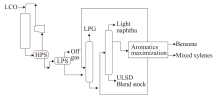
Fig.1
LCO-X process flow"
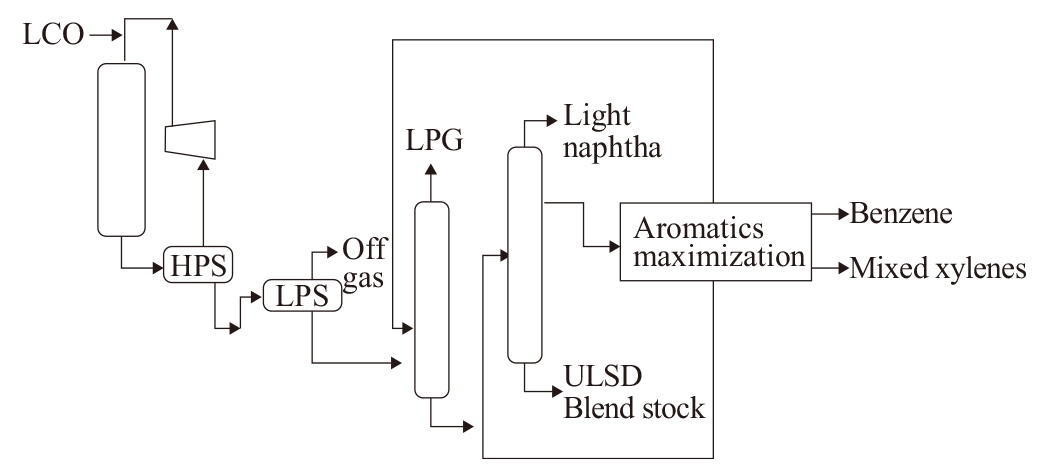
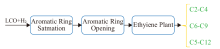
Fig.2
ARO process flow [4]"
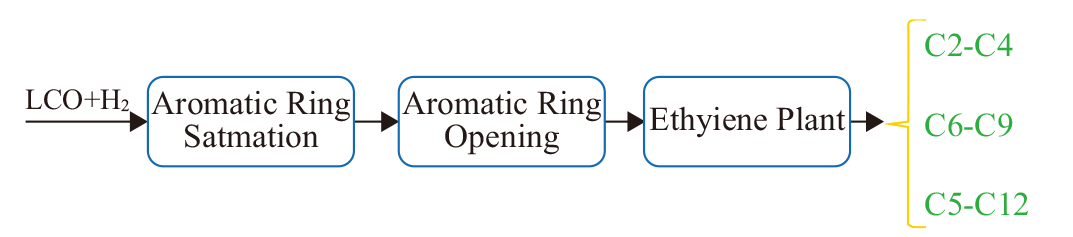
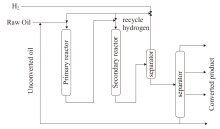
Fig.3
FD2G process flow"
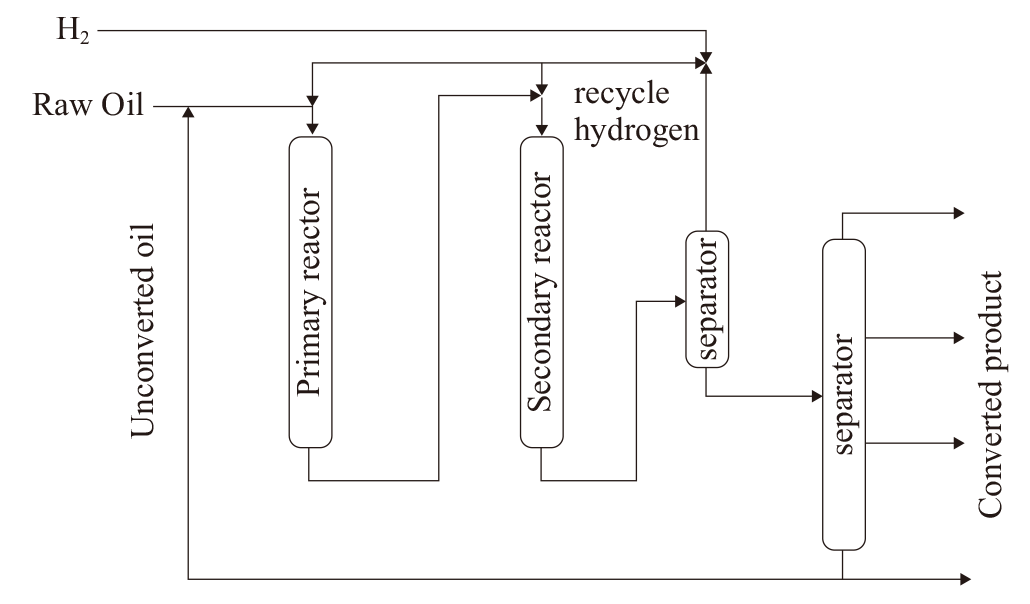
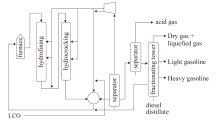
Fig.4
RLG process flow"
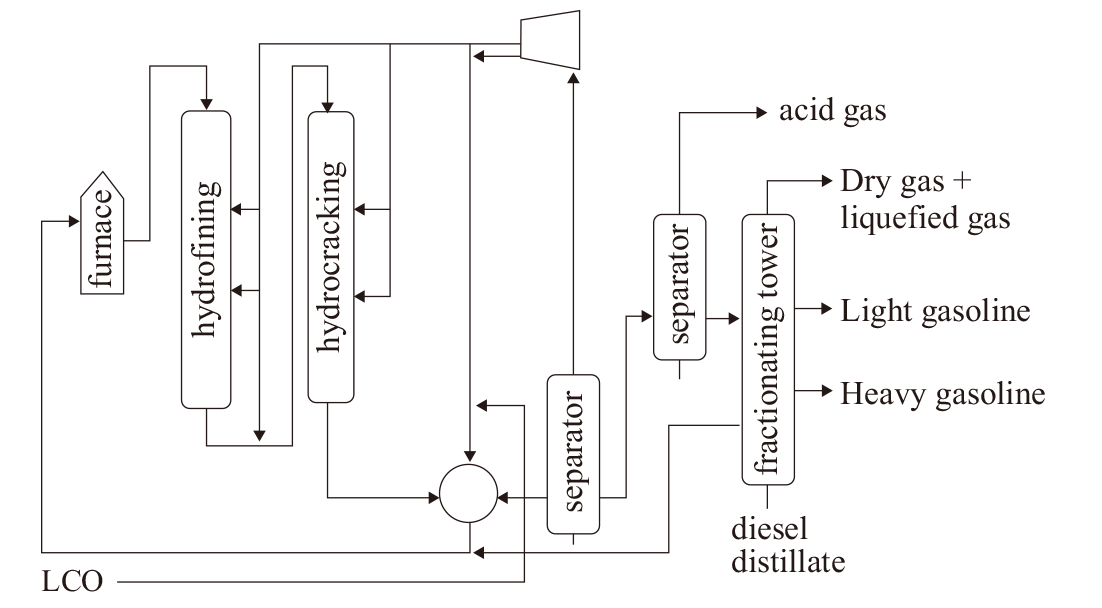
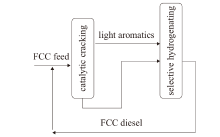
Fig.5
LTAG process flow"
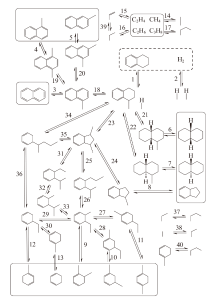
Fig.6
Tetralin hydrocracking reaction network with H-ZSM5 catalyst"
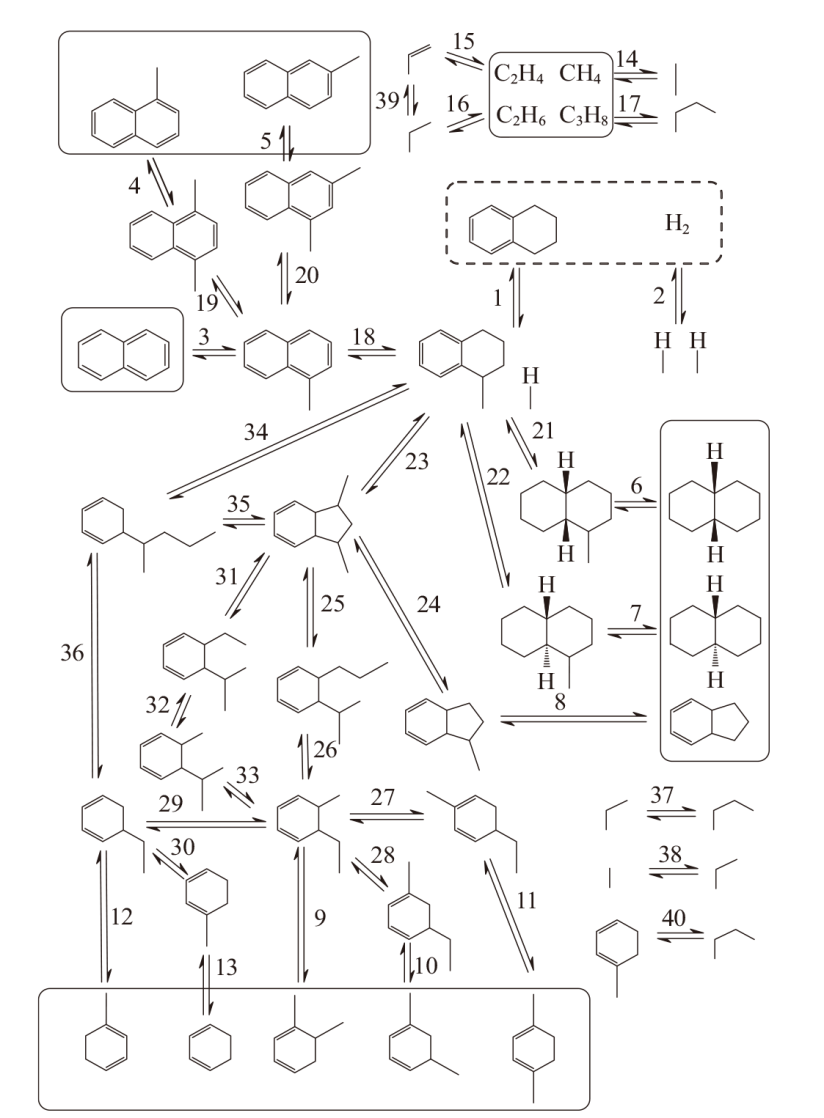
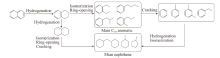
Fig.7
Naphthalene hydrocracking reaction network with NiMo/γ-Al2O3-Beta catalyst"
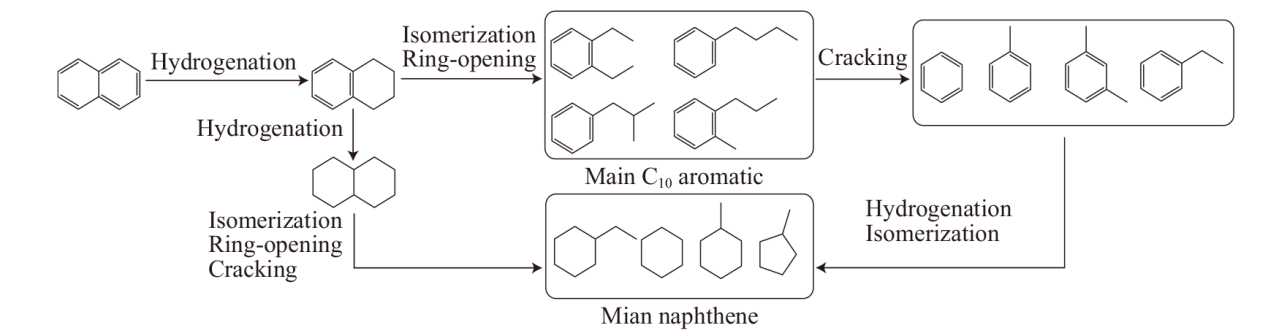
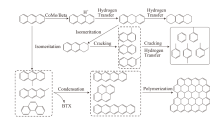
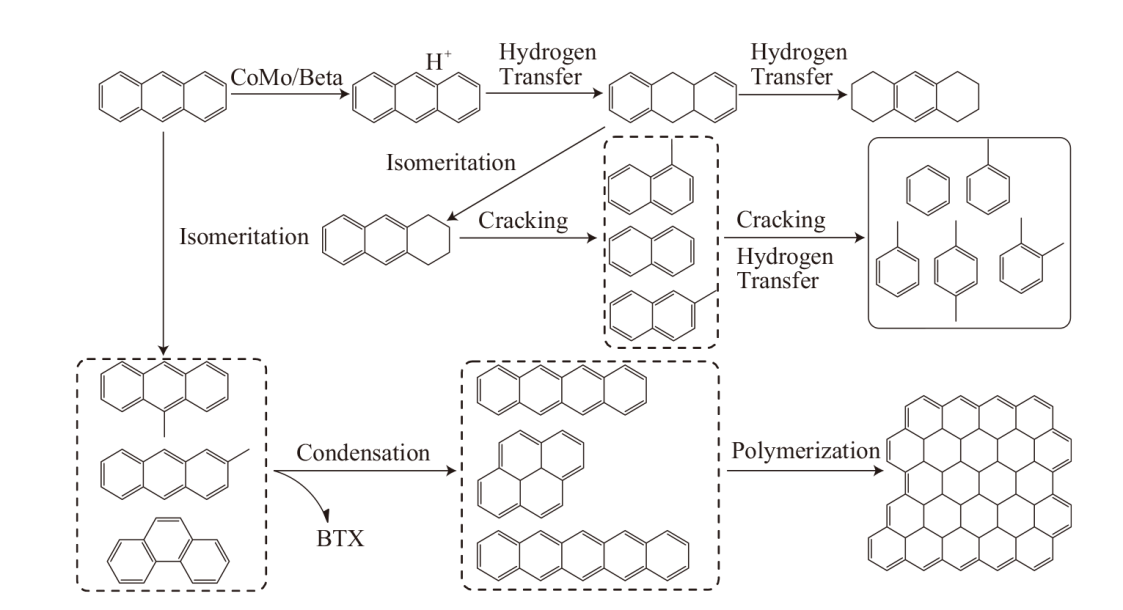
Fig.8
Anthracene hydrocracking reaction network with CoMo/Beta catalyst"
| [1] |
Cao Zhengkai, Zhang Xia, Guo Rong, et al. Oriented hydrocracking of naphthalene into high-value light aromatics over difunctional catalysts: Effect of hydrogen spillover and utilization of hydroreaction characteristics for different active metals[J]. ACS Catalysis, 2020, 10(21): 12342-12353.
doi: 10.1021/acscatal.0c02929 |
| [2] |
Dong Qi, Zhang Chuanhao, Zhang Huifang, et al. Design and preparation of Pt@SSZ-13@β core-shell catalyst for hydrocracking of naphthalene[J]. Journal of Catalysis, 2023, 421: 365-375.
doi: 10.1016/j.jcat.2023.03.035 |
| [3] | Sharma A. Benzene-Toluene-Xylene (BTX) market size & outlook, 2025-2033[R/OL]. Amanora Chambers, 2024: 110. https://straitsresearch.com/report/benzene-toluene-xylene-market. |
| [4] |
Chen Feng, Zhang Guohao, Weng Xiaoyi, et al. High value utilization of inferior diesel for BTX production: Mechanisms, catalysts, conditions and challenges[J]. Applied Catalysis, A. General, 2021, 616(25): 118095.
doi: 10.1016/j.apcata.2021.118095 |
| [5] |
Oh J, Choi Y, Shin J, et al. Synergistic shape selectivity of H-Beta and H-ZSM-5 for Xylene-rich BTX production by hydrocracking of heavy-aromatic compounds[J]. Fuel Processing Technology, 2023, 249: 107856.
doi: 10.1016/j.fuproc.2023.107856 |
| [6] |
Qi Jiayao, Guo Yanni, Jia Hanqiong, et al. Unpredictable properties of industrial HY zeolite for tetralin hydrocracking[J]. Fuel Processing Technology, 2023, 240: 107586.
doi: 10.1016/j.fuproc.2022.107586 |
| [7] |
Hu Zunlong, Wu Tongtong, Xie Haodong, et al. Synthesis and consequence of three-dimensionally ordered macroporous Beta zeolite supported NiW catalyst for efficient hydrocracking of 1-methylnaphthalene to BTX[J]. Chemical Engineering Journal, 2024, 499: 155761.
doi: 10.1016/j.cej.2024.155761 |
| [8] |
Jia Hanqiong, Yan Wenchao, Dong Qi, et al. Selective ring-opening in 9, 10-dihydrophenanthrene hydrocracking over a practical NiMo/Al2O3-USY catalyst under mild conditions[J]. Journal of the Energy Institute, 2024, 116: 101716.
doi: 10.1016/j.joei.2024.101716 |
| [9] |
Wei Lisha, Yang Hui, Qin Bo, et al. Catalytic hydrocracking of 9,10-dihydroanthracene on HY zeolite-Activity dependence on acid strength[J]. Microporous and Mesoporous Materials, 2025, 385: 113468.
doi: 10.1016/j.micromeso.2024.113468 |
| [10] | Bisht D, Petri J. Considerations for upgrading light cycle oil with hydroprocessing technologies[J]. Indian Chemical Engineer Sections A & B, 2014, 56(4): 321-335. |
| [11] | Johnson J A, Frey S J, Thakkar V P. Unlocking high value xylenes from light cycle oil[C] // National Petrochemical Refiners Association Annual Meeting: San Antonio TX (US), 2007: 1-19. |
| [12] |
Simanzhenkov V, Oballa M C, Kim G. Technology for producing petrochemical feedstock from heavy aromatic oil fractions[J]. Industrial & Engineering Chemistry Research, 2010, 49(3): 953-963.
doi: 10.1021/ie900609d |
| [13] |
Peng Chong, Huang Xinlu, Duan Xuezhi, et al. Direct production of high octane gasoline and ULSD blend stocks by LCO hydrocracking[J]. Catalysis Today, 2016, 271(1): 149-153.
doi: 10.1016/j.cattod.2015.11.049 |
| [14] |
Peng Chong, Fang Xiangchen, Zeng Ronghui, et al. Commercial analysis of catalytic hydroprocessing technologies in producing diesel and gasoline by light cycle oil[J]. Catalysis Today, 2016, 276(1): 11-18.
doi: 10.1016/j.cattod.2016.01.017 |
| [15] | Cui Baojing. Research progress on technologies for converting catalytic diesel into light aromatics[J]. Contemporary Chemical Industry, 2021, 50(8): 1962-1966. |
| [16] |
Zheng Qianqian, Fan Yijun, Zhou Zhi, et al. Research on product yield prediction and benefit of tuning diesel hydrogenation conversion device based on data-driven system[J]. Energies. 2023, 16(14): 5332.
doi: 10.3390/en16145332 |
| [17] | Wu Haisheng. Industrial application of RLG technology for catalytic diesel hydro-upgrading[J]. Technology & Economics in Petrochemicals, 2018, 34(1): 9-14. |
| [18] |
Zhang Zhanquan, Zhang Wei, Zhang Yalin, et al. Technical review on flexible processing middle distillate for achieving maximum profit in China[J]. Applied Petrochemical Research, 2017, 7(7): 1-11.
doi: 10.1007/s13203-016-0173-y |
| [19] | Mao Anguo, Gong Jianhong, Tang Jinlian, et al. Key technology and practice of producing high-octane gasoline or light aromatics (LTAG) from catalytic cracking light cycle oil[J]. Chemical Engineering of Oil & Gas, 2020, 49(3): 1-7. |
| [20] | Li Guijun, Liu Xiaohua, Zhou Xiaolong. Industrial technical practice for reducing heavy aromatic diesel in refining and chemical enterprises[J]. Petroleum Processing and Petrochemicals, 2025, 56(4): 64-69. |
| [21] |
Lašič-Jurković D, Kostyniuk A, Likozar B. Mechanisms, reaction micro-kinetics and modelling of hydrocracking of aromatic biomass tar model compounds into benzene,toluene and xylenes (BTX) over H-ZSM-5 catalyst[J]. Chemical Engineering Journal, 2022, 445(1): 136898.
doi: 10.1016/j.cej.2022.136898 |
| [22] |
Yu Feng, Zhang Chuanhao, Geng Ruyi, et al. Hydrocracking of naphthalene over Beta zeolite coupled with NiMo/γ-Al2O3: Investigation of metal and acid balance based on the composition of industrial hydrocracking catalyst[J]. Fuel, 2023, 344: 128049.
doi: 10.1016/j.fuel.2023.128049 |
| [23] |
Ramteke A V, Bhatia D, Pant K K. Conversion of light cycle oil to benzene and alkylated monoaromatics over monometallic and bimetallic CoMo catalysts in the presence of hydrogen donor[J]. Fuel, 2023, 342: 127737.
doi: 10.1016/j.fuel.2023.127737 |
| [24] | Akhtar M N, Aitani A M, Ummer A C, et al. Review on the catalytic conversion of naphtha to aromatics: Advances and outlook[J] . Energy Fuels 2023, 37(4): 2586-2607. |
| [25] |
Dong Qi, Zhang Chuanhao, Zhang Huifang, et al. Design and preparation of Pt@SSZ-13@β core-shell catalyst for hydrocracking of naphthalene[J]. Journal of Catalysis, 2023, 421: 365-375.
doi: 10.1016/j.jcat.2023.03.035 |
| [26] |
Jacquin M, Jones D J, Rozière J, et al. Novel supported Rh, Pt, Ir and Ru mesoporous aluminosilicates as catalysts for the hydrogenation of naphthalene[J]. Applied Catalysis, A: General, 2003, 251(1): 131-141.
doi: 10.1016/S0926-860X(03)00314-4 |
| [27] |
Ardakani S J, Smith K J. A comparative study of ring opening of naphthalene, tetralin and decalin over Mo2C/HY and Pd/HY catalysts[J]. Applied Catalysis, A: General, 2011, 403(1/2): 36-47.
doi: 10.1016/j.apcata.2011.06.013 |
| [28] |
Lee J, Choi Y, Shin J, et al. Selective hydrocracking of tetralin for light aromatic hydrocarbons[J]. Catalysis Today, 2016, 265: 144-153.
doi: 10.1016/j.cattod.2015.09.046 |
| [29] |
Shin J, Oh Y, Choi Y, et al. Design of selective hydrocracking catalysts for BTX production from diesel-boiling-range polycyclic aromatic hydrocarbons[J]. Applied Catalysis, A: General, 2017, 547: 12-21.
doi: 10.1016/j.apcata.2017.08.019 |
| [30] |
Upare D P, Park S, Kim M S, et al. Selective hydrocracking of pyrolysis fuel oil into benzene, toluene and xylene over CoMo/beta zeolite catalyst[J]. Journal of Industrial and Engineering Chemistry, 2016, 46: 356-363.
doi: 10.1016/j.jiec.2016.11.004 |
| [31] |
Oh Y, Shin J, Noh H, et al. Selective hydrotreating and hydrocracking of FCC light cycle oil into high-value light aromatic hydrocarbons[J]. Applied Catalysis A: General, 2019, 577: 86-98.
doi: 10.1016/j.apcata.2019.03.004 |
| [32] |
Dai Xiaojun, Cheng Yan, Liu Tingting, et al. Catalyst for moderate hydrocracking of polycyclic aromatic hydrocarbons in LCO to produce chemical raw materials: Ni in-situ modified Y zeolite-supported-NiWS[J]. Journal of Industrial and Engineering Chemistry, 2024, 140: 343-353.
doi: 10.1016/j.jiec.2024.05.057 |
| [33] |
Liu Xuebin, Ardakani S J, Smith K J. The effect of Mg and K addition to a Mo2C/HY catalyst for the hydrogenation and ring opening of naphthalene[J]. Catalysis Communications., 2011, 12(6): 454-458.
doi: 10.1016/j.catcom.2010.10.025 |
| [34] |
Arribas M A, Concepción P, Martínez A, et al. The role of metal sites during the coupled hydrogenation and ring opening of tetralin on bifunctional Pt (Ir) /USY catalysts[J]. Applied Catalysis, A: General, 2004, 267(1-2): 111-119.
doi: 10.1016/j.apcata.2004.02.037 |
| [35] | Cheng Yan, Dai Xiaojun, Wei Qiang, et al. Heteroatom-modified zeolite Y and catalytic performance of their NiWS supported catalysts for hydrocracking of naphthalene[J]. Chemistry Select, 2022, 7(29): e202201390. |
| [36] |
Pérez-Guevara E, Molinillo J M G, Martínez de la O E J, et al. Selective ring opening of ethylbenzene on bifunctional catalyst Pt-Ir over hierarchical USY zeolite[J]. Petroleum Chemistry, 2020, 60: 104-112.
doi: 10.1134/S0965544120010119 |
| [37] |
Kong Xiaoyang, Liu Zhentao, Zou Yutong, et al. Preparation and optimization of dendritic Ni/Y-silica composite catalysts for naphthalene hydrocracking to BTX[J]. Journal of Catalysis, 2025, 450: 116331.
doi: 10.1016/j.jcat.2025.116331 |
| [38] |
Lin S D, Song C S. Noble metal catalysts for low-temperature naphthalene hydrogenation in the presence of benzothiophene[J]. Catalysis Today, 1996, 31(1-2): 93-104.
doi: 10.1016/0920-5861(96)00038-7 |
| [39] |
Yuan Lijing, Guo Shaoqing, Li Zhenrong, et al. Ring opening of decalin over bifunctional Ni-W carbide/Al2O3-USY catalysts and monofunctional acid Ni-W oxide/Al2O3-USY[J]. RSC Advances, 2017, 7: 9446-9455.
doi: 10.1039/C6RA27378E |
| [40] |
Ramteke A V, Bhatia D, Pant K K. Selective cracking of light cycle oil to monoaromatics over non-noble bifunctional zeolite-supported Ni and NiW catalysts[J]. Fuel, 2024, 358(PartA): 130085.
doi: 10.1016/j.fuel.2023.130085 |
| [41] |
Li Wei, Wang Zhiqiang, Zhang Minghui, et al. Novel Ni2Mo3N/zeolite catalysts used for aromatics hydrogenation as well as polycyclic hydrocarbon ring opening[J]. Catalysis Communications, 2005, 6: 656-660.
doi: 10.1016/j.catcom.2005.05.016 |
| [42] |
Chai Ruidong, Xie Yonggang, Zuo Tongjiu, et al. Specific modification of acidity on USY for highly selective hydrocracking of light cycle oil to benzene, toluene, xylene and ethylbenzene[J]. Reaction Kinetics, Mechanisms and Catalysis, 2025, 138: 3893-3905.
doi: 10.1007/s11144-025-02932-x |
| [43] |
Oh Y, Noh H, Park H, et al. Molecular-size selective hydroconversion of FCC light cycle oil into petrochemical light aromatic hydrocarbons[J]. Catalysis Today, 2020, 352: 329-336.
doi: 10.1016/j.cattod.2019.08.037 |
| [44] |
Qi Lin, Peng Chong, Cheng Zhenmin, et al. Selective hydrocracking of poly-aromatics to mono-aromatics in a catalyst grading system of NiMo/Al2O3-HY and NiMo/Beta[J]. Fuel, 2023, 351: 128941.
doi: 10.1016/j.fuel.2023.128941 |
| [45] |
Lee S H, Kim Y H, Lee J K, et al. Hybrid app security protocol for high speed mobile communication[J]. The Journal of Supercomputing, 2016, 72(5): 1715-1739.
doi: 10.1007/s11227-014-1318-3 |
| [46] |
Wu Tao, Chen Shengli, Yuan Guimei, et al. High metal-acid balance and selective hydrogenation activity catalysts for hydrocracking of 1-methylnaphthalene to benzene, toluene, and xylene[J]. Industrial & Engineering Chemistry Research, 2020, 59(13): 5546-5556.
doi: 10.1021/acs.iecr.9b06158 |
| [47] |
Hu Zunlong, Hu Peng, Wang Xiulin, et al. Selective hydrocracking of 1-methylnaphthalene to benzene/toluene/xylenes (BTX) over NiW/Beta bifunctional catalyst: Effects of metal-acid balance[J]. Fuel, 2024, 363: 130947.
doi: 10.1016/j.fuel.2024.130947 |
| [48] |
Zhang Bin, Geng Sun, Ding Shipeng, et al. Atomically dispersed Pt-1-polyoxometalate catalysts: How does metal-support interaction affect stability and hydrogenation activity[J]. Journal of the American Chemical Society, 2019, 141(20): 8185-8197.
doi: 10.1021/jacs.9b00486 pmid: 31030515 |
| [49] |
Arribas M, Concepción P, Martínez A. The role of metal sites during the coupled hydrogenation and ring opening of tetralin on bifunctional Pt (Ir) /USY catalysts[J]. Applied Catalysis A-general, 2004, 267: 111-119.
doi: 10.1016/j.apcata.2004.02.037 |
| [50] | Hu Linxie, Chen Zhentao, Sun Wei, et al. Measurement of pore diffusivity in NiMo/Al2O3 catalyst pellets by zero length column method[J]. Industrial & Engineering Chemistry Research, 2020, 57(17): 8426-8435. |
| [51] |
Fang Ting, Xie Yangli, Li Lirong, et al. High-efficiency hydrocracking of phenanthrene into BTX aromatics over a Ni-modified lamellar-crystal HY zeolite[J]. Physical Chemistry Chemical Physics: PCCP, 2022, 24(15): 8624-8630..
doi: 10.1039/D1CP05954H |
| [52] |
Sun Junhao, Mu Chao, Li Yi, et al. The hydrotreatment of n-C16 over Pt/HPMo/SBA-15 and the investigation of diffusion effect using a novel W-P criterion[J]. AIChE Journal, 2021, 67(9): e17330.
doi: 10.1002/aic.v67.9 |
| [53] |
Kim Y S, Cho K S, Lee Y K. Morphology effect of beta-zeolite supports for Ni2P catalysts on the hydrocracking of polycyclic aromatic hydrocarbons to benzene, toluene, and xylene[J]. Journal of Catalysis, 2017, 351: 67-78.
doi: 10.1016/j.jcat.2017.03.006 |
| [54] |
Kong Xiaoyang, Mei Jinlin, Liu Zhentao, et al. Regulating metal-acid active sites in hierarchical porous Ni/Y for selective hydrocracking of naphthalene[J]. Carbon Resources Conversion, 2025, 8(4): 100326.
doi: 10.1016/j.crcon.2025.100326 |
| [1] | Pingping Zhou, Lei Xu, Youzhi Wu, Jing Ji, Lingxia Jiao. Application of metal palladium catalyst supported on organosilicone glue in Heck reaction [J]. China Surfactant Detergent & Cosmetics, 2026, 56(1): 82-87. |
| [2] | Peng Wu, Lina Ma, Yu Zheng, Li Luo, Lihong Su, Juntian Li. The synthesis of alcohol ether esters through the catalytic hydrogenation of diethyl oxalate in the Cu-Al systems induced by Al2O3 properties [J]. China Surfactant Detergent & Cosmetics, 2025, 55(9): 1100-1111. |
| [3] | Yanping Li. Preparation of Fe2O3/g-C3N5 photocatalyst and its application in removal of methane from coal mine gas [J]. China Surfactant Detergent & Cosmetics, 2025, 55(9): 1137-1144. |
| [4] | Suhan Chen,Xiaoyi Yang,Jianbo Li,Xiaodan Ren,Heping Zhang. Research progress on preparation and application of metal phthalocyanine [J]. China Surfactant Detergent & Cosmetics, 2025, 55(2): 235-243. |
| [5] | Kong Lingniao, Hong Zheng, Fang Yinjun. Preparation of monoglyceride by glycerolysis of glyceryl tristearate catalyzed by Ce modified MgO [J]. China Surfactant Detergent & Cosmetics, 2023, 53(5): 517-522. |
| [6] | Zhang Chenyun, Zhang Guoxin, Shen Jinghong, Jin Jianjiao, Xu Mingxing, Xin Bingwei. Research progress of nickel-based catalysts mediated by (quasi) ionic liquids [J]. China Surfactant Detergent & Cosmetics, 2023, 53(3): 316-324. |
| [7] | Yu Hongmei,Zhou Feng,Hua Ping,Li Jianhua,Qian Feng. Study on preparation method of magnetic carbon-based solid acid and its application in glycoside synthesis [J]. China Surfactant Detergent & Cosmetics, 2022, 52(7): 717-723. |
| [8] | Wang Mengfei,Du Lianzhi,Xu Jianghui,Bai Dongrui,Zhang Yan,Chao Jianping. Study on the synthesis of 2-heptyl chloroacetate from methyl chloroacetate by using ionic liquid as a catalyst [J]. China Surfactant Detergent & Cosmetics, 2022, 52(6): 601-605. |
| [9] | Yu Hongmei,Hua Ping,Li Jianhua,Qian Feng. Preparation and characterization of magnetic solid acid catalyst Fe3O4/C-SO3H [J]. China Surfactant Detergent & Cosmetics, 2022, 52(4): 396-403. |
| [10] | Zhao Chengzhong,Hu Feifei,Fan Xin,Dang Wei,Lin Qian,Cao Jianxin,Pan Hongyan. Study on the performance of vanadium catalyst for the oxidation of SO2 by modification of H2O2/Se [J]. China Surfactant Detergent & Cosmetics, 2022, 52(3): 263-269. |
| [11] | Zhang Qin,Shi Qiuhong. Application of PoPD-TiO2-GO composite photocatalyst in adsorption and degradation of chemical dye wastewater [J]. China Surfactant Detergent & Cosmetics, 2022, 52(10): 1088-1093. |
| [12] | YIN Yan-ji,TAI Xiu-mei,DU Zhi-ping. Preparation and photocatalytic activity of carbon-quantum-dot-modified nano-TiO2 [J]. China Surfactant Detergent & Cosmetics, 2019, 49(11): 733-736. |
| [13] | LI Feng,WANG Tao,ZHANG Wei-min,ZHANG Guo-hua. Progress of technology for fatty tertiary amine preparation [J]. China Surfactant Detergent & Cosmetics, 2016, 46(7): 419-422. |
| [14] | CHEN Wen,CHEN Xiao-yan,DAI Yin,WANG Zhi-gang,LU Zhi-min. Synthesis of myristic acid sugar ester catalyzed by Candida antarctica lipase B displaying Pichia pastoris [J]. China Surfactant Detergent & Cosmetics, 2016, 46(12): 690-696. |
| [15] | ZHANG Yan-jie, JIANG Wen-wei, YANG Qin, LUO Qin. Synthesis of 4,4′-dicarboxylbenzophenone with phase transfer catalysis [J]. China Surfactant Detergent & Cosmetics, 2015, 45(4): 210-213. |
|
||
