Welcome to China Surfactant Detergent & Cosmetics, Today is


China Surfactant Detergent & Cosmetics ›› 2025, Vol. 55 ›› Issue (12): 1501-1508.doi: 10.3969/j.issn.2097-2806.2025.12.001
• Invited paper • Next Articles
Jing Shi,Lei Zhang,Xingfeng Chen,Shufeng Guo,Binlin Pan*( )
)
Received:2025-11-18
Revised:2025-12-15
Online:2025-12-22
Published:2026-01-23
Contact:
*E-mail: CLC Number:
Jing Shi, Lei Zhang, Xingfeng Chen, Shufeng Guo, Binlin Pan. Study on oil displacement mechanism of chemical flooding based on extended surfactant[J].China Surfactant Detergent & Cosmetics, 2025, 55(12): 1501-1508.
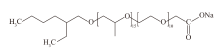
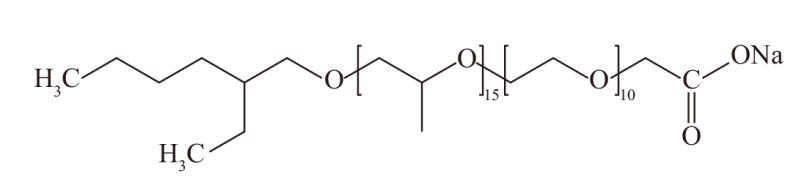
Fig. 1
Structural formulas of extended carboxylate surfactant C8P15E10C"
Tab. 1
Formulation and composition of simulated formation water"
| HCO3-/(mg/L) | Cl-/ (mg/L) | SO42-/ (mg/L) | Na+/ (mg/L) | Ca2+/ (mg/L) | Mg2+/ (mg/L) | TDS/ (mg/L) |
|---|---|---|---|---|---|---|
| 10 | 15 367 | 327 | 8 425 | 914 | 295 | 25 338 |
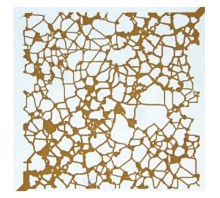
Fig. 2
Oil-wet heterogeneous chip model"
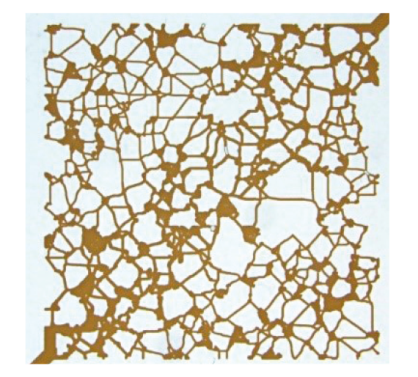
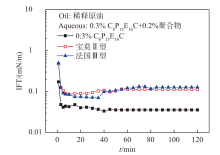
Fig. 3
Dynamic interfacial tensions between chemical flooding solutions and diluted crude oil"
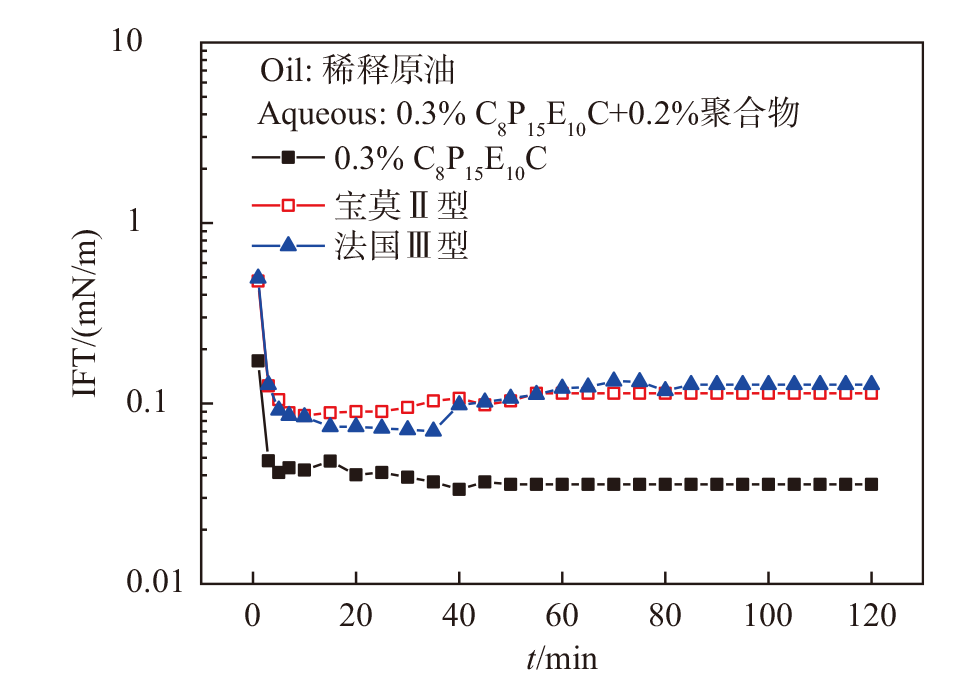
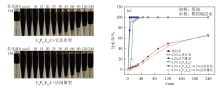
Fig. 4
Emulsion state of C8P15E10C+Baomo Ⅱ system (a) and C8P15E10C+French Ⅲ system (b), and water separation rate of different emulsions (c)"

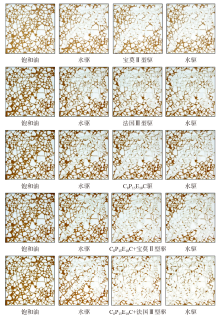
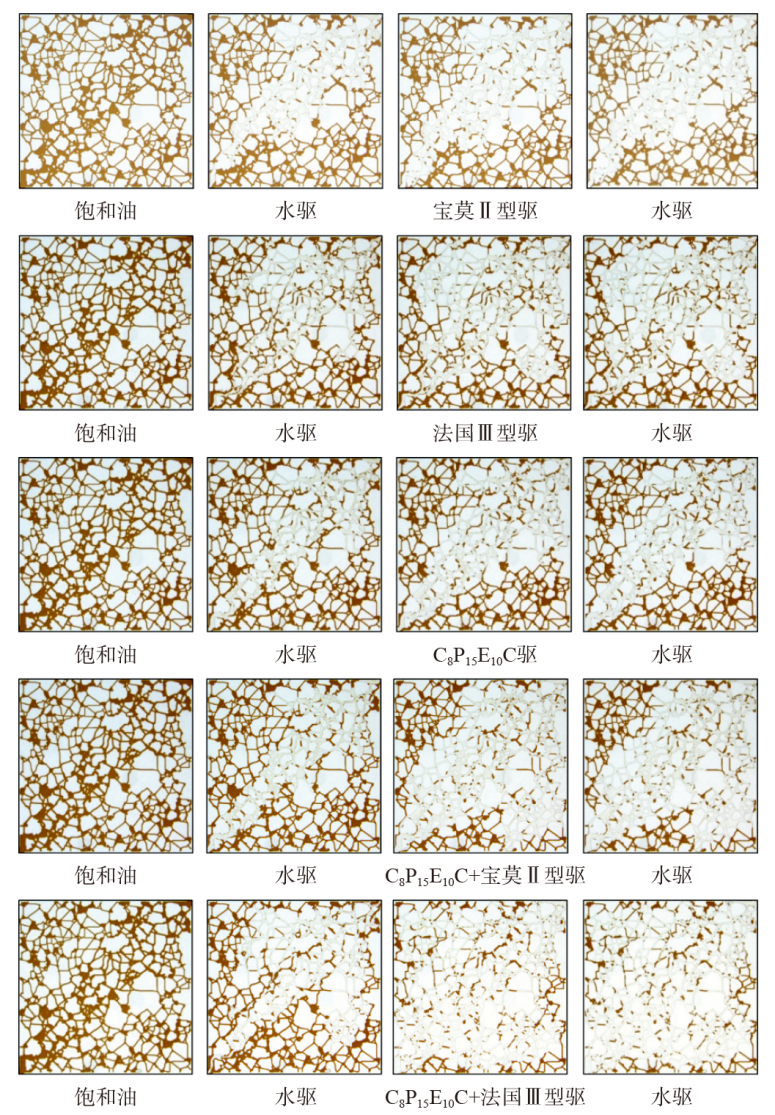
Fig. 5
The displacement effect of surfactant, polymer and their compound solution on the remaining oil after water flooding"
Tab. 2
Displacement efficiency of surfactant, polymer and their compound solution after water flooding"
| 驱油体系 | 体相黏度/(mPa·s) | 界面张力/(mN/m) | 水驱/% | 化学驱/% | 比水驱提高/% | 后续水驱提高/% |
|---|---|---|---|---|---|---|
| 宝莫Ⅱ型 | 11.7 | 33.7 | 41.7 | 8.0 | 0.3 | |
| 法国Ⅲ型 | 22.0 | 34.6 | 49.8 | 15.2 | 0.1 | |
| C8P15E10C | 1.0 | 0.035 6 | 31.4 | 41.0 | 9.6 | 0.1 |
| C8P15E10C+宝莫Ⅱ型 | 10.4 | 0.113 9 | 30.7 | 59.9 | 29.2 | 0.5 |
| C8P15E10C+法国Ⅲ型 | 11.2 | 0.127 1 | 41.6 | 73.1 | 31.5 | 0.5 |
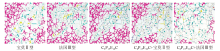
Fig. 6
Remaining oil type analysis diagram after chemical flooding"

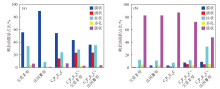
Fig. 7
Quantity (a) and area (b) proportion of remaining oil after chemical flooding"
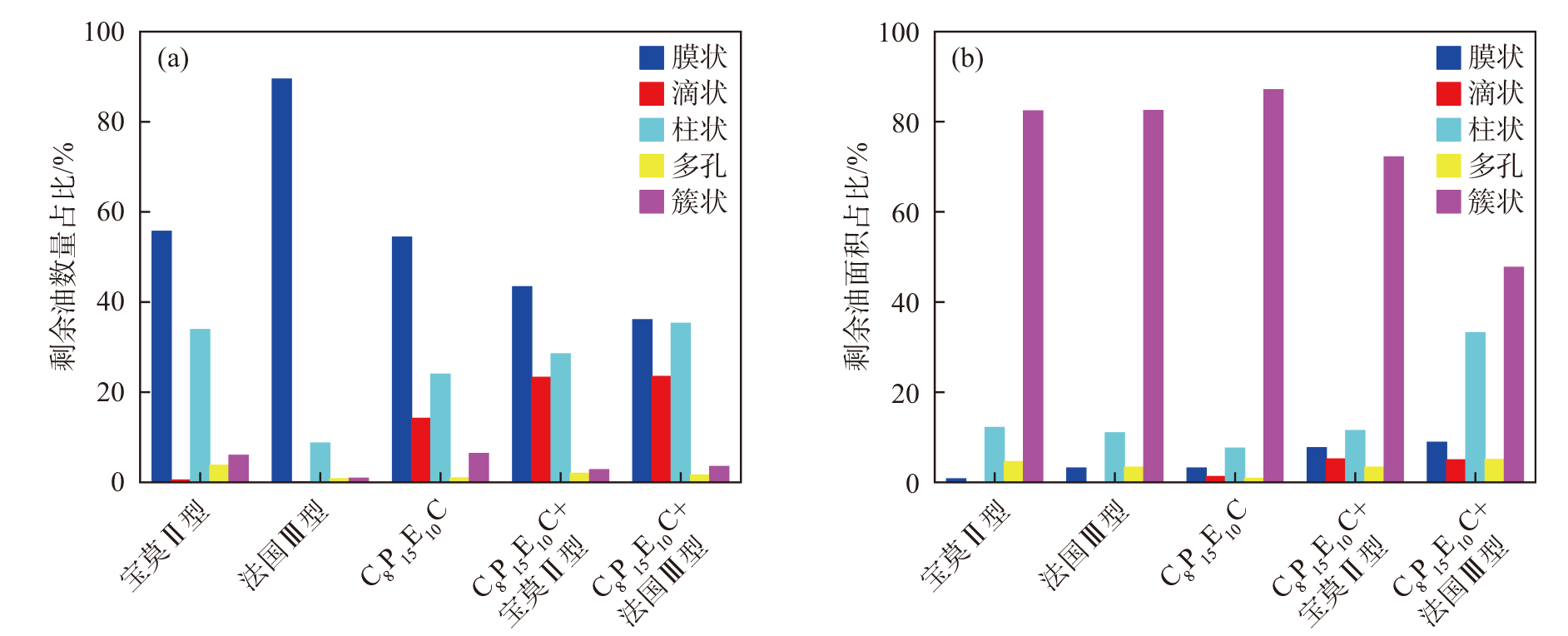
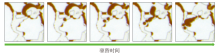
Fig. 8
Microscopic migration characteristic diagram of C8P15E10C+BaomoⅡ binary compound flooding"
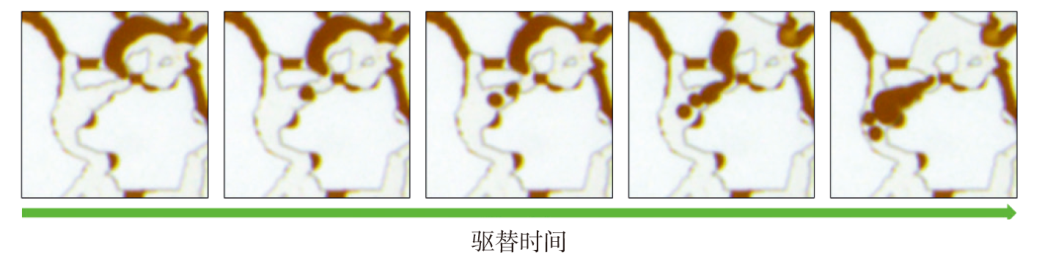
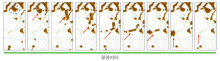
Fig. 9
Microscopic oil displacement mechanism diagram of C8P15E10C+French Ⅲ binary compound flooding"

| [1] | Yuan S Y, Han H S, Wang H Z, et al. Research progress and potential of new enhanced oil recovery methods in oilfield development[J]. Petroleum Exploration and Development, 2024, 51 (4) : 841-854. |
| [2] |
Puerto M, Hirasaki G J, Miller C A, et al. Surfactant systems for EOR in high-temperature, high-salinity environments[J]. SPE Journal, 2012, 17 (1) : 11-19.
doi: 10.2118/129675-PA |
| [3] | 曹绪龙, 石静, 张磊, 等. 高温高盐油藏化学驱提高采收率理论技术与矿场应用[J]. 油气地质与采收率, 2024, 31 (5) : 16-26. |
| [4] |
Lv W F, Zhou Z H, Zhang Q, et al. Study on the mechanism of surfactant flooding: Effect of betaine structure[J]. Advances in Geo-Energy Research, 2023, 10 (3) : 146-158.
doi: 10.46690/ager |
| [5] | 徐辉. 微胶囊乳液型聚合物对延展型表面活性剂界面张力的影响[J]. 日用化学工业(中英文), 2025, 55 (4) : 407-414. |
| [6] |
Wang Z S, Zhou Z H, Han L, et al. The mechanism for lowering interfacial tension by extended surfactant containing ethylene oxide and propylene oxide groups[J]. Journal of Molecular Liquids, 2022, 359: 119364.
doi: 10.1016/j.molliq.2022.119364 |
| [7] | 潘斌林. 海水条件下延展型表面活性剂降低界面张力性能研究[J]. 日用化学工业(中英文), 2024, 54 (7) : 759-766. |
| [8] |
Wang C G, Pan Y, Xu Z C, et al. Ultralow interfacial tension achieved by extended anionic surfactants with a short hydrophobic chain[J]. Journal of Molecular Liquids, 2024, 400: 124514.
doi: 10.1016/j.molliq.2024.124514 |
| [9] |
Oliveira P F, Costa J A, Oliveira L F S, et al. Hydrolysis and thermal stability of partially hydrolyzed polyacrylamide in high-salinity environments[J]. Journal of Applied Polymer Science, 2019, 136 (29) : 47793.
doi: 10.1002/app.v136.29 |
| [10] | 陈洪, 韩利娟, 徐鹏, 等. 疏水改性聚丙烯酰胺的增粘机理研究[J]. 物理化学学报, 2003, 19 (11) : 1020-1024. |
| [11] |
Liang Y, Wang Z L, Jin Y X, et al. Heterogeneity control ability in porous media: Associative polymer versus HPAM[J]. Journal of Petroleum Science and Engineering, 2019, 183: 106425.
doi: 10.1016/j.petrol.2019.106425 |
| [12] |
周朝辉, 张晓杰, 张群, 等. 基于超浸润现象的高效提高原油采收率方法[J]. 石油勘探与开发, 2025, 52 (5) : 1154-1165.
doi: 10.11698/PED.20250029 |
| [13] |
Zhang X J, Zhou Z H, Han Lu, et al. Mechanism responsible for the reduction of interfacial tension by extended surfactants[J]. Colloids and Surfaces A: Physicochemical and Engineering Aspects, 2022, 634: 128013.
doi: 10.1016/j.colsurfa.2021.128013 |
| [14] | 张晓杰, 张明哲, 徐志成, 等. 烷基羧酸甜菜碱驱油机理研究[J]. 日用化学工业(中英文), 2024, 54 (2) : 123-130. |
| [15] | Ma B D, Gao B Y, Yue Q Y, et al. Influence of polymer on dynamic interfacial tensions of EOR surfactant solutions[J]. Journal of Applied Polymer Science, 2014: 40562. |
| [16] |
Wei Z Y, Fan H M, Zhang J Z, et al. Synergistic effects of surfactant and polymer on the viscosity and oil displacement efficiency[J]. Colloids and Surfaces A: Physicochemical and Engineering Aspects, 2023, 676: 132245.
doi: 10.1016/j.colsurfa.2023.132245 |
| [17] |
Sun Q, Hu F T, Han L, et al. The synergistic effects between sulfobetaine and hydrophobically modified polyacrylamide on properties related to enhanced oil recovery[J]. Molecules, 2023, 28: 1787.
doi: 10.3390/molecules28041787 |
| [18] | 王川, 姜汉桥, 马梦琪, 等. 基于微流控模型的孔隙尺度剩余油流动状态变化规律研究[J]. 石油科学通报, 2020, 5 (3) : 376-391. |
| [19] |
Cao H, Li Y Q, Gao W B, et al. Experimental investigation on the effect of interfacial properties of chemical flooding for enhanced heavy oil recovery[J]. Colloids and Surfaces A: Physicochemical and Engineering Aspects, 2023, 677: 132335.
doi: 10.1016/j.colsurfa.2023.132335 |
| [20] | 夏惠芬, 王德民, 王刚, 等. 聚合物溶液在驱油过程中对盲端类残余油的弹性作用[J]. 石油学报, 2006, 27 (2) : 376-391. |
| [1] | Qi Sun, Zhengrong Zhao, Zhicheng Xu, Lei Zhang, Lu Zhang. Effects of extended anionic surfactants on the wettability of polytetrafluoroethylene interface [J]. China Surfactant Detergent & Cosmetics, 2025, 55(8): 949-960. |
| [2] | Hui Xu. Effects of microcapsulated emulsion polymer on the interfacial tension of extended surfactants [J]. China Surfactant Detergent & Cosmetics, 2025, 55(4): 407-414. |
| [3] | Fei Yan, Cheng Ma, Zhicheng Xu, Qingtao Gong, Lei Zhang, Lu Zhang. Study on the foam properties of extended anionic surfactants [J]. China Surfactant Detergent & Cosmetics, 2025, 55(4): 415-421. |
| [4] | Binlin Pan. Study on the performance of extended surfactants in reducing interfacial tension under seawater conditions [J]. China Surfactant Detergent & Cosmetics, 2024, 54(7): 759-766. |
| [5] | Xiaojie Zhang, Mingzhe Zhang, Zhicheng Xu, Qingtao Gong, Lei Zhang, Lu Zhang. Study on oil displacement mechanism of alkyl carboxyl betaine [J]. China Surfactant Detergent & Cosmetics, 2024, 54(2): 123-130. |
| [6] | Xiaoding Zeng, Yancheng Zheng, Guoqing Zhang, Lingchi Zeng, Jian Mu. Performance of branched-chain extended surfactant mixed with zwitterionic or cationic surfactant [J]. China Surfactant Detergent & Cosmetics, 2024, 54(12): 1405-1413. |
| [7] | Guang-yu YUAN. Research progress of the emulsification mechanism in chemical flooding and the new technology of emulsification displacement [J]. China Surfactant Detergent & Cosmetics, 2019, 49(1): 44-50. |
| [8] | KANG Wan-li, LU Yao, YU Yang, LI Zhe, YANG Hong-bin, BAI Bao-jun. Progress and application of physical model used in chemical flooding [J]. China Surfactant Detergent & Cosmetics, 2015, 45(5): 285-290. |
|
